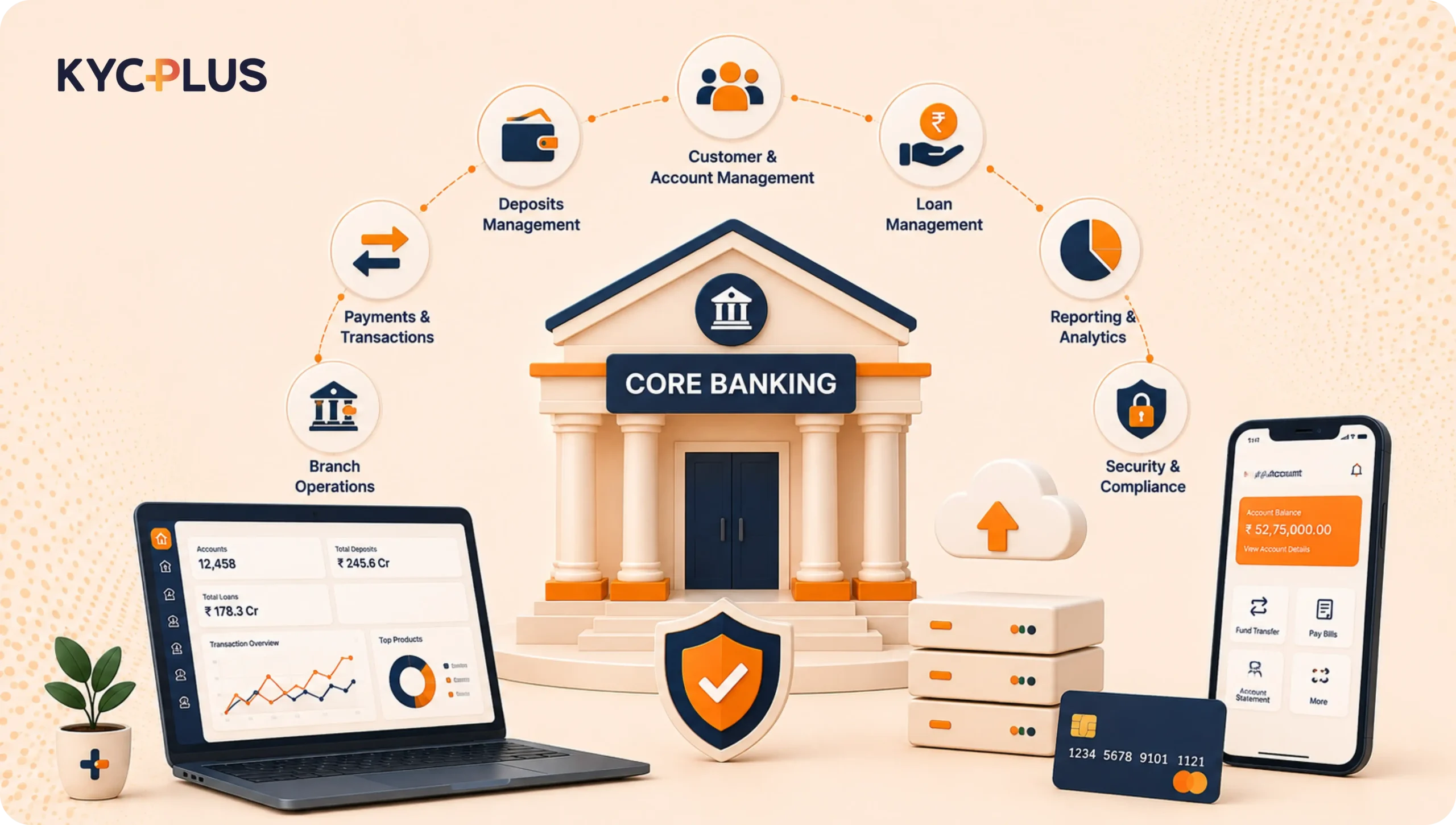
Core banking has become the technological foundation of modern banking operations. Whether it is a commercial bank, cooperative bank, Urban Cooperative Bank (UCB), District Central Cooperative Bank (DCCB), NBFC, or another financial institution, the Core Banking System (CBS) plays a central role in managing everyday banking activities. From customer accounts and deposits to loans, interest calculations, transactions, general ledger management, payments, reporting, and regulatory processes, a bank depends on its core system to keep operations connected and consistent across branches and channels. As banking technology continues to evolve, selecting a reliable CBS Software Provider in India has become an important strategic decision rather than simply an IT procurement exercise.
A modern CBS needs to do much more than process transactions. Banks increasingly expect their core banking platform to support digital channels, APIs, regulatory requirements, payment systems, data analytics, automation, cybersecurity, and integration with specialized applications.
This is particularly important for cooperative banks and DCCBs, where the CBS often needs to work with a wide range of banking applications while supporting branch-level operations and regulatory reporting.
The Indian market has several CBS technology providers and platforms serving different segments of the banking and financial services industry. Examples include Netwin, Trust Systems/Trust Fintech, Infrasoft Technologies, Poset, Oracle and Virtual Galaxy, among others.
However, the right choice is not necessarily the provider with the longest feature list.
Does the CBS fit the bank’s current operations, future growth plans, integration requirements, compliance needs, budget and digital transformation roadmap?
This guide explains the major factors banks should consider before selecting a Core Banking Solutions Provider in India and how modern banking technology is changing the role of core banking systems.
A Core Banking System is the central software infrastructure used by a bank to manage its fundamental banking operations.
The term core banking comes from the idea that the system supports the core activities of a financial institution.
These activities can include:
In a traditional branch-based banking environment, individual branches could maintain relatively independent systems. Modern CBS architecture instead enables centralized processing and connected banking operations.
This means a customer can typically access services through multiple branches or digital channels without the bank treating every location as a completely separate system.
A modern CBS therefore becomes the central technology layer connecting customers, branches, banking products, employees, payment systems and external applications.
Selecting a CBS is a long-term technology decision.
Banks generally do not replace their core banking system frequently because CBS implementation involves significant planning, data migration, integration, testing, employee training and operational changes.
A poor technology decision can therefore create problems for years.
A suitable CBS Software Provider in India should be evaluated not only on the software itself but also on implementation capability, technical support, integration expertise and long-term product development.
Banking operations cannot stop simply because a technology platform is being upgraded.
The CBS must therefore be designed to support high availability, backup, disaster recovery and business continuity.
Banks should ask:
These questions are particularly important for institutions operating multiple branches.
A CBS should support the bank not only today but also several years into the future.
For example, a cooperative bank may currently have 20 branches but plan to expand to 50 or 100 branches.
The system should be capable of handling:
Scalability should therefore be one of the first criteria when evaluating a CBS Software Provider in India.
Banking regulations and reporting requirements can change.
A CBS should provide sufficient flexibility for banks to adapt to regulatory and operational requirements without requiring extensive redevelopment every time a process changes.
Banks should evaluate how the provider handles:
A bank should evaluate the complete technology ecosystem rather than looking at one or two modules.
Customer information is one of the most important components of banking operations.
The CBS should provide centralized customer and account management capabilities.
Depending on the institution, this can include:
The system should also minimize duplicate customer records and provide appropriate controls for maintaining accurate customer information.
For banks where lending represents a major portion of operations, loan functionality is extremely important.
A CBS may support different lending products such as:
The bank should examine how the system handles the complete loan lifecycle.
This includes:
Application → Approval → Disbursement → Interest Calculation → Repayment → Delinquency → Recovery → Closure
The system should also provide appropriate reports and controls for loan monitoring.
Deposits are another fundamental component of core banking.
The CBS should efficiently manage different deposit products and their associated rules.
Banks should examine whether the system can support:
Flexible product configuration is particularly useful because banks frequently introduce or modify products.
Customers expect banking transactions to be processed quickly and accurately.
A modern CBS should support efficient transaction processing across branches and connected channels.
The bank should evaluate:
Performance becomes particularly important as the number of customers and digital transactions increases.
One of the biggest changes in modern banking technology is the growing importance of APIs.
A CBS no longer operates in isolation.
Banks typically need to connect their core system with multiple external applications and platforms.
These can include:
Therefore, when evaluating a CBS Software Provider in India, banks should ask an important question:
A modern API architecture can significantly simplify integration.
For example, instead of creating a completely new application inside the CBS for every requirement, the bank may connect specialized external applications through APIs.
This approach can allow banks to modernize individual processes while keeping the CBS as the central system of record.
KYC is another area where banking technology has evolved significantly.
Historically, customer KYC processes often depended heavily on physical documents and branch-level verification.
Today, banks increasingly use digital processes for customer onboarding, KYC verification, CKYC-related activities and Re-KYC.
The customer information generated or verified through a KYC platform may ultimately need to be reflected in the bank’s core systems.
This makes CBS integration with KYC platforms increasingly important.
For example, a bank could have:
Customer → Digital KYC → Verification → CBS → Account Creation/Update
Instead of repeatedly entering customer information manually, APIs can help transfer relevant data between systems.
This can reduce duplicate data entry and improve operational efficiency.
A CBS is designed to manage the bank’s core banking operations. It does not necessarily need to perform every specialized digital process itself.
This is where complementary banking applications can be useful.
For example, a dedicated digital KYC platform can handle processes such as:
A solution such as KYCPLUS can complement an existing CBS by acting as a specialized digital KYC and Re-KYC Solution, with integration capabilities designed to connect the KYC workflow with the bank’s existing systems.
The key idea is that a bank does not necessarily need to replace its CBS to modernize every customer-facing process.
Instead, it can build an ecosystem around the existing core.
This can be particularly relevant for banks that already have a functioning CBS but want to modernize KYC, Re-KYC or digital onboarding.
Another major consideration is deployment architecture.
Traditionally, many banks operated their CBS infrastructure on-premises or through dedicated data centres.
Cloud technologies have changed the possibilities available to financial institutions.
Today, banks may consider:
On-Premise
The bank manages the infrastructure and application environment.
Advantages can include:
Challenges can include:
The CBS infrastructure is hosted on cloud infrastructure or delivered through a cloud-oriented architecture.
Potential advantages include:
However, banks need to carefully evaluate data security, regulatory requirements, connectivity, vendor dependency and business continuity before selecting a cloud deployment model.
Some institutions may prefer a hybrid model combining existing infrastructure with cloud services.
The right architecture depends on the bank’s size, regulatory environment, technical maturity, budget and existing infrastructure.
A CBS contains highly sensitive financial and customer information.
Therefore, security cannot be treated as an additional feature.
It should be considered a fundamental requirement.
Banks should evaluate:
The provider should also demonstrate how security is maintained during software updates, integrations and infrastructure changes.
One of the most difficult parts of changing or upgrading a CBS is data migration.
Banks may have years or decades of historical information stored in legacy systems.
This can include:
The data must be:
Extracted → Validated → Cleaned → Mapped → Converted → Tested → Migrated → Reconciled
A good CBS provider should therefore have a clearly defined migration methodology.
Banks should ask for details regarding:
A technically strong CBS can still create operational problems if migration is poorly managed.
Support and Implementation Capability
Software is only one part of a successful CBS implementation.
Implementation and post-go-live support are equally important.
Does the provider have experienced banking-domain professionals?
Will employees receive adequate training before and after implementation?
How quickly will technical issues be addressed?
Is there a clearly documented service-level agreement?
How frequently is the product updated?
Can the provider accommodate legitimate bank-specific requirements without creating an unmaintainable system?
The relationship between a bank and its CBS provider can continue for many years, so support capability should be considered alongside software features.
The Indian CBS ecosystem includes several technology companies and platforms with different areas of focus.
There is no universal “best” CBS for every institution.
A solution suitable for a large commercial bank may not necessarily be the right choice for a smaller cooperative bank.
Therefore, banks should evaluate providers based on their own requirements.
Some names that banks may encounter while researching the Indian CBS market include Netwin, Trust Systems/Trust Fintech, Infrasoft Technologies, Poset, Oracle and Virtual Galaxy.
Netwin is an Indian banking technology provider offering a range of BFSI products, including its Core Banking System.
According to Netwin’s current product information, its CBS supports retail, corporate, cooperative and digital banking, with capabilities including real-time processing, multi-channel access, multi-branch operations and regulatory compliance.
Netwin also describes integrations with services such as NPCI payment systems, Aadhaar, PAN and CKYC APIs.
Its broader product ecosystem includes digital banking, loan management, loan origination, workflow automation, payments, reconciliation and compliance-related products.
For a bank evaluating a CBS Software Provider in India, this type of ecosystem is worth considering because modern banking technology increasingly requires the core system to connect with multiple specialized platforms.
However, banks should still evaluate implementation methodology, integration requirements, commercial terms and support capabilities against their specific needs.
Trust Systems & Software has a long association with banking technology, particularly in the cooperative banking ecosystem.
The company subsequently became Trust Fintech Limited, and its business includes core banking software and other BFSI technology solutions.
Its core banking platform has been associated with the TrustBankCBS product.
Industry sources also list TrustBankCBS among core banking products from Indian vendors.
For cooperative institutions, evaluating a provider’s domain experience can be particularly important.
Banks should examine:
Rather than selecting a provider solely because of its market presence, the bank should assess how closely the platform fits its own operational model.
Infrasoft Technologies is another name that appears in India’s banking technology ecosystem.
The company has been associated with banking applications and financial technology deployments.
For example, a Union Bank of India procurement document identifies Infrasoft Technologies for work related to an e-AB AML data migration activity, while NABARD’s national-level study of CBS environments in Regional Cooperative Banks identified Infrasoft Technologies as the CBS service provider/vendor for Assam Cooperative Apex Bank in its study sample.
For banks evaluating an established technology provider, this kind of implementation history can be one useful data point.
At the same time, a bank should assess the current version of the platform, integration architecture, modernization capabilities and support model rather than relying only on historical deployments.
Poset is another name that can be considered when researching CBS technology providers in India.
When evaluating a provider such as Poset, banks should apply the same objective criteria used for any other CBS platform.
The evaluation should cover:
This is important because the actual suitability of a CBS depends on the requirements of the institution rather than simply the name of the provider.
A smaller cooperative bank may prioritize different capabilities from a large commercial bank.
Oracle is a major global technology provider with a significant presence in banking technology.
Its Oracle FLEXCUBE platform is designed for core banking operations across areas including retail, corporate, SME, Islamic banking and microfinance. Oracle also describes its core banking portfolio as supporting cloud and on-premises deployment models.
Oracle’s documentation highlights capabilities such as product management, configurable pricing, deposits and lending, high-performance transaction processing and 24/7 banking.
For institutions with complex requirements, large-scale operations or broader enterprise technology strategies, platforms such as Oracle can be evaluated as part of the CBS selection process.
However, implementation complexity, total cost of ownership, customization, infrastructure requirements and integration effort should be carefully assessed before making a decision.
Virtual Galaxy Infotech is an Indian technology company with a strong presence in banking and cooperative banking technology.
Its E-Banker product is positioned as a Core Banking Solution.
The company’s publicly available information describes E-Banker as a comprehensive CBS product covering banking functions and digital channels.
Virtual Galaxy has also publicly disclosed CBS deployments and orders involving cooperative banking institutions. For example, its corporate disclosures include CBS projects involving District Central Cooperative Banks, while an NSE filing in 2026 noted its ongoing relationship with Buldana District Central Cooperative Bank for CBS and related infrastructure/services.
Its history also includes CBS work with cooperative banking institutions and an international CBS project.
For cooperative banks and DCCBs, implementation experience in similar banking environments can therefore be an important factor to evaluate.
Looking only at the feature list is not enough.
A bank should create a structured evaluation framework.
| Evaluation Area | Questions Banks Should Ask |
| Core functionality | Does it support all required banking products? |
| Scalability | Can it handle future customer and branch growth? |
| APIs | Can third-party systems integrate easily? |
| Security | What security controls are available? |
| Compliance | How are regulatory changes handled? |
| Digital banking | Does it connect with mobile and internet banking? |
| Payments | Does it integrate with required payment rails? |
| KYC | Can it integrate with digital KYC systems? |
| Migration | What is the migration methodology? |
| Support | What SLA and support model is provided? |
| Deployment | Cloud, on-premise or hybrid? |
| Cost | What is the total cost of ownership? |
| Customization | How easily can bank-specific requirements be configured? |
This approach allows the bank to compare providers on measurable criteria instead of marketing claims.
A modern bank is essentially a connected technology ecosystem.
The CBS may be the central system, but several specialized applications work around it.
For example:
CBS + Digital Banking + Payments + KYC + AML + CRM + Analytics + Document Management
If these applications cannot communicate effectively, employees may have to manually move information between systems.
That creates:
For this reason, banks researching a CBS Software Provider in India should ask for API documentation and integration architecture early in the evaluation process—not after signing the agreement.
In a traditional process, the customer may need to visit the branch, submit documents and wait for manual verification.
A digital workflow can potentially allow the customer to complete the process remotely.
A specialized platform such as KYCPLUS can manage the digital KYC/Re-KYC workflow while the CBS continues to serve as the bank’s core transactional system.
A typical architecture can look like:
Customer → KYCPLUS → Verification → API → CBS
This allows each system to perform the function it is designed for.
The KYC platform can focus on:
while the CBS continues managing:
This approach can be especially useful for banks that are satisfied with their current CBS but want to modernize customer-facing processes through a KYC Solution without replacing the entire core system.
One common mistake is comparing only the initial software cost.
The actual cost of a CBS can include:
Therefore, banks should calculate the Total Cost of Ownership (TCO) over several years.
A platform with a lower initial price may become more expensive if it requires significant customization and integration.
Similarly, a more expensive platform may provide greater long-term value if it reduces operational complexity and supports future growth.
Price is important, but it should not be the only deciding factor.
A low-cost CBS that cannot scale or integrate properly can become expensive over time.
Banks sometimes evaluate the core modules but do not sufficiently evaluate integration capabilities.
This can create challenges later when implementing digital banking or third-party applications.
A CBS should not be selected only for today’s requirements.
The bank should consider where its business may be three, five or ten years from now.
The future of core banking is moving toward more connected, modular and digitally integrated architectures.
Banks are increasingly looking for:
Instead of functioning as a standalone application, the core increasingly becomes the central platform within a broader banking ecosystem.
This means the future CBS Software for Banks will need to offer more than traditional transaction processing.
Core Banking + APIs + Digital Channels + Automation + Security + Compliance + Ecosystem Integration
How Banks Can Build a Modern Banking Technology Ecosystem
A bank does not necessarily need to replace every system at once.
A more practical approach can be phased modernization.
Evaluate the existing CBS for:
Introduce workflow automation for repetitive processes.
Use centralized data for:
This phased approach can help banks modernize without unnecessarily disrupting their core operations.
Final Checklist Before Selecting a CBS Provider
Before signing a contract with any CBS Software Provider in India, a bank should ask:
A proper evaluation of these questions can significantly reduce the risk of selecting a platform that does not fit the bank’s long-term requirements.
Choosing a CBS Software Provider in India is one of the most important technology decisions a bank can make.
A modern Core Banking System should not be evaluated simply by counting the number of modules it provides. Banks should consider the complete technology ecosystem, including scalability, security, APIs, digital channels, regulatory adaptability, data migration, disaster recovery, implementation capability and long-term support.
Providers such as Netwin, Trust Systems/Trust Fintech, Infrasoft Technologies, Poset, Oracle and Virtual Galaxy represent different options within the broader banking technology landscape. Each institution should independently evaluate the products and services against its own requirements rather than assuming that one platform is universally suitable.
At the same time, banks do not necessarily need their CBS to perform every specialized digital function.
A modern banking architecture can combine a strong CBS with specialized platforms for digital onboarding, KYC, CKYC, Re-KYC, OCR, document management, fraud prevention and other processes.
This is where solutions such as KYCPLUS can complement an existing CBS. By providing a dedicated digital KYC and Re-KYC layer with integration capabilities, banks can modernize customer verification and compliance workflows without necessarily replacing their entire core banking infrastructure.
Ultimately, the best CBS strategy is not simply about choosing software.
It is about building a secure, scalable, connected and future-ready banking technology ecosystem that can support the institution’s customers, employees and business goals for years to come.
Ans: A CBS Software Provider in India is a technology company that develops or supplies Core Banking Systems used by banks and financial institutions to manage core operations such as accounts, deposits, loans, transactions, branches and financial records.
Ans: Banks should evaluate functionality, scalability, security, APIs, integration capabilities, regulatory adaptability, data migration, implementation support, disaster recovery, deployment options and total cost of ownership.
Ans: Yes. Modern CBS platforms can integrate with external digital KYC platforms through APIs or other integration mechanisms, depending on the architecture and capabilities of the systems involved.
Ans: KYCPLUS can be positioned as a complementary digital KYC and Re-KYC platform that can integrate with a bank’s existing technology environment. The exact integration approach depends on the CBS, APIs and technical architecture of the bank.
Ans: Not necessarily. Cloud, on-premise and hybrid models each have advantages. The appropriate choice depends on the bank’s infrastructure, regulatory requirements, security policies, budget and scalability needs.
Ans: APIs allow the CBS to communicate with external systems such as digital banking platforms, payment systems, KYC applications, CRM platforms and analytics solutions. This makes it easier for banks to build a connected technology ecosystem.
Ans: Data migration is extremely important because banks may have years of customer, account, loan and transaction information in their existing systems. Poor migration can lead to operational and reconciliation problems.
Ans: Cooperative banks, UCBs and DCCBs may have specific operational, regulatory, branch and integration requirements. They should therefore evaluate whether the CBS has relevant experience and functionality for their banking segment.
Ans: No. CBS is the core system responsible for fundamental banking operations. Digital banking typically refers to customer-facing channels and services such as mobile banking, internet banking and digital customer journeys. These systems often need to integrate with the CBS.
Ans: Yes. Banks can use specialized digital KYC platforms that integrate with their existing CBS and other banking systems. This can allow the institution to modernize KYC, Re-KYC and customer onboarding while retaining its existing core system.
