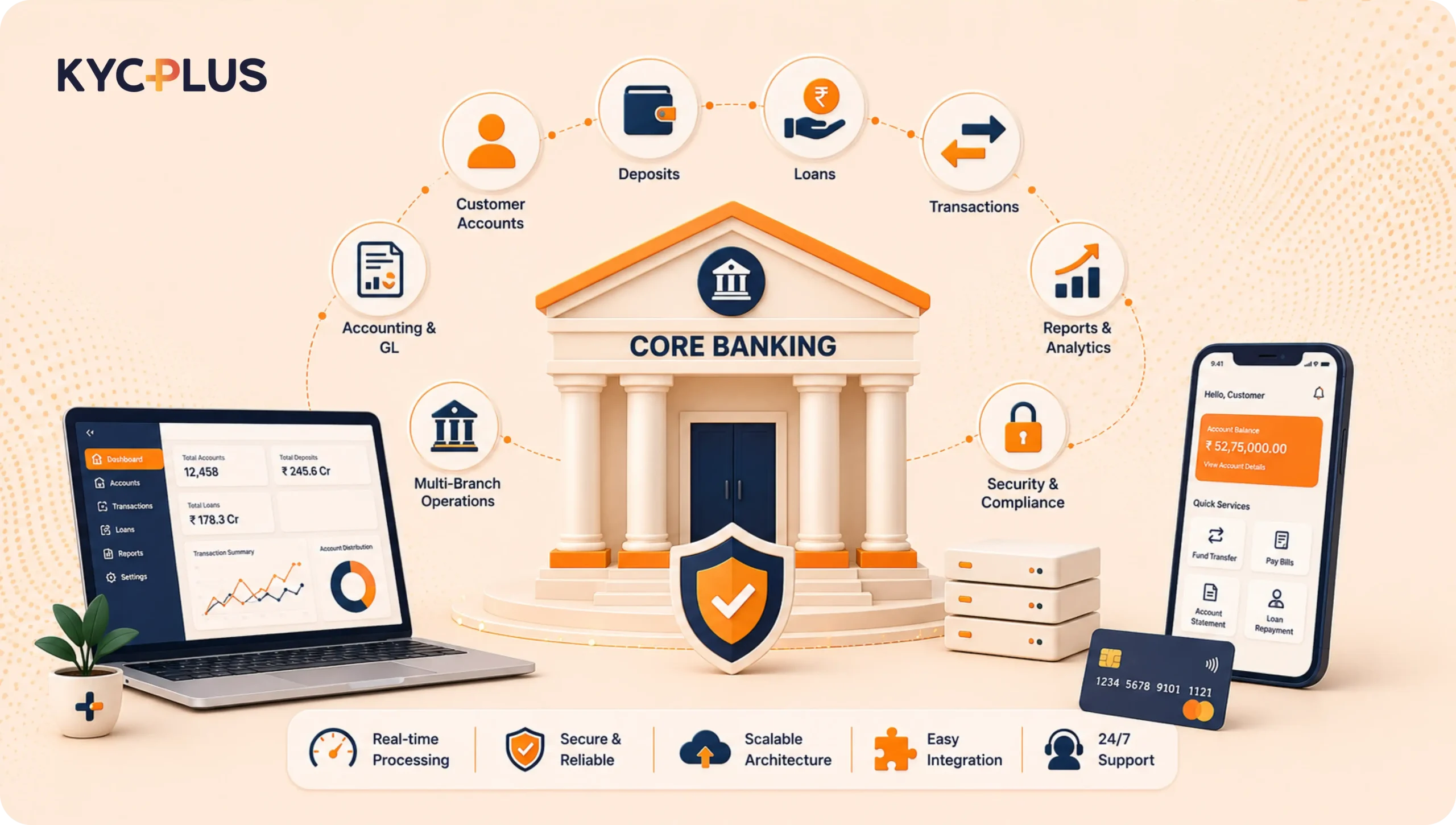
Banking technology has changed significantly in India. Customers today expect banking services to be available across branches, mobile applications, internet banking, ATMs, payment channels, and other digital platforms. At the center of this connected banking environment is the Core Banking Solution (CBS). A Core Banking Solution is the technology platform that manages essential banking operations such as customer accounts, deposits, loans, transactions, interest calculations, accounting, reporting, and branch operations. Instead of maintaining isolated systems at different branches, a centralized CBS allows financial institutions to operate through a common technology platform. For this reason, selecting the right Core Banking Solutions Provider in India is an important decision for banks, cooperative banks, UCBs, DCCBs, NBFCs, and other financial institutions.
The right CBS should not simply offer a long list of features. It should fit the institution’s business model, support its existing infrastructure, integrate with digital applications, provide appropriate security controls, and remain scalable as the institution grows.
This becomes particularly important for cooperative banks and credit societies. Their requirements can be different from those of large commercial banks. A cooperative institution may need a cost-effective and configurable system that supports deposits, loans, member accounts, branch operations, reporting, digital channels, and localized workflows.
At the same time, larger banks may require advanced product configuration, open APIs, high transaction volumes, omnichannel banking, analytics, and extensive third-party integrations.
Therefore, the definition of the “best” Core Banking Solutions Provider in India depends on the institution’s size, operating model, technology requirements, customer base, product portfolio, and digital transformation roadmap.
This guide provides a practical overview of core banking solutions in India, major providers and platforms, the features banks should evaluate, and the role of specialized technologies such as digital KYC and Re-KYC alongside a CBS.
A Core Banking Solution is a centralized software platform that manages the fundamental operations of a financial institution.
The word core” reflects the importance of the system. A CBS typically sits at the center of banking operations and connects customer accounts, transactions, deposits, loans, accounting, branches, channels, and other applications.
For example, when a customer deposits money at one branch and later checks the account balance through another branch or digital channel, the information needs to remain consistent across those touchpoints.
A centralized core banking system helps make this possible.
Depending on the product and institution, a CBS can include capabilities such as:
However, banks should remember that every CBS is not designed for exactly the same purpose.
A large enterprise banking platform may be suitable for a multinational or large commercial bank, while another platform may be particularly relevant to cooperative banks, regional institutions, or credit societies.
That is why evaluating a Core Banking Solutions Provider in India requires more than comparing feature lists.
The Indian financial services sector includes commercial banks, cooperative banks, Urban Cooperative Banks, District Central Cooperative Banks, Regional Rural Banks, NBFCs, credit societies, and other institutions.
A CBS creates a centralized environment for managing customer, account, deposit, loan, and transaction information.
This can help reduce duplicate records and provide authorized employees with a consistent view of banking information.
For banks operating multiple branches, centralized information can significantly simplify day-to-day operations.
Automation can reduce the amount of manual work involved in routine transactions.
Instead of maintaining separate records for individual branches, the CBS can process transactions through centralized workflows.
This can improve operational efficiency and reduce the possibility of errors caused by repetitive manual data entry.
Customers no longer expect banking services to be limited to their home branch.
A modern CBS can help banks provide more connected services across branches and digital channels.
The customer experience can become more consistent when account information and banking processes are available through a centralized platform.
Mobile banking, internet banking, digital payments, online onboarding, APIs, and other modern banking services need to communicate with the bank’s core infrastructure.
Best Core Banking Software Providers in India should therefore consider integration as a fundamental part of the architecture rather than an optional add-on.
A centralized system can provide banks with better access to operational information.
Management teams may use reports for deposits, loans, transactions, branches, customer activity, and other operational metrics.
Better data visibility can support more informed decision-making.
A Core Banking Solutions Provider in India generally provides more than the CBS software itself.
A successful implementation can involve requirement analysis, solution design, configuration, customization, integration, data migration, testing, deployment, employee training, maintenance, and technical support.
The exact services differ between providers, but a typical implementation can include the following stages.
Before implementing a CBS, the technology provider should understand how the institution operates.
This can include:
This assessment helps determine whether the platform can actually support the institution’s requirements.
After requirements are understood, the CBS is configured according to the bank’s products and workflows.
Deposit products, loan products, interest rules, charges, authorization workflows, user roles, and reporting requirements may need to be configured.
Data migration is one of the most critical parts of a CBS project.
A financial institution may have years of historical customer, account, deposit, loan, and transaction data.
Moving this information to a new platform requires mapping, cleansing, validation, testing, reconciliation, and controlled migration.
A reliable Core Banking Solutions Provider in India should have a defined data migration methodology rather than treating migration as a simple database transfer.
Modern banks use several systems alongside the CBS.
These may include:
The ability to integrate these systems is therefore a major consideration.
Customer and account management is one of the basic functions of CBS.
The system should allow authorized users to create, update, view, and manage customer and account information according to the institution’s workflows and controls.
A modern CBS can support multiple deposit products, including savings accounts, current accounts, fixed deposits, recurring deposits, and other products configured by the institution.
Interest calculations, maturity, renewal, charges, and transaction rules should be configurable according to business requirements.
Loan functionality is particularly important for cooperative banks and credit-oriented institutions.
Depending on the platform, loan management may cover:
A bank should evaluate whether the CBS can handle its actual loan products instead of assuming that every platform offers the same capabilities.
Transactions are at the heart of banking.
The system needs to process deposits, withdrawals, transfers, charges, interest postings, and other financial activities accurately and efficiently.
Transaction logs and audit trails are also important for operational monitoring.
A CBS typically interacts closely with accounting processes.
Transactions processed through different banking functions need to be appropriately reflected in the institution’s accounting framework.
Banking systems handle highly sensitive information. User access should therefore be controlled based on roles and responsibilities.
A modern CBS should provide appropriate authentication, authorization, access controls, logging, and administrative controls.
Cooperative banking represents an important segment of India’s financial ecosystem.
Urban Cooperative Banks, District Central Cooperative Banks, State Cooperative Banks, and other cooperative institutions often serve customers and members through networks of branches and localized operations.
Their technology requirements can be very different from those of large commercial banks.
A cooperative institution may prioritize:
The Reserve Bank of India has recognized the importance of CBS adoption in the cooperative banking ecosystem. RBI initiatives have included support for CBS implementation among eligible smaller UCBs, reflecting the broader importance of technology modernization in the sector.
For this reason, choosing a Core Banking Solutions Provider in India should involve a detailed evaluation of cooperative banking experience where relevant.
UCBs often require a combination of traditional branch banking and modern digital services.
A suitable CBS may need to support multiple branches, deposits, loans, customer records, reporting, digital channels, payment services, and integration with external systems.
The platform should also be flexible enough to accommodate the bank’s specific operating procedures.
DCCBs operate within the cooperative banking structure and may serve customers across a wider geographical area.
For these institutions, centralized operations, branch connectivity, transaction processing, reporting, digital services, and reliable infrastructure are particularly important.
The technology platform also needs to support the bank’s broader digital transformation initiatives.
There is no single CBS platform that is automatically the best for every financial institution.
The market includes enterprise-grade platforms, Indian banking technology providers, cooperative banking solutions, and specialized CBS platforms for smaller financial institutions.
For banks researching a Core Banking Solutions Provider in India, the following names are useful starting points for market evaluation:
These platforms should not be treated as an official ranking. Their suitability depends on the institution’s requirements, budget, scale, infrastructure, implementation expectations, and banking segment.
Infosys Finacle is one of the widely recognized names in core banking technology.
Finacle’s Core Banking Solution provides capabilities intended to support banking transformation, including product configuration, parameterization, real-time processing, APIs, and customer insights. Its official product information positions the platform as a foundation for digital banking transformation.
For larger financial institutions, the ability to configure products and connect different banking services can be an important consideration.
Finacle is particularly relevant when an institution is evaluating an enterprise-grade core banking platform and requires extensive digital integration.
Banks evaluating Finacle should consider:
For institutions with complex requirements, Infosys Finacle can be one of the platforms worth evaluating when researching a Core Banking Solutions Provider in India
Oracle FLEXCUBE Universal Banking is another established core banking platform.
FLEXCUBE as a banking platform built around an agile, open architecture and cloud infrastructure. Its capabilities include product management for current accounts, savings accounts, fixed deposits, recurring deposits, loans, overdrafts, and other banking products.
The platform can be relevant for institutions looking for enterprise banking functionality and extensive product configuration.
Banks considering Oracle FLEXCUBE should evaluate:
For larger institutions with sophisticated banking requirements, Oracle FLEXCUBE can be an important name to consider when comparing a Core Banking Solutions Provider in India.
TrustBank is another name associated with core banking software in India, particularly in the context of cooperative and credit-oriented financial institutions.
Available product material for TrustBank describes its CORE Banking Solution as being offered for credit unions and identifies Trust Systems & Software with operations in Nagpur and other Indian locations.
This positioning makes TrustBank relevant when the search is not limited to large commercial-bank CBS platforms but also includes technology solutions designed for cooperative or credit-focused institutions.
For a cooperative institution evaluating TrustBank, important areas to assess include:
The key lesson is that a bank should select a Core Banking Solutions Provider in India based on actual institutional requirements rather than brand recognition alone.
Netwin is an Indian banking technology provider with a strong presence across banking, cooperative banking, NBFC, and related financial services segments.
Its current Core Banking System is positioned for Tier-1 to Tier-3 banks and NBFCs, with support for retail, corporate, cooperative, and digital banking. Netwin describes capabilities including real-time processing, multi-channel access, multi-currency and multi-branch support, regulatory compliance, MIS/BI dashboards, and integrations with payment and identity-related services.
Netwin’s own segment information specifically identifies solutions for cooperative banks and cooperative credit societies.
This makes Netwin particularly relevant to institutions searching for CBS options beyond large enterprise platforms.
Banks and credit institutions can evaluate Netwin based on:
For institutions looking for a technology partner with exposure to cooperative and credit-oriented segments, Netwin is a relevant name to include when comparing a Core Banking Solutions Provider in India.
Virtual Galaxy Infotech Ltd. is an Indian technology company with a core banking product known as E-Banker.
The company describes E-Banker as a comprehensive Core Banking Solution designed to cover banking functions and support implementation across financial institutions.
Virtual Galaxy has also publicly described its banking technology portfolio as serving commercial banks, cooperative banks, NBFCs, and cooperative societies.
Its recent corporate disclosures continue to identify E-Banker as a flagship Core Banking Solution and describe its broader technology portfolio across banking, digital payments, cybersecurity, ERP, and related areas.
The company has also disclosed core banking projects involving cooperative institutions, including a Core Banking Solution project for Osmanabad District Central Co-operative Bank.
This makes Virtual Galaxy an especially relevant name for institutions looking at Indian CBS providers with exposure to cooperative banking.
When evaluating Virtual Galaxy, institutions can consider:
POSET should also be considered when researching CBS solutions for the credit society segment.
Unlike enterprise CBS platforms that are often evaluated primarily by large banks, POSET is relevant to the credit society and cooperative credit institution use case.
For a credit society, the most important question is not whether a CBS has hundreds of enterprise features. The more practical question is whether it can support the institution’s daily operations efficiently.
These can include:
For credit societies specifically, POSET can therefore be included in the list of platforms that institutions may evaluate alongside other CBS options.
Before final procurement, a credit society should independently verify the current product capabilities, deployment model, integrations, implementation support, and commercial terms offered by POSET.
Simply creating a list of CBS providers is not enough.
A bank should create a structured evaluation framework.
The first question should be whether the system can support the bank’s actual products.
For example, a cooperative bank may need specific deposit and loan products that are different from those used by a commercial bank.
The CBS should be able to connect with the bank’s existing technology ecosystem.
Important integrations can include:
The system should be able to accommodate future growth.
The bank may add branches, customers, products, transaction channels, and digital services over time.
Therefore, scalability should be evaluated before selecting a Core Banking Solutions Provider in India
Security cannot be treated as a secondary feature.
A CBS handles sensitive financial information and should therefore operate with appropriate controls for authentication, authorization, data protection, logging, monitoring, backup, and disaster recovery.
The software may be excellent, but implementation can still become difficult if the provider lacks a structured deployment methodology.
Banks should ask:
One of the major decisions banks face is the deployment model.
In an on-premise model, the institution maintains the infrastructure required to operate the system.
Potential advantages can include greater direct control over infrastructure and deployment.
However, it can also require substantial investment in servers, data centers, backup systems, security, IT personnel, maintenance, and disaster recovery.
Cloud-based deployment can reduce the need for institutions to maintain all infrastructure themselves.
It can also support scalability and centralized management.
However, the institution needs to carefully evaluate data governance, security, connectivity, service availability, disaster recovery, contractual terms, and regulatory expectations.
A hybrid approach can combine elements of both models.
The right choice depends on the institution’s infrastructure, risk profile, technology maturity, budget, operational requirements, and provider capabilities.
Therefore, deployment architecture should be an important part of the evaluation of a Core Banking Solutions Provider in India.
APIs have become increasingly important in modern banking.
An API allows two software systems to communicate with each other through defined interfaces.
For example, a bank may use a CBS as its core transaction system while using separate platforms for KYC, digital onboarding, loan origination, analytics, or customer engagement.
Instead of manually transferring information between systems, APIs can enable controlled system-to-system communication.
Customer → Digital Application → KYC Platform → API Layer → CBS → Account/Transaction Processing
This approach allows institutions to modernize individual processes without necessarily replacing the entire core banking platform.
KYC is an important part of customer onboarding and ongoing customer-data management.
However, KYC does not necessarily need to be handled entirely inside the CBS.
A specialized KYC platform can perform functions such as:
The verified information can then be integrated with the bank’s core system.
This architecture allows the CBS to remain focused on core banking operations while specialized systems manage specialized workflows.
Core Banking Is No Longer Just About Branch Banking
The traditional concept of CBS was largely associated with connecting branches and centralizing transactions.
That role remains important, but modern banking requires much more.
Today, the CBS needs to exist as part of a broader technology ecosystem.
A modern banking environment may include:
Core Banking + Digital Banking + Payments + KYC + CKYC + Re-KYC + Loan Origination + CRM + Analytics + Security
The quality of integration between these systems can directly affect operational efficiency.
This is why the selection of a Core Banking Solutions Provider in India should be connected to the bank’s wider technology strategy.
Customer onboarding is one of the areas where banks can significantly reduce manual work.
Traditional onboarding may involve:
1. Customer visits branch
2. Application form is collected
3. Documents are collected
4. Employee enters information
5. KYC verification is performed
6. Documents are reviewed
7. Approval is obtained
8. Account is created
9. Customer receives banking credentials
A digital onboarding system can automate several of these steps.
A customer may submit information digitally, documents can be processed electronically, identity verification can be performed through integrated services, and validated customer information can be transferred to the CBS.
This can reduce repetitive data entry and improve the customer experience.
KYCPLUS is not positioned as a replacement for a bank’s core banking platform.
Instead, it can work as a specialized digital KYC and customer onboarding layer that complements the existing banking technology environment.
KYCPLUS can support workflows such as:
For a bank that already has a CBS, this distinction is important.
The institution does not necessarily have to replace its core banking platform simply because it wants to modernize KYC or onboarding.
A specialized platform can be integrated with the existing CBS.
For example:
Customer → KYCPLUS → Verification → Customer Data → CBS
This approach can allow banks to modernize customer-facing processes while continuing to use their existing core banking infrastructure.
Re-KYC is another process that can benefit from digital integration.
Traditionally, customers may need to visit a branch to update KYC information.
A digital Re-KYC workflow can allow eligible customers to complete required steps remotely, subject to the bank’s policies and applicable regulatory requirements.
A specialized platform can manage the workflow, capture documents and information, perform required checks, maintain an audit trail, and transfer relevant information to the bank’s systems.
The CBS remains the system of record for core banking information, while the KYC platform handles the specialized verification workflow.
This separation can create a cleaner technology architecture.
Security should be one of the first criteria when evaluating a Core Banking Solutions Provider in India
A CBS handles highly sensitive information, including customer details, account information, transactions, loans, deposits, and financial records.
Banks should therefore examine security across multiple layers.
The system should use appropriate mechanisms to verify users before granting access.
Users should only have access to the functions and data required for their responsibilities.
Important actions should be logged so that institutions can investigate activities and maintain accountability.
Sensitive information should be appropriately protected during storage and transmission.
Banks should have defined mechanisms for recovering systems and data following operational disruptions.
Monitoring can help institutions identify unusual activity, system issues, access problems, and potential security incidents.
Security evaluation should include both the software and the provider’s operational practices.
Banking technology operates within a regulated environment.
The technology platform should therefore support the institution’s compliance processes and reporting requirements
However, banks should avoid assuming that simply purchasing a CBS automatically makes them compliant.
Compliance is a combination of:
The CBS should support these processes, but the institution remains responsible for implementing its regulatory obligations appropriately.
A strong Core Banking Solutions Provider in India should therefore be able to explain how its platform supports compliance-related workflows rather than making broad claims that software alone guarantees compliance.
Replacing a legacy CBS can be technically and operationally complex.
Banks may have customer and transaction data accumulated over many years.
The migration process may involve:
Understanding what data exists in the legacy system.
Mapping old fields and structures to the new CBS.
Identifying duplicate, incomplete, inconsistent, or outdated records.
Checking whether migrated records match expected values.
Comparing balances, accounts, transactions, and other financial information.
Running migration simulations before the actual cutover.
Moving the institution to the new system under controlled conditions.
A bank should ask every Core Banking Solutions Provider in India about its migration methodology before signing a major implementation contract.
Technology implementation is not successful simply because the software goes live.
Employees need to understand how to use the new system.
Training can include:
Change management is particularly important when employees have been using a legacy platform for many years.
A technically advanced system may still face adoption challenges if the user experience is complicated or training is insufficient.
Price should not be the only factor when comparing CBS providers.
A bank should calculate its total cost of ownership.
This can include:
A platform with a lower initial price may become expensive if customization and maintenance costs are high.
Similarly, a more expensive platform may provide better long-term value if it reduces operational costs and supports future requirements.
Therefore, financial institutions should evaluate value rather than simply choosing the lowest-cost Core Banking Solutions Provider in India
A structured evaluation can make the selection process easier.
List the institution’s current and future requirements.
Document the current CBS, digital channels, payment systems, KYC systems, accounting applications, and other dependencies.
Determine which problems the new system needs to solve.
Evaluate providers based on relevant banking experience and product capabilities.
A demo should use actual banking scenarios rather than only a standard presentation.
Ask providers to demonstrate how the CBS communicates with existing systems.
Review the proposed data migration methodology.
Review authentication, access control, logging, backup, disaster recovery, and other controls.
Understand response times, escalation procedures, maintenance, upgrades, and post-go-live support.
Calculate the expected cost across the full lifecycle.
A procurement team should ask practical questions.
The answers to these questions can be more useful than a generic feature comparison.
India’s banking technology environment continues to evolve.
Institutions increasingly need to connect their core systems with specialized platforms instead of expecting one application to perform every function.
For example, a bank may use:
The ability to connect these systems through secure APIs can create a flexible architecture.
This approach also reduces dependency on a single application for every banking requirement.
A Core Banking Solutions Provider in India should therefore be evaluated not only for what its CBS does today, but also for how easily the platform can participate in the bank’s technology ecosystem tomorrow.
The future of CBS is likely to be shaped by several technologies and operating models.
Cloud infrastructure can provide scalable computing and storage capabilities while potentially reducing the need for institutions to manage all physical infrastructure themselves.
API-based banking architectures will continue to make integration between banking systems easier.
AI can support areas such as customer service, fraud detection, analytics, document processing, and operational decision support.
Routine banking processes can increasingly be automated through workflow engines, APIs, and intelligent systems.
Banks can use transaction and customer data to understand operational trends, customer behaviour, credit patterns, and business performance.
Identity verification, digital onboarding, CKYC, Re-KYC, OCR, face matching, and related technologies will remain important components of digital banking.
These technologies do not necessarily replace CBS.
Instead, they expand what can be built around the core.
Credit societies have specific requirements that deserve separate consideration.
A credit society may need software that is easier to operate, cost-effective, and aligned with its member-oriented model.
Common requirements may include:
This is why platforms such as TrustBank, Netwin, Virtual Galaxy, and POSET can be relevant when researching technology options for cooperative credit institutions, alongside broader enterprise CBS platforms.
The right choice depends on the size of the society, number of branches, product complexity, digital requirements, budget, and integration needs.
One of the biggest mistakes during technology selection is assuming that the biggest platform is automatically the best platform.
An enterprise bank may require a highly sophisticated global core.
A smaller cooperative institution may instead prioritize:
Therefore, the best Core Banking Solutions Provider in India for one institution may not be the best choice for another.
The selection should always begin with requirements.
Digital transformation is not the same as simply moving an existing process online.
A bank undergoing digital transformation should examine the complete customer journey.
Customer Discovery → Digital Onboarding → KYC → Account Creation → CBS → Digital Banking → Payments → Re-KYC → Customer Service
If each stage operates independently, customers may experience delays and employees may need to manually transfer information.
An integrated technology architecture can reduce these gaps.
This is where a modern Core Banking Solutions Provider in India can become an important part of the institution’s digital transformation strategy.
This architecture allows a bank to modernize KYC-related processes without necessarily replacing the entire CBS.
For cooperative banks, UCBs, DCCBs, NBFCs, and other institutions that already operate a CBS, this can provide a practical approach to digital modernization.
A Core Banking Solution is one of the most important technology systems in a financial institution.
It supports essential operations and increasingly acts as the foundation for digital banking, payments, customer onboarding, analytics, and third-party integrations.
However, selecting the right Core Banking Solutions Provider in India requires more than comparing software brochures.
Banks should examine functionality, integration, security, scalability, migration, implementation, support, deployment options, cost, and future readiness.
Providers such as Infosys Finacle, Oracle FLEXCUBE, TrustBank, Netwin, Virtual Galaxy, and POSET can be considered depending on the institution’s segment and requirements. The right platform ultimately depends on whether it can solve the institution’s specific operational and technology challenges.
For banks that already have a CBS, modernization does not always require replacing the core.
Specialized platforms such as KYCPLUS can complement existing banking infrastructure by digitizing KYC, eKYC, CKYC, Re-KYC, document processing, customer onboarding, and related workflows.
The future of Indian banking is therefore unlikely to depend on a single application. Instead, it will increasingly depend on a connected ecosystem in which the CBS works together with digital banking, payments, KYC, APIs, analytics, security, and automation.
The institutions that select technology based on their real requirements—and build an architecture capable of evolving with those requirements—will be better positioned for the next phase of digital banking.
Ans: A Core Banking Solution is a centralized banking software platform used to manage essential operations such as customer accounts, deposits, loans, transactions, interest calculations, accounting, and reporting.
Ans: There is no single provider that is best for every institution. Banks should compare providers such as Infosys Finacle, Oracle FLEXCUBE, TrustBank, Netwin, Virtual Galaxy, and POSET based on their size, banking segment, features, integration requirements, implementation needs, security, and budget.
Ans: Banks should evaluate functionality, API integration, security, scalability, data migration, deployment options, implementation experience, support, customization, compliance-related capabilities, and total cost of ownership.
Ans: The right CBS depends on the cooperative bank’s requirements. Providers such as Netwin and Virtual Galaxy have publicly described solutions and experience relevant to cooperative banking, while TrustBank and POSET can also be considered for credit-oriented and cooperative institution use cases.
Ans: Yes. CBS platforms can integrate with specialized KYC platforms through APIs. This can connect customer onboarding, eKYC, CKYC, Re-KYC, document verification, and customer-data workflows with the bank’s core system.
Ans: CBS manages core banking operations such as accounts, deposits, loans, transactions, and accounting. Digital banking provides customer-facing services through channels such as mobile banking, internet banking, and digital applications. The two systems commonly work together.
Ans: KYCPLUS is designed to complement existing banking technology by supporting digital KYC, eKYC, CKYC, Re-KYC, digital onboarding, OCR, document processing, and related workflows. Integration depends on the CBS architecture, available APIs, and the bank’s technical requirements.
Ans: Neither deployment model is automatically better for every institution. Banks should evaluate security, infrastructure, scalability, connectivity, data governance, disaster recovery, operational requirements, regulatory considerations, and total cost before choosing cloud, on-premise, or hybrid deployment.
Ans: Credit societies can evaluate solutions based on their specific operational requirements. Netwin publicly identifies cooperative credit societies as a supported segment, while Virtual Galaxy has also described its customer base as including cooperative societies. TrustBank and POSET are additional names that may be evaluated for credit-oriented institutions.
Ans: A bank should begin by documenting its business requirements, existing systems, products, branches, customer base, integrations, security needs, and future digital roadmap. It should then compare shortlisted providers through product demonstrations, integration testing, migration planning, security assessment, implementation evaluation, and total-cost analysis.
