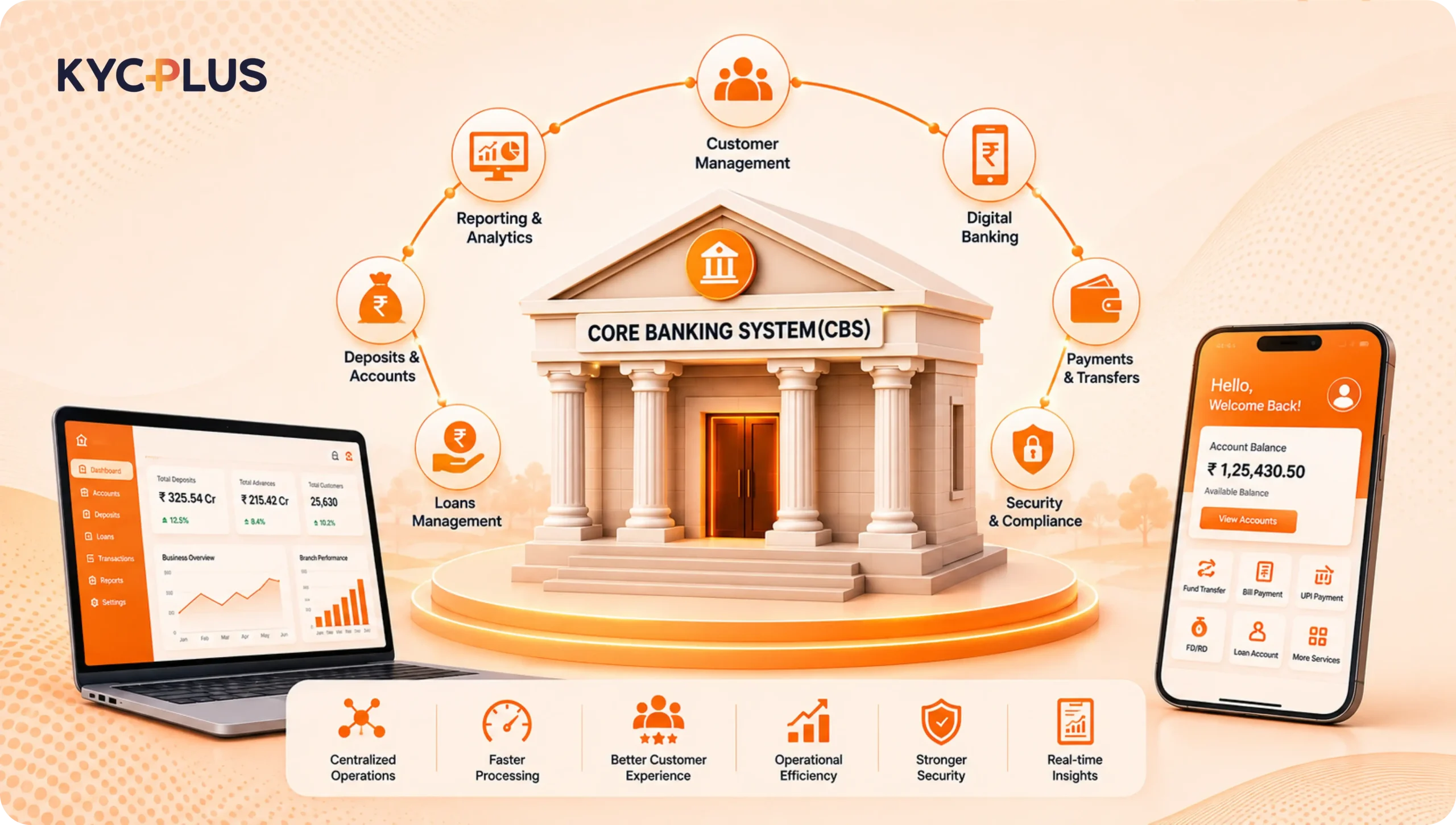
The banking industry has moved far beyond traditional branch-based operations. Customers today expect faster transactions, digital account access, seamless services across channels, and quick resolution of their banking requirements. At the center of these operations is CBS software for banks, the technology infrastructure that manages customer accounts, transactions, deposits, loans, interest calculations, branches, and banking products.
Modern CBS software for banks enables financial institutions to manage core banking operations through a centralized and connected platform. It helps branches, digital channels, employees, and banking applications work with a common banking infrastructure rather than operating as disconnected systems.
However, the role of CBS is evolving. A modern bank does not operate only with a core banking system. It may also use digital onboarding platforms, KYC solutions, CKYC systems, Re-KYC applications, OCR technologies, payment platforms, mobile banking, CRM systems, fraud detection tools, analytics platforms, and other specialized applications.
Therefore, today’s CBS software for banks needs to do more than process transactions. It should provide the flexibility, APIs, security, scalability, and integration capabilities required to connect the core banking platform with the wider digital banking ecosystem.
This guide explains the importance of CBS, its major features, benefits, integration capabilities, implementation considerations, and how banks can modernize their banking operations without unnecessarily replacing every existing system.
CBS software for banks refers to a centralized Core Banking System that manages the fundamental banking operations of a financial institution.
The core system typically manages information and processes related to:
The primary objective of a core banking system is to provide a centralized environment in which banking transactions and account information can be processed consistently.
For example, when a customer deposits money at one branch, the transaction can be reflected in the customer’s account and made available through other authorized banking channels. Similarly, customers can potentially access the same account through branches, ATMs, mobile banking, internet banking, and other channels.
This centralized model is one of the most important advantages of CBS software for banks.
A bank’s technology ecosystem may contain dozens of applications, but the core banking system remains one of the most critical components.
Consider a simple digital banking journey.
A customer may:
Although the customer sees a simple digital experience, multiple backend systems may be involved.
The CBS generally remains responsible for the core account and transaction layer, while specialized applications handle specific processes.
This is why modern CBS software for banks should be viewed as the foundation of a broader technology ecosystem rather than a standalone application.
A core banking system generally consists of multiple interconnected components.
The system maintains customer and account information, including customer profiles, account types, account status, relationships, and other relevant banking data.
The transaction engine processes activities such as deposits, withdrawals, transfers, payments, and other account-related transactions.
Banks offer different financial products. CBS platforms can manage product rules, pricing, interest rates, fees, eligibility conditions, and other configurations.
Core banking systems can support loan accounts, repayment schedules, interest calculations, installments, overdue information, and other lending operations.
Fixed deposits, recurring deposits, and other deposit products can be managed through dedicated CBS modules.
Banking transactions ultimately need to be reflected in accounting records. CBS platforms can interact with general ledger and accounting systems to maintain appropriate financial records.
Modern CBS platforms often provide APIs, web services, middleware, or other mechanisms through which external applications can communicate with the core system.
User roles, authentication, authorization, audit trails, and other controls help protect banking operations and sensitive information.
Together, these components enable CBS software for banks to operate as the central processing platform for banking services.
The features available in a CBS can vary depending on the technology provider and the requirements of the bank. However, several capabilities are particularly important.
A core banking platform provides a centralized view of customer information.
Customer records can be associated with accounts, deposits, loans, transactions, and other banking products.
This reduces dependency on disconnected branch-level records and gives authorized users better visibility into customer relationships.
Savings and current accounts represent fundamental banking products.
CBS platforms can support account opening, account servicing, balance management, transactions, account status changes, and related operational processes.
Automation of these processes can reduce manual intervention and improve consistency.
Banks manage multiple deposit products with different rules.
A capable core banking system can support:
This allows banks to manage deposit operations centrally.
Loan operations require multiple calculations and workflows.
CBS platforms can support loan account creation, repayment schedules, interest calculations, installments, overdue tracking, and servicing activities.
For banks with significant lending operations, loan management capabilities can be an important part of CBS evaluation.
Interest calculations need to follow predefined product and account rules.
A core banking platform can automate these calculations based on applicable rates, balances, periods, and product configurations.
This reduces dependency on manual calculations and helps maintain consistency.
Transaction processing is at the heart of core banking.
The system records financial transactions and updates relevant account information.
Depending on the architecture, transaction processing can support multiple banking channels and operational workflows.
For banks operating across multiple branches, centralized core banking enables branches to work with a common banking platform.
This can help provide consistent access to account information while maintaining appropriate branch-level controls.
Different employees require different permissions.
For example, a teller may need access to transaction-related functions, while an administrator may require broader system privileges.
Role-based access controls help ensure that users can perform only the activities permitted to them.
Banking operations require accountability and traceability.
Audit trails can record user activities, transaction changes, approvals, and other system events.
These records can support internal controls, investigation, and audit processes.
Banks need operational, management, financial, and regulatory reports.
CBS platforms can provide reporting capabilities directly or integrate with dedicated reporting and analytics platforms.
Digital banking has changed the expectations placed on core banking infrastructure.
Customers increasingly interact with banks through:
All these channels may need access to core account information.
A modern CBS software for banks therefore needs to support secure connectivity with digital channels.
For example, a mobile application may retrieve account information from the core banking environment, while a transaction initiated through the application may eventually require processing through the CBS.
This makes API and integration capabilities extremely important.
APIs allow different applications to communicate with each other through defined interfaces.
For banks, this can be particularly valuable because a modern banking environment usually contains multiple specialized systems.
A CBS may need to communicate with:
When evaluating CBS software for banks, banks should therefore examine not only the core functionality but also the integration architecture.
Important questions include:
A CBS that can integrate efficiently with the bank’s digital ecosystem can provide greater long-term flexibility.
Customer onboarding is one area where the relationship between CBS and specialized digital applications becomes particularly important.
Traditional onboarding may require customers to visit a branch, submit physical documents, provide information manually, and wait while employees perform multiple verification activities.
A bank may use a dedicated digital onboarding solution to capture customer information, collect documents, perform verification, and complete required workflows.
After approval, the relevant customer and account information needs to reach the CBS.
This is where integration becomes valuable.
Instead of manually entering the same information again, an integrated architecture can allow validated information to flow between systems through defined interfaces.
For banks looking to modernize onboarding while retaining their existing core banking infrastructure, this approach can be particularly practical.
KYC is an essential part of banking operations, but KYC functionality does not necessarily need to exist entirely inside the CBS.
Banks can use specialized KYC platforms alongside their core banking system.
A digital KYC platform may support functions such as:
The CBS can continue to function as the core account and transaction platform while the specialized KYC solution handles verification-oriented workflows.
This architecture can provide banks with greater flexibility.
For example, solutions such as KYCPLUS can be positioned as a digital KYC and customer onboarding layer that works alongside a bank’s existing technology environment, helping connect digital KYC, Re-KYC, CKYC-related workflows, document processing, and onboarding with the core banking ecosystem.
The important point is that banks do not necessarily need to replace their CBS simply to modernize KYC operations. Specialized digital applications can complement the core system when appropriate integration capabilities are available.
Re-KYC is another operational area where banks can benefit from connecting specialized applications with the core banking environment.
Manual Re-KYC processes can involve:
A digital Re-KYC solution and workflow can reduce several manual steps.
For example, customers may be able to complete applicable KYC update processes digitally, while the bank’s employees can review and approve the information according to internal workflows.
After successful completion, the relevant information can be synchronized with appropriate banking systems.
A solution such as KYCPLUS can support this type of digital KYC and Re-KYC workflow while working alongside the bank’s core environment.
The advantage of this approach is that banks can modernize a specific operational process without necessarily undertaking a complete core banking replacement.
CKYC-related activities can also create operational workloads for banks.
Depending on the bank’s processes, employees may need to search, retrieve, update, upload, or manage customer KYC information.
A specialized KYC platform can help automate parts of these activities.
When connected with the CBS, customer information can be managed through a more connected workflow.
For banks handling large customer volumes, automation can help reduce repetitive data entry and improve process consistency.
KYCPLUS, for example, can be used as part of a broader digital KYC environment where CKYC-related workflows, customer data, document management, and Re-KYC processes are handled through a centralized application layer.
The CBS continues to serve its core purpose while the specialized platform supports KYC-related processes.

One of the biggest changes in modern banking technology is the shift from isolated applications toward integrated ecosystems.
A bank may have:
CBS + Digital KYC + Mobile Banking + CRM + Payments + Analytics + Fraud Monitoring + Document Management
Each system can perform a specific function.
The challenge is making these systems communicate effectively.
If every application maintains separate customer information, employees may need to enter data repeatedly. This can increase operational effort and create inconsistencies.
An integrated architecture can reduce unnecessary duplication.
This is why CBS software for banks should be evaluated not only by what it can do internally but also by how well it can work with the systems around it.
A centralized core system gives banks a common technology platform for managing core banking activities.
This can improve operational visibility and consistency across branches.
Automation and centralized processing can reduce delays associated with manual operations.
Customers can benefit from more consistent account information and access across multiple banking channels.
Authorized employees can access relevant customer and account information through a centralized environment.
Automating repetitive banking processes can reduce operational workloads.
APIs and integration capabilities make it easier to connect the CBS with modern banking applications.
A scalable CBS can support growth in customers, branches, transactions, and products.
Centralized access management, audit trails, workflows, and monitoring can strengthen operational control.
Cooperative banks have unique operational requirements and may serve customers across multiple branches and local communities.
Their CBS requirements can include:
For cooperative banks, the ability to integrate the CBS with specialized digital applications can be particularly useful.
For example, a cooperative bank can retain its existing core banking environment while adding digital KYC, Re-KYC, OCR, customer onboarding, and document management capabilities.
This can be a more targeted modernization strategy than attempting to change every technology system simultaneously.
District Central Cooperative Banks often operate through multiple branches and handle a wide range of deposit, account, and lending activities.
A centralized CBS can help DCCBs manage these operations more efficiently.
However, digital transformation requirements do not end with the core banking platform.
DCCBs may also require digital customer onboarding, KYC automation, Re-KYC, CKYC-related workflows, document processing, and other services.
An integration-friendly CBS software for banks allows these specialized systems to work alongside the core banking platform.
This creates a technology ecosystem in which the CBS remains the central banking engine while specialized applications improve specific customer and operational workflows.
Modernization does not always require a bank to replace its existing CBS.
In many cases, banks can improve specific processes by introducing specialized applications around the core system.
It can support digital KYC-related processes such as customer onboarding, eKYC workflows, CKYC-related activities, Re-KYC, document management, OCR, and verification capabilities.
Through integration with the bank’s existing environment, these capabilities can complement the CBS rather than compete with it.
The CBS remains responsible for core banking operations, while a specialized platform can focus on making customer verification and KYC-related processes more digital and automated.
For banks evaluating modernization, this modular approach can provide a practical path toward digital transformation.
Banks generally evaluate two broad deployment approaches.
In an on-premises deployment, the bank manages the infrastructure within its controlled environment.
Potential benefits include greater infrastructure control and alignment with internal technology policies.
However, the bank is also responsible for infrastructure management, maintenance, upgrades, backups, and other operational requirements.
Cloud-based CBS platforms use cloud infrastructure for hosting and operating the application.
Potential benefits can include scalability, infrastructure flexibility, and easier resource expansion.
However, banks need to evaluate security, compliance, data governance, availability, disaster recovery, vendor controls, and connectivity requirements.
The correct model depends on the individual bank’s strategy and requirements.
Banking systems handle sensitive financial and customer information.
Therefore, security should be one of the highest priorities when evaluating CBS software for banks.
The system should use appropriate mechanisms to verify authorized users and applications.
Employees should receive access according to their roles and responsibilities.
Sensitive information should be appropriately protected during transmission and storage.
Important system activities and transactions should be traceable.
Banks require reliable backup and recovery mechanisms to maintain business continuity.
System and security monitoring can help identify unusual activities, failures, and performance issues.
Security should be considered throughout the CBS lifecycle, from architecture and implementation through ongoing maintenance.
Replacing or upgrading a CBS can involve significant data migration activities.
Banks may have years of customer, account, transaction, and historical data.
A structured migration process generally involves:
1. Data extraction
2. Data cleansing
3. Data mapping
4. Data transformation
5. Validation
6. Test migration
7. Reconciliation
8. Final migration
Incorrect or incomplete migration can create operational problems after implementation.
Banks should therefore establish clear validation and reconciliation procedures before going live.
Selecting a CBS should be treated as a strategic technology decision.
Banks should first document their existing products, branches, transaction volumes, customers, workflows, and technology infrastructure.
The bank should identify future priorities such as:
The system should support the bank’s required products and processes.
Banks should carefully evaluate APIs, middleware, integration tools, documentation, security mechanisms, and third-party connectivity.
The CBS should be capable of handling future increases in transaction and customer volumes.
Implementation assistance, training, maintenance, upgrades, technical support, and response times can influence long-term success.
Initial price does not represent the entire cost of a CBS.
Banks should consider implementation, infrastructure, integration, customization, maintenance, upgrades, training, and support.
A CBS that cannot connect efficiently with digital applications can become a limitation as the bank modernizes.
Data migration should be treated as a major project rather than a simple technical activity.
Banks should evaluate whether the selected CBS can support future digital applications.
Employees need proper training to use the system efficiently.
Automation is increasingly becoming a key part of banking operations.
Core systems can automate processes such as:
Specialized applications can extend automation beyond the core.
For example, digital KYC platforms can automate document collection and verification workflows, while OCR technologies can extract information from documents.
This creates a broader automation ecosystem around the CBS.
Artificial intelligence is increasingly being introduced into banking technology.
AI and intelligent automation can support areas such as:
However, AI does not eliminate the importance of core banking.
Instead, AI-enabled applications often need to interact with core banking data through controlled and secure integration mechanisms.
This further increases the importance of API-ready CBS software for banks.
The future of core banking is likely to be increasingly connected, modular, automated, and API-driven.
Banks will continue adopting specialized technologies for:
The CBS will remain the central banking engine, while specialized applications will provide additional capabilities around it.
This means banks should increasingly look for flexibility rather than simply choosing the system with the longest feature list.
A future-ready CBS should be capable of working with an evolving banking technology ecosystem.
An API-first approach can make it easier for banks to connect their core platform with new applications.
Instead of creating tightly coupled systems, banks can use controlled interfaces to exchange required information.
This can support faster adoption of new digital services.
For example, a bank may introduce a digital KYC solution today and a new analytic platform tomorrow without completely redesigning its core banking architecture.
This flexibility can reduce technology dependency and support continuous modernization.
One of the most practical approaches for many banks is incremental modernization.
Instead of replacing the entire technology environment at once, banks can identify specific areas that create operational challenges.
Existing CBS → API Integration → Digital KYC → Re-KYC → OCR → Document Management → Digital Onboarding
In this model, the core banking platform continues to perform its primary functions while specialized solutions improve specific processes.
This approach can help banks modernize gradually and focus investment on areas where digital transformation can create measurable value.
Before selecting CBS software for banks, decision-makers should ask:
Functional Questions
CBS software for banks is much more than a transaction-processing platform. It is the central technology layer that connects customers, accounts, branches, transactions, products, and increasingly, the entire digital banking ecosystem.
A modern CBS can help banks centralize operations, improve efficiency, support multiple banking channels, automate core processes, and create a reliable foundation for digital transformation.
At the same time, banks should recognize that not every banking requirement needs to be built directly into the CBS.
Digital KYC, Re-KYC, CKYC workflows, OCR, customer onboarding, document management, fraud detection, analytics, and other technologies can operate as connected layers around the core banking environment.
Solutions such as KYCPLUS demonstrate this modular approach by focusing on digital KYC and customer onboarding capabilities that can complement an existing banking technology ecosystem.
For cooperative banks, DCCBs, urban cooperative banks, and other financial institutions, this can provide a practical route toward modernization without making every transformation project dependent on a complete CBS replacement.
Ultimately, the right CBS software for banks should not only solve today’s banking requirements. It should provide the scalability, security, integration capabilities, and flexibility needed to support the bank’s digital journey in the years ahead.
Ans: CBS software for banks is a Core Banking System that centrally manages essential banking activities such as customer accounts, deposits, loans, transactions, interest calculations, branch operations, and related banking processes.
Ans: CBS provides the core infrastructure required to manage banking operations and connect branches and digital channels through a centralized system.
Ans: Yes. Modern CBS platforms can integrate with specialized KYC, digital onboarding, CKYC, Re-KYC, OCR, and document management solutions through APIs and other integration mechanisms.
Ans: KYCPLUS can be positioned as a complementary digital KYC and onboarding layer that works alongside a bank’s existing technology environment, subject to the bank’s integration architecture and requirements.
Ans: Not necessarily. Banks can often introduce specialized digital KYC and onboarding applications alongside their existing CBS when suitable integration mechanisms are available.
Ans: Banks should evaluate functionality, security, scalability, APIs, integration capabilities, deployment options, data migration, implementation support, vendor experience, and total cost of ownership.
Ans: The appropriate deployment model depends on the bank’s infrastructure, security, regulatory, scalability, budget, and operational requirements.
Ans: Yes. Cooperative banks and DCCBs can use core banking platforms to manage accounts, deposits, loans, transactions, branches, reporting, and digital banking requirements.
Ans: APIs allow the CBS to communicate with other authorized applications, enabling banks to connect digital onboarding, KYC, mobile banking, payment, analytics, and other platforms.
Ans: The future of CBS is likely to involve greater API connectivity, automation, cloud technologies, analytics, cybersecurity, modular architecture, and integration with specialized digital banking applications.
