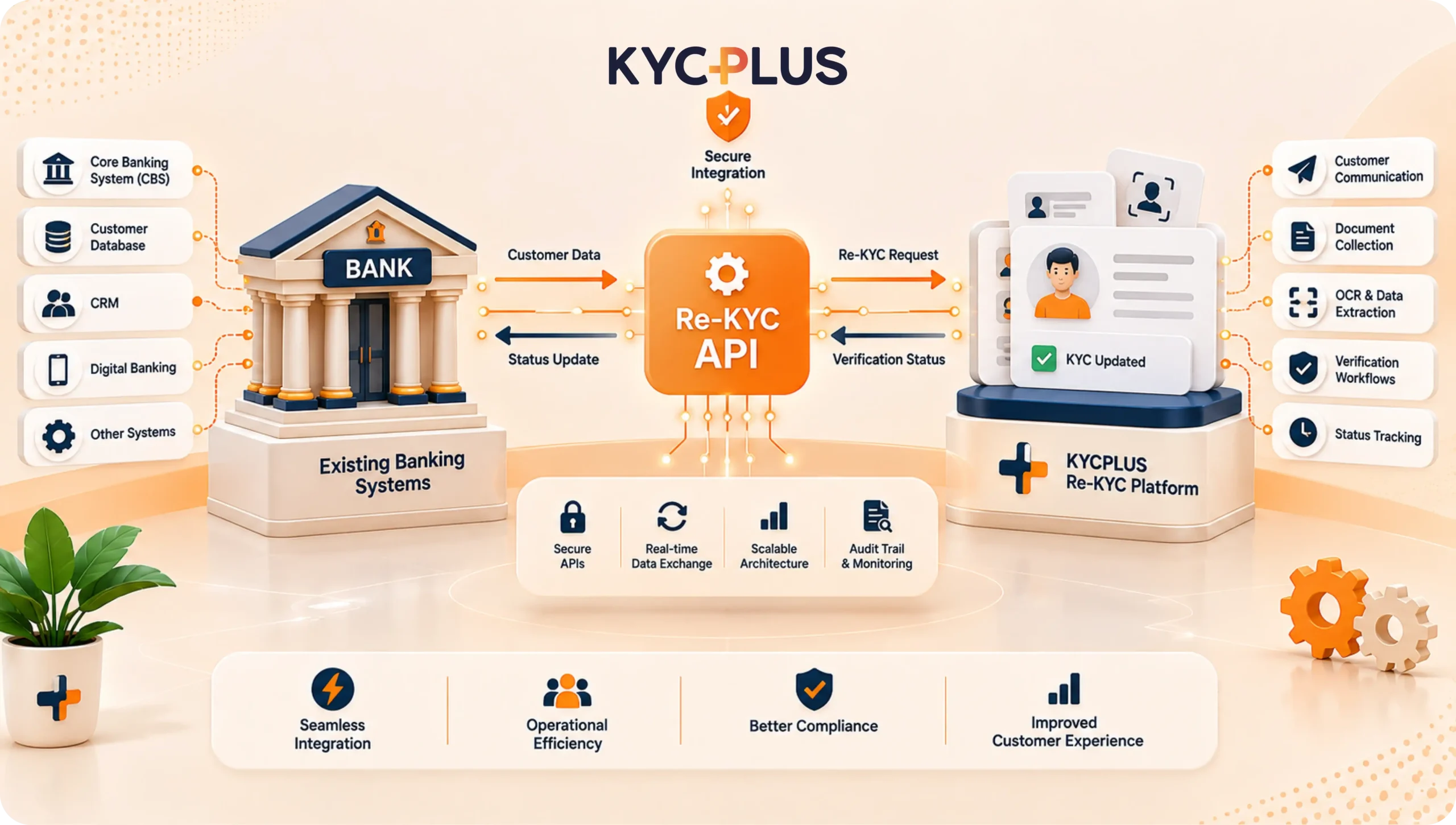
Financial institutions are increasingly adopting digital technologies to make customer management faster, more efficient, and easier to monitor. One area that continues to require significant operational attention is KYC and Re-KYC. A Re-KYC API for Financial Institutions can help streamline these processes and support efficient customer information management. Customer information does not remain unchanged throughout the relationship. Addresses, contact details, identity documents, business information, and other relevant customer information may need to be updated according to applicable requirements and the institution’s internal processes.
For financial institutions managing thousands or millions of customers, collecting and updating this information manually can become a complex task. Employees may need to identify customers, send communication, collect documents, verify information, update records, and maintain an audit trail. When these activities are spread across branches, spreadsheets, emails, physical files, and different applications, the process can become difficult to manage.
An API, or Application Programming Interface, allows different software applications to communicate with each other. In a Re-KYC environment, an API can help connect a specialized KYC platform with the institution’s existing Core Banking System (CBS), customer database, digital banking application, CRM, document management platform, or other systems.
The purpose is not necessarily to replace existing banking technology. Instead, APIs can help financial institutions connect their existing systems with specialized KYC and Re-KYC capabilities.
This approach can be particularly useful for banks, cooperative banks, Urban Cooperative Banks (UCBs), District Central Cooperative Banks (DCCBs), NBFCs, and other financial institutions that want to modernize Re-KYC without completely replacing their existing technology infrastructure.
A well-designed Re-KYC API for Financial Institutions can support information exchange, workflow initiation, status updates, document references, verification results, and other required interactions between systems.
However, API integration is more than simply connecting two applications. Financial institutions need to consider security, authentication, data mapping, error handling, scalability, monitoring, auditability, data governance, and business continuity before implementing an API-based Re-KYC architecture.
This guide explains how Re-KYC APIs work, why they are important, how they can connect with existing banking systems, what features institutions should evaluate, and how KYCPLUS can complement an existing CBS through integration.
A Re-KYC API for Financial Institutions is an application interface that enables a financial institution’s existing systems to communicate with a Re-KYC or KYC platform.
Instead of manually transferring information between applications, APIs can allow systems to exchange relevant data electronically.
For example, a bank’s CBS may contain customer information that is required to initiate a Re-KYC workflow. Through an appropriate API integration, selected information can be transferred to the Re-KYC platform.
The Re-KYC platform can then manage the required workflow, such as customer communication, information collection, document submission, OCR, identity verification, review, and status tracking.
Once the process is completed, relevant status or information can be returned to the appropriate banking system through another integration.
A simplified workflow can look like:
Existing Banking System → API → Re-KYC Platform → Customer/Document Workflow → Verification → API → Existing Banking System
The exact information exchanged depends on the institution’s technology architecture and business requirements.
Many financial institutions already have established CBS and customer-management systems.
Replacing these systems simply to introduce improved Re-KYC capabilities may not be practical.
A Re-KYC API for Financial Institutions provides a way to add specialized functionality while continuing to use existing core systems.
This approach can offer several advantages.
APIs allow different applications to communicate without requiring employees to manually transfer information between them.
Relevant customer information can be exchanged electronically, reducing repetitive data-entry activities.
A Re-KYC case can potentially be created automatically based on information received through an integration.
The banking system and Re-KYC solution platform can exchange workflow status, helping authorized employees understand whether a case is pending, under review, completed, or requires additional action.
API-based architecture allows institutions to add specialized capabilities without rebuilding the entire banking technology environment.
The implementation of a Re-KYC API for Financial Institutions generally involves multiple systems working together.
This may be the CBS, customer relationship management platform, data warehouse, digital banking application, or another authorized system.
The institution then identifies the information that needs to be exchanged.
This could include:
The API securely transfers the required information to the Re-KYC platform.
The platform processes the information according to the configured workflow.
After the customer completes the required process, the platform can provide relevant status information or other approved data back to the originating system.
The integration should be designed so that each system has a clearly defined responsibility.
The CBS can remain responsible for core banking operations, while the Re-KYC platform manages specialized KYC workflows.
One of the most important use cases for a Re-KYC API for Financial Institutions is integration with the existing Core Banking System.
The CBS generally remains the central platform for account and transaction-related activities.
For example, the CBS can provide the customer information required to initiate a Re-KYC case. The Re-KYC platform can then manage customer communication, document collection, OCR, verification, review, and workflow tracking.
Once the process is completed, the relevant status can be communicated back to the CBS or another authorized system.
This architecture allows financial institutions to improve their KYC processes by implementing a flexible KYC solution without treating the CBS as a system that needs to be replaced.
The exact integration model depends on the capabilities of the existing CBS and the APIs supported by both systems.
Customer information is at the center of the Re-KYC process.
A Re-KYC API for Financial Institutions can help transfer selected customer information between the institution’s systems and the KYC platform.
However, data exchange should follow the principle of minimum necessary information.
Financial institutions should identify exactly what data is required for each workflow and avoid unnecessarily transferring sensitive information.
For example, one system may call a field “Customer ID,” while another may use “Customer Reference Number.” The integration needs to map these fields correctly.
Poor data mapping can result in incorrect records, failed transactions, duplicate cases, or processing delays.
Security should be a primary consideration when implementing a Re-KYC API for Financial Institutions.
APIs create communication channels between systems. If those channels are not appropriately protected, sensitive information could be exposed or unauthorized requests could be processed.
Institutions should evaluate appropriate security mechanisms such as:
The exact controls should be determined according to the institution’s security architecture, risk assessment, and applicable requirements.
API security should also be reviewed periodically because threats and technology environments can change over time.
Customer information exchanged through APIs should be protected while in transit.
Encryption helps prevent unauthorized parties from reading information during communication between systems.
A financial institution implementing a Re-KYC API for Financial Institutions should work with its technology and cybersecurity teams to establish appropriate encryption and secure communication mechanisms.
Encryption should not be considered the only security control.
Authentication, authorization, access management, monitoring, logging, and secure application design are also important.
Not every application or user should have access to every piece of customer information.
A well-designed Re-KYC API for Financial Institutions should support appropriate authorization controls.
For example, an API used for retrieving customer information may have different permissions from an API used for updating workflow status.
Role-based access can help ensure that systems and users only perform the actions they are authorized to perform.
Financial institutions should also periodically review API access permissions and remove unnecessary access.
Different banking applications often use different data structures.
The CBS may store customer information in one format, while the Re-KYC platform may use another.
Data mapping creates a connection between these structures.
For example:
The exact fields depend on the systems involved.
A Re-KYC API for Financial Institutions should therefore be implemented with a clearly documented data-mapping specification.
This reduces ambiguity and makes testing easier.
Re-KYC is often not limited to individual customer requests.
Financial institutions may need to process large numbers of customers as part of a Re-KYC campaign.
A Re-KYC API for Financial Institutions can support bulk-processing workflows by allowing the institution to send or identify multiple eligible customer records for processing.
For example, an institution can provide a structured batch of customer references to the Re-KYC platform.
The platform can then create cases according to the configured workflow.
Bulk processing can reduce the need for employees to manually create every case.
However, bulk processing should include validation and exception management.
If one record contains incorrect information, it should not necessarily prevent the entire batch from being processed.
API failures are possible even in well-designed systems.
Networks can become unavailable, systems can experience downtime, data can be incorrectly formatted, or a request can fail validation.
A robust Re-KYC API for Financial Institutions should therefore include appropriate error-handling mechanisms.
Examples of errors may include:
The API should return meaningful error responses so that the responsible application or employee can understand what happened.
Retry mechanisms may also be required for temporary failures, subject to the institution’s architecture and integration design.

Duplicate case creation can create operational problems.
For example, if an API request is repeated because of a timeout, the system should ideally be able to determine whether the original request was already processed.
A Re-KYC API for Financial Institutions can use appropriate unique identifiers or idempotency mechanisms to reduce the risk of duplicate transactions or cases.
This is especially important in bulk processing environments where thousands of requests may be submitted.
The integration design should clearly define how duplicate requests are detected and handled.
API integration is not limited to sending information into a Re-KYC platform.
The systems may also need to receive status updates.
For example, a Re-KYC platform may communicate that a case is:
The bank can then use the relevant information according to its workflow.
A Re-KYC API for Financial Institutions can support this two-way communication, depending on the architecture.
This provides better visibility and reduces the need for employees to manually check multiple applications.
Some modern integrations can use event-based communication or webhooks.
Instead of repeatedly asking whether a Re-KYC case has changed, the platform can send an event when a defined status change occurs.
For example, when a case is completed, the Re-KYC platform can send a notification to an authorized system.
The receiving system can then process the event according to its configured workflow.
Whether webhooks are appropriate depends on the institution’s architecture.
When evaluating a Re-KYC API for Financial Institutions, banks should understand whether the solution supports synchronous APIs, asynchronous processing, webhooks, or other integration patterns required for their environment.
Once APIs are deployed, they need to be monitored.
Financial institutions should be able to identify failed requests, unusual activity, response-time problems, and service interruptions.
A Re-KYC API for Financial Institutions should ideally provide appropriate logging and monitoring capabilities.
Monitoring can help technology teams identify:
Logs should be protected appropriately because they may contain sensitive operational information.
KYC and Re-KYC processes require appropriate traceability.
Financial institutions may need to understand what information was exchanged, when a workflow was initiated, what system performed an action, and how the case progressed.
An API-based architecture should therefore support appropriate audit trails.
A Re-KYC API for Financial Institutions can contribute to process traceability by recording relevant requests, responses, timestamps, system identifiers, and workflow references.
The exact audit requirements should be established by the institution based on its policies and applicable obligations.
Customers increasingly interact with banks through mobile applications and internet banking platforms.
A Re-KYC process can potentially be initiated or completed through digital channels, depending on the institution’s workflow.
The digital banking application can communicate with the Re-KYC platform through appropriate APIs.
For example:
Mobile Banking → API → Re-KYC Platform → Customer Workflow
This can allow customers to complete relevant steps through digital channels while the core banking system continues to perform its normal responsibilities.
A Re-KYC API for Financial Institutions can therefore help connect customer-facing digital applications with specialized KYC workflows.
Customer relationship management systems may contain valuable customer interaction information.
Integrating the CRM with a Re-KYC platform can help employees understand the status of customer requests and follow up where required.
For example, authorized customer-service teams can access the relevant status when a customer has not completed a Re-KYC request.
This can support more coordinated customer communication.
Re-KYC often involves customer documents.
A Re-KYC API for Financial Institutions can connect the KYC platform with an existing document management system where appropriate.
The integration can exchange document references, metadata, or workflow status rather than unnecessarily duplicating entire document repositories.
Define where to store documents, who can access them, how to protect them, and how long to retain them.
OCR can reduce manual data entry by extracting information from supported documents.
When integrated into a Re-KYC workflow, OCR can process submitted documents and provide extracted information to the workflow engine.
For a Re-KYC API for Financial Institutions, the integration may involve document submission, OCR processing, extracted data, validation, and review.
A typical flow could be:
Document Upload → OCR → Data Extraction → Validation → Review → Re-KYC Status
Validate OCR results appropriately because image quality and document characteristics can affect extraction accuracy.
Financial institutions may also need to manage workflows related to CKYC according to applicable processes and requirements.
A Re-KYC platform can support these workflows while integrating with the bank’s existing technology.
The API layer can help exchange relevant customer or workflow information between systems.
Design a Re-KYC API for Financial Institutions with enough flexibility to connect relevant KYC and customer lifecycle processes without creating disconnected databases.
Implement the exact best CKYC Verification API workflow and integrations according to applicable requirements and the institution’s approved process.
Cooperative banks can benefit from API-based Re-KYC architecture when they need to modernize customer lifecycle processes without replacing their existing CBS.
UCBs and DCCBs may have multiple branches and large customer databases.
A centralized KYC platform connected through APIs can help provide a consistent workflow across branches.
A Re-KYC API for Financial Institutions can help connect branch-level operations, the central CBS, and the Re-KYC platform.
Head-office users can potentially monitor overall progress while branch employees manage cases assigned to them.
This can create greater visibility without requiring every branch to maintain separate Re-KYC technology.
API-based Re-KYC extends beyond traditional banks.
NBFCs, lending institutions, cooperative financial institutions, and other regulated entities also manage customer information that they need to update throughout the customer lifecycle.
Their technology environments may include loan management systems, CRMs, digital onboarding platforms, customer databases, and document repositories.
A Re-KYC API for Financial Institutions can provide a standardized way to connect these applications with specialized KYC workflows.
The specific requirements will vary according to the institution’s business model and regulatory environment.
Scalability becomes especially important when an institution needs to process a large number of customers.
An API that performs well for a few hundred requests may not perform the same way under significantly higher workloads.
When evaluating a Re-KYC API for Financial Institutions, institutions should understand expected API throughput, concurrency, rate limits, processing queues, response times, and failure-handling mechanisms.
Test bulk campaigns under realistic workloads.
Scalability should also cover document processing and OCR because these activities may require significant computing resources.
Banking technology evolves continuously.
The bank may upgrade its CBS Software for Banks, change digital channels, and add new functionality to the Re-KYC platform.
API versioning can help manage these changes without immediately breaking existing integrations.
Financial institutions should understand how the provider handles API changes and whether older versions remain supported for an appropriate transition period.
This is an important consideration when selecting a Re-KYC API for Financial Institutions because API integration can become a long-term part of the bank’s technology architecture.
Before selecting a Re-KYC API for Financial Institutions, banks should evaluate both technical and business requirements.
The API should support appropriate authentication and authorization mechanisms.
Technical teams should have access to clear API documentation, endpoint descriptions, data formats, authentication requirements, error codes, and integration examples.
The API should be capable of working with the bank’s existing data structures.
The system should provide meaningful error responses and appropriate mechanisms for retries and exception management.
The API should support expected customer and transaction volumes.
The bank should have visibility into API performance and failures.
Relevant API activities should be traceable.
The provider should support integration with the bank’s CBS and other required applications.
A structured implementation process can reduce integration risks.
The bank should document its CBS, CRM, digital channels, document systems, databases, and other relevant applications.
The bank should define how a Re-KYC case starts, identify the required information, assign employees to review it, and record its completion.
The bank should identify exactly what information needs to move between systems.
Technical teams should define endpoints, authentication, data mapping, error handling, monitoring, and security.
The integration should be tested for successful transactions, failed requests, duplicate requests, invalid data, timeouts, security controls, and high-volume processing.
A controlled pilot can help identify operational issues before wider deployment.
Post-implementation monitoring is essential to identify integration failures and performance issues.
Testing should cover both technical and business scenarios.
A bank should test:
A Re-KYC API for Financial Institutions should also be tested for security vulnerabilities before being deployed into a production environment.
A properly implemented Re-KYC API for Financial Institutions can provide several operational benefits.
Systems can exchange information automatically instead of requiring employees to enter the same data repeatedly.
Automated communication between systems can reduce delays.
Workflow status can be shared between applications, giving employees and management better visibility.
API-based workflows can support higher processing volumes when properly designed.
The Re-KYC platform can become part of the institution’s existing technology ecosystem rather than operating separately.
Employees can focus on exceptions and customer support instead of repetitive administrative activities.
KYCPLUS can complement a financial institution’s existing banking technology by providing specialized KYC and customer lifecycle capabilities.
Rather than replacing the existing CBS, KYCPLUS can integrate with it through appropriate APIs and other supported mechanisms.
A Re-KYC API for Financial Institutions can help connect KYCPLUS with the institution’s existing systems for relevant customer and workflow information exchange.
Depending on the implementation, KYCPLUS can support capabilities such as:
The CBS can continue managing core banking functions, while KYCPLUS can provide specialized KYC and customer onboarding capabilities.
This complementary architecture can be useful for financial institutions that want to modernize KYC processes without replacing their existing core banking infrastructure.
The CBS and a KYC platform serve different purposes.
The CBS is responsible for core banking activities such as accounts, transactions, deposits, loans, interest calculations, and other banking operations.
A KYC platform focuses on customer identification, information collection, document processing, verification workflows, Re-KYC, and related processes.
Therefore, a Re-KYC API for Financial Institutions can act as the connection between these systems.
This allows each platform to perform its specialized role while exchanging relevant information through controlled integration.
For banks, this can provide a more flexible approach to technology modernization.
Consider a bank with a large customer base.
The bank identifies a group of customers who require Re-KYC according to its approved process.
The CBS or another authorized system sends the relevant customer references to the Re-KYC platform through an API.
The platform creates Re-KYC cases and initiates customer communication.
Customers submit the required information and documents through the supported workflow.
OCR can extract information from eligible documents.
The system validates the information and routes exceptions to authorized employees.
Once the case is completed, the Re-KYC platform sends the relevant status back to the bank’s system.
The bank can then maintain the appropriate customer record and continue its normal banking operations.
This demonstrates how a Re-KYC API for Financial Institutions can connect specialized KYC technology with an existing banking ecosystem without replacing the CBS.
API-based Re-KYC offers significant potential, but implementation can also present challenges.
Older CBS platforms may have limited API capabilities.
In such cases, middleware or other integration mechanisms may be required.
Incorrect or incomplete customer information can create integration errors.
APIs need appropriate security controls and continuous monitoring.
Different systems may use different data formats and business rules.
Employees need training on new workflows and exception-handling procedures.
Successful integration may require coordination between the CBS provider, KYC provider, bank IT team, cybersecurity team, and business users.
Understanding these challenges early can help institutions plan a more reliable implementation.
The future of customer lifecycle management is likely to involve greater connectivity between banking systems.
Instead of operating through isolated applications, financial institutions can build integrated technology ecosystems where data and workflows move between specialized platforms.
In this environment, a Re-KYC API for Financial Institutions can serve as an important integration layer.
Banks can connect their CBS, digital banking applications, CRM, document management, KYC platforms, and other systems while retaining the specialized functionality of each platform.
Automation can increasingly handle repetitive processes, while employees can focus on exceptions, approvals, customer support, and activities requiring judgment.
This approach can help financial institutions build scalable customer lifecycle processes without depending entirely on manual intervention.
Before implementing a Re-KYC API for Financial Institutions, banks and financial institutions should review the following:
Clearly define the Re-KYC process and desired outcomes.
Identify the CBS, CRM, digital channels, document systems, and other applications that need to participate.
Define what information needs to be exchanged and how it will be mapped.
Review authentication, authorization, encryption, access control, monitoring, and logging.
Test expected transaction volumes and response times.
Define how to manage invalid data, duplicate requests, timeouts, and system failures.
Ensure that relevant activities can be tracked and reviewed.
Confirm that the API and supporting platform can handle future customer and transaction volumes.
Understand implementation support, documentation, troubleshooting, upgrades, and ongoing maintenance.
Ensure that the solution can work with the institution’s existing and future technology environment.
Re-KYC is an ongoing customer lifecycle requirement that can become increasingly complex as financial institutions grow their customer base and digital operations.
Manual processes can create challenges in customer communication, document collection, data entry, verification, tracking, and reporting. Technology can help streamline these activities, but the technology needs to work with the institution’s existing systems.
A Re-KYC API for Financial Institutions provides a practical way to connect specialized Re-KYC capabilities with existing banking applications.
Through APIs, financial institutions can exchange relevant customer information, initiate workflows, receive status updates, connect document and OCR processes, support bulk processing, and improve visibility across the Re-KYC lifecycle.
Evaluate security, data governance, scalability, error handling, monitoring, auditability, and API documentation before implementation.
For banks, cooperative banks, UCBs, DCCBs, NBFCs, and other financial institutions, the goal should not necessarily be to replace existing technology. Instead, institutions can build an integrated technology environment where the CBS continues to perform core banking functions while specialized platforms support customer lifecycle and KYC requirements.
KYCPLUS follows this complementary approach. It can integrate with an institution’s existing CBS and provide specialized capabilities for Re-KYC, KYC, digital onboarding, OCR, document management, CKYC-related workflows, and compliance processes.
The API layer can help connect these capabilities with the institution’s existing technology ecosystem, allowing relevant information and workflow statuses to move between systems according to the approved architecture.
Ultimately, the value of a Re-KYC API for Financial Institutions comes from more than simply connecting two applications. A well-designed integration can help create a structured, scalable, secure, and connected Re-KYC process that reduces repetitive work while providing better visibility and operational control.
As financial institutions continue to modernize their customer lifecycle processes, API-based integration can become an important part of building a flexible and future-ready banking technology environment.
Ans: A Re-KYC API for Financial Institutions is an application interface that enables banking and financial systems to communicate with a Re-KYC platform. It can help exchange approved customer information, initiate workflows, share status updates, and connect Re-KYC processes with existing banking applications.
Ans: Yes. A Re-KYC API can be used to connect a specialized Re-KYC platform with an existing CBS, subject to the capabilities and integration architecture of the systems involved. The CBS can continue managing core banking operations while the KYC platform manages specialized Re-KYC workflows.
Ans: Depending on the institution’s requirements, an API may exchange customer references, relevant customer information, KYC status, workflow status, document references, branch information, and other approved data. The exact data exchange should be defined through the institution’s integration and security requirements.
Ans: API-based Re-KYC can be designed with appropriate security controls such as authentication, authorization, encryption, access management, monitoring, and logging. Financial institutions should conduct appropriate security assessments before deploying an API in production.
Ans: Yes. APIs can support bulk processing by allowing large numbers of customer records or references to be transferred to a Re-KYC platform. The implementation should include validation, duplicate detection, error handling, rate controls, and monitoring for high-volume processing.
Ans: OCR can extract information from supported customer documents during the Re-KYC workflow. The API can connect document-processing and workflow components so that extracted information can be used for validation and review. OCR output should be appropriately validated before it is accepted.
Ans: Yes. Depending on the architecture, a digital banking application can connect with a Re-KYC platform through APIs. This can allow customers to access supported Re-KYC workflows through digital channels while the bank’s CBS continues performing core banking functions.
Ans: No. KYCPLUS is not a replacement for the CBS. It can integrate with the existing CBS and provide additional capabilities for Re-KYC, KYC, customer onboarding, OCR, document management, CKYC-related workflows, and compliance processes.
Ans: Banks should evaluate API security, authentication, data mapping, integration capabilities, scalability, performance, error handling, monitoring, audit trails, documentation, vendor support, and compatibility with the existing CBS and other banking applications.
Ans: A well-designed API integration can reduce manual data entry, connect different banking applications, automate workflow initiation and status exchange, improve visibility, support bulk processing, and help financial institutions manage Re-KYC through a more centralized and scalable process.
