For cooperative banks, technology is no longer an optional investment. A reliable Core Banking System (CBS) has become an essential part of day-to-day banking operations, customer service, regulatory compliance and digital transformation. For Urban Cooperative Banks (UCBs) and District Central Cooperative Banks (DCCBs), however, choosing a CBS comes with a unique challenge: the bank needs modern technology without taking on an unnecessarily high technology cost. This is why the demand for affordable CBS software for cooperative banks is increasing.
Affordable does not simply mean “the cheapest software available.” A low-cost CBS that lacks essential features, requires expensive customization, has poor integration capabilities or creates high maintenance costs may become more expensive over time.
Instead, an affordable CBS should provide the right balance between functionality, security, scalability, implementation cost, integration, support and long-term value.
This is particularly relevant as cooperative banking in India continues to move toward greater digitization. The Government of India has stated that cooperative banks are working on Core Banking Solutions for Co-Operative Banks in India, while initiatives involving NUCFDC and the broader cooperative banking ecosystem are intended to accelerate technology adoption among UCBs.
For a cooperative bank evaluating affordable CBS software for cooperative banks, the real question therefore should not be:
Instead, banks should ask:
“Which CBS can give us the banking capabilities we need at a sustainable total cost?”
This article explains what UCBs and DCCBs should consider before selecting an affordable Core Banking System, how different CBS providers compare at a high level, what costs banks should evaluate, and how complementary technologies such as a KYC Solution can work with an existing CBS.
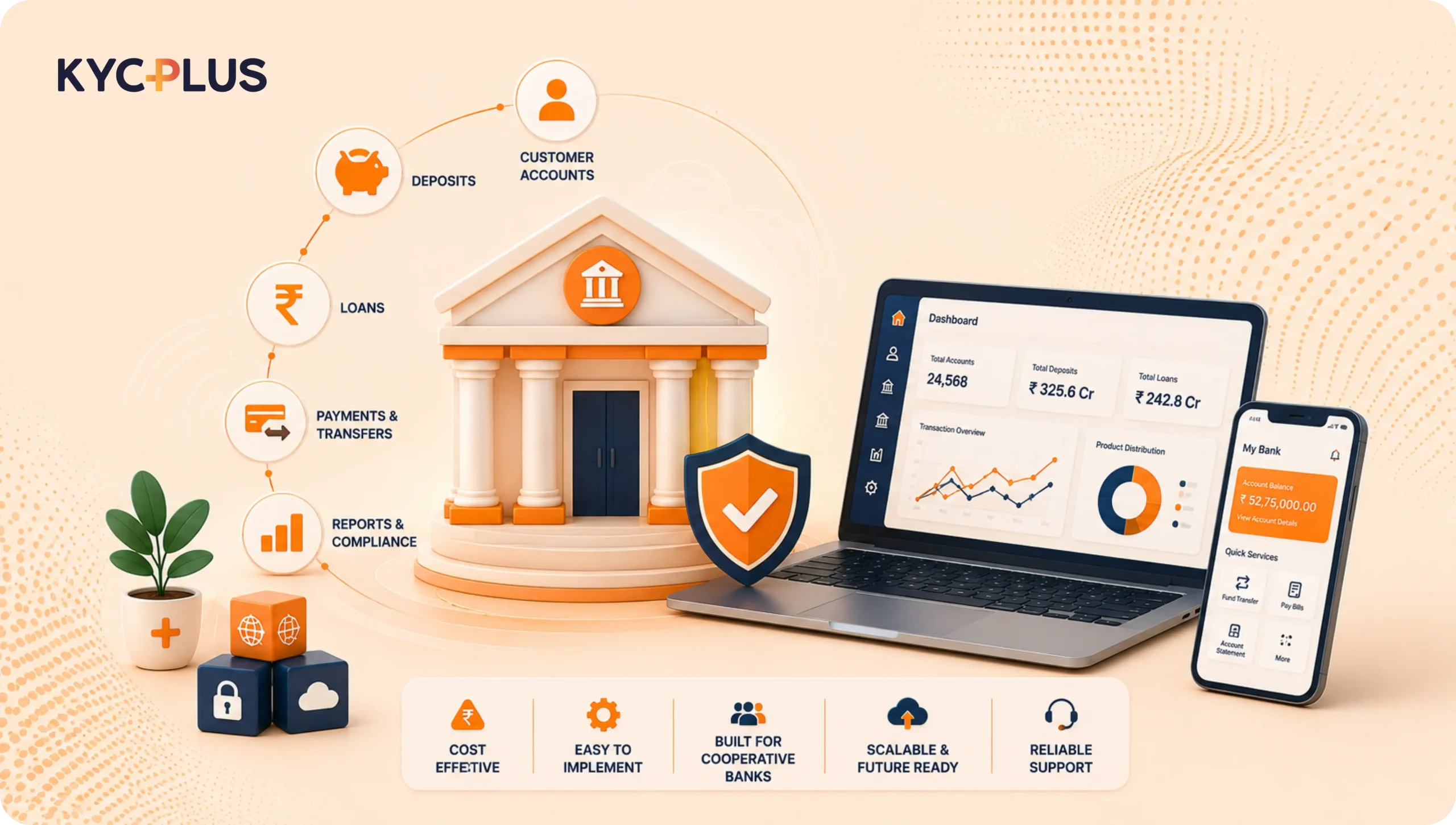
A Core Banking System is the central software platform that manages the fundamental banking activities of an institution.
For a cooperative bank, this can include:
For example, instead of maintaining completely independent customer and account records at every branch, a centralized CBS can allow authorized users to access the relevant information across connected branches.
This becomes particularly important for UCBs and DCCBs because many cooperative banks operate through multiple branches and serve customers across different geographical areas.
The objective of affordable CBS software for cooperative banks should therefore be to provide the core functionality required by the bank while avoiding unnecessary technology expenditure.
Cooperative banks operate in a highly competitive financial environment.
They need to provide services that customers increasingly expect from modern banks, including digital transactions, mobile access, faster service and convenient customer onboarding.
At the same time, technology budgets can be more constrained than those of large commercial banks.
This makes cost efficiency particularly important.
An affordable CBS can potentially help a cooperative bank:
However, affordability must be evaluated over the entire lifecycle of the CBS, not simply at the time of purchase.
The word “affordable” can be misleading when evaluating banking software.
Suppose CBS A costs ₹20 lakh initially, while CBS B costs ₹30 lakh.
At first glance, CBS A appears more affordable.
But imagine CBS A requires:
Meanwhile, CBS B may include more functionality, APIs and managed support within its implementation model.
In that situation, CBS B could potentially have a lower overall cost despite its higher initial price.
Therefore, affordable CBS software for cooperative banks should be evaluated using Total Cost of Ownership (TCO).
Software + Implementation + Infrastructure + Migration + Integration + Customization + Training + Support + Upgrades
This is one of the most important concepts for UCBs and DCCBs to understand before selecting a CBS.
The first consideration should always be functionality.
An affordable CBS is only useful if it can actually handle the bank’s operations.
Banks should evaluate whether the system supports:
A CBS that offers these capabilities without requiring extensive customization may provide better long-term value.
Price is naturally one of the biggest considerations when searching for affordable CBS software for cooperative banks.
However, banks should avoid comparing providers only on their quoted software price.
Instead, request a complete cost sheet covering:
| Cost Component | What the Bank Should Check |
| License/subscription | One-time or recurring? |
| Implementation | Included or additional? |
| Data migration | Included or separately charged? |
| Customization | What is included? |
| API integration | Additional cost? |
| Infrastructure | Bank-owned or provider-managed? |
Training Included?
| Support | Annual cost? |
| Upgrades | Included or paid separately? |
| Disaster recovery | Additional infrastructure cost? |
This approach makes it much easier to identify genuinely affordable CBS software for cooperative banks.
Deployment architecture can have a significant effect on affordability.
Traditionally, banks invested heavily in servers, databases, networking equipment and data-center infrastructure.
Cloud-based or SaaS models can provide another approach.
For smaller cooperative banks, a managed model may reduce the need for large upfront infrastructure investment.
For example, C-Edge describes its banking technology delivery model as SaaS-based and says it manages foundational infrastructure for financial institutions. Its website currently states that it serves cooperative banks and other financial institutions.
There are also CBS products specifically marketed around cloud and affordability. For example, iBankCBS describes itself as a web-based CBS for Primary Cooperative Banks, hosted on private-cloud infrastructure, and explicitly lists affordable pricing alongside CAPEX/OPEX deployment models.
This illustrates an important point:
Cloud does not automatically mean cheaper, and on-premise does not automatically mean expensive.
The bank should calculate the complete cost of each deployment model.
A CBS should be affordable today without becoming a limitation tomorrow.
Consider a UCB with:
The bank may eventually grow to:
The CBS should be capable of supporting that growth.
Banks should therefore ask:
A system that requires complete replacement after a few years is rarely an affordable solution in the long run.
Affordability should never come at the expense of security.
A CBS contains extremely sensitive information including:
Therefore, banks should evaluate:
A CBS provider should also demonstrate how security is maintained during upgrades and integrations.
For UCBs and DCCBs, security should be treated as a fundamental CBS requirement rather than an optional feature.
This is becoming one of the most important criteria when evaluating affordable CBS software for cooperative banks.
A modern bank rarely uses only one software application.
The CBS may need to connect with:
If every integration requires expensive custom development, the overall cost of the CBS can increase significantly.
Therefore, banks should ask whether the provider offers:
A CBS with good integration capabilities can help a bank add new services without rebuilding the core system.
KYC is an excellent example of why integration matters.
A bank may have a strong CBS but still use a separate platform for digital customer onboarding and KYC.
In fact, specialized applications can sometimes provide more focused functionality than trying to make the CBS handle every digital process.
A modern cooperative bank may have a technology flow such as:
Customer → Digital Onboarding → KYC Verification → CBS → Account Creation
Existing Customer → Digital Re-KYC → Verification → CBS Update
A specialized digital KYC platform can handle processes such as:
while the CBS remains responsible for core account and transaction processing.
This type of architecture can help cooperative banks modernize without immediately replacing their entire CBS.
This is where a bank’s technology strategy becomes more interesting.
A cooperative bank does not necessarily need to purchase one giant platform for every requirement.
It can use the CBS as the core banking layer and connect specialized applications around it.
KYCPLUS, for example, can complement an existing CBS by providing digital KYC and Re-KYC capabilities.
Depending on the bank’s integration architecture, a digital KYC workflow can help automate:
The benefit of this approach is that the bank can modernize a specific operational area without necessarily changing its entire core banking infrastructure.
For a cost-conscious UCB or DCCB, this can be an important consideration.
Instead of asking:
the bank can also ask:
“Which parts of our banking ecosystem need modernization, and can they integrate with our existing CBS?”
That distinction can have a significant impact on technology expenditure.
Urban Cooperative Banks operate in a specific regulatory and operational environment.
They may need to manage:
The CBS should therefore support both traditional banking operations and newer digital requirements.
Lower unnecessary technology costs + adequate functionality + reliable support + future scalability.
A CBS that is cheap but cannot integrate with digital services may ultimately require additional spending.
DCCBs have their own operational requirements, particularly because of their relationship with cooperative banking structures and rural banking ecosystems.
A DCCB may need:
The CBS must therefore be able to support a distributed branch network while maintaining centralized control.
Cost is important, but so are:
This makes the evaluation of affordable CBS software for cooperative banks especially important for DCCBs.
There is no single CBS provider that is automatically the right choice for every cooperative bank.
UCBs and DCCBs should compare providers based on their own size, functionality, budget, implementation requirements and future roadmap.
Some providers and platforms that banks may encounter during their evaluation include:
The objective should not be to create a simple “best CBS” ranking.
Instead, banks should evaluate which platform provides the best fit-to-requirement and total cost of ownership.
Netwin offers a Core Banking System positioned for different banking segments, including cooperative institutions.
Its current CBS information describes support for retail, corporate, cooperative and digital banking, with real-time processing, multi-channel access, multi-branch support and regulatory capabilities. Netwin also states that its CBS is used by 500+ institutions.
The company also describes its cooperative banking solutions as designed for the needs of rural India and cooperative institutions.
For banks evaluating affordable CBS Software for Banks, Netwin is therefore one provider worth examining.
The bank should still evaluate:
Trust Systems & Software, now associated with Trust Fintech, has been active in banking technology and has been associated with the cooperative banking segment.
Its banking software ecosystem has included core banking capabilities alongside other financial technology solutions.
When evaluating this type of provider, UCBs and DCCBs should look beyond the product name and evaluate the current version of the platform, deployment model and support framework.
Key questions should include:
These questions help determine whether the solution is genuinely affordable over its complete lifecycle.
Infrasoft Technologies is another established name in Indian financial technology.
Banks considering Infrasoft should evaluate its current CBS capabilities, implementation model, integration options and support structure.
Historical implementation experience can be useful, but banks should also evaluate the current product roadmap.
A modern cooperative bank should specifically assess:
These factors can have a greater impact on long-term affordability than the initial license price.
Poset can also be included in a cooperative bank’s CBS evaluation process.
Rather than judging a CBS only by the number of modules available, UCBs and DCCBs should evaluate how well the platform fits their actual operational requirements.
Important areas to examine include:
A detailed product demonstration based on the bank’s actual workflows is usually more useful than a generic feature presentation.
Oracle is a global technology company with a significant banking technology portfolio.
As a core banking platform, FLEXCUBE supports areas including retail and corporate banking, deposits and lending, product management, and transaction processing. Oracle also describes deployment options including cloud and on-premises environments.
For cooperative banks considering enterprise-grade technology, Oracle can be part of the broader CBS evaluation landscape.
However, affordability should be evaluated carefully.
Banks should calculate:
The question is not whether Oracle is technically capable.
The question is whether the platform’s total cost and complexity are appropriate for the particular cooperative bank.
Virtual Galaxy Infotech is another Indian technology company associated with banking software and CBS solutions.
Its banking technology portfolio includes E-Banker and solutions designed for financial institutions.
For a cooperative bank, Virtual Galaxy can be evaluated based on:
As with every provider, banks should request references and conduct a requirement-based demonstration before making a final decision.
C-Edge is another relevant name for cooperative banks to consider.
A joint venture between TCS and SBI, C-Edge provides banking technology and infrastructure services. Its website states that it serves cooperative banks and other financial institutions and offers SaaS-oriented delivery.
C-Edge is particularly relevant to the cooperative banking discussion because its ecosystem has been used across cooperative banking institutions.
A 2026 Government of India release stated that NABARD initiated onboarding of DCCBs onto CBS in 2013 and negotiated pricing for the TCS/C-Edge CBS solution; the release reported that 13 DCCBs were operating on the C-Edge platform at the time of that publication.
For a bank looking for affordable CBS software, the managed/SaaS model can be worth examining because it can change how infrastructure and operating costs are structured.
Infosys Finacle is another major CBS platform with experience in cooperative banking.
A Finacle Digital Banking SaaS offering, announced by Infosys, is specifically designed for Indian UCBs, with a cost-effective subscription-based model intended to reduce upfront technology investment.
Finacle also has a long history in cooperative banking. For example, Infosys announced the deployment of Finacle at Cosmos Cooperative Bank in 2001, while later public documents have referenced Finacle deployments across cooperative banking environments.
For UCBs evaluating affordable CBS software, the SaaS model is particularly relevant because subscription-based deployment can shift expenditure from large upfront capital costs toward ongoing operating expenditure.
Again, the bank should calculate its own TCO before deciding.
TCS BaNCS is another major banking technology platform.
The BaNCS Global Banking Platform, developed by TCS, is described as serving a broad spectrum of banking institutions, including urban and rural cooperative banks. Its cooperative banking solution specifically highlights requirements such as membership and shares.
For a cooperative bank, this type of segment-specific functionality can be valuable.
However, banks should compare:
This distinction deserves special attention.
When a bank searches for affordable CBS software for cooperative banks, it may naturally focus on the lowest quotation.
But the cheapest quotation is not necessarily the most affordable solution.
Consider two hypothetical CBS platforms.
A
B
Therefore, the right metric is:
Total Value ÷ Total Cost
rather than simply:
Initial Price
A cost-effective CBS for cooperative banks should ideally cover the bank’s essential requirements without unnecessary complexity.
Banks should negotiate not just the license price but also:
Instead of buying everything at once, banks can prioritize the modules they actually need.
A modern banking ecosystem does not always need to be one monolithic application.
A cooperative bank can have:
This approach allows banks to modernize individual functions without replacing the entire banking infrastructure.
For example, if the bank already has a satisfactory CBS, it may not need a new CBS simply because it wants digital Re-KYC.
A specialized platform can potentially integrate with the existing CBS.
For a cost-conscious cooperative bank, this modular approach can be particularly relevant.
Suppose a UCB already has an existing CBS but wants to introduce:
Instead of replacing the CBS, the bank can evaluate a specialized digital KYC platform that integrates with the existing core.
It can serve as a complementary KYC layer while the CBS continues to manage core banking operations.
A simplified architecture can be:
Customer
↓
KYCPLUS
↓
KYC / CKYC / Re-KYC Verification
↓
API Integration
↓
CBS
This can help a cooperative bank modernize a specific operational area while protecting its existing core banking investment.
The exact integration architecture, of course, depends on the CBS APIs and the bank’s technical environment.
Support is sometimes overlooked during CBS procurement.
But for a bank, technical problems can directly affect customer service.
Therefore, banks should ask:
A slightly more expensive CBS with strong support may be more affordable than a cheaper system that causes frequent operational problems.
There is no single standard price for CBS implementation.
Costs depend on:
Therefore, banks should avoid relying on generic “CBS price” figures found online.
Instead, they should request a customized proposal based on their actual requirements.
Scope → Modules → Integrations → Migration → Infrastructure → SLA → Training → Support → Pricing
This allows different CBS providers to be compared fairly.
Before selecting affordable CBS software for cooperative banks, UCB management should ask:
These questions can help prevent unexpected costs later.
DCCBs should additionally evaluate:
For DCCBs, a CBS should be evaluated not just as software but as the technological backbone of a distributed banking network.
A simple scoring framework can help.
| Evaluation Criteria | Suggested Importance |
| Core banking functionality | Very High |
| Security | Very High |
| Reliability | Very High |
| API integration | High |
| Scalability | High |
| Implementation capability | High |
| Data migration | High |
| Support | High |
| Digital banking | High |
| KYC integration | High |
| Cost / Total Cost of Ownership (TCO) | Very High |
| Customization | Medium |
| Cloud readiness | Medium / High |
| Analytics | Medium |
The exact weighting should be customized according to the bank’s strategy.
The future of affordable CBS software for cooperative banks is likely to be shaped by cloud technologies, SaaS delivery, APIs, automation and modular banking architecture.
Cooperative banks will increasingly expect:
The definition of affordability will therefore evolve.
In the past, affordability may have meant simply purchasing cheaper software.
In the future, affordability will increasingly mean:
Lower total cost + faster deployment + easier integration + lower maintenance + better scalability.
That is a much more useful definition for a modern cooperative bank.
Choosing affordable CBS software for cooperative banks requires more than comparing quotations from different technology providers.
UCBs and DCCBs need to evaluate the complete cost and capability of a Core Banking System, including implementation, infrastructure, data migration, customization, integration, support, upgrades and long-term scalability.
Providers and platforms such as Netwin, Trust Systems/Trust Fintech, Infrasoft Technologies, Poset, Oracle, Virtual Galaxy, C-Edge, Infosys Finacle and TCS BaNCS can form part of a bank’s evaluation landscape. The right choice depends on the bank’s size, operational requirements, technology strategy and budget.
The most affordable CBS is therefore not necessarily the one with the lowest initial quotation.
It is the one that delivers the required banking capabilities while keeping the total cost of ownership manageable over the long term.
For cooperative banks, another important consideration is whether the CBS can integrate with specialized banking applications.
A bank can retain its existing CBS while adding digital capabilities such as customer onboarding, CKYC, Re-KYC, OCR, and document verification through complementary platforms. Solutions such as KYCPLUS can fit into this architecture by providing a dedicated digital KYC and Re-KYC Solution layer that can connect with the bank’s existing technology environment.
Ultimately, the goal should be simple:
The right CBS should help a cooperative bank control costs while still providing the security, scalability, integration and digital capabilities needed to compete in modern banking.
Ans: Affordable CBS software for cooperative banks refers to a Core Banking System that provides essential banking functionality at a sustainable overall cost. Affordability should consider software, implementation, infrastructure, migration, integration, support and upgrade costs.
Ans: No. A low initial price can become expensive if the system requires extensive customization, costly integrations, expensive infrastructure or high maintenance charges. Banks should compare total cost of ownership instead.
Ans: UCBs should evaluate core banking functionality, security, scalability, API integration, digital banking, KYC integration, implementation, migration, support and total cost.
Ans: DCCBs should pay particular attention to multi-branch operations, scalability, connectivity, loan management, reporting, security, disaster recovery, digital channels and integration capabilities.
Ans: It can, depending on the bank’s requirements. Cloud or SaaS models may reduce upfront infrastructure investment, but banks should compare the complete multi-year cost before deciding.
Ans: Yes. If the CBS provides suitable APIs or integration interfaces, it can potentially connect with digital KYC, CKYC and Re-KYC platforms.
Ans: KYCPLUS can complement an existing CBS by providing digital KYC and Re-KYC capabilities. The exact integration depends on the bank’s CBS architecture and available APIs.
Ans: Costs can include software licensing or subscription, implementation, infrastructure, data migration, customization, API integration, training, support, security and disaster recovery.
Ans: There is no single CBS that is best for every cooperative bank. UCBs and DCCBs should evaluate providers based on their specific functional requirements, budget, integration needs and long-term technology roadmap.
Ans: APIs allow the CBS to communicate with other applications such as mobile banking, payment systems, KYC platforms, CRM, loan systems and analytics platforms. This makes modernization easier and can reduce future integration costs.
