In today’s digital-first financial ecosystem, Types of KYC have become one of the most important pillars for trust, compliance, & security. Every time a customer opens a bank account, applies for a loan, invests in mutual funds, buys insurance, or signs up for a digital wallet, KYC silently works in the background to answer one critical question:
As India rapidly transitions toward paperless banking, instant onboarding, & mobile-first financial services, the role of Types of KYC has expanded far beyond a regulatory formality. In 2026, KYC is no longer just about submitting documents — it has become a technology-driven, intelligence-based process that directly impacts:
Modern platforms like KYCPLUS are designed to manage these evolving types of KYC through a single intelligent digital workflow that combines compliance, automation, and fraud prevention.
This guide uses a conversational, real-world approach to explain all the major types of KYC used in India—how they work in practice, where they are applied, their strengths and limitations, and how institutions choose the right KYC method for different situations.
KYC stands for Know Your Customer. It is a mandatory regulatory process through which banks & regulated entities verify the identity & address of their customers before starting or continuing a financial relationship.
A common question decision-makers ask is:
“Why do we need so many Types of KYC?”
The answer lies in real-world diversity.
Consider these everyday scenarios:
Each scenario involves different risk levels, urgency, compliance depth, & customer expectations.
A single rigid KYC process would either be:
That is why regulators allow multiple Types of KYC, & why platforms like KYCPLUS are designed to support all KYC types in one unified system, rather than forcing institutions into one method.
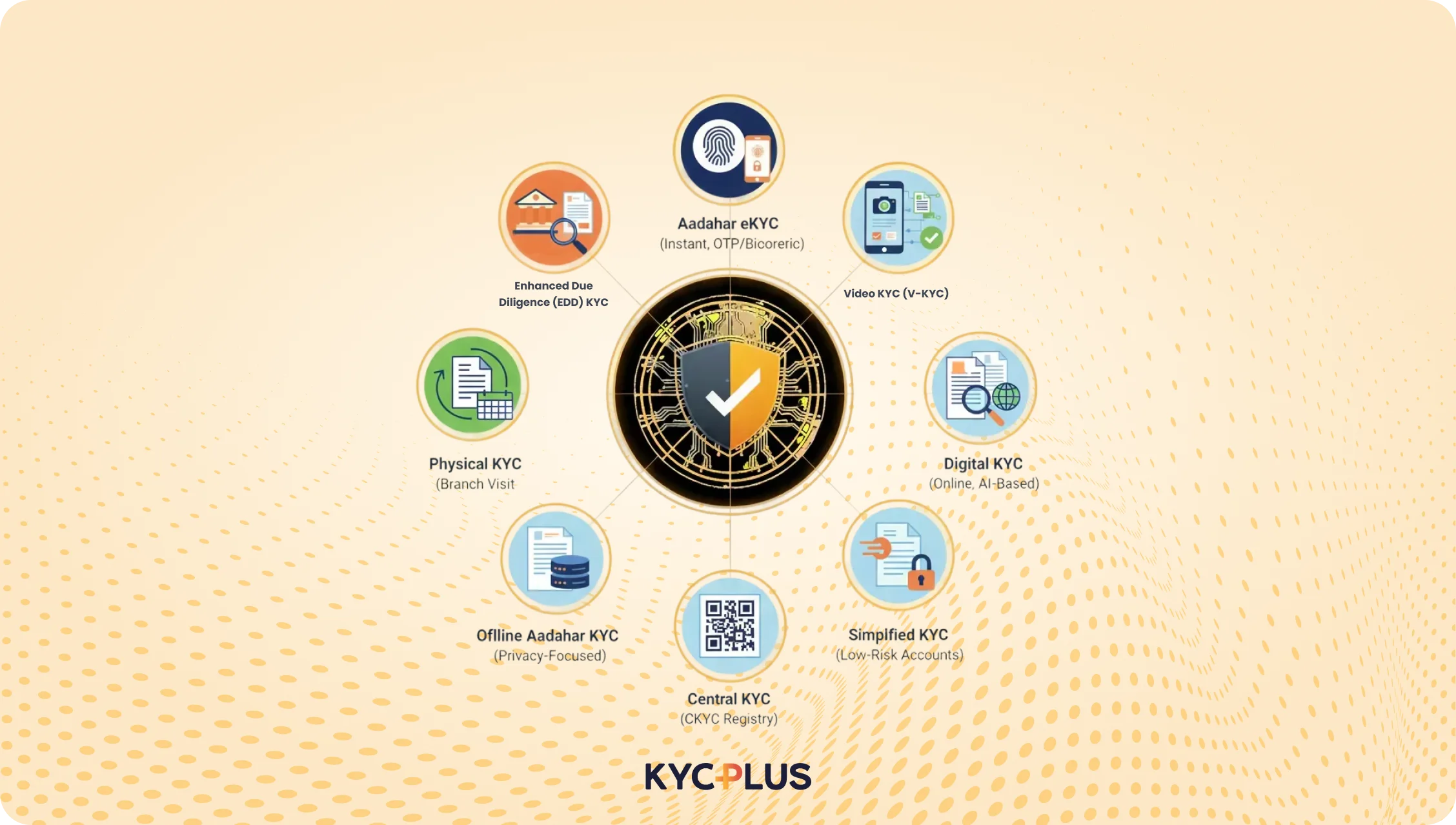
Before we go deeper, here is a structured overview of the most commonly used Types of KYC in India:
Each of these Types of KYC plays a role at a different stage of the customer lifecycle — onboarding, monitoring, updating, and risk management.
Physical KYC is the oldest and most traditional among all Types of KYC. It requires customers to visit a bank branch or authorized service point & submit identity & address documents in person.
Imagine opening a bank account a decade ago:
This process relies heavily on human judgment and physical paperwork.
Among all Types of KYC, physical KYC is steadily declining. Modern platforms like KYCPLUS aim to digitize even branch-based KYC so institutions can reduce dependency on paper while staying compliant.
Aadhaar eKYC is one of the most widely adopted Types of KYC in India. It enables instant, paperless identity verification using Aadhaar authentication through OTP or biometric consent.
Platforms like KYCPLUS integrate Aadhaar eKYC with fallback options (Digital KYC / Video KYC) to ensure onboarding never stops due to OTP failure.
Digital KYC is the most scalable and future-ready among all Types of KYC. It allows customers to complete KYC fully online using document uploads, live selfies, AI-based verification, and fraud detection.
KYCPLUS addresses these challenges using AI-based liveness, face match, document forensics, and real-time risk scoring, making Digital KYC secure at scale.
Video KYC is an RBI-approved remote KYC verification method where identity verification happens through a live video interaction.
How Video KYC works in real scenarios
Video KYC is often integrated inside platforms like KYCPLUS as a risk-based step, not a default flow — improving compliance without slowing everyone down.
Central KYC (CKYC) is a centralized KYC repository managed by CERSAI, allowing customers to complete KYC once & reuse it across institutions.
Modern KYC platforms like KYCPLUS automate CKYC search, upload, update, & retrieval, reducing operational burden on banks.
Re-KYC ensures customer information stays accurate over time.
Without automation, Re-KYC becomes one of the biggest compliance bottlenecks.
KYCPLUS automates Re-KYC using digital journeys, allowing customers to update details remotely while maintaining audit trails.
Offline Aadhaar KYC enhances privacy by enabling the sharing of encrypted XML or QR codes instead of Aadhaar numbers — an ideal solution for privacy-conscious users.
Simplified KYC enables quick onboarding for low-risk accounts with limited transaction caps — often used in wallets and basic accounts.
EDD is the most stringent among all Types of KYC, used for:
EDD involves deeper checks, source-of-funds analysis, & continuous monitoring — all of which KYCPLUS supports through risk scoring & workflows.
Modern institutions do not choose one KYC type — they design risk-based KYC journeys:
Platforms like KYCPLUS deliver a single platform that supports multiple types of KYC with intelligent decisioning.
Several key forces will shape the future of types of KYC:
Manual, paper-based KYC will continue to disappear.
Understanding Types of KYC is no longer just about regulatory compliance — it is about building secure, scalable, & customer-friendly financial systems.
In 2026, institutions that rely on fragmented or manual KYC processes will struggle. Those that adopt intelligent, unified platforms like KYCPLUS will move faster, stay compliant, & earn customer trust.
Ans: KYC (Know Your Customer) is the process of verifying a customer’s identity before or during onboarding. In 2026, KYC is more important than ever due to rising digital fraud, stricter regulations, and increased online financial transactions. Effective KYC helps businesses prevent fraud, comply with regulations, and build customer trust.
Ans: The main types of KYC include Physical KYC, Digital KYC (eKYC), Video KYC (VKYC), Biometric KYC, Central KYC (CKYC), and Aadhaar-based KYC (in India). Each method varies in terms of speed, cost, and regulatory acceptance.
Ans: Digital KYC, or eKYC, is an electronic identity verification process using online documents, APIs, and databases. It enables fast, paperless onboarding and is widely used by fintechs, banks, NBFCs, and startups for seamless customer acquisition.
Ans: Video KYC involves a live or recorded video interaction where a customer’s identity is verified by an authorized official. It is RBI-approved in India and is commonly used by banks and regulated entities to ensure higher compliance and audit readiness.
Ans: Biometric KYC verifies identity using physical traits such as fingerprints, facial recognition, or iris scans. It is commonly used in high-security environments, government services, and financial institutions where strong identity assurance is required.
Ans: CKYC is a centralized KYC registry where customer KYC records are stored and reused across financial institutions. Once a customer completes CKYC, they do not need to repeat the KYC process with other regulated entities, saving time and effort.
Ans: Aadhaar-based KYC uses India’s Aadhaar system for identity verification through OTP or biometric authentication. When implemented via compliant and secure platforms, it is highly reliable, fast, and widely accepted, though it must follow regulatory guidelines strictly.
Ans: Digital KYC combined with Video KYC is considered ideal for fintechs and digital businesses due to speed, scalability, and compliance. Platforms like KYCPLUS offer end-to-end KYC solutions that integrate multiple verification methods through a single, secure API.
Ans: KYCPLUS is one of the best KYC solutions as it provides a unified platform for eKYC, Video KYC, document verification, biometric checks, and AML screening. It helps businesses stay compliant, reduce onboarding time, and improve customer experience with minimal operational effort.
Ans: The right KYC method depends on regulatory requirements, risk profile, customer type, and business scale. Most organizations opt for a hybrid approach using digital, video, and biometric KYC. Choosing a flexible solution like KYCPLUS ensures adaptability to future regulations and growth.
