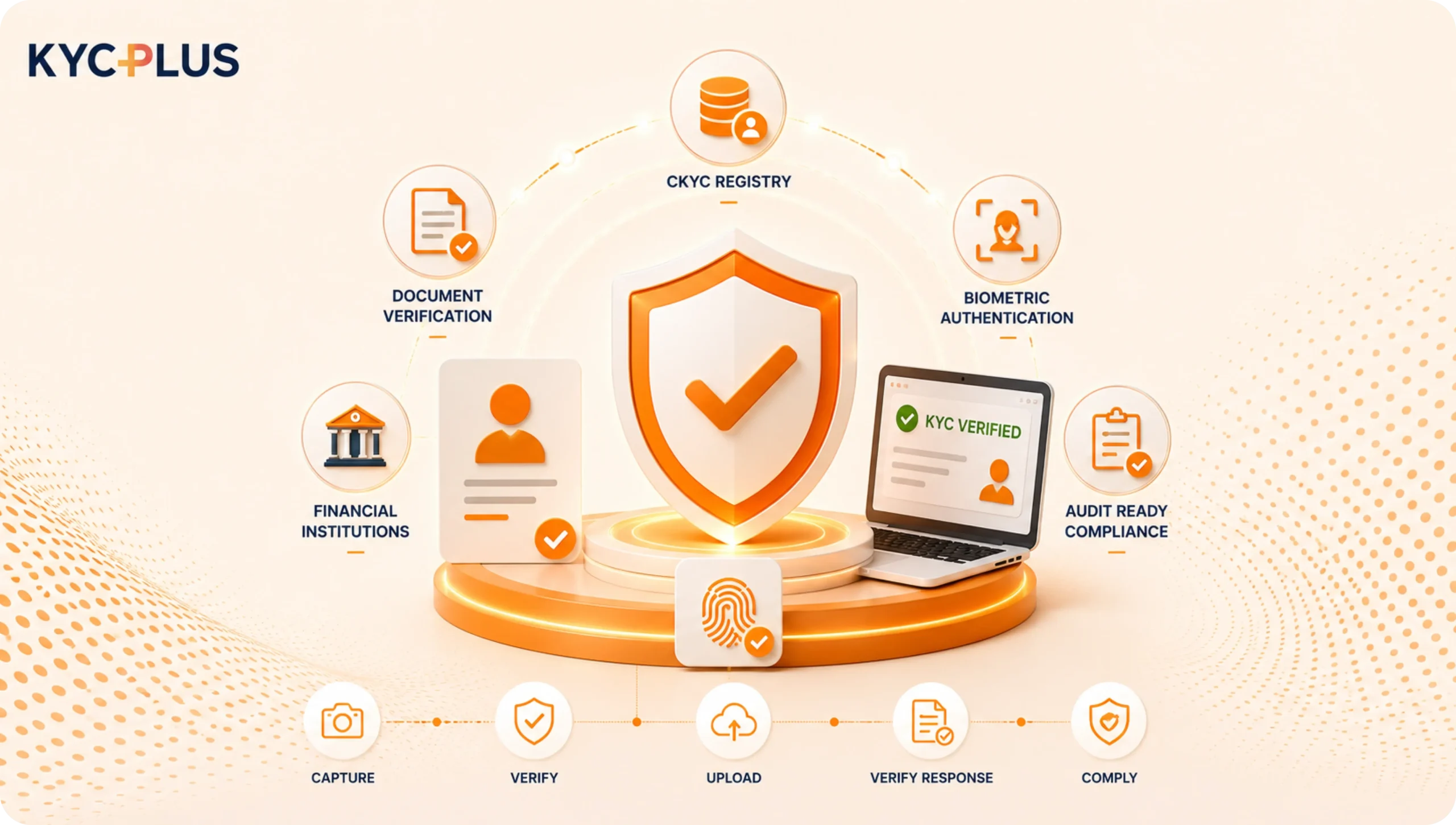
In India’s financial ecosystem, compliance is more than just a regulatory requirement — it is the foundation of trust between institutions and their members. Every bank, NBFC, and co‑operative society must adhere to strict Know Your Customer (KYC) norms mandated by the Reserve Bank of India (RBI) and the Central KYC Registry (CERSAI). These norms are designed to prevent fraud, money laundering, and identity theft, while ensuring transparency in financial transactions. Traditional paper‑based verification systems, however, are no longer sufficient. They are slow, prone to errors, and vulnerable to manipulation. This is where a Real-Time CKYC Verification Service in India becomes essential. By automating verification processes, these providers help institutions remain compliant, reduce operational costs, and build confidence among members.
The Central KYC Registry (CKYC) was introduced to create a unified database of customer records across financial institutions. Instead of repeating KYC processes for every new account or loan, CKYC allows institutions to access verified records instantly. This saves time, reduces duplication, and ensures compliance with RBI guidelines.
For co‑operative societies and banks, managing thousands of member records across multiple branches is a challenge. Without automation, compliance becomes a burden. A trusted Real-Time CKYC Verification Service in India ensures that institutions can seamlessly upload, verify, and manage records while staying audit‑ready.
Over the past decade, several technology companies have entered the market to provide digital CKYC solutions. These platforms combine OCR (Optical Character Recognition), biometric authentication, and AI‑powered fraud detection to deliver faster, more secure verification.
Yet, not all providers are equally effective for co‑operative institutions. Many focus on large commercial banks or fintechs, leaving gaps in rural inclusion, CBS (Core Banking System) integration, and regulator‑friendly reporting. The best Real-Time CKYC Verification Service in India is one that balances compliance accuracy with ease of use.
To appreciate the role of a Real-Time CKYC Verification Service in India, it is important to first understand what CKYC actually is and why it matters. CKYC, or Central KYC, was introduced by the Government of India through CERSAI (Central Registry of Securitization Asset Reconstruction and Security Interest of India) to create a unified, centralized database of customer records. As a foundational KYC Solution, CKYC helps financial institutions streamline customer onboarding, reduce repetitive verification processes, and ensure regulatory compliance through a standardized verification framework.
CKYC is a system where customer KYC information is stored in a central registry. Once a customer completes KYC with one financial institution, the same record can be used across banks, NBFCs, insurance companies, and co‑operative societies. This eliminates duplication and ensures consistency.
A reliable Real-Time CKYC Verification Service in India ensures that institutions can seamlessly upload, verify, and retrieve these records without errors.
CERSAI manages the CKYC Registry, and RBI mandates that all financial institutions must comply with CKYC norms. This includes:
Without automation, these tasks are time‑consuming and prone to mistakes. That is why institutions increasingly rely on a Real-Time CKYC Verification Service in India to handle compliance efficiently.
The introduction of CKYC has transformed compliance in India. Some key benefits include:
For co‑operative societies, which often operate across multiple districts, centralized KYC is especially valuable. A trusted Real-Time CKYC Verification Service in India helps them manage large member bases with ease.
Modern CKYC solutions go beyond simple record storage. They integrate advanced technologies like:
These features make compliance smoother and more reliable. Institutions that adopt digital platforms gain a competitive edge by reducing delays and building member trust.
Several companies have entered this space, offering CKYC modules tailored to different needs. Some focus on large banks, others on fintechs, and a few on co‑operative institutions. Providers like KYCPLUS have built solutions aligned with RBI norms, but the choice of a Real-Time CKYC Verification Service in India depends on the institution’s size, scope, and compliance requirements.
Before institutions embraced digital transformation, KYC processes were largely manual. Paper forms, photocopies of identity documents, and branch‑level verification dominated the workflow. While this system worked in the past, it is no longer sustainable in today’s compliance‑heavy environment. Understanding these challenges highlights why financial institutions increasingly turn to a Real-Time CKYC Verification Service in India.
Traditional KYC requires staff to collect, verify, and store documents physically. This process is slow and often results in backlogs.
A digital Real-Time CKYC Verification Service in India eliminates these delays by automating uploads and validations.
Manual systems make it difficult to detect duplicate accounts or fraudulent identities. Fraudsters exploit gaps by opening multiple accounts under different names.
Digital providers use biometric authentication and AI‑powered anomaly detection to flag suspicious activity, reducing fraud significantly.
Regulators demand transparent, audit‑ready records. Manual systems often result in missing files, incomplete logs, or inconsistent data.
A reliable Real-Time CKYC Verification Service in India ensures audit trails are automatically maintained, making inspections smoother.
Digital CKYC solutions reduce costs by automating repetitive tasks and centralizing data.
A Real-Time CKYC Verification Service in India offers scalable solutions that grow with the institution.
Several providers have stepped in to address these challenges. Some focus on large banks, others on fintechs, and a few on co‑operative institutions. Platforms like KYCPLUS have demonstrated success in reducing onboarding delays and improving audit readiness, but the choice of provider depends on the institution’s specific needs.
As financial institutions move away from manual verification, the demand for advanced digital solutions has grown rapidly. A modern Real-Time CKYC Verification Service in India offers more than just record storage — it delivers a complete compliance ecosystem designed to meet regulatory requirements, prevent fraud, and simplify operations.
The most critical feature is direct integration with the Central KYC Registry (CERSAI).
This ensures that banks, NBFCs, and co‑operative societies remain compliant without delays.
A Real-Time CKYC Verification Service in India with strong document management capabilities helps institutions save time and resources.
This feature is especially valuable for co‑operative societies operating in rural areas where fraud risks are higher.
By leveraging AI, a CKYC Verification Service Provider in India helps institutions stay ahead of fraud attempts.
This feature ensures institutions are always inspection‑ready.
The demand for digital compliance solutions has created a competitive landscape where multiple providers offer CKYC modules. Each Real-Time CKYC Verification Service in India brings unique strengths, but their suitability often depends on the type of institution — large banks, fintechs, NBFCs, or co‑operative societies. Understanding this landscape helps institutions make informed decisions.
KYCPLUS has gained recognition for tailoring solutions to co‑operative societies and regional banks.
Strengths:
Limitations:
Signzy is known for its video KYC and AI‑driven verification tools.
Strengths:
Limittions:
Karza specializes in KYB (Know Your Business) and AML (Anti‑Money Laundering) modules.
Strengths:
Limitations:
Perfios is widely used for financial data aggregation and credit analytics.
Strengths:
Limitations:

Large Banks & Fintechs: Signzy and Perfios often dominate due to their advanced modules.
Corporate Clients: Karza is preferred for KYB and AML compliance.
Co‑Operative Societies & Regional Banks: KYCPLUS stands out as a Real-Time CKYC Verification Service in India that addresses rural inclusion, CBS integration, and regulator‑friendly reporting.
The shift from manual verification to digital platforms has transformed compliance across India’s financial sector. A modern Real-Time CKYC Verification Service in India not only ensures regulatory adherence but also delivers significant operational advantages. Automation reduces human error, accelerates onboarding, and strengthens fraud prevention — all while lowering costs.
By working with a digital Real-Time CKYC Verification Service in India, banks and co‑operative societies can onboard members in minutes instead of days.
By adopting a digital Real-Time CKYC Verification Service in India, societies and banks demonstrate commitment to security and efficiency.
Different providers emphasize different aspects of automation. Some focus on advanced fraud detection, others on video KYC, while a few specialize in co‑operative society workflows. Platforms like KYCPLUS have shown how automation can reduce onboarding delays and improve audit readiness, but institutions must choose based on their unique priorities.
Real-Time CKYC Verification Service in India – Strengthening Compliance and Security
Compliance is the backbone of India’s financial sector. Every institution, whether a large commercial bank, NBFC, or co‑operative society, must adhere to strict guidelines set by the Reserve Bank of India (RBI) and the Securities and Exchange Board of India (SEBI). A modern Real-Time CKYC Verification Service in India ensures that these requirements are met while also safeguarding sensitive customer data.
A trusted Real-Time CKYC Verification Service in India ensures that customer data remains protected at all times.
By working with a reliable Real-Time CKYC Verification Service in India, institutions show that compliance and security are not just obligations but priorities.
The true value of a Real-Time CKYC Verification Service in India is best understood through real‑world use cases. Different types of financial institutions face unique challenges, and digital CKYC solutions help them overcome these hurdles while ensuring compliance.
Insurance companies work with large networks of agents.
Real-Time CKYC Verification Service in India – Embracing the Future of Compliance
The financial sector in India is evolving rapidly, and compliance frameworks like CKYC are expected to grow in scope and sophistication. A modern Real-Time CKYC Verification Service in India must not only meet today’s requirements but also anticipate tomorrow’s challenges. Emerging technologies such as AI, blockchain, and mobile‑first solutions are reshaping how institutions approach verification, fraud prevention, and customer onboarding.
Compliance in India’s financial sector has often been viewed as a regulatory burden, something institutions must do to avoid penalties. Yet, as we have seen throughout this discussion, CKYC is far more than a box‑ticking exercise. It is a framework that builds trust, strengthens transparency, and enables institutions to operate with confidence. By centralizing customer records, reducing duplication, and ensuring accuracy, CKYC has become a cornerstone of modern financial operations.
A reliable Real-Time CKYC Verification Service in India plays a crucial role in this transformation. Instead of struggling with manual processes, institutions can automate verification, integrate compliance into their core systems, and remain audit‑ready at all times. This shift not only reduces costs and fraud risks but also enhances customer experience. Members and borrowers benefit from faster onboarding, smoother loan approvals, and greater confidence in the institution’s integrity.
The broader impact is equally important. Regulators gain transparency, institutions gain efficiency, and customers gain trust. Compliance, when managed effectively, becomes a competitive advantage. Providers that understand the diverse needs of banks, NBFCs, and co‑operative societies — whether through rural inclusion, CBS integration, or advanced fraud detection — are helping reshape India’s financial ecosystem.
Looking ahead, CKYC will continue to evolve with technologies like AI, blockchain, and mobile‑first onboarding. Institutions that partner with forward‑thinking providers will not only meet today’s requirements but also stay prepared for tomorrow’s challenges. Choosing the right Real-Time CKYC Verification Service in India is therefore not just about compliance — it is about building a foundation for growth, resilience, and long‑term success.
Ans: CKYC is a centralized registry managed by CERSAI that stores customer KYC records, making them reusable across banks, NBFCs, and co‑operative societies.
Ans: It reduces duplication, speeds up onboarding, and ensures compliance with RBI guidelines.
Ans: Traditional KYC requires repeating verification for each institution, while CKYC allows one verified record to be shared across multiple institutions.
Ans: Identity proof (PAN, Aadhaar, Passport), address proof, and a photograph are typically required.
Ans: Yes, RBI mandates CKYC compliance for banks, NBFCs, and co‑operative societies.
Ans: By maintaining a single verified record per customer, duplicate accounts and false identities are eliminated.
Ans: Customers enjoy faster onboarding and don’t need to repeat KYC for every new account or loan.
Ans: Modern providers use OCR, biometrics, AI fraud detection, and cloud storage to make compliance efficient and secure.
Ans: The choice depends on priorities — large banks may prefer advanced video KYC, while co‑operative societies may need CBS integration and rural inclusion.
Ans: AI, blockchain, and mobile‑first onboarding will shape the next phase, making CKYC smarter and more inclusive.
