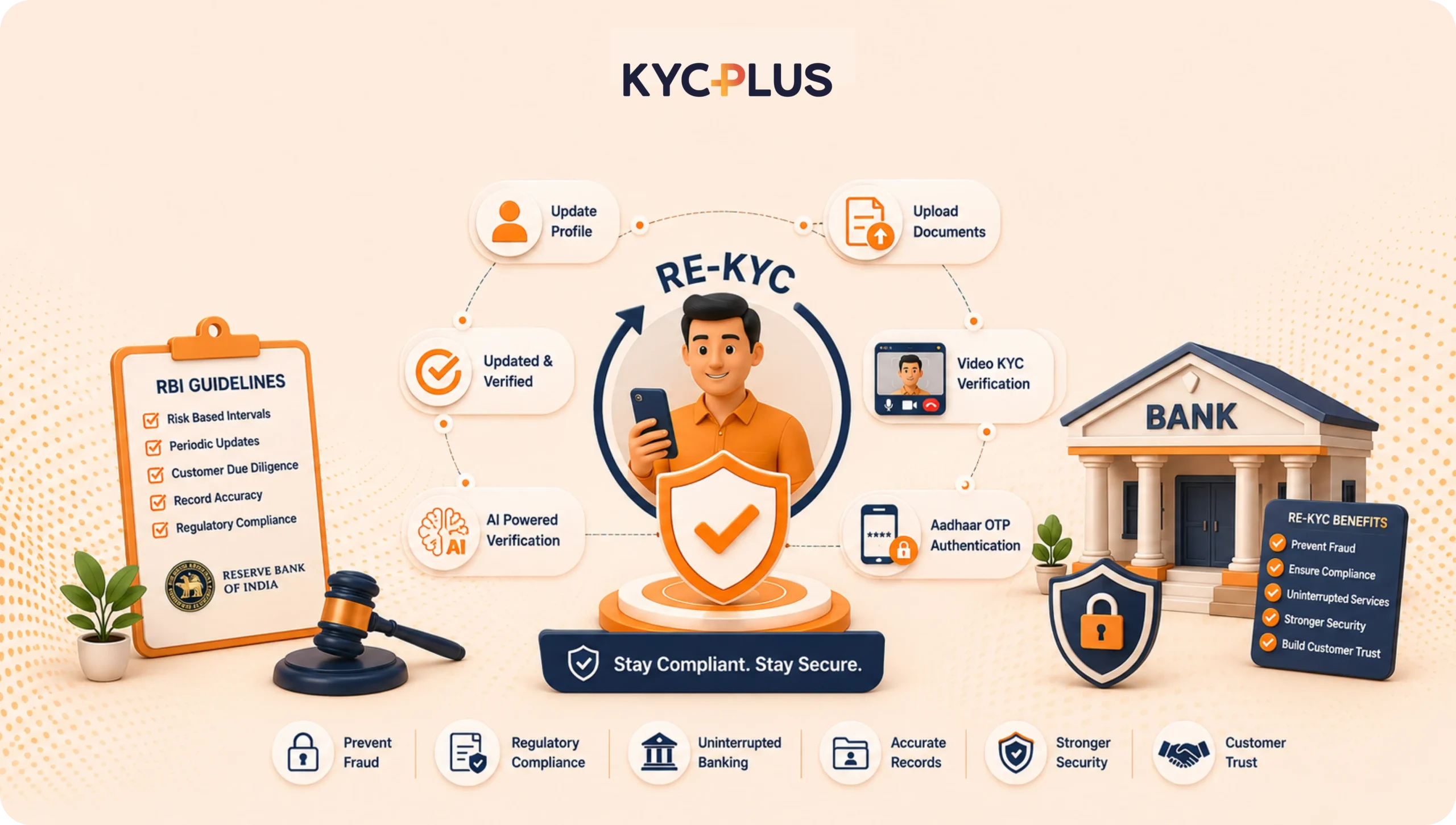
In India’s rapidly evolving financial ecosystem, Know Your Customer (KYC) norms have become the backbone of regulatory compliance. While initial KYC ensures that banks and Non-Banking Financial Companies (NBFCs) verify the identity of customers at the time of onboarding, the Reserve Bank of India (RBI) has mandated Re-KYC as a periodic update to strengthen due diligence, prevent financial crimes, and maintain accurate customer records. The RBI Re-KYC Compliance Requirements are not just a regulatory formality; they are a critical safeguard against money laundering, terrorist financing, and fraudulent activities. For banks and NBFCs, adhering to these requirements is essential to maintain operational integrity, customer trust, and regulatory approval.
The journey of KYC in India began in the early 2000s when RBI introduced guidelines to combat money laundering and protect the financial system. Over time, these norms have been strengthened in line with global standards set by the Financial Action Task Force (FATF).
The RBI Master Directions on KYC provide the framework for banks and NBFCs, mandating periodic updates based on customer risk profiles.
Re-KYC refers to the periodic updating of customer information to ensure that banks and NBFCs have the latest records. Unlike initial KYC, which is performed at onboarding, Re-KYC is a continuous compliance requirement.
The process may involve:
The RBI mandates that all banks and NBFCs must:
While the RBI Re-KYC Compliance Requirements provide a clear regulatory framework, the actual implementation across India’s diverse financial landscape is far from simple. Banks and NBFCs face multiple operational hurdles related to KYC verification that can slow down compliance and increase costs. Understanding these challenges is crucial for institutions aiming to build robust systems that satisfy RBI mandates while maintaining customer trust.
Volume of accounts: Cooperative banks, regional NBFCs, and large commercial banks often manage millions of accounts. Coordinating Re-KYC reminders and updates across such a vast customer base is a logistical challenge.
Communication barriers: Customers in rural and semi-urban areas may not respond to digital notifications, requiring physical outreach through branches or Business Correspondents (BCs).
Customer reluctance: Many customers perceive Re-KYC as unnecessary paperwork, leading to delays in submission.
Legacy systems: Several NBFCs still operate on outdated core banking solutions that lack seamless integration with Aadhaar e-KYC or video KYC platforms.
Data synchronization: Ensuring that updated customer records flow correctly across multiple systems (loan management, deposits, compliance reporting) is complex.
Cybersecurity risks: With increased digital Re-KYC, institutions must safeguard sensitive customer data against breaches.
Connectivity issues: Poor internet penetration in remote areas makes digital Re-KYC difficult.
Limited awareness: Customers may not fully understand why RBI Re-KYC Compliance Requirements are mandatory, leading to resistance.
Dependence on BCs: Business Correspondents play a vital role, but training and monitoring them for accuracy and fraud prevention is a challenge.
Knowledge gaps: Branch staff may not be fully updated on the latest RBI circulars and compliance requirements.
Operational workload: Re-KYC adds to the already heavy workload of frontline staff, impacting efficiency.
Monitoring compliance: Ensuring uniform adherence across thousands of branches and NBFC offices requires strong internal audit mechanisms.
Balancing act: Banks must comply with RBI mandates without alienating customers through repeated requests or account restrictions.
Digital literacy gap: While urban customers adapt quickly to e-KYC, rural customers often need handholding.
Trust factor: Customers may fear misuse of personal data, making them hesitant to share updated documents.
Operational costs: Outreach campaigns, staff training, and system upgrades add significant expenses.
Technology investments: Deploying AI-driven compliance solutions or upgrading to modern core banking systems requires capital.
Penalty risks: Non-compliance can lead to RBI fines, further straining financial institutions.
The financial sector in India is undergoing a rapid digital shift, and this transformation is reshaping how institutions meet RBI Re-KYC Compliance Requirements. Traditional paper-heavy processes are being replaced with a modern re-KYC solution powered by advanced technology that not only improves efficiency but also enhances the customer experience.
Instant verification: Aadhaar authentication allows banks and NBFCs to complete Re-KYC in seconds.
Reduced paperwork: Customers no longer need to submit physical documents repeatedly.
Scalability: Large-scale compliance becomes manageable when identity verification is automated.
Remote onboarding and updates: Customers can complete Re-KYC from home through secure video calls.
Regulatory approval: RBI has permitted video-based customer identification, making it a recognized compliance method.
Fraud prevention: Liveness detection and AI-driven checks reduce impersonation risks.
Risk profiling: AI models help categorize customers into low, medium, and high-risk segments for periodic Re-KYC.
Fraud detection: Machine learning algorithms flag suspicious patterns in customer updates.
Automation: Routine tasks like document verification and data entry are streamlined.
Centralized records: Cloud solutions ensure updated KYC data is accessible across branches and NBFC offices.
Audit readiness: Institutions can quickly generate compliance reports for RBI inspections.
Integration: APIs allow seamless connectivity with Aadhaar, PAN, and other government databases.
Mobile apps: Customers can upload documents, submit self-declarations, and track Re-KYC status.
Multilingual support: Apps and portals in regional languages improve accessibility.
Notifications: Automated SMS and email reminders ensure customers don’t miss deadlines.
Large private banks: Have adopted AI-driven Re-KYC systems, reducing compliance costs by up to 40%.
NBFCs in rural India: Use Business Correspondents equipped with mobile apps to collect Re-KYC data offline and sync later.
Fintech partnerships: Collaborations with RegTech firms like KYCPLUS enable faster, more secure compliance.
Meeting the RBI Re-KYC Compliance Requirements is not optional — it is a regulatory mandate with significant consequences for banks and NBFCs. Institutions that fail to comply face both financial and reputational risks, making risk management a critical part of the Re-KYC process.
Monetary fines: RBI can impose heavy penalties on banks and NBFCs that fail to update customer records within the stipulated timelines.
Operational restrictions: Non-compliant institutions may face restrictions on opening new accounts or offering certain services.
Inspection findings: During RBI audits, lapses in Re-KYC can lead to adverse inspection reports, impacting credibility.
Account freezing: If customers do not complete Re-KYC, banks are required to restrict transactions until compliance is achieved.
Customer dissatisfaction: Blocking accounts without proper communication can damage trust and lead to attrition.
Fraud exposure: Outdated records increase the risk of identity theft, money laundering, and terrorist financing.
Public trust erosion: Customers expect banks and NBFCs to safeguard their data and comply with RBI norms. Lapses can erode confidence.
Media scrutiny: Non-compliance often attracts negative press, especially when penalties are announced publicly.
Competitive disadvantage: Institutions with poor compliance frameworks may lose customers to more digitally advanced competitors.
Proactive communication: Regular reminders via SMS, email, and branch notices help customers complete Re-KYC on time.
Technology adoption: Leveraging Aadhaar e-KYC, video KYC, and AI-driven compliance tools reduces manual errors.
Internal audits: Periodic checks ensure branches and NBFC offices adhere to RBI Re-KYC Compliance Requirements uniformly.
Training programs: Staff must be continuously updated on RBI circulars and compliance procedures.
Suspicious transaction reporting: Institutions must report unusual activity to the Financial Intelligence Unit (FIU-IND).
Regulatory submissions: Updated KYC records must be readily available for RBI inspections.
Continuous monitoring: High-risk accounts require enhanced due diligence and closer scrutiny.

To successfully meet the RBI Re-KYC Compliance Requirements, banks and NBFCs must go beyond minimum regulatory adherence. Building a proactive, customer-centric, and technology-enabled compliance framework ensures not only regulatory safety but also operational efficiency and stronger customer trust.
Risk-based approach: Categorize customers into low, medium, and high-risk groups and schedule Re-KYC accordingly.
Clear policies: Document internal procedures aligned with RBI’s Master Directions.
Centralized monitoring: Use compliance dashboards to track Re-KYC progress across branches and NBFC offices.
Automation: Deploy AI-driven tools for document verification, fraud detection, and risk profiling.
Integration: Connect Re-KYC systems with Aadhaar, PAN, and government databases for seamless updates.
Scalability: Cloud-based platforms allow institutions to handle millions of Re-KYC requests efficiently.
Simplified messaging: Explain Re-KYC requirements in plain language to avoid confusion.
Multi-channel outreach: Use SMS, email, mobile apps, and branch notices to remind customers.
Regional language support: Ensure communication is accessible to rural and semi-urban customers.
Continuous updates: Train staff regularly on RBI circulars and compliance changes.
Fraud prevention: Educate employees on red flags in Re-KYC submissions.
Customer assistance: Equip staff to guide customers through digital Re-KYC processes.
Periodic reviews: Conduct audits to ensure branches are meeting RBI Re-KYC Compliance Requirements.
Gap analysis: Identify weak points in compliance and address them proactively.
Reporting culture: Encourage staff to report compliance lapses without fear of penalty.
Training programs: Ensure BCs understand compliance requirements and fraud prevention.
Digital tools: Provide mobile apps for offline data collection and later synchronization.
Monitoring mechanisms: Regularly audit BC activities to maintain accuracy.
The landscape of compliance is continuously evolving, and the RBI Re-KYC Compliance Requirements are expected to undergo further transformation in the coming years. With India’s push toward digital identity, financial inclusion, and global alignment with anti-money laundering standards, Re-KYC will become even more central to the functioning of banks and NBFCs.
Dynamic risk categorization: RBI may introduce real-time risk profiling based on transaction behavior rather than fixed timelines.
Stricter timelines: High-risk customers could face shorter Re-KYC cycles with enhanced due diligence.
Integration with PMLA updates: Re-KYC requirements will likely align more closely with evolving anti-money laundering laws.
Aadhaar evolution: Aadhaar-based e-KYC will continue to be the backbone of compliance, with stronger biometric safeguards.
DigiLocker integration: Customers may be able to share updated documents directly from DigiLocker for Re-KYC.
Unified digital ID: India’s push for a single digital identity could simplify Re-KYC across multiple financial institutions.
FATF standards: India will continue aligning Re-KYC norms with global anti-money laundering and counter-terrorist financing guidelines.
Cross-border compliance: NBFCs with international exposure may need to adopt stricter Re-KYC frameworks.
AI-driven monitoring: Global banks are already using predictive analytics for compliance; Indian institutions are expected to follow suit.
Frictionless compliance: Re-KYC will become a seamless process integrated into everyday banking apps.
Personalized reminders: AI will tailor communication based on customer behavior and preferences.
Trust-building: Transparent data handling will strengthen customer confidence in compliance processes.
Partnerships: Banks and NBFCs will increasingly collaborate with fintechs like KYCPLUS to automate compliance.
Innovation: Video KYC, AI verification, and blockchain-based identity solutions will redefine Re-KYC.
Scalability: Technology will allow institutions to handle millions of Re-KYC updates without operational bottlenecks.
The RBI Re-KYC Compliance Requirements are not just shaping internal processes within banks and NBFCs — they are transforming the entire financial services industry in India. By enforcing stricter due diligence and periodic updates, RBI is pushing institutions toward greater transparency, accountability, and digital adoption.
AML/CFT compliance: Re-KYC ensures alignment with global anti-money laundering and counter-terrorist financing standards.
Reduced fraud: Updated customer records minimize risks of impersonation, identity theft, and unauthorized transactions.
Trust in institutions: Customers feel more secure knowing their banks are compliant with RBI mandates.
Fintech collaboration: Banks and NBFCs are partnering with RegTech firms like KYCPLUS to automate compliance.
New service models: Video KYC and mobile-based Re-KYC are becoming standard offerings.
Scalable solutions: Cloud-based compliance platforms allow institutions to handle millions of updates simultaneously.
Convenience: Digital Re-KYC reduces the need for branch visits.
Transparency: Customers receive clear communication about why updates are required.
Inclusivity: Regional language support and BC outreach ensure rural customers are not left behind.
Early adopters: Institutions that embrace digital Re-KYC gain a reputation for efficiency and reliability.
Market differentiation: Compliance excellence becomes a selling point in customer acquisition.
Operational savings: Automation reduces manual workload and compliance costs.
To wrap up, here are the essential points about the RBI Re-KYC Compliance Requirements:
The RBI Re-KYC Compliance Requirements have emerged as one of the most significant regulatory mandates shaping the future of India’s banking and NBFC sector. By enforcing periodic updates of customer information, RBI is ensuring that financial institutions remain vigilant against fraud, money laundering, and terrorist financing, while also strengthening customer trust in the system.
For banks and NBFCs, compliance is not just about avoiding penalties — it is about building a culture of transparency, accountability, and digital readiness. Institutions that adopt best practices such as risk-based categorization, proactive communication, staff training, and RegTech partnerships will find themselves better positioned to meet regulatory expectations and deliver superior customer experiences.
Digital transformation is the key enabler here. Aadhaar-based e-KYC, video KYC, AI-driven verification, and cloud-based compliance platforms are redefining how Re-KYC is executed. These innovations make compliance faster, more secure, and scalable, turning what was once a burden into a strategic advantage.
Ultimately, the RBI Re-KYC Compliance Requirements are not just a regulatory checklist — they are a framework for safeguarding financial integrity and preparing institutions for the digital future. Banks and NBFCs that embrace this transformation will not only meet RBI mandates but also strengthen their competitive edge in India’s dynamic financial ecosystem.
Ans: The RBI Re-KYC Compliance Requirements were introduced to ensure that customer records remain accurate and up to date. This helps prevent fraud, money laundering, and misuse of outdated information in the financial system.
Ans: All customers of banks and NBFCs — individuals, companies, and other entities — must comply. The frequency depends on the customer’s risk profile:
Ans: Customers may need to submit updated identity and address proof. Aadhaar, PAN, passport, voter ID, or driving license are commonly accepted. For low-risk customers, a self-declaration may suffice under RBI guidelines.
Ans: Yes. The RBI Re-KYC Compliance Requirements allow multiple digital modes:
Ans: Banks and NBFCs are required to restrict account operations until compliance is achieved. Customers may face blocked transactions, delays in loan disbursement, or inability to open new accounts.
Ans: No. Aadhaar is the fastest method, but customers can use other valid documents. RBI permits flexibility to ensure inclusivity.
Ans: RBI conducts periodic audits of banks and NBFCs. Institutions must maintain updated records, demonstrate adherence to timelines, and show evidence of customer communication efforts.
Ans: Yes. The RBI Re-KYC Compliance Requirements apply equally to NBFCs, cooperative banks, and other regulated entities.
Ans: Yes. If there are no other changes, customers can submit a self-declaration or updated address proof. RBI allows simplified Re-KYC for such cases.
Ans: Ensures account safety and fraud prevention
