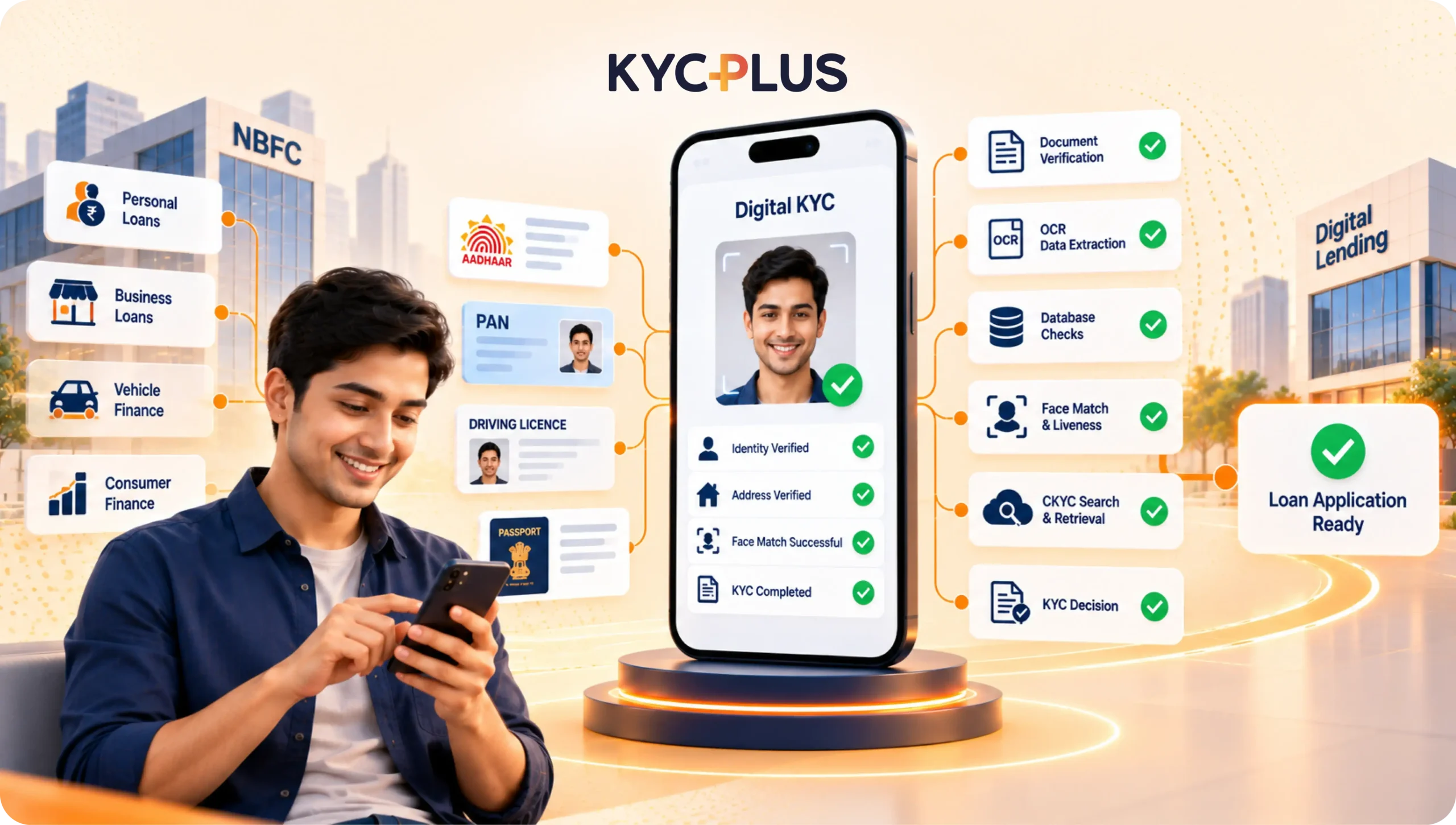
The financial services industry is rapidly moving towards digital customer acquisition, online loan applications, and technology-driven lending operations. Non-Banking Financial Companies (NBFCs), fintech businesses, and digital lending platforms are increasingly using digital channels to reach customers, process applications, and deliver financial services. In this evolving landscape, KYC for NBFCS and digital lending plays a crucial role in customer identification, document verification, fraud prevention, and regulatory compliance. While digital lending makes financial services more accessible, it also increases the need for secure and reliable verification processes.
Know Your Customer (KYC) is a fundamental part of this process. It helps financial institutions establish a customer’s identity, verify relevant information, and maintain appropriate records before providing financial services.
Traditionally, KYC procedures often involved physical documents, manual data entry, branch visits, and repeated verification. These activities can create delays, especially for NBFCs that process large numbers of applications through mobile applications, websites, field teams, and business partners.
This is where KYC for NBFCs & digital lending becomes an important technology and operational consideration. Digital KYC solutions can help institutions collect customer information, process documents, perform supported verification checks, manage exceptions, and maintain records through structured workflows.
However, digital KYC is not simply about replacing paper forms with online forms. Financial institutions must consider applicable regulatory requirements, customer consent, information security, identity fraud, data accuracy, and the appropriate use of technology.
This guide explains how KYC works in NBFCs and digital lending, the role of automation, essential software features, implementation considerations, and how financial institutions can select a suitable digital KYC solution.
Know Your Customer, commonly known as KYC, refers to the process through which a financial institution identifies and verifies a customer according to applicable requirements. For NBFCs, KYC is important when establishing customer relationships, processing loan applications, and maintaining relevant customer records.
Digital lending introduces technology into this process. Customers may submit applications through a website or mobile application, upload documents electronically, and complete supported verification steps without visiting a branch.
KYC for NBFCs and Digital Lending combines customer identification requirements with digital processes that help collect, verify, manage, and protect customer information.
Depending on the product and applicable requirements, a KYC workflow may involve:
The specific steps depend on the institution’s regulatory category, customer type, financial product, and approved process.
Digital lending platforms may receive applications from customers across different locations and channels. Unlike a traditional branch-based process, customer interactions may take place remotely.
This makes it important to establish reliable processes for identifying customers and detecting inconsistencies.
A structured KYC process can help institutions:
KYC does not eliminate every type of fraud or credit risk. It should operate alongside other relevant controls, including credit assessment, fraud monitoring, and customer due diligence.
NBFCs operate across multiple financial products, including personal loans, business loans, vehicle finance, consumer finance, equipment finance, and other lending services. Each product may have different customer onboarding requirements and document needs. As application volumes grow, manual KYC processes can become difficult to manage. KYC for NBFCS and digital lending helps NBFCs establish consistent customer verification workflows, streamline document processing, and reduce repetitive administrative activities through digital KYC Software for Banks.
Traditional onboarding may require customers to submit physical documents or provide the same information at different stages.
Digital KYC allows customers to submit information electronically through supported channels. The software can guide users through required fields, identify missing documents, and move applications through predefined workflow stages.
This can help reduce avoidable delays, although the actual processing time depends on document quality, verification requirements, external services, and the institution’s approval process.
Employees may need to enter customer details into several applications during loan processing.
Repeated data entry increases administrative effort and creates opportunities for typographical errors.
Optical Character Recognition (OCR) can extract information from supported documents and populate relevant fields. Employees can then review the information and correct any inaccuracies.
Integration with existing systems can also reduce repeated entry of approved customer information.
Digital lending allows customers to apply for financial products without necessarily visiting a physical branch.
A well-designed KYC process can support remote document submission and permitted digital verification methods.
Institutions must ensure that the chosen process meets the applicable requirements for customer identification and authentication. Remote onboarding should not be treated as permission to bypass mandatory checks.
NBFCs may receive applications through mobile applications, websites, field officers, dealers, agents, or lending partners.
When each channel follows a different process, the quality of customer information can become inconsistent.
A centralized KYC platform can help standardize document requirements, validation rules, task assignments, and reporting across supported channels.
Managers need to understand where applications are delayed and why cases remain incomplete.
A digital KYC dashboard can display application status, pending documents, verification results, and cases requiring additional review.
This visibility can help teams allocate resources more effectively and identify recurring operational problems.
Digital KYC is a sequence of activities rather than a single verification action. The workflow should be designed around the institution’s requirements and the financial product being offered.
The customer starts a loan application through an authorized digital or assisted channel.
The platform captures the information needed to initiate the application and determine which onboarding workflow applies.
The customer provides the required personal details and supporting documents.
Depending on the product, the institution may need identity information, address details, photographs, contact information, or other documents.
The system can identify missing mandatory fields and guide the customer through the next step.
The customer uploads the required documents through the supported interface.
The platform may perform file validation, image-quality checks, document classification, and OCR-based extraction.
If a document is unreadable or incomplete, the workflow can request another upload or route the case for manual review.
The institution performs the relevant identity verification checks using permitted methods and authorized services.
Depending on the applicable process, this may involve document verification, approved digital identity methods, or other supported checks.
The platform should clearly distinguish between extracting information from a document and independently verifying that information.
The institution reviews the available information and identifies inconsistencies that need resolution.
Where applicable and authorized, the process may also include CKYC search and retrieval.
An existing CKYC record does not automatically satisfy every verification requirement. Additional information or checks may still be necessary.
Applications with missing documents, mismatched details, or uncertain verification results should be directed to the appropriate reviewer.
The system should record the issue and provide a clear next action.
Once the required KYC stages are completed, the relevant customer information and workflow status may be transferred to connected lending systems.
This can include a Loan Origination System (LOS) or Loan Management System (LMS), depending on the institution’s architecture.
KYC completion does not automatically mean that a loan should be approved. Credit assessment, underwriting, and other applicable decisions remain separate.
The institution maintains the relevant records according to its policies and applicable requirements.
Access controls, audit trails, and appropriate retention practices help protect customer information and support operational oversight.
When selecting a solution, institutions should focus on capabilities that address their actual operational challenges.
Digital onboarding allows customers to provide information and supporting documents through an online process.
Useful features may include form validation, document checklists, application tracking, notifications, and task assignment.
The onboarding process should be easy to understand while still collecting the information required for the relevant financial product.
OCR technology converts text in supported documents into machine-readable data.
It can help extract names, dates, document numbers, and addresses, reducing the need for employees to enter every field manually.
A good workflow should support review and correction of extracted information. OCR accuracy can vary according to image quality, language, document type, and layout.
Depending on the institution’s approved process, the software may integrate with authorized identity verification services.
The platform should explain which verification methods are supported and what permissions or dependencies are required.
Institutions should avoid assuming that a document has been authenticated merely because its text has been successfully extracted.
Where applicable and authorized, CKYC workflows can help institutions search for and retrieve available customer records.
This may reduce unnecessary repetition when an appropriate record already exists.
Institutions should verify the precise CKYC functions supported by the platform, including search, retrieval, record preparation, and relevant status tracking.
A Document Management System (DMS) helps organize customer documents and related records.
Useful capabilities include secure storage, document classification, searchable metadata, access permissions, and controlled retrieval.
The institution should define how records are retained, archived, corrected, and deleted according to applicable requirements.
Workflow automation helps applications move through predefined processing stages.
For example, an application may move from document collection to verification, review, and the next authorized stage.
The system should also handle exceptions. Applications with missing information or unresolved discrepancies should not be marked complete automatically.
Some digital identity workflows use face comparison and liveness detection as part of an authorized verification process.
Face matching compares facial images, while liveness detection aims to assess whether the interaction involves a live person rather than a static image or certain presentation attacks.
These technologies have limitations and should be evaluated for accuracy, security, accessibility, and suitability for the intended use. They should not be treated as proof of identity on their own.
Customer information may need to be reviewed or updated during an ongoing relationship.
A Re-KYC module can help institutions manage review tasks, collect updated information, track incomplete cases, and maintain relevant records.
The workflow and review schedule should follow the requirements applicable to the institution and customer.
Audit trails help record relevant user activities, timestamps, approvals, and workflow changes.
Operational reports can show application volumes, pending cases, common errors, processing time, and workloads across teams.
These capabilities can improve oversight when they are configured correctly and access is appropriately controlled.
Integration allows the KYC platform to exchange approved information with existing applications.
KYC for NBFCs and Digital Lending may need connections with LOS, LMS, CRM, document repositories, and customer-facing applications.
Institutions should assess authentication, encryption, error handling, retry mechanisms, monitoring, and data reconciliation.
Fraud prevention is an important consideration for digital lending because customer interactions may occur remotely and through multiple acquisition channels.
KYC helps establish customer identity, but it should not be considered a complete fraud prevention system.
A comprehensive approach combines identity verification with appropriate fraud controls, credit assessment, transaction monitoring, and internal review.
A digital KYC workflow can flag differences between customer-entered information and data extracted from supporting documents.
For example, a mismatch between a name or address field may require clarification before the application proceeds.
Not every mismatch indicates fraud. It may result from a spelling variation, outdated information, or a data-entry mistake. The system should provide a suitable review process.
Where supported, software can help identify potentially duplicate applications using approved matching rules.
Duplicate detection may help employees investigate repeated submissions or unusual patterns.
However, matching results should be assessed carefully because different customers can share similar names or other attributes.
Automated checks can identify blurred images, missing pages, unsupported file formats, or incomplete uploads.
These checks can reduce avoidable rework and help employees focus on more complex cases.
Document quality checks alone do not establish that a document is genuine.
Applications with unusual patterns or uncertain results may require additional investigation.
A well-designed system should make these cases visible, record the reasons for escalation, and allow authorized employees to document the outcome.
Fraud controls should be proportionate and should avoid treating automated alerts as conclusive evidence.
NBFCs commonly use several applications to manage customer acquisition and lending operations.
A digital KYC platform should be evaluated for how effectively it connects with these systems.
A Loan Origination System manages activities associated with receiving, assessing, and processing loan applications.
KYC integration can help provide relevant customer information and verification status within the loan application workflow.
This may reduce duplicate data entry and improve visibility into pending KYC activities.
A Loan Management System generally supports post-origination loan administration and related servicing activities.
Depending on the business process, relevant customer information or KYC status may need to be available to the LMS.
The institution should define which information is transferred and which application remains the source of truth for each field.
A Customer Relationship Management platform helps manage customer interactions, leads, and communication.
Integration can support coordination between customer acquisition teams and onboarding operations without unnecessarily duplicating sensitive information.
A successful integration must do more than transfer data.
It should handle failed requests, prevent unintended duplication, protect information in transit, and provide monitoring when connected systems become unavailable.
Institutions should test successful and unsuccessful scenarios before production deployment.
Financial institutions must ensure that their KYC processes follow the requirements applicable to their regulatory category and business activities.
Digital technology can support these processes, but it does not automatically establish compliance.
NBFCs should assess applicable KYC directions, customer due diligence requirements, record-maintenance obligations, and any other rules relevant to their operations.
The institution should confirm that the configured workflow meets the requirements for its products and customer categories.
KYC records can contain sensitive personal information.
Institutions should understand where information is stored, how it is transmitted, which users can access it, and how it is protected.
Important safeguards may include encryption, role-based access, monitoring, secure backups, and incident response procedures.
Where consent is required for a particular data collection or verification activity, the institution should implement an appropriate process.
Customers should receive clear information about the relevant activity and the use of their information.
Employees should have access only to the customer information and system functions required for their responsibilities.
Privileged access should receive additional scrutiny, and permissions should be reviewed when employees change roles or leave the organization.
Relevant activities should be traceable according to the institution’s policies and applicable obligations.
Retention and deletion procedures should be clearly defined. Records should not be kept indefinitely without an appropriate basis.
Digital document collection, OCR, and workflow automation can reduce certain administrative steps.
Actual processing improvements depend on document quality, external verification services, and the number of exceptions.
Automation can reduce repetitive data entry and manual status tracking.
Employees can focus on cases that require additional review or clarification.
A clear onboarding process can help customers understand which information is required and what action comes next.
Status updates can reduce uncertainty during the application process.
Standardized workflows can help teams follow common procedures across different branches, products, and acquisition channels.
Structured digital records can make authorized retrieval easier and reduce dependence on physical files
Dashboards and reports can help management identify pending cases, recurring errors, and process bottlenecks.
A scalable platform can help an NBFC manage growing application volumes without relying entirely on additional manual processing.
Institutions should validate these benefits through measurable operational data.
Selecting a KYC platform requires a clear understanding of current challenges and future requirements.
Document the existing onboarding process and identify where delays or errors occur.
Determine whether the primary requirement is digital onboarding, document processing, identity verification, CKYC support, Re-KYC solution, or integration with lending systems.
Ask the vendor to demonstrate the required features using realistic application scenarios.
Confirm which functions are included and which require external services, separate authorization, or additional development.
Review access controls, encryption, audit trails, data retention, backup arrangements, and incident response.
Request evidence of implemented safeguards instead of relying only on general claims.
Confirm compatibility with existing LOS, LMS, CRM, and other applications.
Discuss API documentation, authentication, error handling, monitoring, and implementation responsibilities.
The platform should support expected workloads and peak application volumes.
Ask how the system performs with multiple users, large document uploads, and temporary service interruptions.
The total cost may include software licensing, configuration, integration, infrastructure, training, support, and future upgrades.
Compare total ownership costs rather than focusing only on the initial quotation.
Understand the vendor’s support hours, escalation procedures, maintenance policy, and approach to resolving integration issues.
A reliable support arrangement is important when KYC workflows are part of a critical lending process.
Customers may provide incomplete information or documents that do not meet the required standards.
Mandatory-field checks and clear document instructions can help reduce incomplete applications.
Low-resolution images and unreadable documents can affect OCR and verification workflows.
The platform should flag quality issues and provide a process for obtaining corrected documents.
Data exchange can fail because of connectivity issues, authentication errors, or incompatible formats.
Monitoring, logging, and reconciliation help institutions identify and resolve these problems.
Employees need to understand the workflow, verification responsibilities, access restrictions, and exception-handling process.
Practical training can improve adoption and reduce avoidable errors.
Automating every step without suitable controls can allow incomplete or uncertain cases to proceed incorrectly.
Institutions should define where human review is required and ensure that exception handling is effective.
KYC may involve business teams, operations, compliance, IT, and external service providers.
Clear ownership helps ensure that pending cases and technical issues are resolved promptly.
NBFCs should evaluate digital KYC using measurable operational outcomes rather than relying on general claims about automation.
Useful indicators include:
For example, an NBFC processing 8,000 applications per month may save significant employee time if automation reduces repetitive processing by a few minutes per application.
However, the actual savings depend on the proportion of tasks automated, the quality of submitted information, exception rates, and the implementation cost.
Institutions should establish baseline measurements before deployment and compare them with post-implementation results.
A phased pilot can help validate the business case before the solution is introduced across all products and channels.
NBFCs evaluating digital KYC solutions may consider platforms that combine customer onboarding, document processing, verification workflows, and system integration.
KYCPLUS, a digital KYC solution from Azlogics, can be evaluated by institutions seeking to organize KYC-related operations within a structured digital environment.
Depending on the selected modules and configuration, relevant capabilities may include document collection, OCR-based data extraction, document management, workflow automation, verification integrations, dashboards, and connections with existing financial applications.
Institutions should confirm the specific capabilities required for their business, including any CKYC-related operations, during a product demonstration.
An NBFC may already use an LOS for loan applications and an LMS for loan administration.
A digital KYC platform can complement these systems by supporting customer information collection, document processing, and verification workflows.
This approach can help reduce fragmented processes without requiring the institution to replace every existing application.
The institution should define how information moves between systems and how failures, corrections, and exceptions are handled.
Before choosing KYCPLUS or another provider, ask:
A practical demonstration helps determine whether the platform addresses the institution’s specific operational needs.
Advances in OCR and document intelligence can improve information extraction and document classification.
Institutions will still need to validate uncertain results and maintain appropriate review procedures.
Digital platforms may automate more routine onboarding activities, including document collection, validation, task assignment, and status notifications.
Human oversight remains important for unusual cases and decisions requiring judgment.
Connected onboarding, lending, and customer service applications can reduce repeated data entry and improve operational visibility.
Reliable authentication, monitoring, and data governance remain essential.
Institutions may use configured rules and analytics to identify applications that require additional attention.
Automated alerts should support investigation rather than being treated as conclusive proof of fraud.
As digital lending expands, institutions will need clear policies for customer data access, retention, security, and third-party services.
These controls should be considered during product selection and implementation.
KYC is an essential part of responsible lending operations. For NBFCs and digital lending businesses, the challenge is to verify customer information efficiently while maintaining appropriate controls over data accuracy, fraud risk, privacy, and compliance.
KYC for NBFCs and Digital Lending combines established customer identification requirements with digital tools that can streamline document collection, data extraction, verification workflows, record management, and system integration.
A suitable digital KYC platform can reduce repetitive administrative work, improve operational visibility, and provide a more structured onboarding experience. However, the results depend on the institution’s requirements, software capabilities, integration quality, and implementation practices.
Before choosing a solution, NBFCs should assess their current workflows, verify the actual features available, review security controls, evaluate integration requirements, and calculate the total cost of ownership.
A phased implementation supported by employee training and measurable performance indicators can help establish whether the solution delivers the expected operational benefits.
NBFCs can evaluate KYCPLUS as a digital KYC platform that complements their existing lending systems. They should validate the relevant modules and integrations to ensure they meet their specific requirements.
Ultimately, effective digital KYC requires more than technology. It depends on appropriate verification processes, trained employees, secure systems, clear responsibilities, and continuous monitoring.
Ans: KYC for NBFCs and Digital Lending is the process of identifying and verifying customers using suitable physical or digital methods while maintaining the records required for financial services.
Ans: Digital KYC can help NBFCs organize customer onboarding, reduce repetitive data entry, improve document processing, and monitor verification workflows.
Ans: Requirements depend on the financial product, customer category, and applicable rules. Institutions may need identity information, address details, photographs, and other supporting documents.
Ans: Digital KYC may be completed through permitted online methods when the institution’s process and the customer’s circumstances meet the applicable requirements. Not every verification method is suitable for every case.
Ans: OCR extracts machine-readable information from supported documents, reducing manual data entry. Extracted information may still require validation and human review.
Ans: Many platforms support integration through APIs or other technical methods. The institution should confirm compatibility, data flow, security, and error-handling arrangements.
Ans: No. Digital KYC can support identity verification and help identify inconsistencies, but it should operate alongside other fraud controls, credit assessment, and monitoring processes.
Ans: KYC refers broadly to customer identification and verification processes. CKYC refers to the centralized framework for maintaining and accessing customer KYC records through the Central KYC Records Registry, subject to applicable requirements.
Ans: Pricing depends on features, application volumes, integrations, licensing, implementation, infrastructure, and support. Institutions should compare the total cost of ownership.
Ans: An NBFC should identify its process gaps, verify the software’s capabilities, assess security and integrations, compare total costs, and conduct a practical demonstration or pilot before implementation.
