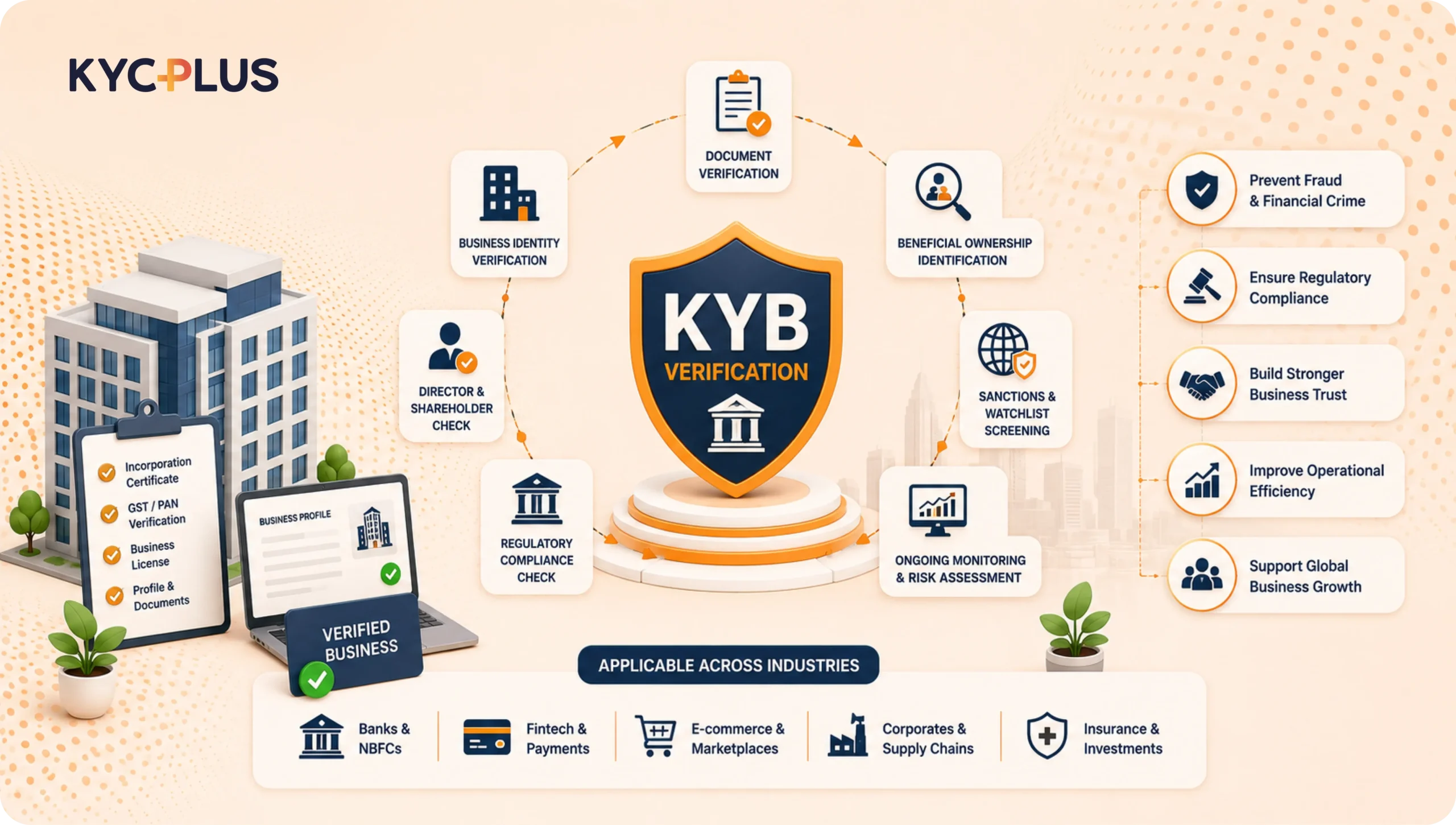
In today’s interconnected business environment, organizations are expected to conduct thorough due diligence before entering into relationships with vendors, suppliers, distributors, corporate clients, merchants, and business partners. Regulatory authorities across the globe have increased scrutiny on business transactions to combat financial crimes such as money laundering, terrorist financing, fraud, tax evasion, corruption, and sanctions violations. As a result, KYB Verification for NBFCs (Know Your Business Verification) has emerged as a critical compliance requirement for organizations operating in regulated industries. Whether it is a bank onboarding a corporate customer, a fintech company verifying a merchant, an insurance provider establishing a partnership, or a B2B marketplace validating sellers, KYB Verification for NBFCs helps ensure that businesses are dealing with legitimate and compliant entities.
At its core, KYB Verification for NBFCs is the process of identifying, verifying, and assessing the legitimacy of a business entity before establishing a commercial relationship. It involves verifying company registration details, ownership structures, directors, beneficial owners, licenses, tax registrations, and regulatory standing.
Without proper verification, organizations expose themselves to significant risks. Fraudulent entities often hide behind complex ownership structures, shell companies, and offshore registrations. These businesses may be involved in money laundering schemes, financial fraud, sanctions evasion, or other illegal activities.
KYB Verification for NBFCs helps organizations identify these risks early and make informed decisions.
Know Your Business Verification is often considered the corporate equivalent of Know Your Customer (KYC). While KYC focuses on verifying individuals, KYB focuses on verifying business entities.
A comprehensive KYB process typically involves:
These checks provide organizations with a complete understanding of a company’s legitimacy, ownership, and risk profile.
Several factors have contributed to the increasing importance of KYB Verification for NBFCs.
Businesses today can establish partnerships and onboard customers without ever meeting face-to-face.
While digital onboarding improves convenience and scalability, it also creates opportunities for bad actors to exploit weak verification processes.
Fraudsters can create fake businesses, manipulate ownership records, and submit forged documents to gain access to financial services and commercial networks.
KYB Verification for NBFCs acts as the first line of defense against such threats.
Governments and regulators worldwide have strengthened compliance requirements.
Organizations are now expected to:
Failure to comply can result in severe penalties.
Modern corporate structures often span multiple countries and involve layers of ownership.
A company may be owned by another company, which is owned by another company, ultimately controlled by an individual located in a different jurisdiction.
KYB Verification for NBFCs helps organizations uncover these structures and identify the individuals who ultimately control the business.
Financial criminals frequently use businesses as vehicles for illegal activities.
Common examples include:
Effective KYB Verification for NBFCs helps organizations identify these risks before onboarding a business.
Many people confuse KYB and KYC because both are compliance processes.
However, they serve different purposes.
Know Your Customer focuses on verifying individuals.
Typical KYC checks include:
Typical KYB checks include:
Most regulated institutions require both KYC and KYB.
For example, when a bank opens a corporate account, it verifies both the company and the individuals who control it.
The demand for Online KYB Verification Solution has grown significantly due to international compliance frameworks.
Major regulatory initiatives include:
FATF has emphasized transparency in corporate ownership structures.
Its recommendations encourage organizations to identify beneficial owners and prevent the misuse of legal entities.
European AML directives require organizations to perform extensive business verification and beneficial ownership checks.
In the United States, financial institutions must comply with Customer Due Diligence (CDD) rules that include beneficial ownership verification.
In India, financial institutions must comply with stringent KYC and AML guidelines, making robust business verification increasingly important.
Organizations implementing strong KYB processes gain several advantages.
Verifying business entities reduces the likelihood of onboarding fraudulent companies.
Organizations remain aligned with regulatory requirements.
Automation significantly reduces onboarding time.
Businesses can identify high-risk entities before establishing relationships.
Strong compliance frameworks improve trust among customers, partners, investors, and regulators.
The concept of business verification has existed for decades. However, the methods, technologies, and regulatory expectations surrounding Online KYB Verification Solution have changed dramatically.
Understanding this evolution helps organizations appreciate why modern KYB solution are essential.
Before digital transformation, business verification was largely manual.
Organizations relied on:
Compliance teams would review:
The process often took weeks.
While suitable for low onboarding volumes, manual verification became increasingly difficult as businesses expanded globally.
The growth of international financial crime led regulators to strengthen compliance requirements.
Governments recognized that criminals frequently used businesses to conceal illicit activities.
This prompted stricter verification requirements involving:
Business verification evolved from simple registration checks into comprehensive risk assessments.
Global business expansion introduced new risks.
Organizations began dealing with:
Traditional verification methods struggled to keep pace.
Challenges included:
KYB Verification for NBFCs became increasingly complex.
Regulatory Technology (RegTech) transformed compliance operations.
RegTech companies developed platforms capable of automating:
This dramatically improved efficiency.
Organizations could verify businesses in hours rather than weeks.
Modern KYB solutions now leverage:
AI helps analyze documents, identify inconsistencies, and detect fraud.
Machine learning improves risk assessment accuracy through continuous learning.
Optical Character Recognition extracts data from business documents automatically.
APIs enable access to:
Tax databases
Sanctions lists
Cloud-based platforms provide scalability and accessibility.
India has witnessed significant growth in digital compliance adoption.
Several factors have contributed:
Organizations increasingly seek automated solutions to streamline compliance.
Platforms such as KYCPLUS support digital onboarding, document verification, risk assessment, and compliance workflows, helping institutions improve operational efficiency while maintaining regulatory compliance.
Banks must verify corporate customers before account opening.
Fintech companies must verify merchants, partners, and business customers.
Insurance providers conduct business verification for brokers, agents, and corporate policyholders.
Trade finance institutions verify importers, exporters, and intermediaries.
Crypto platforms rely heavily on KYB Verification for NBFCs to meet AML obligations.
A successful Online KYB Verification Solution program consists of multiple interconnected components.
Each component helps organizations build a complete picture of a business entity and its associated risks.
The first step is verifying that the company legally exists.
Checks typically include:
This establishes the company’s legitimacy.
Organizations validate official registration records.
Documents may include:
Verification confirms that the business is active and authorized to operate.
Directors play a critical role in corporate governance.
Organizations verify:
This helps identify potential risks associated with management.
One of the most important elements of Online KYB Verification Solution is identifying who ultimately owns and controls the business.
This process prevents criminals from hiding behind complex ownership structures.
UBOs are individuals who ultimately own or control a company.
Identifying UBOs helps organizations:
KYB Verification for NBFCs is not merely a best practice—it is increasingly becoming a regulatory requirement across multiple jurisdictions. Governments, financial regulators, and international organizations have strengthened compliance standards to improve transparency, prevent financial crimes, and ensure accountability in business relationships.
Organizations that fail to conduct adequate Online KYB Verification Solution may face substantial penalties, regulatory scrutiny, operational restrictions, and reputational damage.
Understanding the major regulatory frameworks behind KYB Verification for NBFCs helps businesses appreciate why robust compliance programs are essential.
The Financial Action Task Force (FATF) is the world’s leading anti-money laundering and counter-terrorist financing watchdog.
Established in 1989, FATF develops international standards designed to prevent:
One of FATF’s major concerns is the misuse of legal entities by criminals.
Criminal organizations often establish shell companies to:
To address these risks, FATF requires businesses and financial institutions to identify and verify beneficial ownership information.
Key FATF principles relevant to KYB Verification for NBFCs include:
Modern KYB Verification for NBFCs programs are largely built around these FATF recommendations.
The European Union has introduced multiple Anti-Money Laundering Directives to strengthen financial transparency.
These directives require regulated organizations to:
Recent AMLD updates have expanded requirements surrounding beneficial ownership registers.
Businesses operating within the EU must ensure that Online KYB Verification Solution processes are capable of identifying ownership structures and uncovering Ultimate Beneficial Owners (UBOs).
Failure to comply can result in significant penalties and enforcement actions.
The Financial Crimes Enforcement Network (FinCEN) plays a central role in enforcing anti-money laundering regulations in the United States.
FinCEN’s Customer Due Diligence Rule requires financial institutions to:
Organizations must collect information regarding individuals who own or control legal entities.
The introduction of the Corporate Transparency Act further strengthened ownership transparency requirements.
These regulations highlight the growing importance of effective KYB Verification for NBFCs programs.
The United Kingdom has implemented stringent anti-money laundering regulations through:
Businesses are expected to:
UK regulators place significant emphasis on risk-based due diligence.
Organizations dealing with high-risk customers must perform Enhanced Due Diligence procedures.
Singapore is widely recognized for its strong financial regulatory framework.
The Monetary Authority of Singapore (MAS) requires regulated institutions to:
Given Singapore’s role as a major financial hub, KYB Verification for NBFCs is considered essential for maintaining trust and transparency.
The United Arab Emirates has significantly strengthened compliance requirements in recent years.
Organizations operating in the UAE must comply with regulations relating to:
These measures aim to improve international confidence in the region’s financial ecosystem.
India’s financial sector has undergone substantial transformation.
Several regulators influence KYB-related requirements.
The RBI issues comprehensive KYC and AML guidelines for:
Organizations are expected to perform appropriate due diligence on corporate customers.
SEBI requires regulated entities to:
Corporate onboarding increasingly involves KYB-related procedures.
The PMLA establishes India’s anti-money laundering framework.
Businesses subject to AML obligations must implement adequate due diligence measures.
MCA databases provide valuable information used during KYB Verification for NBFCs, including:
These records play an important role in verifying business legitimacy.
As businesses expand internationally, they must comply with multiple regulatory frameworks simultaneously.
A company operating across India, Europe, Singapore, and the United States may need to satisfy requirements from:
Automated KYB solutions help organizations manage these complex obligations efficiently.
Platforms such as KYCPLUS support digital verification workflows, document management, risk assessment, and compliance automation, helping organizations streamline KYB processes while maintaining regulatory readiness.
Many organizations initially view KYB Verification for NBFCs as a regulatory obligation.
However, effective KYB Verification for NBFCs delivers significant strategic and operational benefits beyond compliance.
Money laundering remains one of the largest threats facing global financial systems.
Criminals often create seemingly legitimate businesses to:
Without proper verification, organizations may unknowingly engage with these entities.
KYB Verification for NBFCs helps identify suspicious ownership structures and high-risk businesses before relationships are established.
Business fraud can take many forms:
Comprehensive KYB Verification for NBFCs enables organizations to validate the legitimacy of counterparties and reduce exposure to fraudulent activities.
Not every business presents the same level of risk.
KYB Verification for NBFCs helps classify entities based on factors such as:
Organizations can then apply risk-based due diligence measures accordingly.
Reputation is one of a company’s most valuable assets.
A single relationship with a fraudulent or sanctioned entity can severely damage public trust.
KYB Verification for NBFCs acts as a safeguard against these risks.
Compliance failures can lead to:
Organizations that implement strong KYB Verification for NBFCs processes are better positioned to satisfy regulatory expectations.
Business relationships are built on trust.
Organizations increasingly expect their partners, vendors, suppliers, and customers to demonstrate transparency.
KYB Verification for NBFCs helps establish confidence by confirming:
This trust strengthens long-term partnerships.
Expanding into new markets introduces unfamiliar risks.
Organizations may encounter:
KYB Verification for NBFCs helps reduce uncertainty and supports safer international growth.
Accurate business information enables better decisions.
Through KYB Verification for NBFCs, organizations gain insights into:
These insights improve strategic planning and risk management.
Traditional verification processes often involve:
Modern KYB platforms can verify businesses within minutes rather than days or weeks.
Benefits include:
Vendor risk management has become increasingly important.
Organizations need assurance that suppliers and service providers are:
KYB Verification for NBFCs supports more effective vendor selection and monitoring.
Environmental, Social, and Governance (ESG) initiatives increasingly emphasize transparency.
Businesses are expected to understand:
KYB Verification for NBFCs contributes to stronger governance and accountability.
Although KYB Verification for NBFCs originated primarily within banking and financial services, its importance has expanded across numerous industries.
Banks remain among the largest users of KYB Verification for NBFCs.
Banks must verify:
Without effective KYB controls, banks face significant AML and regulatory risks.
Non-Banking Financial Companies regularly onboard:
KYB Verification for NBFCs helps assess risk and improve compliance.
Fintech platforms often onboard thousands of businesses digitally.
Examples include:
Automated KYB Verification for NBFCs enables rapid onboarding while maintaining compliance standards.
Payment providers must verify merchants before allowing them to process transactions.
KYB checks help prevent:
Merchant verification has become a critical component of payment compliance programs.
Cryptocurrency platforms face intense regulatory scrutiny.
Many jurisdictions now require exchanges to perform:
Business accounts often require extensive KYB due diligence.
Insurance providers frequently work with:
KYB Verification for NBFCs helps validate these relationships and reduce fraud risks.
Commercial lenders rely on KYB Verification for NBFCs to evaluate borrowers.
Verification helps confirm:
This improves credit risk assessment.
Trade finance transactions often involve multiple parties across different countries.
KYB Verification for NBFCs helps identify risks associated with:
Strong due diligence is essential for preventing financial crime.
Supply chains are becoming increasingly global and complex.
Organizations need visibility into:
KYB Verification for NBFCs improves supply chain transparency and resilience.
Online marketplaces must verify sellers and business participants.
KYB Verification for NBFCs helps:
Verified businesses create safer ecosystems for buyers and sellers.
Large e-commerce platforms increasingly require seller verification.
KYB Verification for NBFCs helps ensure that merchants:
Real estate transactions can involve significant financial risks.
Organizations use KYB Verification for NBFCs to validate:
This helps reduce exposure to money laundering risks.
Law firms, accounting firms, and consulting organizations often conduct KYB Verification for NBFCs before accepting clients.
This helps ensure compliance and protect professional reputations.
Healthcare organizations increasingly verify distributors, suppliers, and business partners.
KYB Verification for NBFCs helps maintain supply chain integrity and regulatory compliance.
Manufacturers frequently work with suppliers across multiple countries.
KYB Verification for NBFCs supports:
Government agencies often perform business verification when:
KYB Verification for NBFCs helps improve transparency and accountability.
Despite its importance, KYB Verification for NBFCs is far from simple. Businesses across industries face numerous challenges when attempting to verify corporate entities, identify beneficial owners, and maintain ongoing compliance.
As regulations continue to evolve and business relationships become increasingly global, organizations must navigate complex verification requirements while balancing customer experience and operational efficiency.
One of the biggest challenges in KYB Verification for NBFCs is the fragmented nature of business information.
Different countries maintain different types of corporate registries, each with varying levels of accessibility, transparency, and data quality.
Organizations often encounter issues such as:
For multinational organizations, collecting accurate information across multiple jurisdictions can be extremely time-consuming.
UBO identification remains one of the most challenging aspects of KYB Verification for NBFCs.
Many businesses operate through complex ownership structures involving:
Criminal organizations frequently exploit these structures to conceal ownership and evade regulatory scrutiny.
Determining who ultimately controls a company often requires extensive research and documentation.
Organizations relying on manual verification often face:
Manual reviews become particularly difficult when onboarding large numbers of business customers.
Businesses operating internationally must comply with multiple regulatory frameworks simultaneously.
Examples include:
Keeping up with changing regulations requires continuous monitoring and compliance expertise.
Global sanctions lists change frequently.
Organizations must regularly screen businesses against:
Failure to identify sanctioned entities can result in severe penalties.
Businesses want robust compliance while maintaining smooth onboarding experiences.
Excessive documentation requirements can:
Organizations must strike the right balance between compliance and convenience.
Compliance programs often involve:
For small and medium-sized enterprises (SMEs), these costs can be significant.
Technology has revolutionized KYB Verification for NBFCs.
Modern compliance platforms leverage advanced technologies to automate verification, improve accuracy, and reduce onboarding times.
AI plays a critical role in modern KYB Verification for NBFCs.
AI-powered systems can:
AI significantly reduces manual workload while improving consistency.
Machine learning enables systems to continuously improve.
Benefits include:
As systems process more data, they become increasingly effective at identifying suspicious activity.
OCR technology extracts information from business documents automatically.
Documents commonly processed include:
OCR eliminates manual data entry and improves operational efficiency.
API integrations provide real-time access to:
Organizations can verify information instantly rather than relying on manual checks.
Blockchain introduces new possibilities for business verification.
Potential benefits include:
Although adoption remains limited, blockchain-based KYB solutions continue to gain attention.
Cloud technology provides:
Organizations can manage KYB processes across multiple locations from a single platform.
Modern KYB systems assign risk scores based on factors such as:
This enables organizations to apply risk-based due diligence efficiently.
Modern platforms help businesses automate:
In India, solutions such as KYCPLUS support digital onboarding, compliance automation, document management, and verification workflows for banks, NBFCs, fintech companies, insurance providers, and regulated organizations seeking to modernize their compliance processes.
The future of KYB Verification for NBFCs will be shaped by increasing regulatory expectations, technological innovation, and growing demand for transparency.
Organizations increasingly expect instant verification capabilities.
Future KYB solutions will provide:
This will significantly reduce onboarding times.
Traditional one-time verification is becoming insufficient.
Future compliance models will emphasize:
Organizations will gain greater visibility into changing risk profiles.
AI will continue to improve:
Predictive analytics may eventually identify potential risks before they become significant issues.
Governments worldwide are strengthening ownership disclosure requirements.
This trend will likely continue as regulators seek to combat financial crime.
Environmental, Social, and Governance (ESG) initiatives increasingly emphasize transparency.
KYB Verification for NBFCs will play an important role in helping organizations understand:
Future business verification systems may integrate with digital identity frameworks.
Benefits could include:
Several high-profile financial crime investigations have revealed how criminals use shell companies to conceal illicit funds.
Common tactics include:
Organizations with weak KYB controls often struggle to identify these risks.
This demonstrates the importance of beneficial ownership verification.
A growing fintech platform experienced increased fraud losses due to fraudulent merchants.
After implementing automated KYB Verification for NBFCs:
This highlights the operational benefits of automation.
A trade finance provider introduced enhanced KYB procedures for cross-border transactions.
Benefits included:
The organization achieved stronger control over international business relationships.
Banks increasingly use digital verification solutions to replace manual onboarding.
Results often include:
Not all businesses present the same level of risk.
Organizations should tailor due diligence based on:
Always validate:
This confirms business legitimacy.
UBO identification should be a core component of every KYB program.
Organizations should understand:
Businesses should conduct screening against:
Regular monitoring is essential.
Documentation should include:
Strong recordkeeping supports audits and investigations.
Automation improves:
Modern KYB platforms can significantly reduce manual effort.
Compliance teams should receive ongoing training regarding:
Knowledgeable staff are essential for effective compliance.
Business risks can change over time.
Organizations should conduct periodic reviews and monitor:
Know Your Business Verification.
Know Your Customer Verification.
Anti-Money Laundering.
Ultimate Beneficial Owner.
Customer Due Diligence.
Enhanced Due Diligence.
Financial Action Task Force.
Financial Crimes Enforcement Network.
Politically Exposed Person.
Optical Character Recognition.
Regulatory Technology solutions designed to automate compliance processes.
The process of checking individuals or businesses against sanctions databases.
In today’s highly regulated and interconnected business environment, KYB Verification for NBFCs has become a critical component of risk management, compliance, and corporate governance.
Organizations can no longer rely solely on trust when establishing business relationships. They must understand who they are working with, who ultimately owns those businesses, and whether those entities present compliance or financial crime risks.
Effective KYB Verification for NBFCs helps organizations:
As regulations continue to evolve and business ecosystems become increasingly digital, the importance of automated KYB Verification for NBFCs will only grow.
Businesses that invest in strong verification frameworks today will be better positioned to navigate future compliance challenges while creating safer, more transparent, and more trusted business relationships.
For organizations seeking to modernize compliance operations, digital platforms such as KYCPLUS can help streamline onboarding, automate verification workflows, support regulatory compliance, and improve operational efficiency without compromising customer experience.
Ultimately, KYB Verification for NBFCs is no longer simply a compliance requirement—it is a strategic business capability that enables sustainable growth, stronger governance, and long-term trust in an increasingly complex global economy.
Ans: KYB Verification for NBFCs (Know Your Business Verification) is the process of verifying a business entity’s identity, ownership structure, registration status, and compliance standing before establishing a commercial relationship.
Ans: KYB Verification for NBFCs helps prevent fraud, money laundering, terrorist financing, and regulatory violations while improving trust and transparency.
Ans: KYC verifies individual customers, whereas KYB verifies business entities, their ownership structures, directors, and beneficial owners.
Ans: Banks, NBFCs, fintech companies, insurance providers, cryptocurrency exchanges, B2B marketplaces, lenders, and many other organizations require KYB Verification for NBFCs.
Ans: A UBO (Ultimate Beneficial Owner) is the individual who ultimately owns or controls a business entity, directly or indirectly.
Ans: In many regulated industries, KYB Verification for NBFCs is required by AML and compliance regulations. Requirements vary by jurisdiction.
Ans: Traditional verification may take days or weeks, while automated KYB solutions can often complete verification within minutes.
Ans: Common documents include:
Certificate of Incorporation
GST Registration
PAN Registration
Business Licenses
Shareholder Information
Director Identification Documents
Ans: Automation reduces manual effort, improves accuracy, accelerates onboarding, enhances compliance monitoring, and lowers operational costs.
Ans: Banking, fintech, insurance, payments, trade finance, cryptocurrency, supply chain management, e-commerce, and corporate lending are among the industries that benefit significantly from KYB Verification for NBFCs.
