 Blog
Digital KYC Verification Software for Fintech: Complete Guide to Automated Customer Verification
Blog
Digital KYC Verification Software for Fintech: Complete Guide to Automated Customer Verification
Blog
Digital KYC Verification Software for Fintech: Complete Guide to Automated Customer Verification
Blog
Digital KYC Verification Software for Fintech: Complete Guide to Automated Customer Verification
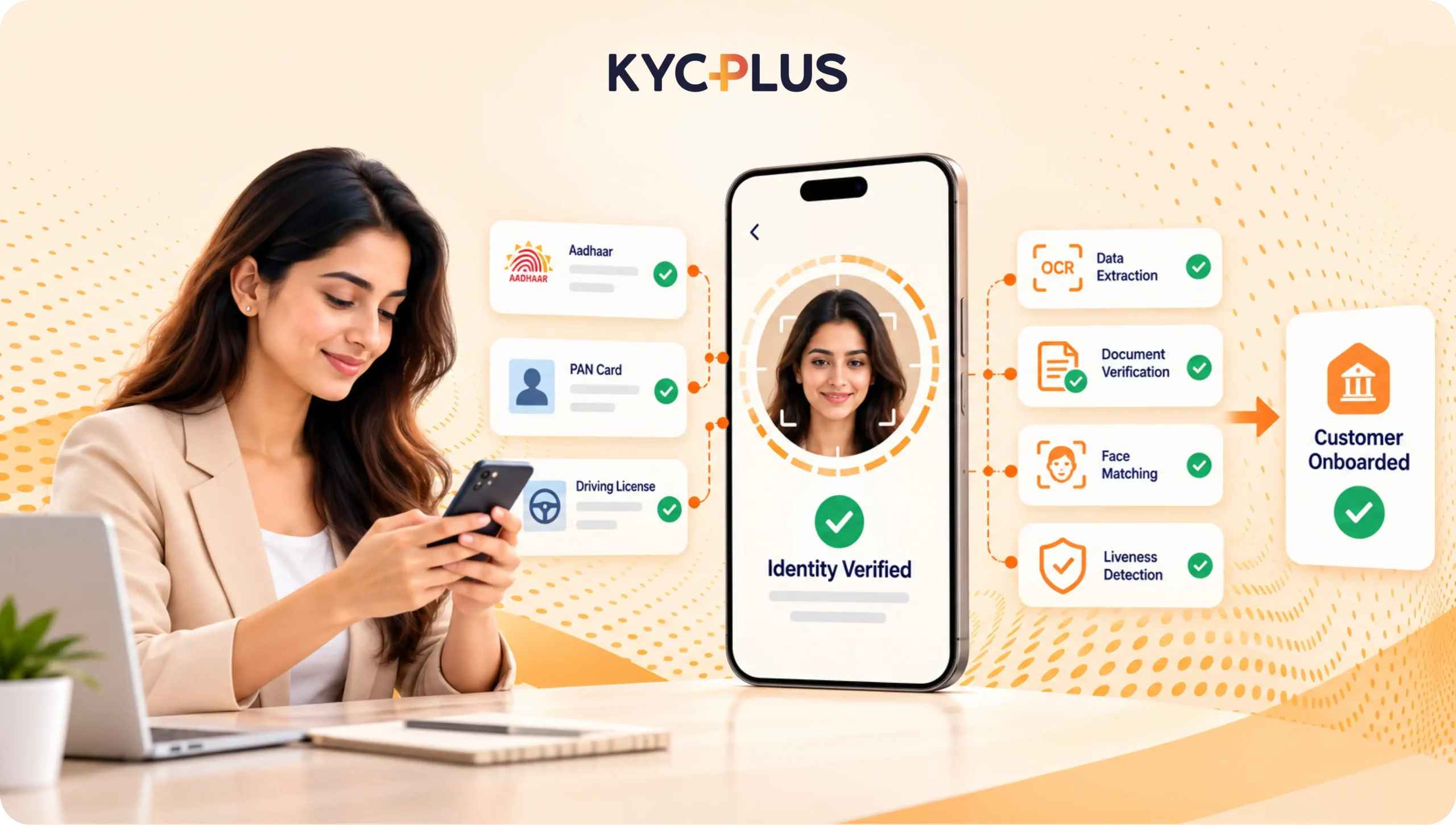
The fintech industry has transformed the way people access financial services. Customers can now apply for loans, open digital accounts, purchase insurance, make investments, and access payment services through websites and mobile applications. Many of these activities can be completed without visiting a physical branch. However, providing financial services digitally also creates an important responsibility: verifying the identity of customers accurately and securely. Digital KYC Verification Software for Fintech helps fintech companies establish that their customers are who they claim to be. Depending on the business model, regulatory framework, and applicable requirements, this process may involve collecting identity information, verifying documents, validating data, checking customer details against permitted sources, and maintaining appropriate records.
Traditional verification processes can make digital onboarding slow and complicated. Manual document reviews, repeated data entry, disconnected applications, and lengthy approval workflows may create friction for both customers and operations teams.
Digital KYC Verification Software for Fintech enables financial technology companies to automate and manage customer identification and verification workflows through digital interfaces, APIs, document intelligence, and configurable verification processes.
Instead of relying entirely on manual checks, fintech companies can create structured onboarding journeys that collect customer information, process documents, perform supported verification checks, and route cases for approval or further review.
The objective is not simply to verify customers faster. It is to create a reliable onboarding process that balances customer convenience, operational efficiency, fraud prevention, data protection, and applicable compliance requirements.
For fintech startups, lending platforms, payment service providers, digital financial applications, and established financial technology businesses, selecting the right KYC software can become an important part of their technology strategy.
This guide explains how digital KYC works, which features fintech companies should evaluate, how APIs and OCR support verification, how to integrate KYC with existing systems, and how to select a suitable solution for long-term growth.
Digital KYC Verification Software for Fintech is a technology platform that helps fintech businesses collect, process, verify, and manage customer identity information through digital workflows.
KYC stands for Know Your Customer. It refers to the processes used to establish and verify customer identity and, where applicable, understand relevant customer information as required by the institution’s business model and regulatory obligations.
Depending on the implementation, a software platform may provide:
Not every platform includes all these capabilities, and availability may depend on integrations, permissions, deployment configuration, and applicable regulations.
For example, a fintech lending application may allow customers to submit their details through a mobile application. The KYC platform can then process supported documents, perform configured verification checks, and send the result to the lending system.
If information is incomplete or a verification check requires further review, the case can be routed to an operations employee.
This combination of automation and human review makes digital KYC useful for fintech companies that need to process customer applications at scale.
Fintech businesses operate in an environment where customer experience, technology integration, and processing speed are important.
Customers often choose digital financial services because they want convenient access without unnecessary paperwork or branch visits.
However, fintech companies cannot simply remove verification steps to make onboarding faster. They need to design digital processes that meet applicable requirements while minimizing unnecessary friction.
Digital KYC Verification Software for Fintech helps address this challenge through structured workflows.
Manual verification may require employees to inspect documents, enter information, and move data between different systems.
Automated workflows can reduce repetitive tasks by capturing information digitally and processing supported checks within the same journey.
This can help fintech companies improve turnaround times, although actual processing speed depends on document quality, integration availability, exception rates, and verification requirements.
Customers may abandon an application if onboarding involves confusing instructions, repeated document uploads, or unnecessary delays.
A well-designed KYC journey can provide clear steps, mobile-friendly document capture, status updates, and guidance when additional information is required.
This makes the onboarding experience easier to understand.
Employees who manually enter information from identity documents may introduce typing errors or inconsistencies.
OCR technology can extract supported fields from documents and send them into validation workflows.
The extracted information should still be checked according to the institution’s verification requirements.
A fintech company may receive a few hundred applications during its early stages and significantly more as its business grows.
Manual processing can become difficult to scale.
Automation can help process routine cases systematically while directing exceptions to employees.
Digital dashboards can help management monitor applications, pending cases, failed checks, and verification exceptions.
This allows teams to identify bottlenecks and improve internal processes.
Different employees may handle manual verification differently.
A centralized software platform can apply configured validation rules and approval processes consistently.
These advantages explain why Digital KYC Verification Software for Fintech is becoming an important consideration for companies building digital financial services.
A digital KYC process typically involves several connected stages. The exact sequence depends on the fintech company’s business model and applicable verification requirements.
The customer begins by registering through a website, mobile application, or other digital channel.
The application may collect basic details such as name, contact information, date of birth, and other required information.
Only the information needed for the relevant process should be collected.
Where required, the customer is informed about the relevant data processing and provides the necessary consent or authorization.
The system captures the information required for the applicable verification workflow.
The customer submits supported identity documents through the digital interface.
The system may provide instructions for taking clear photographs or uploading document images.
If OCR is enabled, the software extracts relevant information from supported documents.
The extracted data can be compared with information submitted by the customer.
The platform performs the verification checks configured for the fintech company’s use case.
These may involve document checks, supported identity verification services, database integrations, or other permitted methods.
The specific checks depend on the product and regulatory requirements.
Where supported and appropriate, face matching can compare a customer’s selfie with a reference photograph.
Liveness detection can help assess whether the submitted facial capture represents a live person rather than a photograph or other presentation attempt.
These technologies have limitations and should be implemented with suitable safeguards and review procedures.
The system processes available results and routes the case according to configured rules.
A case may be completed, rejected, or sent for manual review depending on the verification outcome.
An automated result should not be treated as a substitute for any human decision or regulatory review required by the applicable process.
Once the required checks and approvals are completed, relevant customer information can be transferred to the fintech’s CRM, lending platform, customer database, or other business application.
The platform can maintain relevant documents, verification results, timestamps, and workflow activity according to the institution’s retention policies and applicable requirements.
This structured process is a core capability to evaluate when comparing Digital KYC Verification Software for Fintech.
A fintech company should evaluate KYC software based on its actual business requirements rather than selecting a platform only because it offers a large number of features.
Digital onboarding allows customers to complete relevant application and verification steps through an online interface.
A good onboarding workflow should be easy to navigate, support suitable devices, and explain what the customer needs to do next.
For fintech companies, onboarding software should also support integration with the business’s existing application journey.
Document verification helps establish whether submitted documents meet the configured validation requirements.
Depending on the implementation, the platform may check document readability, required fields, format consistency, and supported authenticity indicators.
Automated checks may not identify every form of fraud. Additional verification or manual review may still be necessary.
Optical Character Recognition converts supported document images into machine-readable information.
OCR can extract fields such as names, dates, addresses, and document numbers where those fields are supported and readable.
This can reduce repetitive data entry and help standardize customer information.
Face matching compares facial information captured during onboarding with an available reference image.
This capability may be useful in supported verification workflows.
Fintech companies should evaluate matching accuracy, image quality requirements, privacy implications, and exception handling before deployment.
Liveness detection helps assess whether a facial capture appears to come from a live person. Depending on the implementation, the process may use passive or active liveness methods.
Fintech companies should understand the technology’s limitations and how it handles failed or inconclusive results.
APIs allow different applications to exchange information.
A KYC platform can connect with a fintech company’s website, mobile application, CRM, lending system, customer database, or other authorized services.
API integration can reduce manual data transfers and make verification a more natural part of the customer journey.
For institutions and use cases where CKYC processes are applicable, a digital KYC platform may provide workflows for search, retrieval, processing, and relevant record updates.
The platform must support the applicable framework and authorized access arrangements.
CKYC functionality should not be confused with being the centralized registry itself.
Some financial institutions need to review or update customer KYC information during the customer lifecycle.
A Re-KYC solution can help manage customer notifications, document collection, verification, status tracking, and applicable update workflows to support efficient customer information updates.
A Document Management System helps organize customer documents in a centralized environment.
Features may include document categorization, search, access controls, indexing, retrieval, and retention management.
This is particularly useful when fintech teams handle large numbers of customer applications.
An audit trail records relevant actions performed within the platform.
Depending on the system, it may include timestamps, user activities, case status changes, verification outcomes, and approval history.
Audit trails can help with internal monitoring, investigations, and applicable audit requirements.
Dashboards provide operational visibility into verification activity.
Useful metrics may include:
These insights can help fintech teams improve the onboarding process.
Fintech startups face different challenges from established financial institutions.
They may have limited operational teams, evolving technology architecture, and a need to launch products quickly.
A manual KYC process can create operational pressure as application volumes grow.
For example, a digital lending startup may initially process applications through spreadsheets and manual document reviews. As demand increases, the same process can become difficult to manage.
Digital KYC Verification Software for Fintech can help startups establish a more structured onboarding process from the beginning.
A startup should consider several factors when selecting a solution.
Startups often build their applications using modern technology stacks.
A solution with clear API documentation, testing environments, and predictable integration workflows can simplify implementation.
Startups should understand the pricing model, including setup costs, transaction charges, recurring fees, and charges for additional verification services.
The platform should support growth without requiring a complete redesign of the onboarding process.
Different fintech products may require different verification steps.
Configurable workflows allow businesses to adapt the process to their use case and applicable requirements.
Startups may need technical support during integration, testing, and production deployment.
The provider’s implementation and support model should be evaluated before signing an agreement.
For early-stage fintech companies, the objective is to build a reliable verification process without creating unnecessary technical complexity.
Digital lending platforms frequently depend on fast and structured customer onboarding.
Applicants may apply through mobile applications, partner channels, websites, or assisted digital processes.
Before an application proceeds, the lender may need to perform identity verification and other checks according to its applicable obligations.
Digital KYC Verification Software for Fintech can support the identity-related stages of this process.
A typical workflow may include:
KYC verification and credit underwriting serve different purposes. Verifying a customer’s identity does not automatically establish creditworthiness or guarantee loan approval.
A well-designed integration keeps these processes connected while preserving their distinct responsibilities.
For digital lenders, this approach can reduce repetitive administrative work and improve visibility across customer onboarding.

Payment and wallet businesses may serve large numbers of customers through digital channels.
Depending on the product, transaction limits, customer category, and applicable regulatory framework, different customer identification requirements may apply.
KYC technology can help businesses collect information and apply the required verification workflows.
For example, a payment application may need to:
A digital KYC platform can help organize these steps.
However, fintech companies should not assume that every payment product follows the same KYC requirements. The appropriate process depends on the service being offered and the applicable rules.
When evaluating Digital KYC Verification Software for Fintech, payment companies should ensure that the selected solution can support their particular operating model.
Investment applications and wealth management platforms also need customer identification processes appropriate to their services.
Customers may use digital platforms to access investment products, portfolio management, financial planning, or related services.
KYC requirements can vary according to the product, intermediary, customer type, and applicable regulatory framework.
Digital KYC technology can help streamline information collection and verification workflows.
Potential capabilities include:
A well-integrated platform can help reduce manual handling while preserving the checks required by the relevant business and regulatory process.
Insurtech businesses use digital channels to distribute insurance products, manage customer relationships, and provide policy-related services.
Identity verification may be required at different points in the customer journey depending on the product and applicable rules.
A digital KYC platform can help insurance technology companies organize identity information and supporting documents.
For example, a platform may connect the insurance application with a verification workflow and then transfer the relevant result to the policy administration system.
This can reduce disconnected manual processes.
Insurance businesses should also consider whether the platform supports different customer categories, document types, and workflow requirements.
API integration is one of the most important considerations for a technology-driven fintech business.
Without integration, employees may need to download customer data from one system and upload it into another.
This creates extra work and increases the possibility of mistakes.
With API integration, the fintech application can communicate with the KYC platform through defined interfaces.
Customer Mobile App → Fintech Backend → KYC API → Verification Workflow → Verification Result → Fintech Backend
The fintech application can then use the result according to its configured business logic.
APIs may also connect the KYC platform with:
Before implementation, the technology teams should define the required fields, authentication mechanisms, error responses, timeouts, retry policies, and monitoring requirements.
A strong API integration should also prevent duplicate processing and handle situations in which an external verification service is temporarily unavailable.
Digital KYC Verification Software for Fintech should therefore be evaluated not only on the number of available APIs but also on integration quality, documentation, reliability, and support.
OCR has become an important technology for automating document-heavy processes.
In manual onboarding, an employee may need to read an identity document and enter the same information into an application.
OCR can extract supported information from document images and make it available for validation.
For example:
Document Upload → Image Processing → OCR → Data Extraction → Field Validation → Verification Workflow
The system may compare extracted data with information submitted by the customer.
If a mismatch is detected, the application can be flagged for correction or review.
OCR can also help process large volumes of documents.
However, extraction quality depends on factors such as image clarity, document layout, language, lighting, and the OCR engine’s capabilities.
Fintech companies should therefore test OCR using realistic documents and measure accuracy before relying on it in production.
When combined with suitable verification checks, Digital KYC Verification Software for Fintech can use OCR to reduce repetitive work and improve data consistency.
Some digital onboarding workflows require additional checks to help establish that the applicant corresponds to the identity information being presented.
Face matching and liveness detection can support these workflows when appropriately implemented.
Face matching compares facial information from two images.
For example, a platform may compare a selfie captured during onboarding with a reference photograph available through an authorized process.
The result can be used as one input into the verification workflow.
Liveness detection helps assess whether a facial capture appears to represent a live person rather than a static photograph, replayed video, or another presentation attempt.
Different solutions use different methods, and their effectiveness can vary.
Remote onboarding can create risks that do not arise in the same way during face-to-face verification.
Face matching and liveness detection can provide additional signals to help assess a verification case.
However, neither technology guarantees that fraud will be detected in every situation.
Fintech companies should evaluate accuracy, false acceptance and rejection rates, privacy implications, accessibility, and manual review procedures.
These capabilities can be useful components of Digital KYC Verification Software for Fintech when selected for an appropriate use case.
Central Know Your Customer, or CKYC, is a centralized KYC framework relevant to applicable financial institutions and processes in India.
Where CKYC procedures apply, a fintech or financial institution may need to search for or retrieve existing KYC information and complete the relevant processing steps.
A digital platform can help integrate these activities into the customer journey.
For example:
Customer Information → Applicable CKYC Search → Record Retrieval Where Available → Verification → Customer Workflow → Required Record Processing
The exact process depends on the institution’s eligibility, access arrangements, regulatory obligations, and the applicable CKYC procedures.
Fintech companies should distinguish between general identity verification and CKYC-related processing. They are related but are not identical functions.
A provider offering Digital KYC Verification Software for Fintech may support CKYC workflows directly or through an integration, depending on its capabilities and the institution’s requirements.
Customer verification is not always a one-time activity.
Depending on the applicable framework, customer category, and institutional policies, customer information may need to be reviewed or updated over time.
Re-KYC workflows can help institutions manage these activities systematically.
A digital process may include:
Automation can help institutions manage large customer populations without relying entirely on manual reminders and spreadsheets.
A fintech platform should select Re-KYC capabilities according to the customer lifecycle and regulatory requirements relevant to its business.
Organizations use different methods to capture, process, monitor, and maintain information through traditional and digital systems.
A manual process may involve physical or emailed documents, repeated data entry, employee-led verification, spreadsheet tracking, and separate document storage.
This may be appropriate in some limited circumstances, but it can become difficult to scale when customer volumes increase.
A digital process can capture information electronically, perform configured validations, integrate with supported verification services, and track each case through a centralized workflow.
Employees can focus on exceptions rather than handling every routine activity manually.
The best approach depends on the organization’s use case. Automation should improve consistency and efficiency without bypassing required verification controls.
KYC systems process sensitive personal information, which makes security and privacy essential considerations.
Fintech companies should assess how customer information is collected, transmitted, stored, accessed, and retained.
The platform should support appropriate user permissions so that employees can access only the information required for their responsibilities.
Sensitive information should be protected through suitable encryption mechanisms during transmission and, where appropriate, while stored.
API connections should use suitable authentication, authorization, and other protective controls.
The platform should collect and process information relevant to the intended purpose rather than collecting unnecessary data.
Customer information should be managed according to applicable legal requirements, retention policies, and legitimate business needs.
Relevant system activity should be recorded to support monitoring and investigation.
Fintech companies should assess the provider’s security controls, incident response process, infrastructure, subcontractors, and data-handling arrangements.
The company should determine which KYC, data-protection, outsourcing, and security requirements apply to its specific business model.
Digital KYC Verification Software for Fintech should be selected with these considerations in mind. A vendor’s security claims should be validated through appropriate technical and contractual review.
Fintech companies in India operate under different regulatory arrangements depending on the services they provide.
A lending platform, payment-related business, insurance intermediary, investment platform, and regulated financial institution may have different obligations.
Consequently, there is no single KYC workflow that applies identically to every fintech business.
Before implementing a solution, the company should identify:
For example, where RBI-regulated entities are involved, the applicable RBI KYC requirements and the relevant regulated entity’s responsibilities need to be considered.
A technology provider can support the implementation of verification workflows, but purchasing software does not automatically make a fintech company compliant.
The institution remains responsible for determining and meeting its applicable obligations.
When evaluating Digital KYC Verification Software for Fintech, businesses should therefore assess both technical capabilities and the provider’s ability to support their specific compliance workflow.
Choosing a KYC platform is an important technology decision. The right solution should fit the company’s business model, customer volume, integration environment, and verification requirements.
Start by identifying the services you provide.
Are you a digital lender, payment business, fintech marketplace, insurance technology company, or investment platform?
The answer determines which verification workflows are relevant.
Check which capabilities are included and which require external integrations.
These may include document verification, OCR, face matching, liveness detection, CKYC workflows, and other permitted checks.
Evaluate the quality of API documentation, authentication, test environments, error handling, and integration support.
Consider current customer volume and expected future growth.
Ask how the platform handles peak loads, bulk operations, and concurrent requests.
Evaluate setup fees, transaction charges, monthly subscriptions, minimum commitments, integration costs, and charges for optional verification services.
A low headline price may not represent the total cost of operating the solution.
Review access controls, encryption, audit logging, data retention, incident response, and infrastructure security.
Confirm that the system provides the operational metrics needed by compliance, product, and customer support teams.
Ask how the platform handles inconclusive results, missing information, document failures, service downtime, and cases requiring human review.
Confirm who will handle integration, testing, training, deployment, and ongoing support.
Before full deployment, test the platform using realistic customer journeys and documents.
Measure completion rates, exception rates, integration reliability, and the operational effort required.
A structured evaluation can help fintech companies select Digital KYC Verification Software for Fintech that fits both their current requirements and future growth plans.
Implementing KYC technology can deliver significant benefits, but the process requires careful planning.
Legacy applications or poorly documented APIs can make integration more difficult.
Solution: Map existing systems and define integration requirements before development begins.
Blurry images, glare, cropped documents, and unsupported formats can reduce OCR and verification performance.
Solution: Provide clear capture instructions and appropriate document-quality checks.
Information entered by customers may differ from information extracted from documents.
Solution: Implement field validation, comparison rules, and clear correction workflows.
If verification rules are too strict or customer instructions are unclear, many cases may require manual review.
Solution: Analyze exception reasons and improve the customer journey without weakening required controls.
A fintech company may depend on external services for certain verification checks.
Solution: Define service-level expectations, error handling, monitoring, and contingency procedures.
Technical teams, operations teams, and compliance teams may have different expectations.
Solution: Assign clear responsibilities for verification rules, approvals, incident handling, and customer communication.
These challenges should be considered when implementing Digital KYC Verification Software for Fintech.
Fintech companies should evaluate KYC software based on measurable operational and business outcomes.
The return on investment depends on customer volume, existing processes, transaction pricing, integration effort, and the improvement achieved after implementation.
Calculate the total cost of verification and related operational work divided by the number of processed cases.
Measure the percentage of customers who complete the required onboarding journey.
Track the time from submission to completion or a final verification decision.
Measure the proportion of cases requiring employee intervention.
Track the percentage of cases that fail or require correction because of missing information, document issues, or technical problems.
Measure how many customers abandon the onboarding process before completion.
Assess the number of cases employees can handle while maintaining required quality and control standards.
For example, if automation reduces repetitive work, employees may be able to focus more on exception cases and customer support.
However, ROI should not be calculated using processing speed alone. Accuracy, security, customer experience, compliance controls, and ongoing vendor costs also matter.
Fintech companies may choose cloud-based or on-premises deployment depending on their infrastructure, security requirements, and operating model.
Cloud-based software can offer flexible scaling and reduce the need to manage all infrastructure internally.
It may be suitable for fintech companies that need to launch quickly and adjust capacity as application volumes change.
However, cloud deployment still requires careful review of data location, access controls, contractual obligations, and applicable regulatory requirements.
On-premises software runs within infrastructure managed by the organization or its designated hosting environment.
This may suit businesses with specific infrastructure policies or integration requirements.
It can also require more internal responsibility for infrastructure management, maintenance, and upgrades.
A hybrid architecture may combine internal systems with cloud-based services.
For example, a fintech company may maintain its core customer database internally while integrating selected verification services through APIs.
The appropriate model depends on the organization’s requirements and risk assessment.
Digital KYC Verification Software for Fintech should be evaluated according to the deployment model the business can securely and effectively operate.
Artificial intelligence can support several stages of the KYC workflow.
Potential use cases include document classification, information extraction, image-quality assessment, anomaly detection, and workflow prioritization.
For example, an AI-enabled document-processing system may identify the type of document submitted and route it to the appropriate extraction process.
A system may also flag inconsistent information for further review.
However, AI-generated results should be evaluated for accuracy, reliability, bias, explainability, and suitability for the intended use.
Fintech companies should understand when the platform makes automated decisions, when it generates recommendations, and when human approval is required.
AI should strengthen the verification process rather than become an unexamined replacement for appropriate controls.
As these technologies mature, Digital KYC Verification Software for Fintech may increasingly combine AI, OCR, APIs, and configurable workflows to support more efficient customer verification.
Fintech companies and financial institutions evaluating digital KYC technology can consider specialized platforms such as KYCPLUS.
KYCPLUS is designed to support digital KYC, customer onboarding, CKYC-related workflows, Re-KYC, document management, and connected verification processes.
Depending on the configured implementation and required integrations, the platform can bring together capabilities such as:
The value of an integrated platform lies in connecting the steps that might otherwise be managed across separate applications.
For example, a fintech company may collect customer information through its own digital interface, connect that application to the KYC platform, process supported verification checks, and transfer relevant results to its internal customer or lending system.
This can help reduce disconnected manual activities and improve workflow visibility.
KYCPLUS can also complement existing financial software rather than replacing systems responsible for other business functions.
For instance, a lender can continue using its Loan Origination System for loan applications and decision workflows while using a specialized KYC platform for applicable customer verification and documentation activities.
Before selecting any provider, fintech companies should confirm the exact features available, integration requirements, security controls, service levels, and suitability for their regulatory obligations.
Identity verification is an important part of onboarding, but it is not the only operational requirement.
A growing fintech company may also need to manage:
If each activity is managed in a separate system, the organization may continue to experience manual handoffs even after introducing identity verification software.
A more connected architecture can help bring these activities together.
Customer Application → Digital KYC → Document Processing → Verification → Review → Customer Database → Business Application → Audit and Reporting
This architecture allows the fintech company to build a repeatable process that can support growth.
When evaluating Digital KYC Verification Software for Fintech, companies should therefore consider the complete workflow rather than focusing only on a single identity-checking feature.
Digital verification technology continues to evolve as fintech companies introduce new customer experiences and automation capabilities.
More fintech products are designed around connected applications.
API-first KYC services can make it easier to embed verification directly into customer journeys.
OCR and document intelligence can help extract information, classify documents, and identify incomplete submissions.
Platforms can route cases based on verification outcomes, document quality, risk indicators, or configured business rules.
Mobile-friendly interfaces, clearer instructions, and fewer unnecessary steps can make digital onboarding easier.
Customer information may need to be reviewed or updated throughout the customer lifecycle.
Digital platforms can help organize applicable ongoing KYC processes.|
Fintech companies are likely to continue investing in layered verification processes, risk signals, monitoring, and exception management.
KYC software may increasingly connect with lending platforms, CRM systems, customer databases, document repositories, and core banking systems.
The future is not simply about automating one verification step. It is about building a connected and controlled customer verification process.
Fintech companies depend on digital onboarding to attract customers and deliver convenient financial services. However, onboarding must also include reliable customer identification, appropriate verification controls, secure data handling, and structured recordkeeping.
Digital KYC Verification Software for Fintech helps businesses manage these responsibilities through digital data capture, document processing, OCR, verification integrations, APIs, workflow automation, and audit trails.
The right platform can reduce repetitive manual work, improve operational visibility, support higher application volumes, and create a smoother customer journey.
However, selecting a solution requires careful consideration. Fintech companies should evaluate verification capabilities, API quality, integration effort, security, pricing, scalability, exception management, and support for their specific business and regulatory requirements.
It is equally important to recognize that digital KYC is not a single technology. It is a connected process involving customer information, identity checks, documents, workflow decisions, records, and ongoing customer management.
Platforms such as KYCPLUS can help bring together digital KYC, CKYC-related workflows, Re-KYC, OCR, document management, and integration capabilities, depending on the implementation.
Ultimately, the goal of adopting Digital KYC Verification Software for Fintech is to establish a verification process that is efficient, scalable, secure, and aligned with the requirements of the business.
For fintech companies planning long-term growth, a well-designed KYC infrastructure can become an important foundation for digital customer onboarding and sustainable operations.
Ans: Digital KYC Verification Software for Fintech is a technology platform that helps fintech businesses collect customer information, process identity documents, perform supported verification checks, and manage digital onboarding workflows.
Ans: Fintech companies use digital KYC software to organize identity verification, reduce repetitive manual work, improve onboarding workflows, track verification status, and maintain relevant records.
Ans: Important features may include digital onboarding, document verification, OCR, API integration, workflow management, dashboards, audit trails, and exception handling. Additional capabilities such as face matching, liveness detection, CKYC, and Re-KYC depend on the use case.
Ans: Yes. Many platforms provide APIs that allow fintech applications to connect with verification workflows. The exact integration depends on the provider’s API capabilities and the fintech company’s technical architecture.
Ans: OCR stands for Optical Character Recognition. It extracts machine-readable information from supported document images and can reduce manual data entry. Extracted information should still be validated as required.
Ans: Yes. Digital lenders can use KYC software to support customer identification and verification before the application proceeds through the lender’s separate underwriting and lending processes.
Ans: Some platforms support CKYC-related workflows and Re-KYC alongside digital onboarding. The exact functionality depends on the provider, integrations, implementation, and applicable requirements.
Ans: Yes. Startups can benefit from API-based verification and structured onboarding workflows. They should evaluate pricing, ease of integration, scalability, security, and the verification capabilities required for their business model.
Ans: They should review access controls, encryption, API security, audit logging, data retention, incident response, infrastructure security, and the vendor’s data-handling practices.
Ans: A fintech company should assess its use case, required verification methods, API capabilities, integration effort, security, pricing, scalability, reporting, exception handling, implementation support, and applicable regulatory obligations.