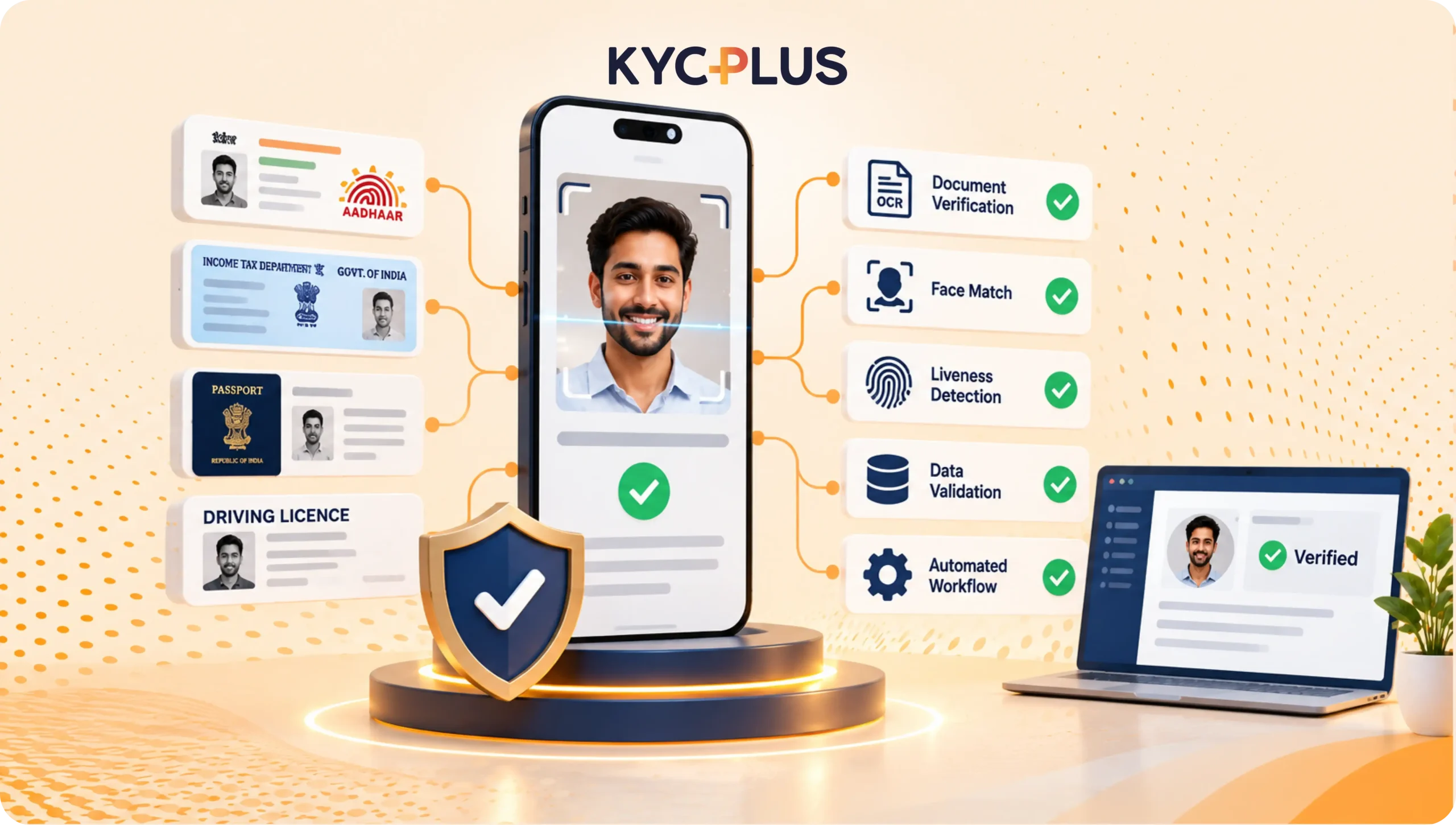
Digital transformation has changed the way businesses interact with customers. Banking, lending, insurance, fintech, investment, e-commerce, telecom, and other industries are increasingly offering services through websites, mobile applications, APIs, and digital platforms. As customer journeys become digital, identity verification has also moved from physical paperwork toward technology-enabled processes. Businesses can use digital ID verification solutions in India to support these evolving customer verification requirements. A customer may now open a bank account, apply for a loan, purchase an insurance policy, register for a financial service, or access a digital platform without visiting a physical branch. However, before providing these services, businesses need to establish and verify the identity of their customers through appropriate processes.
Digital identity verification uses technologies such as document verification, Optical Character Recognition (OCR), data extraction, identity validation, Face Match, Liveness Detection, APIs, and workflow automation to support customer verification.
Instead of depending completely on employees to manually inspect documents and enter information, organizations can automate repetitive parts of the verification process while keeping human review available for cases that require additional attention.
Digital ID Verification Solutions in India can be used by banks, cooperative banks, NBFCs, fintech companies, insurance providers, financial institutions, and other businesses that need structured digital identity workflows.
A complete digital identity verification process should help organizations collect information, process documents, validate data, identify exceptions, manage customer records, and maintain appropriate visibility into the verification journey.
Digital ID verification is the process of verifying a person’s identity using digital technologies instead of relying entirely on physical or manual verification.
During a digital onboarding process, a customer may provide personal information and upload or capture an identity document.
The verification system can then process the submitted information.
A typical workflow may include:
The exact workflow depends on the organization’s requirements and the verification methods applicable to its customer journey.
Digital ID Verification Solutions in India may be available as individual verification APIs, SDKs, software platforms, or complete digital KYC ecosystems.
For example, a fintech company may only need an API to verify a specific identity document, while a bank may require a broader platform covering onboarding, KYC, CKYC, Re-KYC, document management, and identity verification.
Identity is at the center of many business relationships.
Before opening an account, approving a financial application, issuing an insurance policy, or providing certain services, organizations need to establish customer identity through appropriate processes.
Traditional verification can become difficult when customer volumes increase.
Employees may need to:
At a small scale, this may be manageable.
At a large scale, however, repetitive manual work can increase operational workload.
Digital ID Verification Solutions in India can automate or assist with several of these activities.
This can help organizations create a more standardized process and reduce dependency on repetitive manual tasks.
Digital identity verification usually consists of multiple stages.
Understanding each stage helps businesses determine which capabilities they actually need from a verification platform.
The process starts with collecting information from the customer.
Depending on the business and use case, information may include:
The information can be collected through a website, mobile application, branch application, assisted onboarding interface, or API-connected platform.
The objective is to create the initial customer profile that will be used during verification.
The customer provides an identity document.
The document can be uploaded as an image or PDF or captured through a smartphone camera.
For a successful digital experience, customers should receive clear instructions about how to capture documents.
The document should generally be readable, properly positioned, and sufficiently clear for automated processing.
Poor image quality can affect OCR and other verification processes.
Once a document is uploaded, the system can determine what type of document has been submitted.
For example, the system may identify a document as:
Document classification allows the system to determine which information fields need to be extracted and which verification rules are applicable.
OCR, or Optical Character Recognition, converts text from an image or scanned document into machine-readable information.
For example, instead of an employee manually entering a customer’s name and document number, the OCR system can extract those details from the document.
Depending on the document, extracted information may include:
The extracted information can then be passed into the next stage of the verification workflow.
After extracting information, the system can compare document data with information entered by the customer.
For example:
Customer-entered name
Document name
Customer-entered date of birth
Document date of birth
Customer-entered ID number
Document ID number
If the information matches according to configured rules, the application can continue.
If there is a mismatch, the case can be flagged for additional review.
Additional validation can be performed depending on the identity document and business process.
This may involve supported APIs, databases, verification services, or other appropriate mechanisms.
The purpose is to establish greater confidence in the information being submitted.
Some digital onboarding processes require facial comparison.
The customer may be asked to capture a selfie or live facial image.
The system can compare the customer’s image with a permitted reference image, such as a photograph associated with the identity document.
Face Match can therefore provide an additional identity verification layer.
Liveness Detection can be used in certain remote verification workflows.
It is designed to help determine whether the interaction involves a live person rather than certain types of static-image or presentation-based attempts.
When combined with Face Match and document verification, it can contribute to a more comprehensive identity verification workflow.
After completing the configured checks, the system can generate a result.
Common workflow statuses may include:
Applications requiring additional attention can be routed to authorized employees.
There are multiple approaches to digital identity verification.
The right approach depends on the organization’s customer journey and verification requirements.
This involves processing identity documents submitted by customers.
OCR can extract information while validation and matching mechanisms can help process the information.
PAN-related verification can be incorporated into applicable financial onboarding workflows.
It can help businesses validate relevant PAN information through supported verification mechanisms.
Aadhaar-related verification can be used where the applicable process and legal framework permit it.
Organizations should use appropriate authorized mechanisms and follow applicable requirements.
Face verification can compare a customer’s facial image with an appropriate reference image.
This can provide an additional layer to a digital onboarding process.
Liveness Detection can help assess whether a remote facial interaction appears to involve a live person.
API-based Digital ID Verification Solutions in India allow businesses to connect identity verification capabilities with their own applications.
This is particularly useful for businesses that already have their own customer-facing platforms.
Modern identity verification platforms combine several technologies.
OCR extracts text from documents.
It can reduce manual data entry and create structured customer information.
AI can support document classification, information extraction, image analysis, and workflow automation.
AI-based systems can also help identify cases that require additional review.
Computer vision can be used to analyze document images and facial information.
It can help systems understand visual characteristics that are difficult to process through traditional text-based methods.
Face Match can compare two facial images and generate a similarity result according to the configured process.
Liveness technology can add another layer to remote identity verification.
APIs allow verification services to communicate with external applications.
This makes it possible to integrate identity verification into banking, lending, insurance, fintech, and enterprise workflows.
Document intelligence combines document classification, OCR, extraction, validation, and workflow processing.
This can make document verification more automated and structured.

Businesses adopt digital identity verification for several operational reasons.
Digital workflows can process repetitive verification activities faster than completely manual processes.
This can reduce delays in customer onboarding.
Employees do not have to manually enter every piece of information from every document.
OCR and automation can reduce repetitive work.
Automated extraction and validation can reduce certain types of manual data-entry mistakes.
Customers can complete identity verification digitally through supported channels.
This can reduce unnecessary physical visits and paperwork.
A centralized system can provide visibility into verification activities across branches and channels.
Cases that do not pass automated checks can be routed to employees.
This allows human resources to focus on exceptions rather than every application.
Digital workflows can help organizations handle increasing customer volumes without increasing manual work at the same rate.
Digital platforms can organize customer documents and make them easier for authorized employees to access.
Banks handle large volumes of customer information.
Identity verification can be required across different customer journeys, including account opening, lending, deposits, and other financial services.
A digital verification platform can help banks automate document processing and identity-related workflows.
For banks with multiple branches, centralized verification can provide greater visibility.
Employees can track application status and access relevant information through authorized systems.
A specialized identity and KYC solution platform can also complement a Core Banking System.
The CBS can continue managing core banking operations such as accounts, deposits, loans, transactions, and accounting.
A specialized platform can handle digital onboarding, KYC, identity verification, CKYC, Re-KYC, document management, and related workflows.
This allows organizations to use specialized technology without treating identity verification as a replacement for core banking software.
Cooperative banks, UCBs, and DCCBs operate across branch networks and serve diverse customer groups.
Many such institutions are modernizing their customer onboarding and KYC processes.
Digital verification can help them reduce paperwork and create centralized workflows.
A digital identity platform can support:
For institutions with multiple branches, centralized digital workflows can also improve visibility into pending and completed cases.
KYCPLUS can complement existing banking infrastructure by providing specialized KYC and digital identity workflows.
NBFCs increasingly use digital channels for customer acquisition and loan applications.
A customer may begin an application online, submit documents, and complete identity verification without visiting an office.
This makes an efficient verification process important.
Digital verification can help NBFCs:
API integration can connect identity verification with loan origination systems and other business applications.
Fintech businesses typically focus on digital-first customer experiences.
Customers may complete the entire onboarding process through a mobile application.
This means verification should be integrated directly into the customer journey.
API-based Digital ID Verification Solutions in India can provide verification capabilities without requiring fintech companies to build every component internally.
A typical journey can look like:
Customer Registration
↓
Personal Information
↓
Identity Document Upload
↓
OCR & Data Extraction
↓
Document Validation
↓
Identity Verification
↓
Face Match
↓
Liveness Detection
↓
Verification Result
↓
Account Activation / Service Onboarding
This type of architecture can create a smoother customer journey while reducing manual processing.
Insurance companies also need structured customer identification processes.
Digital identity verification can support online policy applications and other customer onboarding activities.
Customers can submit documents digitally, while the verification platform processes relevant information.
OCR can extract document information, and additional validation mechanisms can be incorporated according to the organization’s workflow.
Centralized document management can also make it easier for authorized teams to access customer records.
Manual verification depends heavily on human effort.
Employees inspect documents, enter information, compare details, save files, and track applications.
Automated verification uses technology to assist or perform repetitive steps.
Consider a customer onboarding team processing thousands of applications.
With a completely manual process, employees may need to review every document and manually enter every field.
With an automated KYC workflow, OCR can extract information, matching rules can compare data, and cases requiring additional attention can be routed to employees.
This creates a more efficient allocation of human resources.
Automation does not necessarily mean removing humans from the process.
Human review remains valuable for exceptions and cases where automated checks are insufficient.
While Digital ID Verification Solutions in India can improve efficiency, businesses still need to address several challenges.
Blurred images, glare, cropping, and low-resolution documents can affect automated extraction.
Customers may have variations in how names appear across different documents.
Matching systems therefore need appropriate rules.
Addresses can appear in different formats or abbreviations.
Organizations should design matching and review processes accordingly.
Businesses may already have multiple systems.
Connecting verification capabilities with CRM, CBS, loan systems, insurance platforms, and customer applications requires technical planning.
A complicated verification journey can result in customers abandoning onboarding.
The verification process should therefore be simple and easy to understand.
Identity documents contain sensitive information.
Businesses need appropriate security, access controls, monitoring, and data governance.
API Integration with Digital Identity Verification
API integration is one of the most important features businesses should consider.
Many organizations already have customer-facing applications.
Instead of creating a separate verification portal, identity verification capabilities can be integrated into the existing application.
For example:
Business Application
↓
Identity Verification API
↓
Document Processing
↓
OCR
↓
Validation
↓
Face Match / Liveness
↓
Verification Result
↓
Business Application
This allows verification to become part of the existing customer journey.
APIs can also reduce manual movement of information between different systems.
Digital identity verification involves sensitive information.
Therefore, security should be part of the solution architecture.
Organizations should evaluate areas such as:
Businesses should also ensure that their implementation follows applicable legal, regulatory, contractual, and internal requirements.
Security should not be treated as an optional feature.
Choosing the right solution requires understanding the organization’s requirements.
Before selecting a platform, businesses should evaluate:
Does the platform support the identity documents required by the organization?
Can the platform extract the required information accurately from supported documents?
Does it provide the verification methods required by the business?
Are facial verification capabilities available if required?
Can the platform integrate with existing applications?
Can applications be automatically routed based on verification results?
Can customer documents be centrally managed?
Can the platform handle future customer growth?
Does the solution provide appropriate security controls?
Does the provider offer implementation and technical support?
A feature checklist should therefore be combined with an assessment of actual business requirements.
KYCPLUS is a specialized digital KYC platform designed to support organizations in modernizing customer onboarding and KYC-related workflows.
Its capabilities can include digital onboarding, KYC Document Verification, OCR, CKYC workflows, a Re-KYC solution, document management, Face Match, Liveness Detection, and API-based integration.
For financial institutions, KYCPLUS can complement existing technology infrastructure.
For example, a bank can continue using its existing Core Banking System for core banking operations while using KYCPLUS for specialized digital KYC and identity-related workflows.
This approach allows organizations to modernize specific processes without replacing their entire core technology infrastructure.
The platform can also support centralized workflows, helping authorized teams manage customer documents and verification activities through a structured digital environment.
The exact implementation should be configured according to the organization’s processes, customer journey, existing systems, and applicable requirements.
One of the biggest applications of identity verification is digital customer onboarding.
A customer can begin the process remotely.
The business can collect the required information and documents.
The verification platform can process those documents and return the required verification status.
A complete onboarding workflow may include:
Customer Registration
↓
Information Collection
↓
Document Capture
↓
OCR
↓
Data Matching
↓
Identity Validation
↓
Face Match
↓
Liveness Detection
↓
Manual Review if Required
↓
Final Onboarding
This process can help reduce unnecessary manual intervention.
Digital identity verification can also support existing customers.
Re-KYC processes may involve updating or revalidating customer information according to applicable requirements.
When organizations manage large customer bases, manually processing every customer’s document can create significant operational work.
A digital workflow can allow customers to complete applicable verification steps remotely.
The organization can then monitor completion, identify pending cases, manage documents, and route exceptions.
When integrated with broader KYC capabilities, a platform such as KYCPLUS can support both new customer onboarding and ongoing KYC workflows.
Identity verification is often one of the most important steps in digital onboarding.
If the process is complicated, customers may abandon the application.
Therefore, businesses should design the verification experience carefully.
A good digital verification journey should be:
Customers should know what document is required and how to capture it.
If an image is unclear, the application should explain what needs to be corrected.
If additional verification is required, the customer should receive clear instructions.
The objective is to combine verification accuracy with a frictionless customer experience.
The future of identity verification will likely involve increasing levels of automation and integration.
AI-powered document processing can improve classification and extraction.
Computer vision can support document and image analysis.
Facial verification can support remote identity workflows.
APIs can connect identity verification with banking, lending, insurance, fintech, and enterprise applications.
Digital identity verification can also become part of broader customer lifecycle management rather than being limited to account opening.
KYC, CKYC, Re-KYC, document management, customer onboarding, and identity verification can increasingly operate through connected digital workflows.
However, technology will need to develop alongside appropriate security, privacy, governance, and regulatory controls.
The future is therefore not simply about replacing manual verification.
It is about creating intelligent workflows were automation and human review work together.
The main value of digital verification goes beyond faster document processing.
It can help businesses create a more measurable and structured customer onboarding process.
With a manual process, it can be difficult to understand:
A digital system can provide greater visibility into these activities.
This allows businesses to identify bottlenecks and improve their onboarding processes.
Digital ID Verification Solutions in India can therefore contribute to operational efficiency, customer experience, process visibility, and scalability.
Digital identity verification has become an important part of modern customer onboarding.
As businesses move from branch-based processes toward digital customer journeys, they need verification systems that can process identity information efficiently and securely.
Digital ID Verification Solutions in India can combine OCR, document processing, identity validation, Face Match, Liveness Detection, APIs, and workflow automation to create a connected verification process.
Banks, cooperative banks, DCCBs, NBFCs, fintech companies, insurance providers, and other organizations can use these technologies according to their specific business requirements.
The right solution should not be selected only on the basis of the number of features.
Businesses should evaluate integration capabilities, customer experience, verification methods, scalability, security, document management, workflow automation, exception handling, and ongoing support.
A specialized platform such as KYCPLUS can help organizations bring digital onboarding, KYC, CKYC, Re-KYC, document verification, document management, and identity-related workflows into a centralized ecosystem.
The goal of Digital ID Verification Solutions in India is ultimately to make identity verification more efficient, structured, scalable, and convenient while maintaining appropriate verification and security controls.
Ans: Digital ID Verification Solutions in India are software platforms, APIs, and technology services that help organizations verify customer identity digitally using documents, OCR, identity validation, facial verification, liveness detection, and other technologies.
Ans: Businesses can use digital identity verification to support customer onboarding, reduce repetitive manual work, improve verification workflows, and provide digital customer experiences.
Ans: Common technologies include OCR, artificial intelligence, document intelligence, Face Match, Liveness Detection, APIs, and identity validation services.
Ans: Yes. API-based identity verification capabilities can be integrated with applications such as banking systems, CRM platforms, loan origination systems, insurance applications, fintech applications, and customer onboarding portals.
Ans: Yes. Banks can use digital identity verification as part of relevant customer onboarding, KYC, Re-KYC, document processing, and identity-related workflows.
Ans: Yes. Cooperative banks, UCBs, and DCCBs can use digital identity verification to support branch-based and digital customer onboarding processes.
Ans: OCR stands for Optical Character Recognition. It extracts text and information from supported documents and converts it into machine-readable data.
Ans: Face Match compares a customer’s facial image with a permitted reference image as part of an identity verification workflow.
Ans: Liveness Detection is a technology used in certain remote identity verification workflows to assess whether an interaction appears to involve a live person rather than certain presentation-based attempts.
Ans: KYCPLUS provides digital KYC and identity-related capabilities such as document processing, OCR, CKYC, Re-KYC, Face Match, Liveness Detection, document management, and API-based integration, depending on the configured implementation.
