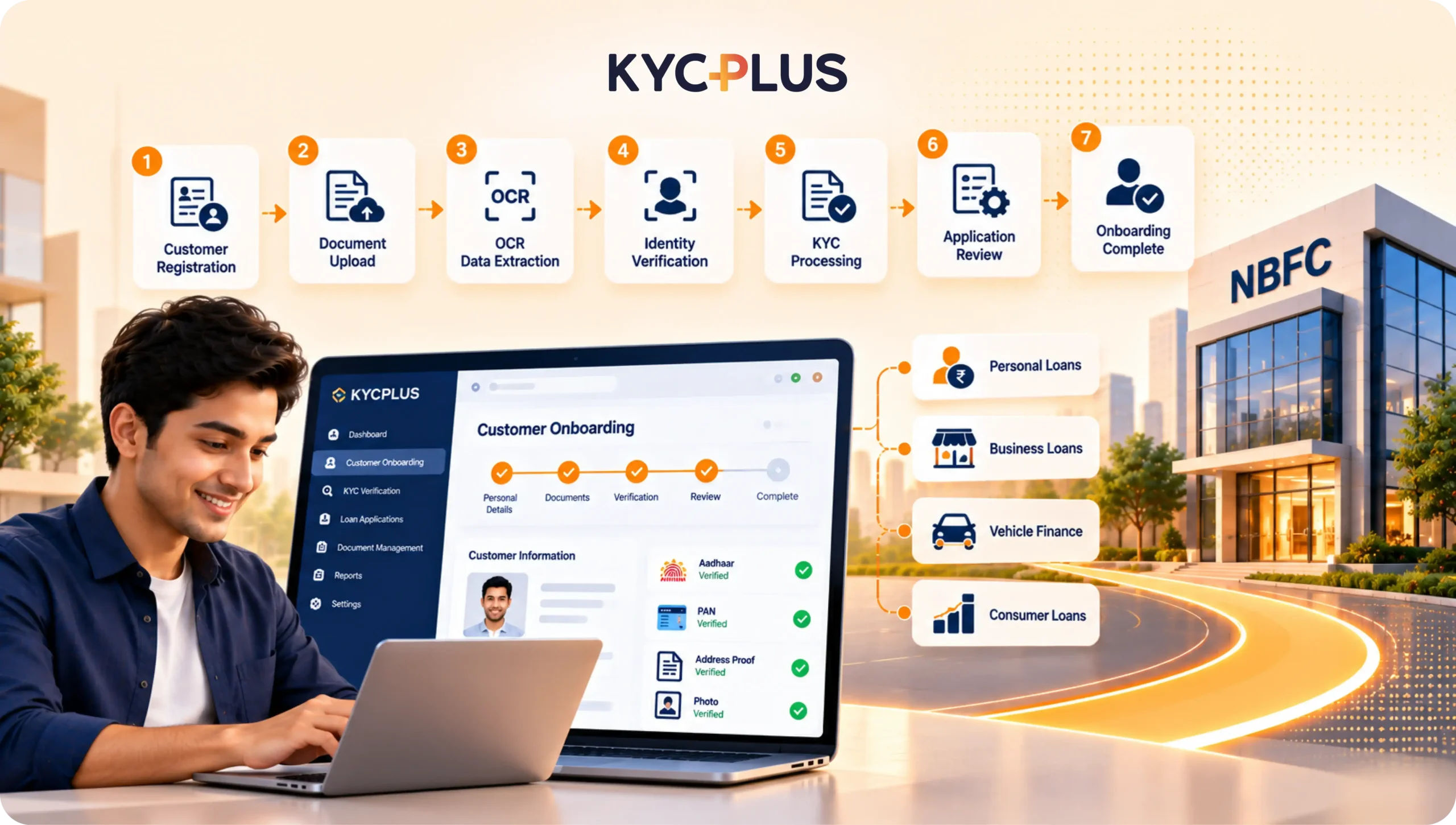
The Non-Banking Financial Company (NBFC) sector is experiencing a significant shift towards digital financial services. Customers increasingly expect a simple and convenient way to apply for personal loans, business loans, vehicle finance, consumer loans, and other financial products. At the same time, NBFCs need to manage customer information, verify identities, collect documents, and process applications efficiently. Traditional onboarding methods often involve paper forms, manual data entry, repeated document requests, and disconnected software systems. These processes can increase employee workload, delay application processing, and make it difficult to track the status of customer applications. This is why customer onboarding software for NBFCs has become an important technology investment for financial institutions looking to modernize their operations. A digital onboarding platform with an integrated KYC solution can help organize customer registration, document collection, KYC workflows, verification activities, and communication between different departments.
The right solution can also connect with existing lending systems, helping information move more efficiently from customer registration to loan application processing.
However, selecting an onboarding platform requires more than comparing software features. NBFCs must consider their business requirements, customer experience, regulatory responsibilities, integration needs, information security, and long-term scalability.
This guide explains how customer onboarding software for NBFCs works, which features matter most, how it supports digital lending, and what financial institutions should consider before implementing a solution.
Customer onboarding software for NBFCs is a digital solution designed to help financial institutions register new customers, collect the necessary information, organize documents, support identity verification, and manage onboarding workflows.
Instead of handling every activity manually, an NBFC can use a centralized platform to guide customers through a structured application journey.
Depending on the product and configuration, the software may support:
The exact capabilities vary by vendor and implementation. NBFCs should verify which features are included, which require third-party services, and which involve additional integration or configuration.
For example, a customer applying for a personal loan may complete an online application, submit identity documents, and provide supporting information through a digital interface. The platform can organize the submitted information, initiate configured verification checks, and route the application to the appropriate team.
This structured process helps make customer information easier to manage and reduces dependence on scattered records and manual follow-ups.
Customer onboarding software for NBFCs does not necessarily replace every system used by a financial institution. Instead, it can work alongside a Loan Origination System (LOS), Loan Management System (LMS), Customer Relationship Management (CRM) platform, and other business applications.
The objective is to create a connected onboarding process that supports both customer convenience and operational control.
Customer onboarding directly affects how easily prospective borrowers can access financial products. If the application process is confusing or unnecessarily lengthy, customers may abandon it before completing the required steps.
For NBFCs, inefficient onboarding can also create additional work for operations teams and delay the movement of applications into credit assessment.
Implementing customer onboarding software for NBFCs can help institutions address these challenges through structured workflows, digital document handling, and improved application visibility.
Manual registration can require employees to enter information, check forms, request missing details, and update multiple systems.
A digital onboarding process allows customers to submit information through online forms and provides validation for mandatory fields.
When connected systems and verification services are configured correctly, certain steps can be completed with less manual intervention.
This helps NBFCs create a more organized registration process while allowing employees to focus on applications that require additional attention.
Paper-based processes often require employees to enter the same customer information more than once.
This can increase processing effort and introduce avoidable errors.
Customer onboarding software for NBFCs can help digitize forms, organize documents, and extract selected information from supported documents through OCR.
Employees can review extracted information, correct inaccuracies, and validate details before moving the application forward.
The result can be a more consistent information collection process.
Customers expect financial services to be convenient and easy to understand.
A digital onboarding platform can provide clear instructions, document checklists, progress indicators, and status updates.
Customers can understand which information is required and what they need to complete next.
A mobile-friendly interface can also help applicants submit information without visiting a branch for every administrative step, where the institution’s process permits remote onboarding.
When onboarding activities are managed through email and spreadsheets, employees may find it difficult to determine which applications are pending and why.
A centralized platform can display application status, pending documents, verification outcomes, and assigned tasks.
This allows operations managers to identify delays and direct work towards applications that need attention.
Customer documents are important throughout onboarding and may need to be retrieved later for legitimate operational, compliance, or audit purposes.
A suitable platform can organize documents against customer records and provide controlled access to authorized employees.
Features such as document categorization, search, access permissions, and activity history can make information retrieval more manageable.
The most suitable platform is one that matches the institution’s actual workflow rather than simply offering the largest number of features.
When evaluating customer onboarding software for NBFCs, institutions should focus on capabilities that solve existing operational problems and support future business requirements.
Digital forms allow customers to provide required information through a structured interface.
Important capabilities include:
Different products may require different information. For example, an individual applying for a personal loan may need to provide different details from a business applying for commercial financing.
Configurable forms help NBFCs create appropriate journeys for these customer categories.
KYC is a critical component of customer onboarding in financial services.
Customer onboarding software for NBFCs should support the KYC processes required by the institution and its applicable regulatory obligations.
Depending on the platform and its integrations, this may include document collection, identity verification workflows, verification status management, and connections to authorized verification services.
NBFCs should confirm the specific checks supported by the vendor and ensure that the configured process matches their approved procedures.
Software alone does not guarantee regulatory compliance. The institution remains responsible for operating the onboarding process correctly.
Optical Character Recognition converts text from supported documents or images into machine-readable information.
For example, OCR may extract a name, address, or document number from a supported document and populate the relevant application fields.
This can reduce manual data entry and help employees process applications more efficiently.
However, OCR can produce inaccurate results when documents are blurred, damaged, poorly lit, or formatted in an unsupported way. Extracted information should therefore be checked and validated as required.
Some digital verification workflows use facial comparison and liveness detection to support identity checks.
Face matching compares two facial images, while liveness detection attempts to identify whether the presented face belongs to a live person rather than certain types of spoofing attempts.
These technologies serve different purposes and should not be treated as a complete guarantee against identity fraud.
NBFCs should assess accuracy, privacy safeguards, exception handling, and the need for manual review when considering these capabilities.
Workflow automation helps determine what happens after each onboarding activity.
For example, an application with missing documents may be assigned for follow-up, while an application requiring additional verification may be routed to a designated reviewer.
Customer onboarding software for NBFCs can support configurable task assignment, status updates, reminders, and escalation rules.
Well-designed workflows should also handle unsuccessful checks and conflicting information rather than automatically moving every application to approval.
A centralized document repository can help authorized employees locate relevant customer information.
Audit trails can record important actions, such as application updates, document changes, verification status changes, and review decisions.
NBFCs should check which events are recorded, how access is controlled, and whether the platform supports the institution’s recordkeeping and retention requirements.
Many NBFCs use several applications to manage lending operations.
Customer onboarding software for NBFCs should be assessed for integration with the systems relevant to the institution, such as:
Integration can reduce duplicate data entry and improve the movement of information between systems.
Before implementation, the institution should confirm API availability, data mapping, authentication, error handling, testing responsibilities, and ongoing support.
Dashboards help managers monitor the progress of customer applications.
Useful reports may show incomplete applications, pending verification, document-related delays, application volumes, processing times, and team workloads.
These insights can help institutions identify operational bottlenecks and make improvements based on actual performance.
Digital lending involves several connected activities, beginning with customer registration and continuing through application review, credit assessment, approval, and loan processing.
The quality of customer information collected at the beginning can affect later stages of the process.
Customer onboarding software for NBFCs helps organize the early stages by bringing customer details, supporting documents, and verification workflows into a structured process.
Personal loan applicants may need to provide identity details, contact information, employment information, income documents, and other required records.
A digital platform can guide applicants through the required fields and help employees identify incomplete submissions.
Where integrations are available, relevant information can be passed to the loan origination or credit assessment system.
Business lending may involve additional documentation and information about the business, its ownership, authorized representatives, and financial position.
An onboarding platform can support separate workflows for business entities and individuals, helping NBFCs collect the information relevant to each application.
The exact requirements depend on the product, customer type, and applicable policies.
Vehicle finance and consumer lending may require customer identification, application details, supporting documents, and product-specific information.
A digital workflow can help collect the required information and provide better visibility into outstanding tasks.
This can be particularly useful when onboarding activities involve multiple teams or connected service providers.
NBFCs serving merchants and small businesses may need to collect business details, verify representatives, and maintain supporting records.
Configurable onboarding workflows can help institutions manage these requirements without applying the same process to every customer category.
Across all lending products, the purpose of customer onboarding software for NBFCs is to make customer information collection and verification more organized. Credit assessment, underwriting, and loan approval may still be handled by separate systems and teams.
Customer onboarding software and Loan Origination System software can complement each other, but their responsibilities are not always identical. Typically, customer onboarding focuses on registering customers, collecting information, organizing documents, and supporting KYC verification workflows.
An LOS generally manages a broader set of loan application activities, which may include credit assessment, underwriting, approval workflows, and loan origination.
Some vendors combine both capabilities in one platform, while others provide specialized systems that integrate with one another.
Before selecting customer onboarding software for NBFCs, an institution should identify whether it needs a dedicated onboarding platform, an LOS with suitable onboarding functionality, or an integrated combination.
The decision should reflect existing systems, operational gaps, integration requirements, budget, and future plans.
The goal is to establish a clear division of responsibilities and avoid unnecessary duplication of information or functionality.
NBFCs in India must design their Automate Customer Onboarding processes around the regulatory requirements applicable to their business.
These may include relevant RBI directions, applicable KYC requirements, privacy obligations, information security controls, and internal policies.
The precise obligations depend on the institution and its activities. NBFCs should review current requirements with their compliance and legal teams.
The platform should support the required identity verification workflow, evidence collection, exception handling, and recordkeeping.
Institutions should confirm that the software’s capabilities match their approved procedures and the services they are authorized to use.
Customer records may contain personal and financial information.
NBFCs should evaluate encryption, authentication, role-based permissions, secure data transfer, logging, backup arrangements, and incident response procedures.
They should also understand how the vendor handles customer information and what controls apply to third-party integrations.
Authorized employees may need to retrieve records for operational reviews, audits, or other legitimate purposes.
The system should support appropriate record retention, access monitoring, and retrieval processes.
Institutions should confirm how records are stored, exported, retained, and deleted in accordance with applicable requirements.
Some verification capabilities depend on external service providers.
NBFCs should understand the services involved, their availability, contractual responsibilities, data handling arrangements, and procedures for failed or unavailable checks.
A well-implemented platform can improve the efficiency and consistency of customer acquisition operations.
Digital forms, document extraction, and workflow automation can reduce delays caused by repeated data entry and manual handoffs.
Actual processing time depends on the application, verification requirements, integration performance, and internal approval procedures.
Automating selected repetitive activities can reduce the time employees spend checking application status, sending reminders, entering data, and locating documents.
This allows teams to focus on customer support and applications requiring additional attention.
Structured forms and field validation can help reduce missing information and certain types of data-entry errors.
OCR can further reduce manual typing, although extracted information still needs appropriate validation.
Clear instructions, accessible application forms, and better status visibility can make onboarding easier for customers.
A smoother experience may also help reduce abandonment, which NBFCs can measure through application completion data.
As application volumes increase, a digital workflow can help institutions manage onboarding more consistently.
Scalability depends on platform capacity, system integrations, operational procedures, and the ability to manage exceptions.
Centralized status tracking helps managers identify pending applications, recurring delays, and workloads that need attention.
This information can support continuous improvement and more effective allocation of resources.
Selecting the right platform requires a practical assessment of the institution’s current process and future requirements.
Map the customer journey from initial enquiry to completed onboarding.
Identify repetitive tasks, common document errors, delays, and areas where employees use multiple systems to complete one activity.
List essential capabilities, such as digital forms, document management, KYC workflows, OCR, reporting, and system integration.
Separate must-have features from optional capabilities.
Check whether the platform can integrate with the NBFC’s LOS, LMS, CRM, and other relevant systems.
Ask vendors to demonstrate the proposed integration rather than relying only on general compatibility statements.
Review access permissions, data handling, logging, encryption, and the vendor’s security practices.
Confirm how sensitive information is protected and which parties can access it.
Test the complete process on commonly used devices.
Include normal applications as well as incomplete submissions, unreadable documents, failed checks, and other exceptions.
Consider licensing, implementation, integrations, verification transactions, customization, training, maintenance, and support.
The lowest initial price may not represent the lowest total cost over the life of the solution.
Understand how technical issues, integration failures, configuration changes, and product updates will be handled.
Ensure that responsibilities and support commitments are clear before signing the agreement.
A phased implementation helps NBFCs test the solution and resolve operational issues before a wider rollout.
Document existing workflows required customer information, verification steps, and system dependencies.
Define measurable goals, such as reducing incomplete applications or lowering manual data entry.
Configure application forms, document checklists, workflow rules, user roles, and status definitions.
Ensure that the configured journey matches the institution’s approved processes.
Connect the platform to required systems and verification providers.
Test data transfers, permissions, error handling, duplicate applications, and failed verification scenarios.
Start with a selected product or team.
Collect employee feedback, review application performance, and fix issues before expanding to additional products or locations.
Train employees on the platform, security procedures, exception handling, and customer support.
Provide clear instructions for customers who require help completing the digital process.
Compare results with the original baseline.
Use metrics such as processing time, application completion, document errors, manual interventions, and unresolved exceptions to identify further improvements.
The return on investment depends on application volume, current processing costs, implementation expenses, and the level of improvement achieved.
NBFCs should measure actual results rather than assume that every digital transformation project will deliver the same savings.
Useful performance indicators include:
For example, if employees regularly enter the same information into several applications, integration may reduce duplicate work. If applicants frequently submit incomplete documents, clearer instructions and automated reminders may help improve completion rates.
Customer onboarding software for NBFCs should therefore be evaluated using measurable business outcomes, not simply the number of features included in the product.
NBFCs evaluating digital customer verification and onboarding workflows may consider KYCPLUS from Azlogics as one option within their technology evaluation.
Depending on the modules and integrations included in the proposed implementation, a digital KYC platform can help organize customer information collection, document handling, and verification-related workflows.
Before selecting a platform, NBFCs should confirm its specific capabilities, including the supported KYC processes, document handling requirements, integration options, workflow configuration, audit trails, and security controls.
KYCPLUS should be evaluated against the institution’s operational requirements and existing technology environment. It should complement the wider lending ecosystem rather than be assumed to replace every LOS, LMS, or other business application.
The broader objective is to help financial institutions create a structured customer onboarding process that supports digital operations while maintaining appropriate review and control.
The future of digital onboarding will be shaped by improvements in automation, system integration, analytics, and customer experience.
AI-assisted tools may help classify documents, extract information, and identify inconsistencies.
Institutions should test these capabilities carefully and establish review procedures for inaccurate or uncertain results.
Better integration between onboarding platforms, LOS, LMS, CRM, and verification services can reduce duplicated work and improve information flow.
Configurable workflows can provide different forms and document requirements based on the relevant product and customer category.
This can make the process more relevant while ensuring that required information is still collected.
As digital processes expand, secure access, data protection, monitoring, and third-party risk management will remain important priorities.
Operational reporting can help NBFCs identify common reasons for incomplete applications and delays.
These insights can guide improvements to forms, instructions, workflows, and resource allocation.
Efficient customer onboarding is essential for NBFCs seeking to improve customer acquisition and modernize digital lending operations. Manual data entry, scattered documents, repeated follow-ups, and disconnected systems can make the process unnecessarily complicated for customers and employees.
Customer onboarding software for NBFCs helps bring customer registration, information collection, document management, KYC workflows, and application tracking into a more structured digital process.
The right solution can support faster processing, improved visibility, reduced repetitive work, and a more convenient customer experience. However, the benefits depend on selecting suitable capabilities, implementing integrations correctly, and maintaining appropriate security and compliance controls.
NBFCs should evaluate software based on their actual business needs, current systems, customer journeys, total cost, and long-term scalability.
For financial institutions planning to strengthen their digital lending operations, customer onboarding software for NBFCs can be an important component of a more connected and customer-focused technology strategy.
Ans: Customer onboarding software for NBFCs is a digital platform that helps financial institutions register customers, collect information, manage documents, support KYC workflows, and track onboarding activities.
Ans: The main benefits can include reduced manual work, better document organization, improved application tracking, more consistent workflows, and a more convenient customer experience.
Ans: NBFCs should evaluate digital application forms, document management, OCR, KYC workflow support, verification integrations, workflow automation, dashboards, audit trails, security controls, and APIs.
Ans: Yes, depending on the platform. Integration can allow customer details, documents, and application status to move between onboarding and loan origination systems. The exact integration scope should be confirmed with the vendor.
Ans: No, not necessarily. KYC software focuses on customer identification and verification workflows. Customer onboarding software may include KYC functionality alongside application forms, document collection, task management, and status tracking.
Ans: It helps organize customer registration, information collection, and verification workflows before applications move to credit assessment and other lending stages.
Ans: No. Software can support workflows and recordkeeping, but the NBFC remains responsible for meeting applicable regulatory requirements and correctly operating its processes.
Ans: Pricing varies based on modules, application volume, integrations, verification services, customization, deployment, and support. NBFCs should request a detailed quotation covering implementation and ongoing costs.
Ans: It can reduce certain delays caused by manual entry, missing documents, and repetitive follow-ups. Total processing time also depends on verification providers, underwriting, approvals, and other activities.
Ans: An NBFC should map its workflow, define essential requirements, evaluate integrations and security, test the customer journey, compare total costs, and run a pilot before a full rollout.
