 Blog
Bulk Re-KYC Solution for Financial Institutions: A Complete Guide to Automated Customer Verification
Blog
Bulk Re-KYC Solution for Financial Institutions: A Complete Guide to Automated Customer Verification
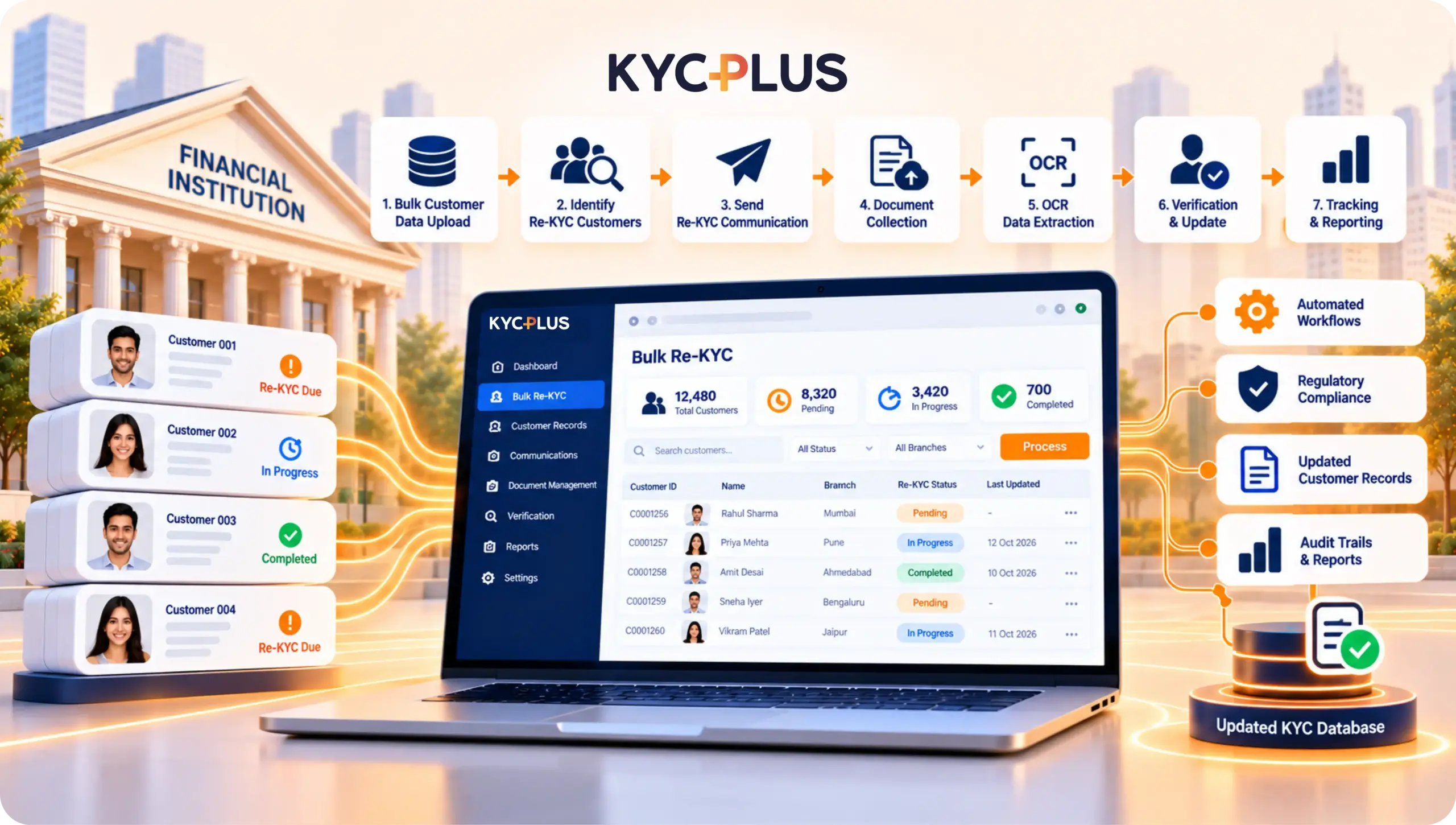
Financial institutions manage thousands, and sometimes millions, of customer records. Over time, customer information changes. Customers move to new addresses, update their mobile numbers, change their identity documents, or revise other important details. Financial institutions must maintain accurate and updated customer records to support regulatory compliance, risk management, and smooth operations. This is where a bulk Re-KYC solution for financial institutions becomes important.Traditional Re-KYC processes often involve manual communication, physical document collection, repetitive data entry, and individual verification of customer records. When an institution needs to update a large customer base, these activities can create significant operational pressure. Employees may spend considerable time following up with customers, checking documents, updating records, and maintaining verification reports.
A bulk Re-KYC solution helps financial institutions manage these activities through a more structured and technology-driven process. Instead of handling every customer record separately, institutions can process customer data in bulk, identify pending cases, collect updated documents, validate information, and monitor verification progress through centralized workflows.
For banks, cooperative banks, Urban Cooperative Banks (UCBs), District Central Cooperative Banks (DCCBs), NBFCs, and credit societies, automated Re-KYC processing can improve operational efficiency while supporting consistent customer verification practices.
This guide explains how bulk Re-KYC works, why financial institutions need it, its essential features, implementation considerations, and how automation can simplify customer data management.
A bulk Re-KYC solution for financial institutions is a digital system that helps banks and other regulated financial organizations manage customer re-verification activities for a large number of accounts simultaneously.
Re-KYC, or periodic updating of Know Your Customer information, involves reviewing and updating customer identification details and other required records. The process helps institutions maintain current customer information in accordance with applicable regulatory requirements and internal policies.
In a traditional process, employees may need to identify customers whose KYC information requires updating, contact them individually, collect documents, verify the information, and update the institution’s records.
A bulk Re-KYC solution introduces automation into this workflow.
It allows institutions to:
The main objective of a bulk Re-KYC solution for financial institutions is to reduce repetitive manual activities and make large-scale customer verification more organized, trackable, and efficient.
It is important to understand that automation supports the Re-KYC process; financial institutions must still follow applicable RBI directions, KYC requirements, customer identification procedures, and their approved internal policies.
Financial institutions continuously manage customer information across different branches, systems, and operational departments. As the customer base grows, maintaining accurate KYC records becomes increasingly challenging.
A small institution may initially manage Re-KYC through spreadsheets and manual follow-ups. However, the same approach becomes difficult when thousands of customer records need attention.
A bulk Re-KYC solution for financial institutions helps address these operational challenges.
Banks and financial institutions may have thousands of savings accounts, current accounts, loan accounts, and other customer relationships.
When Re-KYC activities become due, identifying and processing every eligible customer manually can consume considerable time.
Bulk processing allows institutions to upload customer records and manage verification activities through a centralized system.
Manual data entry increases employee workload and may introduce errors when updating customer names, addresses, identification details, and other information.
Automated data extraction and validation can reduce repetitive typing and help employees review information more efficiently.
Customer follow-ups are an important part of Re-KYC. Customers may not respond to the first communication, may submit incomplete documents, or may require additional assistance.
A digital Re-KYC workflow can help institutions organize communication, track responses, and identify customers who still need to complete the process.
Outdated customer information can create operational difficulties during account servicing, communication, and verification activities.
A structured bulk Re-KYC solution helps institutions maintain a more consistent process for updating customer records.
Without centralized monitoring, management may find it difficult to understand how many customers have completed
Re-KYC and how many cases remain pending.
A centralized dashboard can provide visibility into completed, pending, rejected, and under-review cases.
Before understanding the benefits of automation, it is important to examine the challenges financial institutions face with traditional Re-KYC operations.
Employees may need to review customer databases, identify records requiring updates, and prepare separate lists for follow-up.
This process becomes time-consuming when data is distributed across multiple branches or systems.
Traditional processes may require customers to visit branches and submit physical copies of identity and address documents.
This can create inconvenience for customers, especially those living far from their home branch.
Employees often need to check documents, compare information, enter updated details, and maintain records manually.
Repeating these activities across a large customer database increases operational workload.
When different employees and branches maintain separate spreadsheets or registers, it becomes difficult to identify the latest status of each customer.
Management may not have a consolidated view of the entire Re-KYC operation.
Physical files and scattered digital documents can make it difficult to retrieve customer records when required.
A centralized document management system can help organize customer documents and verification records.
Manual reporting may require employees to collect information from different departments and prepare consolidated reports.
Automated dashboards and reports can reduce this effort and improve visibility.
A bulk Re-KYC solution for financial institutions generally follows a structured workflow. The exact process may vary depending on the institution’s requirements, technology infrastructure, customer categories, and applicable regulatory guidelines.
The following steps explain how an automated bulk Re-KYC process can work.
The first step is collecting customer information from the institution’s existing systems.
Financial institutions may have customer records stored in Core Banking Systems (CBS), customer management platforms, spreadsheets, or other databases.
A bulk Re-KYC solution allows authorized employees to upload customer data using supported file formats or configured integrations.
The uploaded information may include:
Before processing, the system should check whether the uploaded data follows the required format and contains the necessary fields.
After uploading customer data, the system can perform configured validation checks.
These checks may identify:
Institutions can also classify customers based on their Re-KYC requirements and internal workflows.
For example, customers may be grouped into categories such as:
This classification helps financial institutions prioritize their Re-KYC activities.
Once customer records are classified, the institution can initiate communication through configured channels.
Depending on the platform and integration, communication may include SMS, email, or other supported notification methods.
Customers can receive instructions explaining why their information needs to be updated and how they can complete the process.
Clear communication is important because customers should understand what information is required and how to submit it securely.
A digital Re-KYC workflow can allow customers to submit the required documents through an approved digital channel.
Depending on the institution’s process, customers may be asked to provide updated identity documents, address information, photographs, or other required details.
The system can organize submitted documents against the corresponding customer record.
This reduces dependence on physical document handling and helps employees access customer submissions through a centralized interface.
Optical Character Recognition (OCR) technology can extract information from supported document images and PDFs.
For example, OCR may help extract:
Extracted information can be presented to employees for review and comparison with existing customer records.
OCR improves data-entry efficiency, but extracted information should not automatically be treated as verified. Appropriate validation and review controls remain necessary.
After collecting documents and customer details, the institution must verify the information according to its applicable KYC procedures.
A bulk Re-KYC solution for financial institutions can support configured verification workflows, document checks, comparison of existing and updated information, and employee review.
Depending on the institution’s approved process and available integrations, additional verification methods may also be used.
Cases that cannot be processed automatically can be assigned for manual review.
Once the verification process is completed and approved, updated customer information can be transferred to the institution’s relevant systems through supported integration methods.
For banks, this may involve integration with the Core Banking System (CBS).
The exact update process depends on the bank’s system architecture, permissions, integration scope, and approval workflow.
Maintaining consistency between the Re-KYC platform and the institution’s primary customer records is important.
The final step is monitoring the progress of Re-KYC activities.
A centralized dashboard can display information such as:
These reports help management understand the progress of bulk Re-KYC operations and identify areas that require attention.
Not every digital KYC platform offers the same capabilities. Financial institutions should evaluate a solution based on their operational requirements, customer volume, integration needs, security expectations, and regulatory responsibilities.
The following features are particularly useful when selecting a bulk Re-KYC solution for financial institutions.
Bulk upload is one of the most important capabilities.
The system should support importing a large number of customer records through approved file formats or integrations.
It should also provide validation results so employees can identify incorrect formats, missing information, and duplicate entries before processing.
A useful Re-KYC platform should help institutions organize customer records according to their verification requirements.
This may include categorization by customer type, document status, pending information, or internal priority.
Proper classification makes it easier for employees to manage large volumes of customer records.
OCR technology can reduce manual document reading and data-entry activities.
A document intelligence capability can extract information from supported documents and make it available for review.
Institutions should check which document types are supported and whether the solution provides confidence indicators, validation checks, and manual correction options.
A digital document collection facility allows customers to submit updated information without depending entirely on branch visits.
The platform should provide a clear customer journey and securely associate uploaded documents with the correct customer record.
Workflow automation helps manage each stage of the Re-KYC process.
For example, a case may move through the following stages:
1. Customer record uploaded.
2. Re-KYC requirement identified.
3. Customer notification initiated.
4. Documents submitted.
5. Verification in progress.
6. Employee review, if required.
7. Approval or rejection.
8. Record update completed.
Institutions should be able to configure workflows according to their internal operating procedures.
A centralized dashboard provides a consolidated view of Re-KYC operations.
Branch managers and authorized administrators can monitor progress, identify pending cases, and review operational performance.
Dashboard filters can also help institutions analyze cases by branch, customer category, status, or date.
For banks, integration with the Core Banking System is an important consideration.
CBS integration can help exchange relevant customer information between systems, subject to the institution’s technical architecture and approved integration scope.
It can reduce duplicate data entry and support consistency between customer records.
Financial institutions should verify the available APIs, data mapping, access permissions, and update controls before implementation.
A Document Management System (DMS) helps organize customer documents and related records in a structured digital repository.
Authorized employees can retrieve documents when required, subject to access controls and retention policies.
A centralized repository can also reduce dependency on scattered files and physical documentation.
Financial institutions need visibility into activities performed during the Re-KYC process.
A suitable solution should maintain relevant activity logs, such as:
The audit trail should support the institution’s internal audit, security, and record-retention requirements.
Not every employee should have access to every customer record or system function.
Role-based access control helps define what different users can view, modify, approve, or manage.
For example, branch employees, verification teams, administrators, and auditors may have different permissions.
This helps institutions manage access according to job responsibilities.
Management Information System (MIS) reports help decision-makers monitor the overall Re-KYC process.
Useful reports may include pending customer lists, completed cases, branch-wise progress, rejected submissions, and employee workload.
The availability of exportable reports can also help management perform further analysis.
Financial institutions should consider whether the platform can support their current customer volume as well as future growth.
A scalable bulk Re-KYC solution should be capable of handling increased data volumes, additional branches, more users, and changing operational requirements.

Different financial institutions have different operating models. A cooperative bank may have branch-level customer records, while an NBFC may manage customer information through lending and servicing systems.
A flexible bulk Re-KYC solution for financial institutions can support these different operating requirements.
Cooperative banks serve customers across different locations and branches. Their customer databases may contain records accumulated over many years.
Managing Re-KYC manually across multiple branches can create coordination challenges.
A digital bulk Re-KYC system can help cooperative banks:
This can help cooperative banks improve coordination between their branches and central operations teams.
Urban Cooperative Banks handle different categories of customers, including individuals, businesses, and other entities.
Their Re-KYC requirements may vary according to customer type and applicable verification procedures.
A bulk Re-KYC solution can help UCBs manage customer information updates through structured workflows.
It can also provide better visibility into pending cases and support the centralized management of digital documents.
DCCBs may operate through multiple branches and maintain customer relationships across a wide geographical area.
Coordinating customer verification activities across branches can be challenging without centralized monitoring.
A bulk Re-KYC solution can help DCCBs consolidate customer records, track branch-level progress, and manage verification activities through a common platform.
NBFCs manage customer information across loan applications, existing loan accounts, repayment activities, and customer servicing operations.
Re-KYC may involve updating customer identification and address information while maintaining consistency across connected systems.
A digital Re-KYC platform can support document collection, OCR-based extraction, verification workflows, and integration with relevant lending or customer management systems.
Multistate credit societies may operate through branches or offices in multiple states.
They need organized processes to manage member records, customer documents, and updated information.
A bulk Re-KYC solution can help these institutions centralize customer verification activities and monitor progress across different locations.
Other regulated financial institutions may also benefit from automated customer information updates.
The suitability of a solution depends on the institution’s regulatory framework, customer categories, operational requirements, and approved KYC processes.
Bulk Re-KYC vs Manual Re-KYC: Understanding the Difference
Manual Re-KYC and automated bulk Re-KYC follow the same broad objective: updating and verifying customer information.
Automation does not remove the need for employee oversight. Instead, it helps financial institutions organize repetitive tasks and allows employees to focus on verification, exceptions, and customer support.
Selecting software is only one part of a successful Re-KYC initiative. Financial institutions should also plan how the solution will fit into their existing processes.
Before implementation, institutions should review the quality and structure of their customer databases.
They should identify duplicate records, missing information, inconsistent formats, and outdated contact details.
A clean and properly mapped database makes bulk processing easier.
Different customers may require different types of information updates or verification.
Institutions should define customer categories and the corresponding workflows before configuring the system.
Re-KYC processes should follow the applicable regulatory directions and the institution’s approved policies.
For banks regulated by the Reserve Bank of India, the applicable RBI KYC directions and subsequent updates should guide the institution’s process.
Technology should support these requirements rather than replace the institution’s responsibility for compliance.
Financial institutions should identify which existing systems need to exchange information with the Re-KYC platform.
These may include:
The institution should confirm integration feasibility, API availability, data mapping, and security controls.
A successful implementation requires clearly defined responsibilities.
Institutions should decide who can upload customer data, review documents, verify information, approve cases, and access reports.
Approval workflows should reflect the institution’s internal control structure.
Employees should understand how to use the system, manage customer requests, review extracted information, and handle incomplete or exceptional cases.
Training should cover both system functionality and the institution’s Re-KYC operating procedures.
Customer KYC information is sensitive financial data.
Institutions should evaluate encryption, authentication, access controls, activity logging, secure document storage, backup arrangements, and data-retention policies.
They should also assess the technology provider’s security practices and contractual responsibilities.
Before rolling out the solution across the entire institution, it may be useful to begin with a selected branch or customer segment.
A pilot can help identify data issues, workflow gaps, integration problems, and training requirements.
The institution can use these findings to improve the process before wider deployment.
A bulk Re-KYC solution should be evaluated through measurable operational indicators rather than simply counting the number of records uploaded.
Financial institutions can monitor the following Key Performance Indicators (KPIs):
This measures the percentage of targeted customers who have successfully completed the required Re-KYC process.
This indicates how many customer cases are still awaiting documents, verification, approval, or other action.
This measures the proportion of submitted documents that are rejected or require resubmission.
A high rejection rate may indicate unclear customer instructions, poor-quality uploads, or issues with document validation.
This measures the time taken to process a Re-KYC case from initiation to completion.
Institutions can compare processing times before and after automation to understand operational improvements.
For institutions with multiple branches, branch-level reports can help management identify differences in completion rates and pending workloads.
Institutions can monitor how many cases employees process and how much time is spent on manual activities.
These indicators can help management identify opportunities to improve workflows and resource allocation.
Some cases may require additional verification or management intervention.
Tracking these cases helps institutions understand where the process needs better controls or additional employee support.
A combination of these KPIs provides a more complete picture of the performance of a bulk Re-KYC solution for financial institutions.
Managing Re-KYC activities across a large customer base requires more than a document collection facility. Financial institutions need a structured platform that can support customer data processing, document management, verification workflows, and operational monitoring.
KYCPLUS by Azlogics is a digital KYC platform designed to support financial institutions in managing digital KYC, CKYC, Re-KYC, and Automate Customer Onboarding activities.
For institutions looking to improve their bulk Re-KYC operations, KYCPLUS can support several important activities.
KYCPLUS supports bulk-oriented data processing workflows that can help institutions manage customer information more systematically.
Instead of depending entirely on individual record handling, authorized users can work with customer data through structured digital processes.
KYCPLUS includes AI-powered OCR and document intelligence capabilities that can help extract relevant information from supported customer documents.
This can reduce repetitive manual data-entry work and make document review more organized.
Digital workflows can help institutions manage customer information updates, document submissions, and verification activities through a centralized application.
The process can be configured according to the institution’s operational requirements.
KYCPLUS provides document management capabilities that help institutions organize customer documents and maintain digital records.
This can make document retrieval and internal review more convenient for authorized employees.
Financial institutions often need their KYC platform to work alongside existing banking infrastructure.
KYCPLUS supports integration-oriented workflows, including CBS integration, subject to the institution’s technical environment and agreed integration scope.
Centralized monitoring helps authorized users review process progress and manage customer verification activities.
Digital activity records can also support operational tracking and internal audit requirements.
The right implementation depends on the institution’s customer volume, system architecture, verification policies, and specific requirements. Financial institutions should evaluate the available modules and integration scope before deployment.
The financial services industry is increasingly adopting digital systems to improve customer experience and operational efficiency.
Re-KYC is also moving towards more structured digital processes. As customer databases grow, financial institutions will need better ways to identify pending cases, collect updated information, process documents, and monitor verification activities.
Several technologies are expected to play an important role in this development.
AI-powered document processing can help extract and organize information from customer documents.
It may also support document classification and identification of information that requires employee attention.
However, AI-based outputs should be used with suitable validation and human oversight.
API-based architecture can help different systems exchange customer information more efficiently.
Integration between Re-KYC platforms, banking systems, and document management applications can reduce duplicate data entry and improve workflow coordination.
Customers increasingly expect convenient digital services.
Financial institutions can improve the Re-KYC experience by offering clear instructions, secure document submission, and transparent communication about pending requirements.
Centralized dashboards can help management monitor customer verification activities across branches and departments.
This can support better planning, workload allocation, and operational decision-making.
Not every customer record can be processed through a standard automated workflow.
Future systems will increasingly focus on identifying exceptions, routing them to the right employees, and tracking their resolution.
These developments can help make bulk Re-KYC operations more organized while preserving the importance of verification controls and regulatory compliance.
Managing customer information is an ongoing responsibility for banks and financial institutions. As customer databases expand, traditional Re-KYC methods can create challenges related to manual processing, document collection, customer communication, and operational monitoring.
A bulk Re-KYC solution for financial institutions provides a structured way to manage these activities through digital data processing, document intelligence, workflow automation, centralized monitoring, and system integration.
For cooperative banks, UCBs, DCCBs, NBFCs, and credit societies, the right platform can help reduce repetitive administrative work, improve visibility into pending cases, and organize customer verification activities across branches.
However, successful implementation requires more than selecting software. Institutions should evaluate data quality, regulatory requirements, integration capabilities, security controls, employee responsibilities, and customer experience.
Platforms such as KYCPLUS by Azlogics can support financial institutions in building more organized digital KYC and Re-KYC workflows.
As the financial sector continues to adopt digital processes, bulk Re-KYC automation will remain an important part of efficient customer information management.
Ans: A bulk Re-KYC solution for financial institutions is a digital platform that helps banks and other financial organizations process customer re-verification activities for large numbers of customers. It can support bulk data uploads, document collection, information extraction, verification workflows, and centralized reporting.
Ans: Banks need bulk Re-KYC software to manage customer information updates more efficiently. It helps organize large customer databases, reduce repetitive manual activities, track pending cases, and maintain structured digital records.
Ans: Cooperative banks, Urban Cooperative Banks, District Central Cooperative Banks, NBFCs, multistate credit societies, and other financial institutions can use bulk Re-KYC solutions, depending on their regulatory requirements and operational needs.
Ans: Bulk Re-KYC automation generally involves uploading customer records, validating data, identifying customers requiring updates, collecting documents, extracting information through OCR, completing verification workflows, and tracking case status through a centralized dashboard.
Ans: Yes. A bulk Re-KYC platform can integrate with a Core Banking System through supported APIs or other approved integration methods. Integration feasibility depends on the CBS architecture, available interfaces, security requirements, and agreed scope.
Ans: OCR helps extract relevant information from supported document images and PDFs. It can reduce manual data entry by making information available for employee review and validation.
Ans: Yes. Depending on the institution’s approved process and the available platform capabilities, customers may submit updated information and documents through digital channels. The institution must ensure that the selected process meets applicable KYC requirements.
Ans: Important features include bulk customer data upload, data validation, OCR, digital document collection, workflow automation, CBS integration, centralized document management, role-based access, audit trails, dashboards, and MIS reporting.
Ans: Yes. It can help cooperative banks and credit societies organize customer information updates, manage documents, coordinate branch-level activities, and monitor Re-KYC progress through centralized workflows.
Ans: KYCPLUS by Azlogics is a digital KYC platform that supports KYC, CKYC, Re-KYC, document management, OCR-based document processing, and integration-oriented workflows. Financial institutions can evaluate its capabilities based on their customer verification requirements and implementation scope.