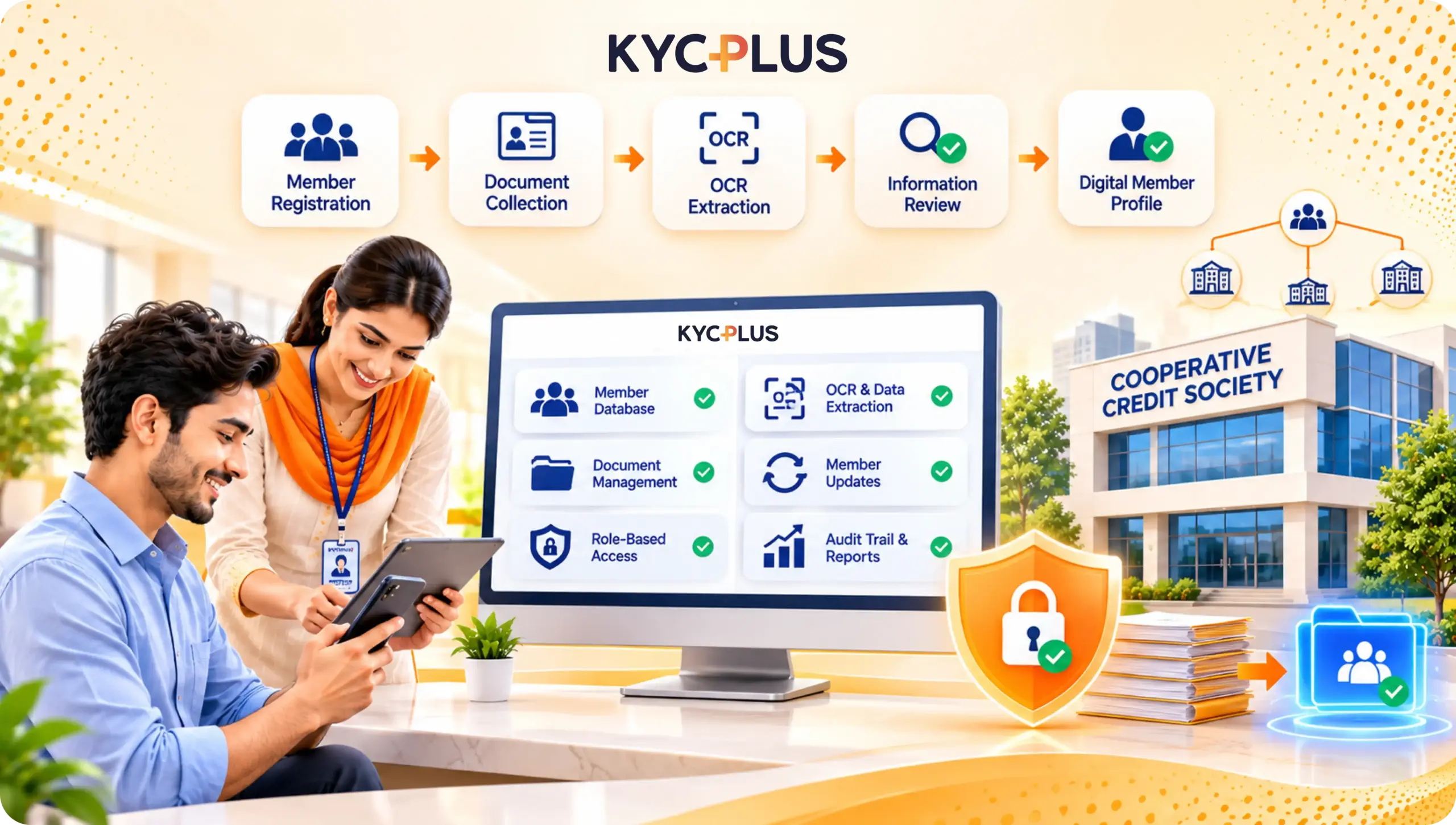
Cooperative credit societies play an important role in providing financial services to their members. They help individuals, small business owners, employees, and local communities access savings and credit facilities through a member-focused financial structure. As the number of members increases, managing their personal information and identification documents becomes an important operational responsibility. Implementing a KYC Solution for Cooperative Credit Societies helps streamline member onboarding, simplify identity verification, and maintain accurate member records. Every new membership application requires collecting relevant details, checking documents, maintaining records, and ensuring that information is properly updated.
For many societies, these activities are still managed through paper forms, physical registers, spreadsheets, and manual document verification. While these methods may work for a small number of members, they can become difficult to manage as the society grows.
A digital KYC solution helps societies organize member information, collect documents, extract data, manage verification activities, and maintain digital records through a structured platform.
Instead of depending entirely on paperwork and manual data entry, cooperative credit societies can use technology to simplify everyday member verification activities.
A suitable KYC Solution for Cooperative Credit Societies can help improve the member onboarding experience, reduce repetitive administrative work, make document retrieval easier, and provide better visibility into member records.
This guide explains how digital KYC solutions work, why cooperative credit societies need them, which features to consider, and how technology can make member verification easier.
A KYC Solution for Cooperative Credit Societies is a digital system designed to help societies collect, verify, organize, and maintain member identification information and supporting documents.
KYC stands for Know Your Customer. In the context of cooperative credit societies, the process involves identifying members and maintaining the information and documents required under the applicable laws, regulatory requirements, and the society’s approved policies.
Traditionally, societies may collect member details through printed forms and physical document copies. Employees manually enter the information into registers or software and store documents in individual files.
A digital KYC platform helps bring these activities into a more organized workflow.
Depending on the available features, a KYC solution can support:
The main purpose of a KYC Solution for Cooperative Credit Societies is to simplify member information management while maintaining an organized verification process.
It is important to note that cooperative credit societies should follow the KYC and identification requirements applicable to their legal classification and operations. CKYC requirements should not be assumed to apply automatically to every cooperative credit society.
Cooperative credit societies often work with a growing number of members and documents. As membership increases, maintaining accurate records becomes more challenging.
Manual processes can create difficulties in document collection, information entry, record retrieval, and member verification.
A KYC Solution for Cooperative Credit Societies can help address these challenges.
As societies expand their membership, the volume of personal information and supporting documents also increases.
Maintaining every member’s information through physical registers and separate spreadsheets can become difficult.
A digital KYC platform helps organize member profiles in a centralized environment.
Employees often need to check identity documents, compare personal information, and enter details manually.
These activities take time, especially when processing multiple membership applications.
Digital document processing and OCR can reduce repetitive data-entry activities and make document review more structured.
When member documents are stored in physical files, retrieving an old record can take considerable time.
Employees may need to search through registers, folders, and filing cabinets.
A digital KYC solution allows authorized employees to search and access member records through a structured system.
The same member information may need to be entered into multiple forms, registers, or applications.
This increases administrative work and creates opportunities for data-entry mistakes.
A digital platform with information extraction and reusable member profiles can help reduce repeated entry.
Member information can change over time.
For example, members may update their residential addresses, mobile numbers, or other personal details.
A structured digital system helps societies record these changes and maintain an updated member profile according to their policies and applicable requirements.
Some cooperative credit societies operate through multiple branches or offices.
When every branch maintains separate records, head-office employees may find it difficult to monitor overall member information.
A centralized KYC platform can help authorized users access relevant member records across branches, subject to defined permissions.
Before adopting a digital solution, it is important to understand the difficulties associated with traditional member verification.
Many societies still depend on printed membership forms to collect personal information.
Employees need to review the forms, check the submitted documents, and enter the details into their records.
This process can increase paperwork and administrative effort.
Maintaining identity documents, address proofs, photographs, and membership records in physical files requires proper organization.
As records increase, document storage and retrieval can become difficult.
Sometimes members submit forms with missing details or incomplete documents.
Employees must contact the member, request the missing information, and update the records.
A digital workflow can help identify missing mandatory fields before a submission moves to the next stage.
Without a centralized tracking system, employees may find it difficult to understand whether a membership application is pending, under review, or completed.
A digital dashboard can help provide better visibility into application status.
Manual data entry and separate branch-level records may result in duplicate member profiles.
A KYC platform with configured duplicate identification checks can help employees identify possible duplicate records for review.
Preparing member-related reports manually can require collecting information from multiple registers and spreadsheets.
Digital reporting can help societies generate organized reports with less repetitive work.
Every cooperative credit society has different operational requirements. Some societies manage a limited number of members, while others handle thousands of member records across multiple branches.
Therefore, selecting the right KYC Solution for Cooperative Credit Societies requires understanding the features that can simplify everyday operations.
Digital member onboarding helps societies collect member information through structured digital forms.
Instead of depending entirely on handwritten applications, employees can enter member details directly into the platform.
A digital onboarding module can include:
This makes the membership registration process more organized and reduces unnecessary paperwork.
A centralized member database helps societies maintain member information through a common digital platform.
Authorized employees can search for member records and access relevant information without depending on physical registers.
Important capabilities include:
For societies operating through multiple branches, centralized member data management can improve coordination between branches and head-office teams.
Optical Character Recognition (OCR) is one of the useful technologies available in modern KYC platforms.
OCR helps extract information from supported document images and PDF files.
For example, when a member uploads an identity document, OCR technology can help extract details such as:
Employees can review the extracted information and correct any errors before completing the verification process.
An AI-powered KYC Solution for Cooperative Credit Societies can reduce repetitive manual data entry and help employees process documents more efficiently.
A Document Management System (DMS) helps societies maintain member documents in a structured digital repository.
Instead of storing every document in separate physical files, the platform can associate digital documents with individual member profiles.
Important capabilities include:
This makes it easier for authorized employees to retrieve member documents whenever required.
Depending on applicable requirements and the society’s verification process, member identification may involve PAN details, officially valid documents, and other accepted identification information.
A digital KYC platform can help collect these details, organize supporting documents, and provide verification workflows.
The society should configure the system according to its legal obligations and approved internal policies.
Member details may change after registration.
For example, a member may change their address, mobile number, or other personal information.
A suitable KYC Solution for Cooperative Credit Societies should allow authorized employees to update member information and maintain relevant records of the changes.
This helps societies maintain more accurate member databases.
Depending on the society’s applicable legal requirements and internal policies, member information may need to be reviewed or updated periodically.
A digital platform can support these activities through structured workflows.
Possible capabilities include:
The frequency and nature of these activities should be determined by the requirements applicable to the particular society.
Employees frequently need to search for member details while handling daily operations.
A centralized KYC system should provide convenient search options based on available member information.
Search fields may include:
Quick retrieval can reduce the time employees spend searching through physical files.
Different employees perform different activities within a cooperative credit society.
A KYC platform should allow administrators to define permissions according to employee responsibilities.
For example:
Role-based access helps societies manage customer information securely.
A digital KYC platform should maintain relevant activity records.
These may include:
A suitable audit trail helps societies review activities and maintain better operational accountability.
Management needs visibility into membership and verification activities.
A centralized dashboard can display:
A KYC Solution for Cooperative Credit Societies with useful reporting capabilities can help management monitor operations without collecting information manually from different employees.
Many cooperative credit societies already use software to manage accounting, member records, deposits, loans, and other operations.
A digital KYC platform should be evaluated for its ability to integrate with the society’s existing applications.
Depending on technical feasibility, integration may support:
The integration scope should be discussed with the existing software provider and KYC solution providers before implementation.
A digital KYC process generally follows a series of steps, starting with member registration and ending with verification and record maintenance.
The exact workflow may differ according to the society’s operational requirements.
The process begins when an individual applies for membership.
The society collects the required personal information through a digital form or an employee-assisted registration process.
The member submits the required identification and supporting documents.
These may include documents accepted under the society’s applicable verification process.
The employee uploads the documents to the KYC platform.
The platform uses OCR to extract available information from supported documents.
Employees can review the extracted details and compare them with the information submitted by the member.
The society reviews the member’s information and supporting documents according to its applicable procedures.
If any information is incomplete or incorrect, the employee can request clarification or additional documentation.
After the required checks and approvals, the member’s information can be organized into a digital profile.
The profile can contain personal information, identification details, supporting documents, and relevant membership records.
The documents are associated with the member profile and stored in the configured document management system.
Authorized employees can retrieve the documents when required.
Whenever member information changes, authorized employees can update the relevant details through the configured workflow.
The platform can maintain an activity history to support tracking and accountability.
Management can monitor new registrations, pending verification activities, completed cases, and other operational information through centralized reports.
Adopting a KYC Solution for Cooperative Credit Societies can improve the way societies manage member information and documentation.
The benefits extend beyond reducing paperwork. Digital KYC can help improve operational organization, employee productivity, and member service.
Digital forms, document uploads, and organized verification workflows can simplify the registration process.
Employees can manage applications through a structured system rather than depending entirely on paper-based procedures.
Digital document collection and storage can reduce the need to maintain large volumes of physical KYC files.
This can make everyday administration more convenient.
A centralized database helps societies organize member information in a searchable format.
Authorized employees can retrieve relevant records more easily.
OCR-based document processing can extract information from supported documents.
This helps reduce repetitive typing and allows employees to focus on reviewing the information.
Digital document storage makes it easier to retrieve member documents without searching through physical registers and folders.
Employees can manage multiple activities through one structured platform.
This can reduce time spent on repetitive administrative work
A centralized platform helps different branches work with common member records, subject to their access permissions.
Head-office teams can also monitor relevant activities through consolidated reports.
Member details can be updated through structured workflows, helping societies maintain accurate records.
Activity logs, verification status, and digital records can help management understand how member applications and information updates are being processed.
As membership increases, manual record management can become more difficult.
A scalable digital KYC platform can support additional members, employees, branches, and document volumes.
Employee review, document checks, approvals, and compliance controls remain important.
The objective is to make the process more organized and reduce avoidable manual work.
Not every cooperative credit society operates in the same way.
Some societies work through a single office, while others manage members across multiple branches or locations.
Their software requirements may therefore differ.
Smaller societies may need a straightforward system to manage member registration, identification documents, and digital records.
Important features include:
Societies with multiple branches need better coordination and centralized visibility.
A KYC Solution for Cooperative Credit Societies operating across branches should support:
Patsansthas manage member relationships and financial records as part of their cooperative operations.
A digital KYC platform can help organize member identification documents, registration details, and information updates.
It can also reduce dependence on physical member files.
Societies operating across multiple states may manage members and documents through different offices.
A centralized digital platform can help bring relevant member information and verification activities into one organized environment.
As societies expand, they may need more structured processes for managing member records and employee access.
A scalable KYC platform can support increased document volumes and additional users as operational requirements grow.
Selecting the right software is an important decision for any cooperative credit society.
A solution that works for a small society may not be sufficient for an institution managing thousands of members across multiple branches.
Before selecting a KYC Solution for Cooperative Credit Societies, management should evaluate the following factors.
Start by understanding how the society currently manages member information.
Identify:
This assessment helps identify the areas where digital automation can provide value.
The software should provide a structured way to create, search, update, and manage member profiles.
Check whether employees can quickly retrieve records using member IDs, names, mobile numbers, and other available identifiers.
OCR can reduce repetitive data-entry activities.
However, societies should evaluate the technology based on supported document types, extraction accuracy, language support, and manual correction facilities.
The platform should support secure digital storage and convenient retrieval of member documents.
Check whether documents can be organized by member, document category, and other relevant parameters.
If the society already uses accounting or member management software, integration can be an important requirement.
Discuss available APIs, data exchange formats, and integration feasibility before selecting a platform.
Member information should be protected through suitable security measures.
Important considerations include:
Management should be able to understand membership activities and document verification status without depending entirely on manually prepared reports.
Look for useful dashboards, member reports, and branch-wise monitoring.
Compare the software cost with the features, implementation requirements, customization, training, and ongoing support.
A solution should fit the society’s current requirements and provide room for future expansion.
Before making a decision, request a live demonstration.
Ask the provider to demonstrate actual workflows such as member registration, document upload, OCR extraction, record search, and document retrieval.
This helps management understand how the platform will work in everyday operations.
A KYC Solution for Cooperative Credit Societies handles personal information and identification documents. Therefore, security should be considered an essential part of software selection.
Member information should be protected against unauthorized access, alteration, and disclosure.
The platform should use appropriate security controls for storing and transferring information.
Employees should only have access to the information and functions required for their responsibilities.
For example, a data entry employee may create a member profile, while an authorized manager may review and approve the information.
Digital member documents should be stored securely.
The society should understand how documents are protected, accessed, backed up, and retained.
The system should maintain relevant activity logs so that authorized administrators can review important actions performed by employees.
Societies should understand the backup process and recovery arrangements offered by the software provider.
This helps ensure that important member information can be restored in the event of a technical issue.
Cooperative credit societies should identify the laws, regulatory directions, registration conditions, and internal policies applicable to their particular legal structure and operations.
The KYC software should be configured to support those requirements.
A technology platform can help organize the process, but it does not independently guarantee regulatory compliance.
Even a feature-rich KYC platform may not deliver the expected results if implementation is not properly planned.
Cooperative credit societies should avoid the following common mistakes.
Choosing software only because it has many features can lead to unnecessary complexity.
The society should first identify its actual member verification and document management requirements.
Old member databases may contain incomplete details, duplicate entries, and inconsistent formats.
Importing this data without validation can create problems later.
Data cleaning and mapping should be part of the implementation plan.
Employees are the primary users of the system.
Without proper training, they may continue using manual registers and spreadsheets even after software implementation.
Training should cover member registration, document uploads, information updates, and report generation.
Providing unrestricted access to every employee can create unnecessary data security risks.
User roles and permissions should be defined before the system goes live.
Societies should understand how their documents will be stored and retrieved.
They should also review backup, retention, and access policies.
A full implementation without testing can expose the society to avoidable operational problems.
Start with a small group of users or a selected branch, identify issues, and improve the workflow before expanding deployment.
Managing member information through physical files and manual registers can become difficult as a cooperative credit society grows.
A digital platform can help organize member onboarding, document processing, verification activities, and information management through a structured workflow.
KYCPLUS by Azlogics is a digital KYC platform designed to support financial institutions with digital onboarding, KYC operations, document management, and related verification workflows.
For cooperative credit societies, its relevant capabilities can support the following activities.
KYCPLUS can support digital information collection workflows, helping employees manage member details through structured forms and digital processes.
Its AI-powered OCR capabilities can help extract relevant information from supported documents.
This can reduce repetitive manual data entry and make document processing more organized.
KYCPLUS provides document management capabilities that help organize member documents and associate them with relevant records.
Authorized employees can access documents according to configured permissions.
A structured digital workflow can help societies manage member information and related document records more efficiently
Where applicable to the institution’s requirements, KYCPLUS can support workflows for collecting updated information and managing related verification activities.
For societies using existing software, integration requirements can be evaluated based on available APIs, system compatibility, and agreed implementation scope.
Digital workflows and activity tracking can help authorized users monitor verification progress and review relevant operational activities.
The exact modules, deployment model, and integration scope should be evaluated according to each society’s requirements.
Cooperative credit societies are gradually adopting technology to improve member services and internal operations.
Digital KYC is one area where technology can help reduce paperwork and make member information management more structured.
Several developments may influence the future of KYC Solution for Cooperative Credit Societies.
Digital member registration can make the process more convenient by reducing dependence on paper-based applications.
AI and OCR technologies can help extract information from documents, classify files, and identify incomplete information for employee review.
Societies may increasingly adopt centralized digital databases to manage member records across multiple branches.
Digital repositories can help societies organize documents, retrieve records, and maintain relevant information histories.
Integration between KYC platforms and existing society management software can reduce duplicate data entry and improve information exchange.
Digital document collection and structured information updates can make interactions between members and society employees more convenient.
The future of digital KYC will not simply be about replacing paper forms. It will be about creating better systems for managing member information, improving operational efficiency, and supporting responsible data management.
Member verification is an important part of cooperative credit society operations. As membership increases, managing identification documents, personal information, and member records through traditional methods can become time-consuming.
A KYC Solution for Cooperative Credit Societies provides a structured way to manage these activities through digital onboarding, OCR-based document processing, centralized member records, document management, and information update workflows.
For patsansthas, multibranch societies, and growing cooperative credit societies, digital KYC can help reduce paperwork, improve document accessibility, and simplify everyday administrative activities.
However, selecting the right solution requires understanding the society’s actual requirements, applicable legal obligations, data security needs, and existing software infrastructure.
Platforms such as KYCPLUS by Azlogics can help societies explore digital approaches to member information collection, document processing, and KYC management.
Moving from manual paperwork to organized digital member records can be an important step towards more efficient cooperative credit society operations.
Ans: A KYC Solution for Cooperative Credit Societies is a digital platform that helps societies collect, verify, organize, and maintain member identification information and supporting documents through structured workflows.
Ans: KYC software helps societies manage member records, reduce paperwork, organize identification documents, simplify information updates, and improve document retrieval.
Ans: Yes. Digital KYC software can help patsansthas manage member registration, identification documents, digital records, and information updates, depending on their operational and legal requirements.
Ans: Depending on applicable requirements, a KYC platform may support PAN, officially valid documents, address proof, photographs, and other relevant identification documents.
Ans: OCR extracts available information from supported document images and PDFs. It can reduce manual data entry and help employees review member information more efficiently.
Ans: Yes. A centralized KYC platform can maintain searchable member profiles and associated documents, with access controlled according to employee permissions.
Ans: Yes. Depending on the platform’s capabilities, authorized employees can update member details through configured workflows and maintain relevant activity histories.
Ans: No. CKYC applicability depends on the institution’s legal classification and regulatory status. Cooperative credit societies should verify their specific obligations rather than assume CKYC applies to every society.
Ans: Integration may be possible through APIs or other supported interfaces. It depends on the existing software’s technical capabilities and the agreed integration scope.
Ans: It can simplify information collection, document uploads, OCR-based extraction, verification workflows, and digital record creation, helping employees manage membership applications more efficiently.
