 Blog
Digital KYC Platform for Cooperative Banks: Complete Guide to Automation, Compliance, and Customer Onboarding
Blog
Digital KYC Platform for Cooperative Banks: Complete Guide to Automation, Compliance, and Customer Onboarding
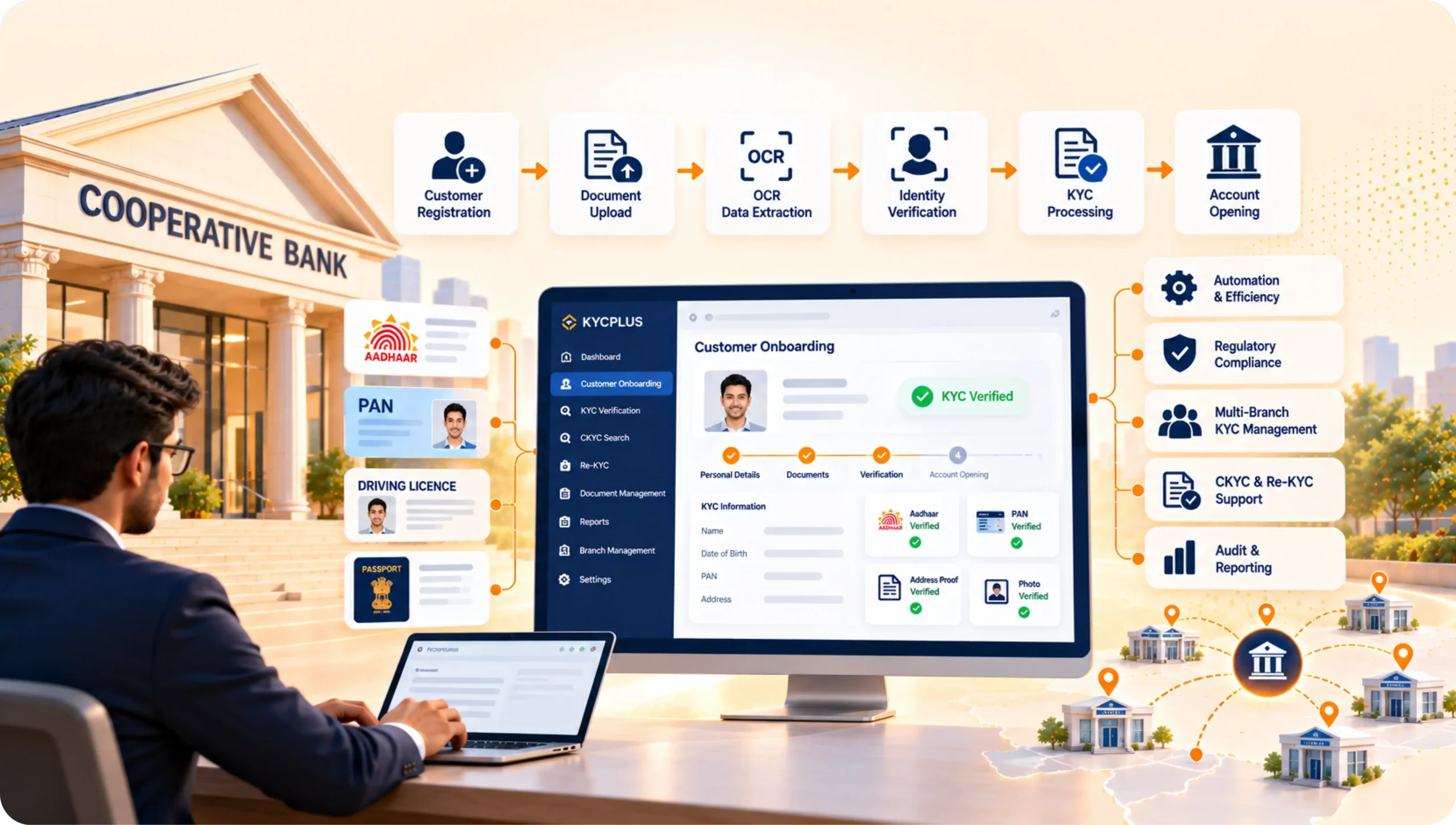
Cooperative banks play an important role in India’s financial ecosystem by providing banking services to individuals, small businesses, farmers, local communities, and members of cooperative societies. As customer expectations change and banking operations become increasingly digital, cooperative banks need efficient ways to manage customer identification, document verification, account opening, and periodic KYC updates. Traditional KYC processes often involve paper forms, physical document collection, manual data entry, repeated customer visits, and time-consuming verification activities. These processes can increase the workload of bank employees and make it difficult to maintain consistent customer records across branches. A digital KYC platform for cooperative banks can help address these challenges by bringing customer information collection, document handling, verification workflows, and record management into a structured digital environment.
Instead of managing every KYC activity separately, banks can use digital workflows to organize customer documents, extract information from supported records, track verification status, and support authorized CKYC and Re-KYC processes.
For cooperative banks operating through multiple branches, a digital approach can also improve visibility into pending applications and help standardize processes across locations.
However, implementing digital KYC is not simply about replacing paper forms with online forms. Banks must consider regulatory requirements, data security, existing banking software, employee workflows, and the needs of customers who may have different levels of digital access.
This guide explains how a digital KYC platform for cooperative banks works, its essential features, its role in CKYC and Re-KYC, and how cooperative banks can evaluate the right solution for their operational requirements.
A digital KYC platform for cooperative banks is a technology solution that helps banks manage customer identification, information collection, document verification workflows, and KYC record management through digital processes.
KYC stands for Know Your Customer. It refers to the procedures financial institutions use to establish and verify customer identity and collect the information required under applicable rules and internal policies.
In a traditional process, bank employees may collect physical forms, inspect documents, enter customer details manually, and maintain records across different systems. A digital KYC platform helps organize these activities within a more structured workflow.
Depending on the solution and its configuration, a digital KYC platform for cooperative banks may support:
The availability of these features varies between providers. Banks should verify which capabilities are included in the proposed implementation and which depend on external services or additional integrations.
For example, when a new customer applies to open an account, the bank may collect the required information and supporting documents through a configured digital workflow. The system can help organize the information, support document checks, and route the application to the appropriate employee for review.
A digital KYC platform does not automatically replace the bank’s Core Banking System (CBS). The CBS generally manages core banking operations, while the KYC platform focuses on customer information, verification workflows, documents, and related processes.
When appropriately integrated, these systems can complement each other and reduce repetitive data entry.
Cooperative banks often serve customers across different branches, towns, and local communities. Their KYC requirements can involve a combination of new customer onboarding, existing customer updates, document management, and periodic reviews.
Managing these activities manually can become difficult as customer records and operational requirements grow.
A digital KYC platform for cooperative banks helps organize KYC activities and gives bank teams a more consistent way to manage customer information.
Manual KYC processing can involve checking forms, entering information, scanning documents, filing records, and following up on incomplete submissions.
These repetitive tasks can consume valuable employee time.
A digital platform can support document capture, OCR-based data extraction, workflow routing, and application status tracking. Employees can then focus on validating information, resolving exceptions, and assisting customers.
The amount of manual work reduced depends on the platform’s capabilities and how well the bank configures its processes.
Opening a bank account may require collecting customer details, identity documents, address information, photographs, declarations, and other records relevant to the account type.
A digital KYC platform for cooperative banks can help organize the required information into a structured account-opening workflow.
When integrated with the bank’s other systems, verified information may be transferred to the appropriate application or banking process, subject to the bank’s controls.
This can reduce repeated data entry and help employees identify missing information earlier.
Cooperative banks operating through several branches need consistent procedures for collecting and managing customer information.
When every branch follows a different manual process, document quality, record organization, and processing practices may vary.
A centralized digital workflow can help standardize document checklists, status definitions, review steps, and access permissions.
This can make it easier for authorized employees to understand application status and retrieve records across branches.
Customer information may need to be reviewed, updated, or retrieved throughout the banking relationship.
If documents are stored in physical files, spreadsheets, emails, and disconnected applications, locating the right record can take time.
A digital KYC platform for cooperative banks can provide a structured way to associate documents with customer records and retrieve information when authorized.
Access permissions, retention policies, and recordkeeping procedures should be configured according to applicable requirements.
Existing customers may need to update information or complete periodic KYC requirements, depending on the applicable rules and circumstances.
Managing these updates manually can involve identifying customers whose records require attention, contacting them, collecting updated documents, and tracking completion.
A digital platform can help organize Re-KYC workflows, maintain status visibility, and manage pending tasks.
The specific workflow should reflect the bank’s approved policies and applicable regulatory requirements.
Choosing the right software requires evaluating how its features address the bank’s actual operational needs.
A digital KYC platform for cooperative banks should be assessed on its ability to support customer onboarding, document processing, KYC updates, reporting, integration, and information security.
The platform should support the collection and organization of customer documents through the channels used by the bank.
Depending on the implementation, this may include scanned documents, uploaded images, and files captured during an assisted branch process.
Important capabilities include:
A structured document collection process can reduce avoidable follow-ups and make customer records easier to manage.
Optical Character Recognition helps convert text from supported document images into machine-readable information.
For example, OCR may extract a customer’s name, address, or document number from a supported document and populate the relevant fields.
This can reduce manual typing and help employees process customer information more efficiently.
However, OCR is not the same as document authentication. Extracted information may contain errors, particularly when documents are blurred, damaged, poorly lit, or formatted in an unsupported way.
The bank should have appropriate validation and correction procedures before relying on extracted information.
A digital KYC platform for cooperative banks should support the bank’s required identification and verification processes.
Depending on the implementation, this may involve collecting customer information, organizing documents, tracking verification outcomes, and connecting with authorized verification services.
The platform should clearly distinguish between information collection, automated checks, employee review, and final decisions.
Banks should confirm which verification methods are supported and ensure that the configured workflow meets their approved procedures.
Central Know Your Customer (CKYC) processes are important for eligible financial institutions and customers where applicable.
CKYC involves the Central KYC Records Registry framework and the applicable procedures for submitting, retrieving, or updating customer KYC records.
A digital KYC platform for cooperative banks may help organize CKYC-related tasks, prepare information, manage documents, and track workflow status, depending on its capabilities and authorized integrations.
Banks should confirm whether a provider supports the required CKYC functions, which services require external access, and what credentials or permissions are necessary.
A software platform should not be assumed to be the official registry or to have direct registry access simply because it offers CKYC workflow functionality.
Existing customer records may require updates when information changes or when periodic review is necessary.
A digital KYC platform for cooperative banks can help organize customer lists, track pending updates, collect required information, and record completion status.
Potential capabilities include:
Banks should configure these processes according to applicable requirements rather than treating every customer as subject to the same update procedure.
A digital KYC workflow can support account opening by organizing the customer information and documents required during onboarding.
Depending on the implementation, the workflow may include form completion, document submission, identity verification, employee review, and transfer of approved information to connected systems.
Banks should confirm whether account opening is handled within the KYC platform or through a separate application that integrates with it.
A Document Management System (DMS) helps banks store, organize, retrieve, and manage customer documents.
Important features may include:
A digital KYC platform for cooperative banks with suitable document management capabilities can reduce dependence on scattered records and help authorized staff locate relevant documents more easily.
Banks need visibility into relevant KYC activities and changes made to customer records.
Audit trails may capture actions such as document uploads, information updates, workflow status changes, and employee reviews.
Reporting can help managers identify pending applications, incomplete documents, processing bottlenecks, and branch-level workloads.
The bank should evaluate the level of audit detail available and confirm whether the platform supports its recordkeeping and reporting requirements.
Many cooperative banks already use a Core Banking System to manage accounts and other banking operations.
A digital KYC platform for cooperative banks should be evaluated for its ability to integrate with the bank’s existing CBS and related applications.
API-based integration may help transfer approved customer information between systems and reduce duplicate data entry.
Before implementation, banks should confirm API availability, data mapping, security controls, error handling, testing responsibilities, and ongoing support.
Integration capability should be demonstrated and documented rather than assumed.
Customer KYC records contain sensitive personal information and require appropriate protection.
The platform should support access permissions based on employee responsibilities, secure authentication, and logging of relevant activities.
Banks should also assess encryption, secure data transfer, backup arrangements, incident response, vendor access, and applicable data protection obligations.
Security controls should be evaluated as part of the overall implementation, not only after the software is deployed.

CKYC and Re-KYC are related to customer information management, but they serve different purposes within a bank’s KYC operations.
A digital KYC platform for cooperative banks should help employees manage these workflows clearly without confusing record retrieval, information updates, and verification decisions.
CKYC refers to the Central KYC Records Registry framework used for maintaining KYC records in accordance with the applicable framework.
Where the bank and customer are eligible and the relevant procedures apply, CKYC-related workflows may involve preparing records, submitting information, retrieving available records, or handling updates.
A suitable digital platform can help organize the information and documents required for these activities.
The bank must still follow the applicable procedures and ensure that authorized access and submissions are handled correctly.
Re-KYC solution refers to the process of updating or reviewing customer KYC information when required under the applicable rules and circumstances.
Depending on the situation, the process may involve confirming existing details, collecting updated information, obtaining supporting documents, or completing additional verification.
A digital KYC platform for cooperative banks can help identify pending work, manage customer requests, and record completion status.
The bank should apply the appropriate requirements to each customer category and case.
Without a clear system for tracking KYC tasks, employees may struggle to identify incomplete records or determine which customers need further action.
Digital workflow visibility can help branch teams understand what remains pending and give managers a consolidated view of progress.
The platform can also help record why an application or update requires additional review.
Urban Cooperative Banks and District Central Cooperative Banks may have different operating structures, customer volumes, and technology environments. However, both can benefit from well-organized digital KYC workflows.
Urban Cooperative Banks may serve retail customers, local businesses, professionals, and other customer segments.
A digital KYC platform for cooperative banks can support:
The specific benefits depend on the bank’s existing processes and selected software capabilities.
DCCBs may operate through multiple branches and work within a wider cooperative banking structure.
Their operational requirements can include consistent record management, coordinated workflows, and clear visibility into activities across locations.
A suitable digital platform can help standardize processes, organize document records, and provide branch-level or centralized reporting, depending on the implementation.
Banks should also assess integration requirements and responsibilities across their existing systems.
Across different cooperative banking models, digital KYC can help reduce repetitive administrative work and improve the organization of customer records.
It can also make it easier to monitor pending tasks, retrieve documents, and maintain a consistent process for relevant KYC activities.
However, technology must be combined with clear operating procedures, employee training, and appropriate oversight to deliver meaningful results.
Traditional KYC processes often depend on physical forms, manual document checks, and records maintained in separate locations.
A digital KYC platform for cooperative banks can organize these activities through a more structured digital workflow.
In a traditional process, employees may need to enter information manually, locate physical files, and follow up through separate communication channels.
In a digital process, the bank may be able to collect information electronically, use OCR to assist with data entry, manage documents centrally, and track application status through a dashboard.
The comparison depends on the platform’s actual capabilities and how the bank implements it.
Activity: Information collection
Traditional approach: Paper forms or manual entry.
Digital approach: Digital forms or configured data capture.
Activity: Document processing
Traditional approach: Manual inspection and filing.
Digital approach: Digital capture and document workflows.
Activity: Data entry
Traditional approach: Often repetitive.
Digital approach: OCR-assisted, where supported.
Activity: KYC status tracking
Traditional approach: Separate records or spreadsheets.
Digital approach: Centralized workflow tracking.
Activity: Re-KYC monitoring
Traditional approach: Manual follow-ups.
Digital approach: Configured task tracking and reporting.
Activity: Document retrieval
Traditional approach: Physical files or separate folders.
Digital approach: Searchable digital records, where supported.
Activity: Reporting
Traditional approach: Manual compilation.
Digital approach: Configurable dashboards and reports.
Activity: System integration
Traditional approach: May require repeated entry.
Digital approach: API integration, where available.
Digital processing does not eliminate every manual task. Some cases still require employee review, additional documentation, or alternative verification procedures.
The objective is to reduce unnecessary work while preserving the checks and controls required by the bank.
Choosing software is an important operational decision. Banks should compare solutions based on their needs rather than relying only on demonstrations or feature lists.
Start by reviewing the existing process.
Identify where employees spend the most time, which documents are frequently incomplete, how customer information is stored, and where delays occur.
These findings can help define the capabilities that will deliver the most value.
List the specific CKYC and Re-KYC workflows the bank needs to manage.
Ask vendors to demonstrate these workflows and explain which activities are supported directly, which require external services, and which need manual intervention.
Confirm compatibility with the bank’s current Core Banking System.
Ask for details about APIs, supported data fields, authentication, integration testing, error handling, and maintenance responsibilities.
Check how the platform stores, searches, retrieves, and protects customer documents.
Confirm whether access permissions, record history, and retention configuration meet the bank’s requirements.
Evaluate authentication, role-based access, encryption, logging, data handling, and vendor access arrangements.
The bank should review the relevant technical documentation and assess the solution against its security requirements.
Involve branch employees and operational teams in the evaluation.
Test common tasks such as creating a customer record, uploading documents, reviewing extracted information, updating KYC details, and retrieving records.
The system should be understandable to the people who will use it every day.
Consider software licensing, implementation, integration, customization, external verification charges, training, support, and maintenance.
Compare the total expected cost with measurable operational improvements rather than focusing only on the initial price.
Understand how the vendor will handle configuration changes, integration issues, system updates, and support requests.
The implementation scope, service commitments, and responsibilities should be clearly documented.
A phased implementation can help a cooperative bank introduce digital KYC without disrupting essential operations.
1.Phase: Process Assessment
2.Phase: Requirement Definition
3.Phase: Configuration and Integration
4.Phase: Testing
5.Phase: Pilot Deployment
6.Phase: Employee Training
7.Phase: Performance Monitoring
A digital KYC platform for cooperative banks can improve workflows, but the results depend on how well the implementation addresses real operational challenges.
Customers may submit missing, blurred, or incorrect documents.
Clear instructions, document validation, and appropriate follow-up workflows can help reduce these problems.
Some banks may use older banking applications or systems with limited integration options.
A technical assessment should identify supported interfaces, data mapping requirements, and the need for additional development.
Employees may need time to adapt to a new process.
Practical training and a phased rollout can help staff understand the platform and reduce avoidable mistakes.
Customer information may contain inconsistent names, outdated addresses, or duplicate records.
Banks should define procedures for correcting data and resolving inconsistencies before information is transferred to connected systems.
Automated workflows cannot resolve every situation.
Failed checks, conflicting details, and unusual cases need a clear review and escalation process.
The return on investment depends on customer volumes, existing processing costs, software pricing, implementation effort, and the level of improvement achieved.
Banks should establish a baseline before deployment and compare actual results after implementation.
Useful metrics include:
For example, if employees regularly search through physical files to locate customer documents, a searchable digital repository may reduce retrieval time.
If staff frequently enter the same information into several systems, suitable integration may reduce duplicate work.
A digital KYC platform for cooperative banks should therefore be evaluated using measurable operational outcomes. Savings should not be assumed without considering implementation costs, external services, training, maintenance, and ongoing support.
Cooperative banks evaluating digital KYC solution may consider KYCPLUS from Azlogics as part of their technology assessment.
Depending on the modules and integrations included in the proposed implementation, a digital KYC platform can help organize customer information, document management, KYC-related workflows, and relevant onboarding activities.
When evaluating KYCPLUS or any other solution, cooperative banks should confirm its suitability for their specific requirements, including:
Banks should verify the specific modules, integration capabilities, and third-party services available for their intended use case.
KYCPLUS should be evaluated as part of the bank’s broader technology environment. It is not a replacement for the Core Banking System or the official CKYC registry.
The objective is to help cooperative banks build a more structured digital process for managing customer information and related KYC activities.
Digital KYC is likely to remain an important area of technology development as cooperative banks modernize customer services and operational processes.
AI and document intelligence technologies can help classify documents and extract information.
Banks should validate accuracy and establish appropriate procedures for reviewing uncertain results.
Better integration between KYC platforms, CBS, and other applications can reduce repeated data entry and improve the movement of customer information.
Digital dashboards and configurable workflows can help staff monitor pending updates and prioritize tasks according to the bank’s policies.
As customer records become increasingly digital, banks must continue to evaluate access controls, data protection, monitoring, and vendor security.
Reporting can help banks identify common processing delays, document errors, and branch-level workload differences.
These insights can support better process design and resource allocation.
The future opportunity is to use technology to make KYC processes more efficient while maintaining appropriate verification, oversight, and customer support.
KYC is an essential part of customer onboarding and ongoing customer information management in cooperative banking. However, paper-based processes, repetitive data entry, disconnected records, and manual follow-ups can make these activities difficult to manage consistently.
A digital KYC platform for cooperative banks can help organize customer information collection, document processing, verification workflows, CKYC-related tasks, Re-KYC updates, and record management.
For Urban Cooperative Banks and DCCBs, the right solution can improve visibility across branches, reduce repetitive administrative work, and help employees manage customer records more efficiently.
Before selecting a platform, banks should evaluate functionality, integration compatibility, data security, implementation costs, employee usability, and vendor support.
A successful digital KYC implementation requires more than software. It also requires clear procedures, trained employees, reliable integrations, and appropriate oversight.
For cooperative banks planning to modernize their operations, a well-selected digital KYC platform for cooperative banks can be an important step towards more structured customer onboarding and efficient KYC management.
Ans: A digital KYC platform for cooperative banks is a software solution that helps banks collect customer information, organize documents, support verification workflows, and manage KYC records digitally.
Ans: Digital KYC software can help cooperative banks reduce repetitive manual work, improve document retrieval, track pending activities, standardize workflows, and support more efficient customer onboarding.
Ans: Depending on its features and authorized integrations, a platform may support CKYC-related workflows such as organizing customer information, preparing records, and tracking submissions or updates. Banks should confirm the exact capabilities available.
Ans: Digital KYC software can help identify pending updates, organize document collection, track application status, and maintain records of completed activities. The workflow should follow applicable requirements and the bank’s approved policies.
Ans: Yes, where the platform and the bank’s Core Banking System support compatible integration methods. Banks should confirm API availability, data mapping, security, and implementation requirements with the vendor.
Ans: OCR stands for Optical Character Recognition. It helps extract text from supported document images and convert it into machine-readable information. Extracted information should be validated because OCR can make mistakes.
Ans: No. A Core Banking System manages core banking operations, while a digital KYC platform focuses on customer information collection, verification workflows, documents, and related processes. The two systems may integrate.
Ans: Digital KYC can support both UCBs and DCCBs, depending on their requirements, operating structure, technology environment, and selected solution. Each bank should evaluate its own workflow and integration needs.
Ans: Security depends on the solution’s design and implementation. Banks should assess encryption, access controls, authentication, audit logs, data handling, vendor access, and applicable security requirements.
Ans: Pricing varies by software modules, customer volume, integration requirements, deployment model, customization, verification services, and support. Banks should request a detailed quotation that includes implementation and ongoing costs.