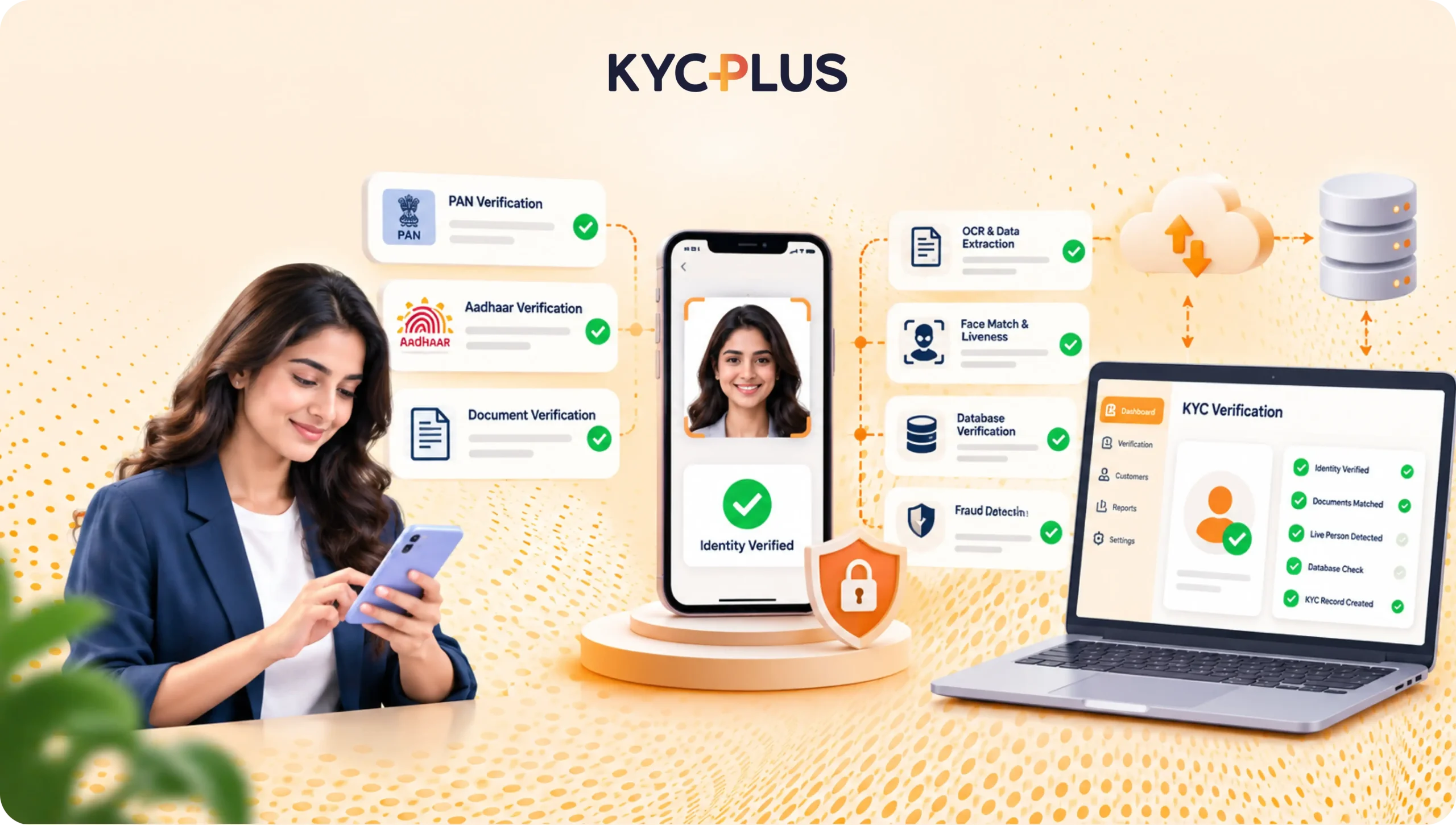
The way businesses verify customers has changed significantly with the growth of digital banking, fintech, insurance, lending, investment platforms, and online financial services. Customers increasingly expect to open accounts, apply for loans, purchase insurance, access investment products, and use financial services without completing lengthy paper-based processes. In this evolving environment, an online KYC verification service provider can help organizations streamline customer identity verification through digital processes. At the same time, organizations need reliable methods to establish customer identity, validate information, reduce fraud risks, and maintain appropriate KYC records.
An online KYC verification service provider offers technology, APIs, software platforms, or digital workflows that help businesses collect and verify customer identity information electronically. Depending on the use case, these solutions can include document verification, OCR, PAN verification, face matching, liveness detection, database checks, CKYC integration, Video KYC, and other identity verification services.
For banks, NBFCs, fintech companies, insurance providers, cooperative banks, investment platforms, and other organizations, online KYC can become an important part of customer onboarding.
However, choosing a provider is not simply about finding the largest number of verification APIs. Organizations need to consider regulatory requirements, integration, security, customer experience, scalability, verification accuracy, and ongoing support.
This guide explains how online KYC verification works, what technologies are involved, the benefits of digital verification, and what businesses should evaluate before selecting an online KYC verification service provider.
KYC stands for Know Your Customer.
It refers to processes used by organizations to establish and verify the identity of customers.
Traditional KYC can involve physical forms, paper documents, branch visits, manual data entry, and employee-led document verification.
Online KYC moves eligible parts of this process to digital channels.
A customer may complete KYC through a website, mobile application, assisted digital platform, or another electronic channel.
A typical online KYC process can include:
The exact process depends on the organization, customer type, product, and applicable regulatory requirements.
In India’s financial sector, RBI’s KYC framework includes provisions for digital and non-face-to-face customer identification processes, including Aadhaar OTP-based e-KYC authentication, CKYC-based approaches, equivalent electronic documents, and Video-based Customer Identification Process under applicable conditions.
Therefore, online KYC should not be treated as a single verification method. It is a broader digital workflow that can combine multiple identity and authentication technologies.
An online KYC verification service provider typically provides the technology infrastructure required to automate one or more stages of the KYC process.
The provider may offer APIs that connect directly with an organization’s application.
For example:
Customer Application → KYC API → Document / Identity Verification → Face Match / Liveness → Verification Result → Customer Onboarding System
This allows businesses to integrate verification directly into their customer journey.
Instead of employees manually checking every document, the software can perform supported checks automatically and return a result.
Depending on the provider, the solution may also include dashboards, workflow management, audit logs, reporting, document storage, and manual-review capabilities.
The growth of digital financial services has created a need for faster customer verification.
Customers may now apply for financial products from:
If the customer has to print documents, visit a branch, and wait for manual verification, the onboarding journey can become longer and more complicated.
Digital KYC can reduce some of these operational steps.
Although workflows differ between providers, most online KYC systems follow a similar structure.
The customer begins the onboarding process through a website, mobile application, or digital interface.
Basic information may be collected, such as:
The exact information depends on the financial product and applicable KYC requirements.
An OTP may be used to verify the customer’s mobile number or authenticate a step in the onboarding journey.
This creates an additional verification layer.
The customer provides the required identity or address document.
The document can be uploaded from a device or captured through a mobile camera.
Some workflows may also support digital document retrieval.
OCR, or Optical Character Recognition, extracts information from the submitted document.
For example, the system can identify:
The extracted information can then be used to populate application fields.
The system can perform supported checks to determine whether the document is valid and whether the information can be verified against relevant databases or sources.
Document verification and OCR should not be treated as the same thing.
OCR extracts information.
Verification checks whether the information or document can be validated.
In workflows that use facial verification, the customer may provide a selfie.
The system can compare the live facial image with the appropriate reference image, where applicable.
Liveness detection helps determine whether the person interacting with the system is physically present rather than submitting a static photograph or certain types of spoofing attempts.
The system returns a result based on the checks performed.
A straightforward case may continue automatically.
An exception can be routed to a manual review team.
After successful verification and completion of required checks, the customer can proceed to the next stage of the organization’s onboarding process.
An online KYC verification service provider may use several technologies to create a complete verification workflow.
OCR allows software to extract text from identity documents.
It can reduce manual data entry and help populate digital application forms.
However, OCR does not by itself prove that a document is genuine.
It should generally be combined with relevant verification methods.
Document verification can assess whether submitted documents meet required criteria and, where supported, validate their information against appropriate sources.
The exact verification process differs according to document type and provider.
Face matching compares facial images from two sources to determine whether they correspond to the same person.
It can be useful in remote identity verification workflows.
Liveness detection is designed to help determine whether a real person is present during the verification process.
Some providers offer passive liveness, while others use active challenges.
Where authorized and supported, KYC platforms can connect to relevant databases to validate customer information.
The exact databases available depend on the provider, use case, permissions, and applicable regulations.
CKYC can be integrated into a broader KYC workflow where applicable.
An eligible institution may use centralized KYC records instead of repeatedly collecting information that is already available through the applicable CKYC process.
Video-based Customer Identification Process can provide another digital route for eligible financial institutions.
RBI has established a framework for V-CIP, subject to applicable requirements.
APIs allow KYC services to connect directly with an organization’s applications.
This is particularly important for businesses that want verification to happen within their existing customer journey.
Using an external technology provider can offer several operational benefits.
Automated checks can reduce the time required for certain verification steps.
OCR, API-based verification, and automated workflows can reduce repetitive data entry and manual checking.
Customers can complete eligible verification activities remotely.
Automated workflows can support increasing customer volumes without increasing manual work at the same rate.
Organizations can manage KYC activities through a centralized technology layer.
Structured digital forms and automated extraction can reduce errors caused by repetitive manual data entry.
APIs allow KYC services to be embedded into banking, lending, insurance, fintech, and other applications.
A properly designed system can maintain records of verification steps, user activity, and decisions.
Combining multiple verification signals can help organizations identify suspicious applications and reduce certain identity-related risks.
The effectiveness of fraud controls depends on the quality of the underlying technology, configuration, data, and review processes.
Banks are among the major users of digital KYC technology.
A bank may need KYC during:
A typical digital bank onboarding journey can look like:
Customer Application → Mobile Verification → Document Capture → OCR → Identity Verification → Face Match / Liveness → KYC Decision → Account Opening
The KYC platform can communicate with the bank’s other systems through APIs.
For banks with existing CBS infrastructure, this can allow the KYC platform to operate as a specialized verification and onboarding layer rather than replacing the core banking system.
NBFCs often operate digital lending and customer acquisition journeys.
A customer may apply for a loan through a website or mobile application.
The organization then needs to verify identity before proceeding with the relevant process.
An online KYC platform can be integrated with the loan origination system.
For example:
Loan Application → Customer Information → KYC API → Document Verification → Face Match / Liveness → KYC Result → Credit and Loan Processing
This can reduce manual movement between systems.
Fintech platforms typically need APIs that can operate within a digital customer experience.
Instead of redirecting customers to multiple external applications, fintech companies can integrate KYC verification into their own interface.
This can be particularly important for customer conversion.
A complicated verification process can cause users to abandon onboarding.
Therefore, fintech companies often need to balance:
The role of an online KYC verification service provider is therefore not limited to identity checks. Integration and user experience can also influence the effectiveness of the overall implementation.
Insurance companies can use digital KYC during customer onboarding and policy-related processes, subject to applicable regulatory requirements.
An insurance application may require identity and document verification before a customer can proceed.
Digital KYC can be integrated into:
The exact workflow depends on the insurance product and applicable regulations.
Cooperative banks often have a combination of branch-based operations and digital banking infrastructure.
For these institutions, implementing online KYC does not necessarily mean replacing their existing CBS.
A specialized KYC platform can sit alongside the core banking system.
For example:
Customer → Online KYC Platform → Identity Verification → KYC Data → API → CBS
This architecture allows the CBS to continue handling core banking functions while the KYC platform handles specialized identity verification and onboarding workflows.
KYCPLUS publicly describes this type of architecture, where digital KYC, eKYC, CKYC, Re-KYC, OCR, document processing, face matching, liveness detection, and audit trails can operate alongside an existing CBS through APIs.

Operating within the digital KYC and identity verification space, KYCPLUS provides a technology platform designed to support various KYC-related processes. Its API-based architecture can work alongside existing banking and financial systems, helping organizations integrate digital verification capabilities into their workflows.
Its public product information describes AI-powered verification, OCR and document parsing, face matching, liveness detection, data validation, CKYC, and CBS integration.
The platform can therefore be considered when an organization is looking for a broader KYC workflow rather than an individual verification API.
Its broader KYC offering includes digital customer onboarding and verification workflows.
For financial institutions with existing CBS infrastructure, KYCPLUS also describes an API-based approach in which the core banking system continues to manage core banking activities while the KYC platform handles specialized KYC and onboarding processes.
The digital KYC market includes several providers with different technology approaches.
Businesses should evaluate each provider based on their specific requirements rather than assuming that every platform offers identical functionality.
IDfy provides digital KYC and identity verification solutions.
Its published KYC solution includes document verification, OCR, name matching, face matching, and liveness detection.
IDfy also provides a Digital KYC solution designed for field-agent-assisted verification, combining multiple KYC APIs within a single workflow.
For organizations evaluating an online KYC verification service provider, IDfy can therefore be considered where digital identity verification needs to be combined with broader KYC checks.
Signzy operates in digital identity verification, KYC, KYB, AML, and compliance technology.
Its public product information describes APIs and no-code workflows for identity verification, including OCR, face matching, liveness, and other verification capabilities.
Signzy has also introduced a One-Touch KYC offering designed to combine multiple verification steps into a single digital workflow.
Its financial-services offering includes identity verification, liveness, document verification, AML screening, and configurable onboarding workflows.
HyperVerge provides digital identity verification and customer onboarding technology.
Its platform includes eKYC, identity verification, video verification, OCR, face authentication, KYC record search and download, and other onboarding capabilities.
HyperVerge also provides an integration marketplace with KYC-related services such as DigiLocker and KYC record search and download.
This makes it another provider that businesses can evaluate when building digital KYC and onboarding workflows.
Choosing an online KYC verification service provider requires evaluating more than the number of APIs available.
Organizations should examine the complete customer journey.
First, determine which checks are actually required.
These may include:
Not every business needs every service.
The API is the connection between the verification platform and the organization’s application.
Check:
Mobile-first businesses may require SDKs for Android, iOS, or web applications.
An SDK can provide a more integrated customer experience than sending users to a separate verification interface.
Security should be evaluated at both the application and infrastructure levels.
Organizations should examine:
Technology providers can support regulated workflows, but the regulated entity remains responsible for ensuring that its KYC process meets applicable requirements.
RBI’s KYC framework contains specific requirements for customer identification and non-face-to-face onboarding.
Organizations should therefore involve compliance and legal teams when selecting and configuring the solution.
A platform that works for 1,000 monthly verifications may need a different architecture when the organization reaches 100,000 or more.
Ask about:
The KYC journey should be easy to understand.
Customers should know:
A secure but unnecessarily complicated process can increase customer drop-offs.
One important decision is whether the organization needs individual APIs or a complete KYC platform.
An organization may choose individual APIs for:
This approach provides flexibility but requires the organization to build and maintain the complete workflow.
A complete KYC platform can combine multiple services into a single workflow.
For example:
Customer Registration → Document Capture → OCR → Identity Verification → Face Match → Liveness → KYC Decision → Record Management
The correct approach depends on the organization’s technical capabilities, existing infrastructure, and required level of customization.
Remote identity verification creates a challenge that traditional branch-based KYC does not face in the same way.
When a customer is physically present in a branch, an employee can directly observe the individual and documents.
In an online process, the organization needs digital mechanisms to establish confidence that:
1. The submitted document belongs to the customer.
2. The person completing the verification is physically present.
3. The captured information matches the expected identity.
For example, IDfy describes its face comparison API as comparing two images and returning a match score, while its liveness API checks whether the submitted selfie represents a live person.
HyperVerge similarly describes face authentication and passive liveness as components of its digital identity verification stack.
These technologies should be configured according to the organization’s risk and regulatory requirements.
Manual data entry remains one of the most repetitive activities in customer onboarding.
Suppose an employee receives a customer’s identity document.
Without OCR, the employee may need to manually enter:
OCR can extract this information automatically.
Document → OCR → Structured Data → Validation → Verification
This can improve efficiency.
However, OCR output should still be validated because image quality, document layout, handwriting, lighting, and other factors can affect extraction.
KYC verification is also closely connected with fraud prevention.
Fraudsters may use:
Therefore, modern KYC platforms increasingly combine multiple signals.
For example:
This layered approach can provide more information than relying on a single verification method.
IDfy, for example, describes fraud prevention capabilities that combine document, liveness, identity, and other signals to identify suspicious patterns.
Signzy also describes combining document verification, face matching, liveness, and AML screening in its identity and compliance workflows.
Security and customer experience need to work together.
If the verification journey is too complicated, customers may abandon it.
A good digital KYC process should minimize unnecessary steps.
Registration → Multiple Forms → Document Upload → Re-enter Data → Separate Verification → Repeated Upload → Manual Review
Registration → Document Capture → Automatic Data Extraction → Verification → Face/Liveness → Confirmation
The objective is not to remove every verification step.
Instead, the goal is to make required verification steps as clear and efficient as possible.
KYC does not always end after initial onboarding.
Customer information may need to be updated periodically or when relevant information changes.
For example:
An organization can extend its digital KYC infrastructure to support Re-KYC.
Initial KYC → Customer Relationship → KYC Information Update → Digital Re-KYC → Verification → Record Update
This can help organizations avoid maintaining completely separate systems for initial KYC and ongoing customer verification.
CKYC and online KYC serve related but different purposes.
Online KYC refers to the digital process used to collect and verify customer information.
CKYC refers to the centralized KYC records ecosystem.
An organization may therefore use online KYC technology during customer onboarding while also integrating CKYC-related processes.
For example:
Customer → Online KYC Verification → CKYC Search → Existing Record / New Record → Customer Onboarding
This can create a connected KYC workflow.
The exact implementation depends on the organization’s regulatory status and applicable requirements.
Digital KYC provides several benefits, but organizations can also face implementation challenges.
Blurred or damaged documents can affect OCR and verification.
Older devices may produce images that are difficult to process.
Poor connectivity can interrupt digital verification.
Long or confusing processes can cause customers to abandon onboarding.
Automated systems may sometimes flag legitimate cases for manual review.
Connecting a new KYC platform with legacy systems can require significant development work.
KYC regulations and technology requirements can evolve.
Organizations should therefore choose a provider that can support ongoing updates and workflow changes.
A structured evaluation can make the selection process easier.
Determine whether the requirement is:
Create a list of required verification methods.
Check whether the provider can integrate with:
Run real-world test cases.
Test:
Conduct security and compliance due diligence.
Understand current and future transaction requirements.
Review:
A proof of concept can help identify issues before full implementation.
The cost of an online KYC verification service provider depends on the services required.
Pricing may be based on:
Organizations should therefore compare total cost of ownership rather than looking only at the price of one API call.
For example, a low-cost document-verification API may appear attractive, but if the business also needs OCR, face matching, liveness, workflow management, dashboards, and integration support, the final project cost can be significantly different.
The online KYC ecosystem is evolving rapidly.
Several technology trends are shaping the future of customer verification.
AI can support document analysis, facial verification, fraud detection, and anomaly identification.
Passive liveness can reduce the number of actions required from customers while still providing a liveness signal.
As synthetic media becomes more sophisticated, identity platforms are increasingly focusing on detecting manipulated images and videos.
Businesses increasingly want KYC services that can be integrated directly into their applications.
Some providers are developing workflow builders that allow businesses to configure verification journeys without building every component from scratch.
Organizations may increasingly connect initial onboarding with ongoing customer monitoring, KYC updates, and Re-KYC.
KYC is increasingly becoming an embedded part of digital customer journeys rather than a separate process.
These developments are likely to make digital identity verification more integrated with banking, lending, insurance, investment, and other online services.
An online KYC verification service provider can help businesses move customer verification from manual, paper-heavy processes toward structured digital workflows.
Modern KYC platforms can combine OCR, document verification, database checks, face matching, liveness detection, APIs, CKYC, Video KYC, and workflow automation.
For financial institutions, this can improve operational efficiency while creating a more convenient customer onboarding experience.
However, selecting a provider requires careful evaluation.
Organizations should consider:
KYCPLUS is one example of a digital KYC verification platform that combines identity verification with OCR, face matching, liveness detection, CKYC, Re-KYC, document processing, and CBS integration.
Other providers, including IDfy, Signzy, and HyperVerge, offer different combinations of KYC, identity verification, onboarding, fraud prevention, and compliance capabilities.
The right technology depends on the organization’s specific requirements.
A bank may prioritize CBS integration and regulatory workflows. An NBFC may focus on digital lending and rapid verification. A fintech may prioritize APIs and customer experience. An insurance company may require a different combination of identity and document checks.
Therefore, businesses should evaluate an online KYC verification service provider not simply by the number of features offered, but by how effectively the technology fits into the organization’s customer journey, compliance framework, existing systems, and long-term digital strategy.
Ans: An online KYC verification service provider is a technology company that provides digital tools, APIs, software, or workflows for collecting and verifying customer identity information electronically.
Ans: Online KYC can involve customer information capture, document upload, OCR, identity verification, database checks, face matching, liveness detection, Video KYC, and digital record management, depending on the use case.
Ans: KYC is the broader customer identification and verification process. Online KYC performs eligible parts of that process through digital channels using technologies such as APIs, OCR, document verification, and biometric or facial checks.
Ans: Common technologies include OCR, document verification, PAN verification, database checks, face matching, liveness detection, OTP authentication, CKYC integration, Video KYC, APIs, and SDKs.
Ans: Some providers support Re-KYC as part of their broader KYC lifecycle capabilities. Organizations should verify the specific Re-KYC workflows, integrations, and compliance features offered by the provider.
Ans: Some providers support Re-KYC as part of their broader KYC lifecycle capabilities. Organizations should verify the specific Re-KYC workflows, integrations, and compliance features offered by the provider.
Ans: Security depends on the technology provider, implementation, configuration, and organization’s controls. Businesses should evaluate encryption, authentication, access controls, audit trails, data handling, infrastructure security, and applicable compliance requirements.
Ans: Digital KYC can support fraud prevention by combining document verification, face matching, liveness detection, database checks, and other risk signals. However, no single verification method can eliminate all forms of identity fraud.
Ans: Businesses should compare providers based on required verification methods, API capabilities, security, scalability, integration options, customer experience, regulatory requirements, support, and total cost of ownership.
Ans: Banks, NBFCs, fintech companies, insurance providers, cooperative banks, investment platforms, and other organizations that need customer identity verification can evaluate online KYC technology, subject to their applicable regulatory and legal requirements.
