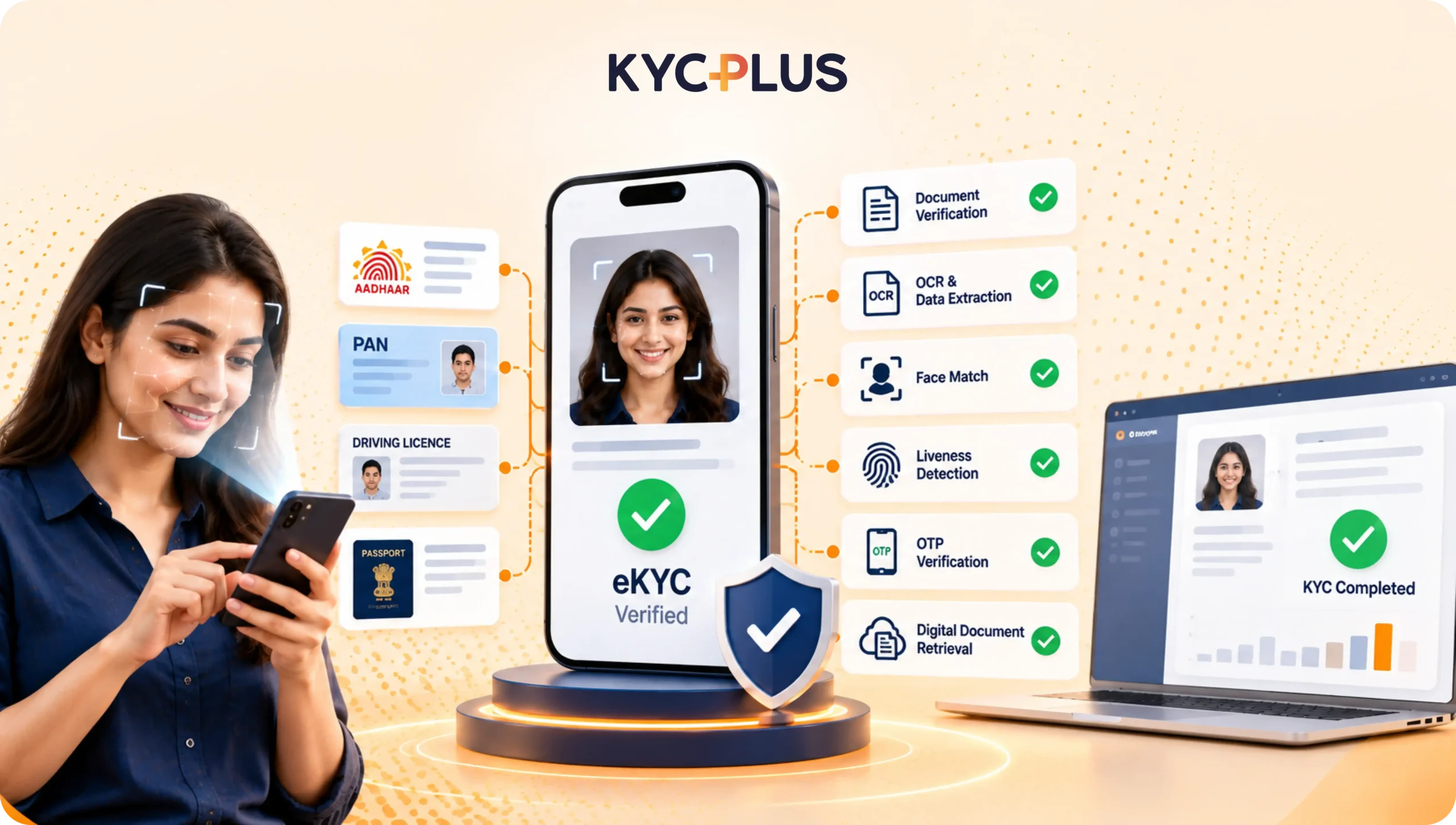
Customer onboarding has changed significantly with the growth of digital banking, fintech, insurance, lending, and online financial services. Customers increasingly expect to open accounts, apply for financial products, and access services without repeatedly visiting a branch or submitting physical paperwork. At the same time, businesses and financial institutions need reliable processes to establish and verify customer identities. An e-KYC Verification Solution helps organizations streamline digital identity verification while supporting faster, more secure, and compliant customer onboarding.
Electronic Know Your Customer, commonly known as eKYC, uses digital technologies to collect, verify, and process customer identity information. Depending on the applicable regulatory framework and use case, digital KYC can involve identity documents, government databases, OTP-based authentication, digital document retrieval, biometric or facial verification, liveness detection, OCR, and video-based verification.
The purpose is not simply to make-KYC faster. A well-designed digital KYC process also needs to support security, data accuracy, regulatory requirements, auditability, and a smooth customer experience.
For banks, NBFCs, fintech companies, insurance providers, cooperative banks, credit societies, and other organizations, choosing the right e-KYC Verification Solution can therefore become an important technology decision.
This guide explains what eKYC is, how digital identity verification works, the technologies involved, key benefits, implementation considerations, and how organizations can evaluate an eKYC platform.
eKYC stands for Electronic Know Your Customer.
Traditional KYC usually involves collecting customer information and documents through physical forms or branch-based processes. eKYC digitizes significant parts of this process.
Instead of manually handling every document, an organization can use digital technologies to:
The exact process depends on the institution, product, customer type, and applicable regulatory requirements.
In India, RBI’s KYC framework recognizes several digital methods and provides specific requirements for non-face-to-face customer onboarding. RBI material describes Aadhaar OTP-based e-KYC authentication, CKYC-based approaches, DigiLocker/e-document routes, and Video-based Customer Identification Process (V-CIP), subject to applicable conditions.
Therefore, eKYC should not be viewed as one single technology.
It is better understood as a combination of identity verification methods and digital workflows used to complete-KYC requirements.
An e-KYC Verification Solution is a technology platform or set of APIs that helps businesses digitally collect and verify customer identity information.
A typical solution may combine several technologies, including:
The purpose is to create a structured digital KYC journey.
Customer → Mobile / Web Application → Information & Document Capture → Identity Verification → Document Validation → Face Match / Liveness → KYC Decision → Customer Onboarding
The actual workflow can be simpler or more complex depending on the organization’s requirements.
Financial services increasingly operate through digital channels.
Customers can apply for:
Through websites and mobile applications.
If KYC still depends entirely on physical documentation and manual verification, it can create friction in the customer journey.
Digital KYC can help organizations reduce unnecessary manual steps while maintaining structured verification processes.
For example, instead of a customer submitting a document to one employee and waiting for another employee to verify it manually, an automated workflow can capture the document, extract relevant information, perform supported checks, and route the application for approval or further review.
This is one reason demand for an e-KYC Verification Solution has increased across digital financial services.
The exact workflow differs between providers and uses cases, but a typical digital KYC process can include several stages.
The customer enters basic information into a website, mobile application, or assisted digital KYC interface.
This may include:
The fields depend on the product and applicable requirements.
An OTP can be sent to the customer’s registered mobile number to verify control of that number.
Email verification may also be used where relevant.
This step provides an additional layer of authentication.
The customer may provide an identity document or other required documentation.
Digital platforms can allow customers to:
OCR, or Optical Character Recognition, can convert information from documents into machine-readable data.
For example, an OCR engine may extract:
This can reduce manual data entry.
The extracted information and document can then be checked according to the verification services integrated into the workflow.
Depending on the document and provider, this may include database verification or document authenticity checks.
Some digital KYC workflows use a selfie or live facial image.
The system can compare the customer’s face against an image associated with an identity document or another approved source, where applicable.
Liveness detection is designed to determine whether the person interacting with the system is a live individual rather than simply a photograph, screen replay, or other presentation attack.
Modern identity verification platforms may combine liveness with face matching and other fraud signals.
The platform evaluates the available information and produces a verification result or routes the case for manual review.
Cases that meet defined criteria may proceed automatically, while exceptions can be sent to an operations or compliance team.
Once the verification process is completed, the relevant customer information and supporting records can be stored within the organization’s systems.
The information can then be used for customer onboarding and applicable compliance processes.
A modern e-KYC Verification Solution can combine several technologies.
Understanding these technologies helps businesses select the right platform.
OCR is one of the most common technologies used in digital document processing.
It allows systems to extract text from documents automatically.
Without OCR, employees may have to manually enter information from every document.
OCR can therefore reduce repetitive data entry and improve processing efficiency.
However, OCR alone does not establish that a document is genuine.
It is a data-extraction technology and generally needs to be combined with other verification mechanisms.
Document verification checks whether submitted documents meet defined requirements and, where supported, whether the information or document can be validated through relevant sources.
Different document types may require different verification approaches.
Face matching compares facial information from two sources.
For example, a digital onboarding process may compare a customer’s selfie with an image associated with an identity document, subject to the applicable workflow.
Liveness detection helps determine whether the person completing the verification is physically present.
It is particularly relevant to remote identity verification because it can help address certain presentation attacks.
OTP-based verification can help confirm possession of a registered mobile number or authenticate a customer during a digital journey.
Where applicable, digital document retrieval can reduce the need for customers to manually upload physical copies.
Digital document ecosystems can therefore become part of an eKYC workflow.
CKYC can complement digital KYC by allowing eligible institutions to access existing centralized KYC information under applicable requirements.
This can be particularly useful when a customer already has an existing CKYC record.
The primary difference between traditional KYC and eKYC is the way information is collected and processed.
Traditional KYC may involve:
An eKYC process can use:
This does not mean every traditional KYC activity can simply be replaced by software.
Regulatory requirements differ by customer type and financial product, and certain processes may still require human intervention.
The objective of an e-KYC Verification Solution is therefore to digitize and automate eligible parts of the-KYC workflow while maintaining required controls.

Digital KYC can provide several operational benefits when implemented correctly.
Automated verification can reduce waiting time between application and verification.
This can be particularly valuable for digital-first businesses.
OCR, APIs, automated validation, and workflow automation can reduce repetitive administrative tasks.
Automated extraction and validation can reduce errors associated with manually copying information from documents.
Customers can complete more of the verification process remotely instead of repeatedly visiting branches or submitting paperwork.
Digital workflows make it easier to store and retrieve customer information in structured systems.
Dashboards and workflow tracking can help organizations identify pending, completed, rejected, and exception cases.
Automated workflows can support higher customer volumes without increasing manual processing at the same rate.
Combining document verification, face matching, liveness, and other verification signals can strengthen identity verification processes.
The effectiveness of these controls depends on implementation, configuration, data quality, and the specific verification services used.
An e-KYC Verification Solution can be relevant to several industries.
Banks can use digital KYC solution during account opening, digital product applications, customer updates, and other eligible workflows.
NBFCs can use eKYC for customer onboarding and lending journeys.
Digital verification can be particularly relevant when loan applications are submitted remotely.
Fintech platforms often require API-based identity verification that can operate directly within a digital application.
Insurers can integrate digital KYC into policy onboarding and other customer verification journeys, subject to applicable regulatory requirements.
Cooperative banks can use digital KYC to modernize branch and customer onboarding processes.
A KYC layer can also be integrated with an existing CBS rather than requiring replacement of the core banking system.
Credit and thrift societies may use digital KYC to improve customer record management and verification workflows, depending on their applicable regulatory framework and technology requirements.
Depending on the applicable laws and industry requirements, digital identity verification can also be relevant to telecommunications, marketplaces, professional services, and other businesses that need to verify customers.
For banks and financial institutions, digital KYC is not simply a customer experience feature.
It is part of a regulated process.
RBI’s KYC framework contains requirements around customer identification, customer due diligence, non-face-to-face onboarding, and Video-based Customer Identification Process.
Therefore, financial institutions need to design their eKYC processes carefully.
Important areas include:
A technology platform should support the institution’s compliance framework rather than determine compliance by itself.
APIs are critical to modern digital KYC architecture.
A financial institution may already have several systems:
Customer Application → CRM → Loan Origination System → KYC Platform → Core Banking System → Document Management
An API can allow these systems to communicate.
For example, once customer information is captured, the application can send it to the-KYC platform for verification.
The verification result can then be returned to the originating application.
This reduces manual data transfer.
An e-KYC Verification Solution should therefore be evaluated not only on its front-end interface but also on its API architecture.
Before integrating an eKYC API, technical teams should evaluate several factors.
Documentation should clearly explain endpoints, authentication, request formats, response formats, errors, and integration requirements.
The organization should understand how API access is authenticated and protected.
A sandbox can help developers test the integration before production deployment.
The API should clearly communicate failed requests, validation issues, and verification exceptions.
The platform should be capable of handling expected transaction volumes.
Organizations should be able to identify failed requests, delays, and integration problems.
Technical support during implementation can reduce integration difficulties.
Banks that already have a CBS often ask whether implementing digital KYC requires replacing the existing system.
In many cases, it does not.
A specialized KYC platform can operate alongside the CBS.
For example:
Customer → eKYC Platform → Identity Verification → KYC Data → API → CBS
The CBS can continue managing core banking functions such as accounts, deposits, loans, transactions, and accounting.
The-KYC platform can focus on digital onboarding, verification, document processing, CKYC, Re-KYC, and related KYC workflows.
KYCPLUS publicly describes this type of architecture, positioning its platform as a digital KYC and customer onboarding layer that can communicate with existing CBS environments through APIs.
This architecture can be particularly relevant to cooperative banks and financial institutions that already have established CBS infrastructure.
KYCPLUS is one example of an e-KYC Verification Solution available for businesses and financial institutions.
Its public platform information describes capabilities including automated KYC, OCR and document parsing, face matching, liveness detection, data validation, CKYC, and CBS integration.
The platform also describes digital KYC workflows involving identity and address verification, contact verification, liveness and document validation, followed by review and submission.
For organizations evaluating digital KYC technology, these capabilities can be considered as part of a broader customer onboarding and KYC lifecycle.
A financial institution can therefore use eKYC technologies during customer onboarding while also using CKYC workflows where applicable.
For example:
Customer Application → eKYC Verification → KYC Validation → CKYC Search → Existing Record / New Record Processing → Customer Onboarding
This combination can create a more connected KYC workflow.
The exact implementation depends on regulatory requirements and the institution’s systems.
KYC does not necessarily end after initial onboarding.
Customer information can change over time.
A customer may update:
Therefore, organizations also need processes for ongoing KYC updates.
A modern KYC platform can connect initial eKYC with Re-KYC.
For example:
Initial Digital KYC → Customer Relationship → KYC Information Update → Digital Re-KYC → Verification → Record Update
This can create a more complete customer lifecycle.
KYCPLUS also provides a Re-KYC solution workflow that includes digital authentication, information updates, identity and liveness verification, and final submission.
Identity information is highly sensitive.
Therefore, security should be considered from the beginning of an eKYC implementation.
Sensitive information should be appropriately protected during transmission and storage
Only authorized users and systems should be allowed to access customer KYC information.
Strong authentication mechanisms should be implemented for administrative users and system integrations.
The system should maintain records of important actions.
Organizations should understand how long customer information and documents are retained and how they are managed.
The workflow should capture and manage consent wherever required.
Organizations should evaluate whether the platform provides appropriate mechanisms for detecting suspicious or fraudulent verification attempts.
Security should be evaluated by the organization’s technology, information security, compliance, and legal teams before deployment.
Artificial intelligence is increasingly being used in identity verification.
AI and machine learning can support:
However, AI should not be treated as a replacement for regulatory controls.
A good e-KYC Verification Solution should combine automation with appropriate human review and exception handling.
For example, if a document is unclear or a verification signal does not match, the application can be routed for manual review instead of automatically approving or rejecting every case.
Digital KYC can improve efficiency, but implementation also introduces challenges.
Blurred or poorly captured documents can affect OCR and verification.
Customers may enter incorrect information during registration.
Lighting, camera quality, facial positioning, or other factors can affect face matching and liveness.
Digital verification requires reliable internet connectivity.
Connecting the-KYC platform with legacy systems can require significant technical work.
A complicated KYC journey can cause customers to abandon the onboarding process.
Regulatory requirements can evolve, requiring organizations to update workflows.
These challenges should be considered during product selection and implementation.
A technically strong system can still provide a poor customer experience if the workflow is complicated.
Organizations should therefore focus on simplicity.
Only collect information that is necessary for the particular process.
Customers should understand why they are being asked to provide information or complete a verification step.
For document capture, explain how the customer should position the document and camera.
Use OCR and verified information to pre-fill fields where appropriate.
If verification fails, explain what the customer needs to correct.
Many digital customers complete onboarding using smartphones.
Some customers may need assistance from branch employees or field agents.
A well-designed e-KYC Verification Solution should therefore balance security, compliance, automation, and usability.
Cooperative banks often have a combination of branch-based and digital processes.
For these institutions, eKYC can help modernize customer onboarding without necessarily changing the entire core banking infrastructure.
A typical workflow could be:
Customer → Digital / Assisted KYC → Document Capture → OCR → Identity Verification → Face Match and Liveness → KYC Approval
This model allows the-KYC workflow to operate separately from the core banking layer.
It can be particularly useful for banks with multiple branches where centralized KYC processing and monitoring are required.
NBFCs and fintech companies often have digital-first customer acquisition models.
For these organizations, APIs and SDKs can be particularly important.
An eKYC platform can be integrated directly into:
The customer may complete the entire-KYC journey without interacting with a branch.
However, the organization must still ensure that the workflow meets applicable regulatory requirements.
Choosing a platform should begin with business and compliance requirements.
Determine whether the requirement is for:
Determine which methods are required.
These could include:
Understand how the platform will connect with existing systems.
Review encryption, authentication, access control, audit trails, data handling, and security processes.
Estimate current and future transaction volumes.
Test the complete customer journey on both desktop and mobile.
A proof of concept can help identify technical or operational issues before full implementation.
Evaluate implementation assistance, technical support, documentation, and post-deployment service.
The cost of an e-KYC Verification Solution can vary significantly.
Pricing may depend on:
Therefore, organizations should compare the total implementation and operating cost rather than looking only at the price of an individual API.
A lower API price may not necessarily result in a lower overall project cost if additional components are required.
Digital identity verification is expected to become increasingly integrated into financial and digital services.
Future eKYC platforms are likely to focus on:
The direction of the market suggests that KYC will increasingly become an embedded part of digital customer journeys rather than a separate administrative activity.
Organizations will therefore need platforms that can evolve as their products, customer volumes, and regulatory requirements change.
An e-KYC Verification Solution can help organizations transform customer identity verification from a largely manual process into a structured digital workflow.
By combining technologies such as OCR, document verification, APIs, OTP authentication, face matching, liveness detection, CKYC integration, and digital record management, organizations can build faster and more connected KYC journeys.
Financial institutions need to design their workflows around applicable regulations, customer consent, security requirements, data protection, risk controls, and appropriate human review.
The right solution should also fit into the organization’s existing technology ecosystem.
For banks, integration may involve connecting with a Core Banking System (CBS). An NBFC may integrate the solution with its Loan Origination System (LOS), while fintechs can embed APIs and SDKs directly into their mobile applications.
KYCPLUS is one example of a platform that combines digital KYC with OCR, document processing, face matching, liveness detection, CKYC, Re-KYC, and CBS integration.
Ultimately, businesses should evaluate an e-KYC Verification Solution based on their specific customer journey, verification requirements, regulatory framework, integration environment, security expectations, scalability, and long-term KYC strategy.
A successful digital KYC implementation is not simply about removing paperwork. It is about creating a secure, reliable, compliant, and convenient identity verification experience for both the organization and the customer.
Ans: An e-KYC Verification Solution is a digital technology platform or API-based system that helps businesses collect, verify, and manage customer identity information electronically.
Ans: eKYC can involve customer information capture, document collection, OCR, identity verification, OTP authentication, face matching, liveness detection, database checks, and digital record management, depending on the workflow.
Ans: KYC is the broader process of identifying and verifying a customer. eKYC refers to carrying out eligible-KYC activities through electronic and digital methods.
Ans: Digital KYC methods are recognized within India’s regulatory framework subject to applicable conditions. RBI’s KYC framework includes provisions covering non-face-to-face onboarding, Aadhaar OTP-based e-KYC authentication, CKYC-based approaches, and Video-based Customer Identification Process.
Ans: Common technologies include OCR, document verification, API integration, OTP authentication, face matching, liveness detection, digital document retrieval, CKYC integration, and video-based verification.
Ans: Yes. An eKYC platform can be integrated with an existing Core Banking System through APIs or other supported integration mechanisms. This allows the-KYC platform to handle verification workflows while the CBS continues managing core banking operations.
Ans: Yes. Depending on the platform, the same digital KYC infrastructure can support customer information updates and Re-KYC workflows.
Ans: No. OCR primarily extracts information from documents. It does not by itself establish that the document or identity is genuine. Additional verification methods may be required depending on the use case.
Ans: Businesses should evaluate verification coverage, API capabilities, security, scalability, integration options, customer experience, audit trails, support, pricing, and compatibility with applicable regulatory requirements.
Ans: Banks, NBFCs, fintech companies, insurance providers, cooperative banks, credit societies, and other organizations that need customer identity verification can evaluate an e-KYC Verification Solution, subject to their applicable legal and regulatory requirements.
