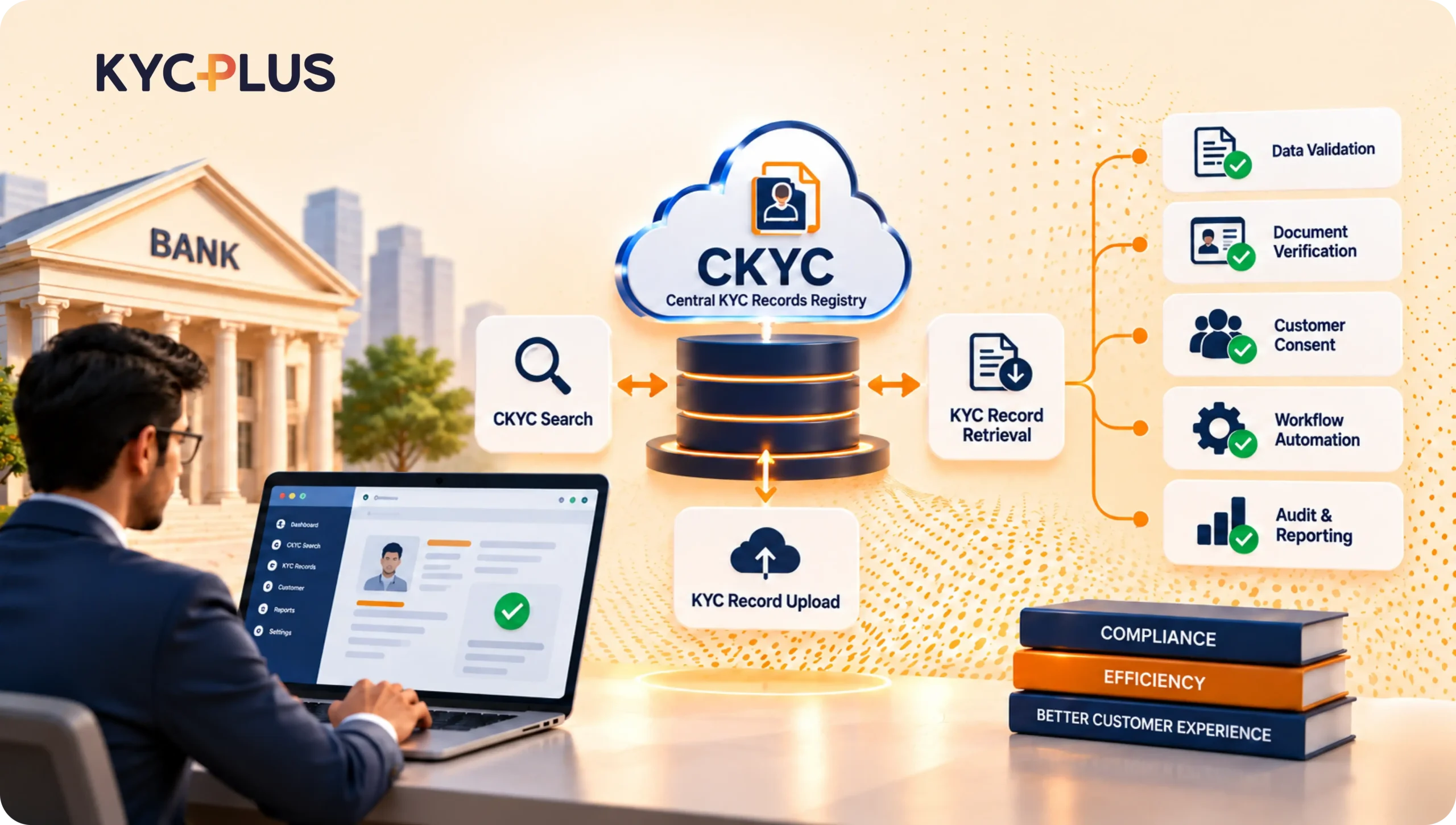
Central Know Your Customer, commonly known as CKYC, has become an important part of the digital KYC ecosystem in India’s financial services sector. Banks, NBFCs, cooperative banks, insurance companies, fintech businesses, and other regulated entities increasingly rely on technology to manage customer identification, KYC records, verification, and compliance workflows. As customer volumes increase, managing CKYC activities manually can become time-consuming. Searching customer records, downloading existing KYC information, preparing new records, validating documents, updating information, and maintaining an audit trail can involve several operational steps. This has increased the demand for technology platforms that can connect CKYC workflows with existing banking and financial systems. The market for CKYC Solution Providers in India includes companies offering different combinations of CKYC APIs, digital KYC, identity verification, document processing, OCR, customer onboarding, Re-KYC, compliance automation, and system integration.
However, not every provider offers the same capabilities. Some platforms primarily focus on APIs and identity verification, while others provide broader customer onboarding and KYC lifecycle management.
This guide explains the CKYC ecosystem, important features to evaluate, the role of technology providers, and some of the companies operating in the wider CKYC and digital KYC technology market.
CKYC stands for Central Know Your Customer.
The Central KYC Records Registry, or CKYCRR, provides a centralized mechanism for maintaining KYC records of customers. Registered reporting entities can search and download KYC records using supported identifiers and authentication factors. The official CKYCRR documentation also provides functionality for institutions to upload KYC records and manage KYC information.
The objective is to reduce repetitive KYC processes where an existing KYC record can be used in accordance with applicable requirements.
For example, when a customer already has a KYC Identifier and provides the required consent, an eligible reporting entity can retrieve the customer’s KYC record from the Central KYC Records Registry rather than asking the customer to repeatedly submit the same KYC information, subject to applicable rules and requirements.
A typical CKYC workflow can involve:
Technology can help financial institutions automate several of these activities.
This is where CKYC Solution Providers in India become relevant.
Financial institutions process large amounts of customer information every day.
A traditional KYC workflow can involve customer forms, identity documents, address proofs, photographs, manual data entry, verification, approval, and record maintenance.
When these activities are performed manually, institutions may experience:
Digital CKYC solutions can connect these activities into a structured workflow.
For example:
Customer Application
↓
Identity and Document Verification
↓
CKYC Search
↓
Existing Record Retrieval / New Record Processing
↓
Validation
↓
Approval
↓
KYC Record Management
↓
Core Banking / Financial System
This type of architecture can reduce manual intervention and make KYC operations easier to monitor.
The exact level of automation depends on the platform and the institution’s implementation.
Different CKYC Solution Providers in India offer different combinations of technology and services.
Before selecting a provider, financial institutions should understand the major capabilities available in the market.
A CKYC solution may provide functionality for searching customer records using supported identification details or a CKYC identifier.
This can help an institution determine whether an existing KYC record is available.
The CKYCRR documentation describes search and download functionality for registered institutions.
Once a relevant record is identified, authorized institutions can retrieve available KYC information through supported processes.
This can reduce the need to collect identical information repeatedly from customers.
However, institutions need to follow applicable consent and regulatory requirements when accessing customer records.
Financial institutions may also need to submit new or updated KYC records.
The CKYCRR documentation provides mechanisms for institutions to upload KYC details and supporting images, including bulk-upload processes.
Technology providers can help institutions prepare and manage these workflows.
Incorrect or incomplete information can create problems during KYC processing.
A digital platform can incorporate validation rules before information is submitted to the next stage.
Validation can cover:
Optical Character Recognition, or OCR, can extract information from documents and convert it into structured data.
For example, an OCR system can read relevant information from identity or address documents and populate digital fields.
This reduces repetitive manual typing.
Modern KYC platforms may combine CKYC with other verification services.
These can include:
The exact services depend on the provider and applicable regulations.
API integration is one of the most important capabilities when implementing a CKYC solution.
A bank may already have:
A CKYC platform can connect with these systems through APIs rather than requiring employees to move information manually between different applications.
Selecting a CKYC technology provider should involve more than comparing a list of features.
Financial institutions should evaluate how the solution fits into their existing processes.
The first consideration is whether the solution supports the CKYC workflows required by the institution.
Depending on the use case, this may include:
A modern financial institution should evaluate the provider’s API capabilities.
Important areas include:
Large banks and cooperative banking networks may need to process substantial volumes of KYC records.
Bulk processing capabilities can therefore be important.
The official CKYCRR documentation itself provides for bulk upload functionality for reporting entities.
Institutions should therefore evaluate whether the technology platform can support their required volume and workflow.
KYC is not limited to data.
Documents are an important part of customer verification.
A technology platform may need to support:
Customer information changes over time.
A customer may change their:
Therefore, institutions should evaluate whether the provider supports the broader KYC lifecycle instead of focusing only on initial CKYC processing.
Financial institutions need visibility into activities performed on customer records.
A digital audit trail can help track:
This can make internal monitoring and audit processes easier.
Banks should carefully evaluate how a CKYC platform integrates with their existing Core Banking System.
A CKYC solution does not necessarily need to replace the CBS.
Instead, it can work as a specialized KYC and compliance layer connected to the existing banking infrastructure.
This approach can be particularly useful for banks that already have an established CBS but want to modernize their KYC processes.
KYCPLUS is one of the platforms operating in the digital KYC technology space in India.
Its public product information describes CKYC and CBS integration alongside broader KYC capabilities such as OCR, document parsing, face matching, liveness detection, digital verification, and Re-KYC.
For financial institutions, the platform can be considered when CKYC needs to operate as part of a wider customer KYC workflow rather than as an isolated function.
The platform is designed to work with existing systems through integration, which can be relevant for banks that do not want to replace their existing core banking infrastructure.
The important point is that CKYC is only one part of the overall customer lifecycle.
An institution may eventually require digital onboarding, document processing, Re-KYC, identity verification, and customer record management as well.
The Indian market contains several companies operating across CKYC, KYC, identity verification, digital onboarding, and financial compliance technology.
Their products and implementation models differ, so institutions should evaluate them according to their own requirements.
IDfy operates in the identity verification and digital onboarding technology space.
Its publicly available product information includes identity verification capabilities and CKYC-related functionality. The company provides API-based verification services covering different identity and onboarding use cases.
For institutions considering CKYC Solution Providers in India, IDfy can be evaluated when CKYC needs to be integrated into a broader identity verification or customer onboarding workflow.
The suitability of a particular implementation depends on the institution’s required CKYC processes, APIs, integrations, and compliance requirements.
Signzy provides identity verification and financial compliance technology.
Its current CKYC offering is positioned around CKYCRR workflows and integration with banking systems. Its public product information describes CKYC search, download, validation, data transformation, and submission-related capabilities.
Signzy also provides broader KYC capabilities including document verification, OCR, liveness, and configurable identity verification workflows.
This makes it one of the technology platforms that institutions can evaluate when comparing CKYC Solution Providers in India.
HyperVerge operates in digital identity verification and onboarding.
Its public product information includes KYC record search, download, and upload capabilities.
The company’s broader technology stack includes digital identity and onboarding capabilities.
For financial institutions, HyperVerge can therefore be considered where CKYC requirements are part of a larger digital verification workflow.
Perfios operates across financial technology, data, verification, and digital onboarding.
Its KYC/KYB product information describes a broad API suite covering identity and address verification, document extraction, entity verification, and AI-based authentication capabilities.
Organizations evaluating CKYC Solution Providers in India can consider Perfios when they require CKYC-related functionality alongside broader verification or financial technology capabilities.
AuthBridge provides identity verification, digital KYC, eKYC, video KYC, and other verification services.
Its public KYC information specifically describes Central KYC functionality for accessing and verifying KYC data from the centralized repository.
Its digital KYC offering also includes capabilities such as OCR, liveness detection, face matching, and API/SDK-based integrations.
This makes AuthBridge another provider that can be evaluated in the wider CKYC Solution Providers in India landscape.
There is no single architecture used by every provider.
Some platforms are primarily API-driven.
Others provide complete digital onboarding journeys.
Some focus on identity verification.
Others combine KYC with KYB, fraud prevention, compliance, or financial data services.
This means that a simple provider list does not necessarily tell a financial institution which technology architecture will fit its requirements.
For example, consider three different requirements.
A financial institution may already have its own onboarding platform and only require CKYC connectivity.
In that case, an API-centric solution may be sufficient.
Another institution may need an end-to-end customer onboarding workflow.
It may require:
Here, a broader platform may be more relevant.
A larger institution may require:
In such a situation, the institution may evaluate a broader KYC platform rather than a standalone CKYC API.
Cooperative banks, DCCBs, and UCBs often operate with established CBS platforms and branch-based processes.
For such institutions, the technology objective may not be to replace the existing core banking system.
Instead, the institution can introduce a specialized KYC layer that communicates with the existing CBS.
A possible architecture is:
Customer
↓
Digital KYC Application
↓
Document Capture and OCR
↓
Identity Verification
↓
CKYC Workflow
↓
Approval and KYC Record Management
↓
CBS Integration
This approach allows the institution to modernize KYC-related processes while retaining the existing banking infrastructure.
For cooperative banks with multiple branches, centralized KYC workflows can also help create a consistent process across branches.
NBFCs and fintech businesses often operate digital-first customer journeys.
Their requirements may include API-based identity verification, automated document processing, CKYC search, customer onboarding, and compliance workflows.
For these organizations, API performance and integration flexibility can be particularly important.
A CKYC platform may need to connect with:
The provider should therefore be evaluated not only on CKYC functionality but also on integration capabilities.
CKYC generally forms part of the wider KYC lifecycle.
The customer relationship does not end after the initial KYC process.
Information may need to be reviewed or updated later.
For this reason, financial institutions increasingly look at platforms that can support both initial KYC and ongoing KYC processes.
A broader lifecycle can look like:
Customer Acquisition
↓
Digital Onboarding
↓
KYC Verification
↓
CKYC Search / Creation
↓
Account or Service Activation
↓
Ongoing KYC Management
↓
Re-KYC
↓
Customer Record Updates
A platform that connects these stages can reduce the need to maintain separate workflows.
KYCPLUS, for example, publicly describes automated Re-KYC capabilities alongside its KYC and CKYC-related functionality.
However, organizations should assess whether the exact workflow meets their internal and regulatory requirements.
CKYC systems handle sensitive customer information.
Therefore, security should be one of the most important criteria when evaluating CKYC Solution Providers in India.
Customer information should be appropriately protected during transmission and storage.
Only authorized users should be able to access sensitive KYC information.
Strong authentication mechanisms should be implemented for users and system integrations.
Organizations should be able to track access and important actions performed on customer information.
Institutions should understand how customer information and documents are stored and retained.
Customer consent requirements should be incorporated into relevant workflows.
The CKYCRR has specifically issued guidance concerning customer consent for downloading CKYC records, including reference to applicable data-protection and KYC requirements.
Therefore, CKYC automation should not simply focus on technical connectivity. The workflow should also account for applicable compliance requirements.
Another consideration is deployment.
Some financial institutions prefer cloud-based platforms because they can reduce infrastructure requirements and support faster deployment.
Others may have internal policies requiring specific hosting or deployment arrangements.
Before selecting among CKYC Solution Providers in India, organizations should understand the available deployment models.
Questions to ask include:
The correct model depends on the institution’s technology, security, regulatory, and procurement requirements.
Banks should conduct technical due diligence before implementing a CKYC Software for Co-operative Banks.
Is complete and understandable documentation available?
How does the API authenticate applications and users?
How are failed requests and validation errors communicated?
What performance characteristics are expected under normal and peak workloads?
Is there a testing environment available before production deployment?
Can the institution monitor API requests and failures?
Can the solution support future growth in transaction volumes?
What technical support is available during integration and after deployment?
These questions can help technology and compliance teams evaluate CKYC Solution Providers in India more systematically.
When implemented correctly, CKYC automation can provide several operational benefits.
Automated data extraction and verification can reduce repetitive typing.
Digital workflows can reduce unnecessary manual steps.
Structured workflows can help standardize customer information.
Teams can monitor customer KYC processes from a centralized system.
Digital status tracking can help identify pending and completed cases.
Digital logs and records can provide visibility into workflow activity.
APIs can connect CKYC processes with existing banking applications.
Digital workflows can reduce repetitive document submission and unnecessary manual interactions where applicable.
Financial institutions can sometimes focus too heavily on individual features.
For example, an organization may select a platform because it offers a CKYC API but later discover that it also needs document management and Re-KYC solution.
Another organization may require integration with an older CBS platform and discover that the provider’s integration model does not match its environment.
Some common mistakes include:
A structured evaluation can help avoid these problems.
A practical selection process can follow several stages.
Understand how CKYC currently works inside the organization.
Identify manual activities and bottlenecks.
Create a list of mandatory requirements.
For example:
Evaluate providers according to the defined requirements rather than generic marketing claims.
The IT team should discuss:
The compliance team should review:
A proof of concept can help determine whether the platform works with the institution’s actual systems.
The technology provider should be evaluated not only on software but also on implementation and support capabilities.
The CKYC ecosystem is likely to become increasingly integrated with digital onboarding and automated KYC processes.
Future technology development is likely to focus on:
Integration with banking systems
As institutions digitize more of their customer lifecycle, CKYC will increasingly become part of a broader KYC technology architecture.
This means organizations should avoid evaluating CKYC as an isolated process.
Instead, they should consider how CKYC connects with customer onboarding, identity verification, document management, Re-KYC, compliance, and existing banking infrastructure.
The growth of digital banking and financial services has increased the importance of efficient KYC and CKYC processes.
For institutions handling large customer volumes, manual CKYC operations can create additional operational workload and make centralized monitoring more difficult.
Modern CKYC Solution Providers in India offer different approaches to solving these challenges. Some focus primarily on CKYC APIs, while others combine CKYC with identity verification, digital onboarding, OCR, document processing, Re-KYC, fraud prevention, and broader compliance capabilities.
KYCPLUS is one example of a broader KYC platform that includes CKYC and CBS integration alongside digital KYC, OCR, document processing, face matching, liveness detection, and Re-KYC capabilities.
Other providers, including IDfy, Signzy, HyperVerge, Perfios, and AuthBridge, operate across different areas of KYC, identity verification, onboarding, and compliance technology. Their capabilities and implementation approaches vary, so financial institutions should validate the specific functionality they require before selecting a platform.
The right approach is therefore to evaluate CKYC Solution Providers in India based on the institution’s actual workflow, existing technology infrastructure, API requirements, security expectations, scalability, compliance processes, and long-term KYC strategy.
A CKYC platform should ultimately fit into the organization’s broader customer lifecycle rather than operate as a disconnected technology component.
Ans: CKYC Solution Providers in India are technology companies that offer software, APIs, platforms, or services to help financial institutions manage CKYC-related activities such as record search, retrieval, upload, validation, integration, and KYC workflow automation.
Ans: Banks deal with large volumes of customer KYC information. Digital CKYC solutions can help reduce repetitive manual activities, improve processing efficiency, and connect CKYC workflows with existing banking systems.
Ans: KYC refers to the broader process of identifying and verifying customers. CKYC refers to the centralized KYC records framework through which KYC information can be maintained and accessed by eligible entities under applicable requirements.
Ans: Banks can evaluate CKYC search, download, upload, validation, bulk processing, APIs, document management, OCR, audit trails, security, CBS integration, Re-KYC, scalability, and implementation support.
Ans: Yes. Depending on the platform and integration architecture, CKYC solutions can be connected with existing Core Banking Systems through APIs or other supported integration mechanisms.
Ans: Yes. CKYC can be integrated into broader digital onboarding workflows that may include document capture, OCR, identity verification, face matching, liveness detection, and customer approval.
Ans: KYCPLUS provides CKYC-related functionality as part of its broader digital KYC platform. Its public product information includes CKYC and CBS integration along with KYC, OCR, document processing, and Re-KYC capabilities.
Ans: No. CKYC Solution Providers in India can have different product architectures and feature sets. Some may focus on APIs, while others offer broader identity verification, onboarding, KYC, or compliance platforms.
Ans: Applicable consent requirements should be incorporated into the CKYC workflow. The CKYCRR has issued specific guidance requiring reporting entities to obtain customer consent before downloading CKYC records in the circumstances covered by its notification.
Ans: The institution should first document its existing KYC workflow and then evaluate providers based on CKYC functionality, APIs, CBS integration, security, scalability, document processing, Re-KYC capabilities, implementation support, and overall technology requirements.
