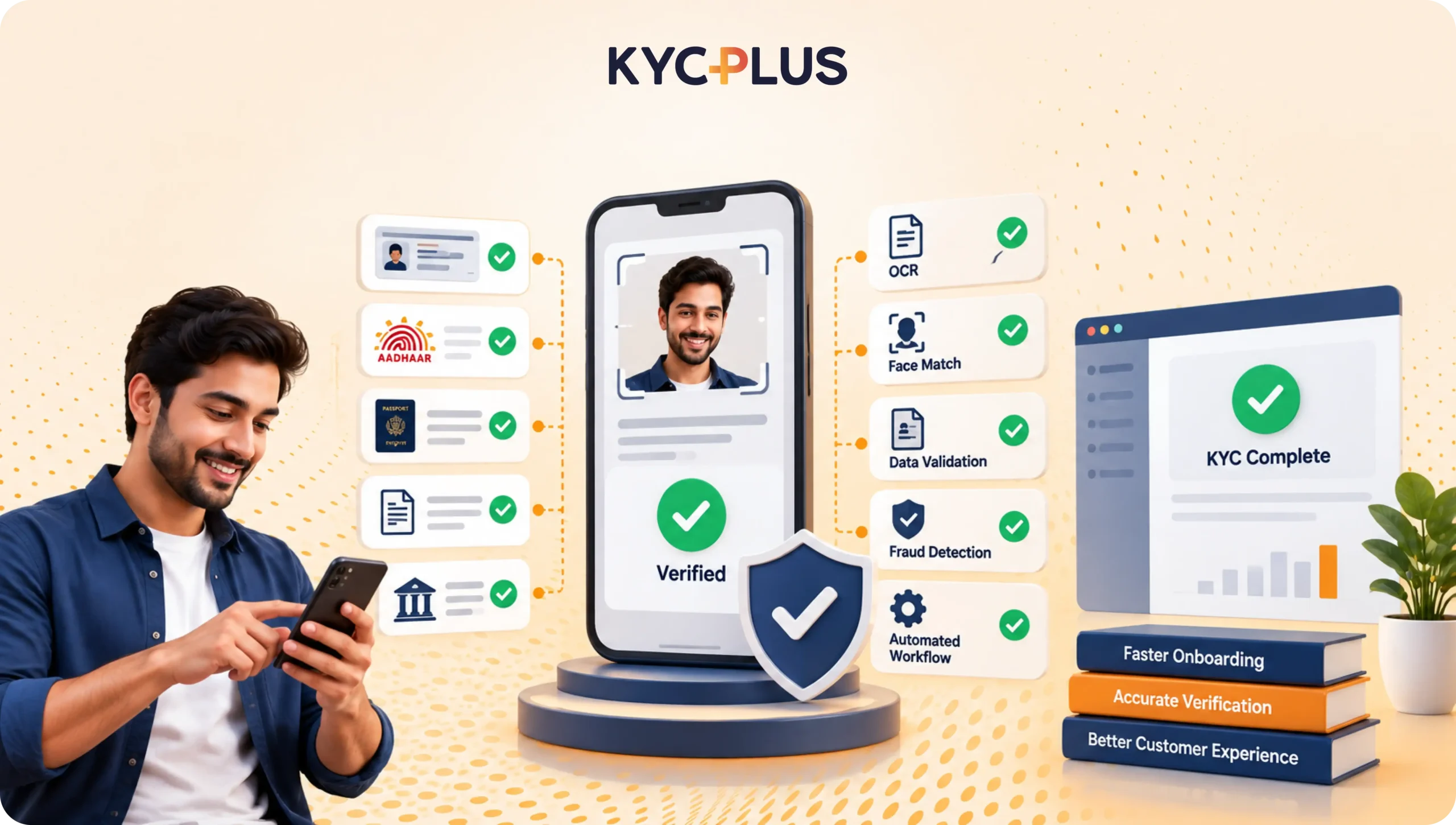
Customer onboarding is becoming increasingly digital across banks, NBFCs, fintech companies, insurance providers, cooperative banks, financial institutions, and other businesses. Customers today expect faster services with fewer forms, less paperwork, and minimal physical visits. However, faster onboarding also creates a major responsibility for organizations: verifying customer identity and documents accurately. This is where KYC Document Verification becomes an important part of the digital onboarding journey.
KYC stands for Know Your Customer. It is the process through which an organization collects and verifies customer information before providing a product or service. Depending on the organization and applicable requirements, customers may need to provide identity, address, tax, or other relevant information.
Traditional KYC processes often depend on employees manually checking documents, entering information into systems, comparing customer details, maintaining document copies, and following up on incomplete applications.
This process can become challenging when customer volumes increase. KYC Document Verification uses technology to make these activities more structured and efficient. Modern verification platforms can use Optical Character Recognition (OCR), document classification, data extraction, validation, face matching, liveness detection, workflow automation, and digital document management.
The objective is to create a complete verification workflow where customer information can be captured, checked, matched, reviewed, stored, and retrieved efficiently. For organizations handling large volumes of customers, this approach can reduce repetitive manual work while improving the overall onboarding experience.
KYC Document Verification is the process of examining customer-submitted documents and information to verify the customer’s identity and other relevant details during onboarding or an ongoing KYC solution process.
In a manual environment, an employee may receive a document, inspect it visually, enter information into an application, compare it against customer-provided details, and save a copy of the document. A digital KYC Document Verification process automates or assists many of these repetitive activities.
For example, when a customer uploads a document, the system can identify the document type, extract information from it using OCR, organize the extracted information into structured fields, compare it with customer-entered data, perform configured checks, and generate a workflow status.
The exact process depends on the organization, document type, technology, and applicable requirements. Therefore, KYC Document Verification should be viewed as a complete operational process rather than a single software feature.
Customer documents contain important identity and personal information. If this information is incorrectly captured or processed, it can create operational problems later.
An effective KYC Document Verification process helps organizations create a more controlled approach to customer onboarding.
Manual data entry can result in spelling mistakes, incorrect numbers, missing fields, or inconsistent formatting. OCR technology can extract information directly from documents and convert it into structured digital data. This reduces the amount of information employees have to manually type.
However, OCR extraction should always be combined with appropriate validation because the quality of extracted information depends on document quality and other factors.
KYC teams can spend considerable time performing repetitive activities such as reading documents, entering information, checking fields, renaming files, and searching for customer records. Automation can handle many of these repetitive steps.
Employees can then spend more time on exceptions and cases that require human judgment.
Customer expectations have changed. A customer who is comfortable ordering products, making payments, and completing applications digitally may also expect a smooth digital onboarding process.
An automated KYC Document Verification workflow can reduce unnecessary delays caused by manual document processing.
In a branch-based organization, different employees may follow slightly different verification procedures. A centralized digital workflow can help standardize the process. This is especially useful for organizations with multiple branches, departments, onboarding channels, or customer service teams.
Paper-based and fragmented document storage can make it difficult to locate customer records. Digital document management can organize customer documents within a controlled environment.
Authorized users can search and retrieve records without depending entirely on physical files.
A digital KYC Document Verification process generally involves multiple stages.
The process starts by collecting customer information.
Depending on the use case, this can include:
Information may be collected through a website, mobile application, branch application, assisted onboarding interface, or API-based system. The objective is to capture the information required for the relevant customer journey.
The customer provides the required document. Documents may be uploaded as images or PDFs or captured directly through a mobile device. The system can provide instructions to help customers upload readable documents. Image quality matters significantly. Blurred images, excessive glare, cropped documents, poor lighting, and low resolution can affect the accuracy of automated processing.
After receiving a document, the system can identify its document type. For example, it may identify a submitted document as a PAN card, passport, driving licence, voter ID, or another supported document.
Document classification helps determine which fields should be extracted and what checks should be performed.
Optical Character Recognition is a major component of modern document processing. OCR technology reads text from an image or scanned document and converts it into machine-readable information. For example, instead of manually typing a document number, the system can extract the number from the uploaded document.
Similarly, it may extract:
The extracted information can then be structured into digital fields.
The next step can involve comparing customer-entered information with document-extracted information.
For example:
If information does not match according to configured rules, the application can flag the case.
This can help reduce the need for employees to manually compare every field.
After information extraction and matching, additional validation can be performed.
Depending on the use case, validation may involve external verification services, document-specific checks, database checks, or other configured controls.
Organizations should determine the appropriate checks according to their products, processes, and applicable requirements.
Some onboarding journeys may require additional verification.
This can include:
Each technology solves a different problem.
For example, OCR focuses on extracting information, while Face Match can compare a person’s image with an identity document photograph.
After the configured checks are completed, the application can generate a workflow status.
Possible statuses can include:
The exact terminology can be customized according to the organization’s process.
Applications requiring additional investigation can be routed to authorized employees.
After verification, customer documents and relevant verification information can be stored according to organizational policies.
A digital system can also maintain information such as:
This creates greater visibility into the onboarding process.
Different organizations may use different documents depending on the customer category and applicable requirements.
Some commonly encountered documents include the following.
Aadhaar is widely used in India’s digital identity ecosystem.
Organizations using Aadhaar-related verification need to follow applicable requirements and use permitted verification mechanisms.
PAN is an important document for many financial and tax-related processes.
Organizations may capture and validate PAN information during relevant onboarding journeys.
A passport contains identity information and a photograph and can be used as an identity document in applicable situations.
A driving licence can contain information such as name, photograph, date of birth, document number, and address, depending on the document format.
Voter identification documents may also be used in applicable KYC processes.
Depending on the customer type and applicable framework, other officially recognized documents may also be accepted. Organizations should define their accepted document types according to the requirements applicable to their specific products and customer categories.
Manual verification has traditionally been an important part of customer onboarding. An employee receives a document, examines it, enters the information, compares details, stores the document, and updates the application.
The workload can grow rapidly.
Digital KYC Document Verification introduces automation into repetitive activities.
This does not mean human verification becomes unnecessary.
Rather, technology can help employees work more efficiently by reducing repetitive tasks.
OCR has become an important technology in digital document processing. Traditional document workflows often treat documents as images or physical pages. OCR converts the information inside those documents into usable digital data.
In KYC Document Verification, OCR can help with:
For example, a customer uploads a PAN card.
Instead of an employee manually entering the PAN number, name, and other relevant information, an OCR system can extract the information and present it in structured fields.
The employee or application can then perform the appropriate validation. However, OCR itself does not prove that a document is genuine. A clear image can still represent an incorrect or manipulated document. Therefore, OCR should be one component of a broader KYC Document Verification workflow.
One of the most overlooked aspects of digital verification is document quality. A verification system can only process the information that it receives. If a customer uploads a blurred or partially hidden document, automated extraction may not work correctly.
Common document-quality problems include:
A well-designed onboarding application can provide real-time guidance to customers. For example, the system can ask the customer to retake an image when the document is unreadable. This creates a better experience and can reduce unnecessary manual review.
Organizations can face several challenges when managing KYC documents manually.
Employees may need to enter information from every document.
This consumes time and can introduce errors.
When document volumes increase, manual verification can create backlogs. This can affect customer onboarding timelines.
Customers may submit duplicate documents or multiple versions of the same document. Without proper document management, identifying the correct version can become difficult.
Documents may be stored across branch systems, email inboxes, shared folders, physical files, and different applications.
This makes centralized access difficult.
Different employees may follow different verification steps. This can make process monitoring more difficult.
Some applications will always require additional review.
Without a structured workflow, these cases can remain pending or require repeated follow-ups.
Organizations need visibility into how customer information and documents were processed. Maintaining appropriate records manually can become difficult as the volume of customers increases.
A properly implemented KYC Document Verification system can provide several operational benefits.
Automation can reduce the time required for repetitive document-processing activities.
OCR can extract information directly from documents, reducing manual typing.
Customers can complete document submission digitally without unnecessary physical interactions.
Documents and verification information can be maintained within a centralized system.
Teams can track pending, completed, failed, and review-required applications.
Automated systems can support higher document volumes without increasing manual effort at the same rate.
Applications that require human intervention can be separated from cases that successfully complete automated checks.
Banks manage large volumes of customer information across savings accounts, current accounts, loans, deposits, and other financial products. This makes efficient document processing important.
For banks, KYC Document Verification can be incorporated into account-opening workflows, digital onboarding, branch operations, customer updates, and other KYC-related processes.
Cooperative banks and Urban Cooperative Banks can also benefit from structured digital workflows, especially when multiple branches or large customer records are involved.
A specialized KYC platform can work alongside an existing Core Banking System.
The objective is not necessarily to replace the CBS.
The CBS continues to manage core banking activities such as accounts, deposits, loans, transactions, and related operations, while a specialized KYC platform can focus on digital onboarding, document verification, KYC workflows, CKYC, Re-KYC solution, document management, and related activities.
NBFCs often need to onboard customers across different products and channels. Depending on the business model, customer onboarding may involve loan applications, financial products, digital applications, or assisted onboarding.
Manual document processing can create delays when application volumes increase.
Digital KYC Document Verification can help NBFCs capture documents, extract information, perform configured checks, and manage exceptions through a structured workflow.
API-based integration can also allow KYC capabilities to connect with existing loan origination systems, CRM platforms, customer portals, or other business applications.
Fintech businesses are generally designed around digital customer experiences. Customers may complete the entire onboarding process through a smartphone. For such businesses, document verification needs to work efficiently within the digital journey.
An API-based KYC Document Verification system can allow the fintech application to submit customer information and documents for processing and receive verification-related results.
This reduces the need for employees to manually move information between systems.
Insurance onboarding may require customer identity information and supporting documents.
Digital verification can help insurance organizations manage documents as part of digital policy issuance and customer onboarding workflows.
OCR can extract information from submitted documents, while additional validation mechanisms can be incorporated depending on the process.
A centralized workflow can also make it easier for teams to track incomplete applications and verification exceptions.
Document verification focuses primarily on the submitted identity document.
However, organizations may also need to determine whether the person completing the onboarding process corresponds to the identity represented by the document. This is where Face Match can become useful.
Face Match technology can compare a customer’s live image or selfie with the photograph available in an identity document or permitted identity source.
It can help determine whether the interaction is coming from a live person rather than a static photograph or certain types of presentation attacks. Together with document processing, these technologies can create a broader digital identity verification workflow.
However, organizations should select verification methods according to their specific risk model and applicable requirements.
Identity fraud is an important concern for digital businesses. Fraudsters may attempt to use incorrect information, manipulated documents, stolen identities, or other methods to pass onboarding checks.
KYC Document Verification can contribute to fraud-prevention processes by checking information and identifying mismatches or exceptions.
For example, an automated system can identify situations where:
APIs make it possible for different software systems to communicate with one another. This is particularly useful for organizations that already have applications for customer onboarding, CRM, loan processing, insurance, or banking operations.
Instead of building every verification function internally, a business can integrate a specialized verification service through APIs where appropriate.
For example:
Customer Application
↓
KYC API
↓
Document Processing
↓
OCR / Verification
↓
Validation
↓
Result
↓
Customer Application
This approach can reduce development effort and allow organizations to introduce specialized KYC capabilities into existing applications.
KYCPLUS provides a specialized digital KYC platform that helps organizations modernize customer onboarding and KYC-related workflows.
Its capabilities can include digital onboarding, KYC Document Verification, OCR-based document processing, CKYC workflows, Re-KYC, document management, Face Match, Liveness Detection, and API-based integration.
For banks and financial institutions, this approach can complement existing banking infrastructure.
For example, an organization can continue using its Core Banking System for core banking operations while using a specialized platform for KYC and document-related workflows.
This separation can help organizations use the right technology for the right operational requirement.
KYCPLUS can also support centralized workflows where authorized teams can manage customer documents, verification activities, and related processes through a structured digital environment.
The exact configuration should depend on the organization’s requirements, existing systems, customer journey, and applicable compliance framework.
Organizations evaluating verification platforms should look beyond a simple document-upload feature.
A comprehensive solution may include the following capabilities.
The platform should be able to extract relevant information from supported documents.
The system should identify the document type being processed.
Compare customer-entered information with the information extracted from documents.
The solution should support appropriate verification and validation mechanisms.
Where required, the platform should support facial comparison as part of the identity verification journey.
For applicable digital onboarding processes, liveness capabilities can provide an additional verification layer.
Organizations should be able to manage customer documents in an organized digital environment.
Automatically route applications that require additional review to the appropriate team.
The platform should provide visibility into important verification activities.
APIs can make it easier to connect the solution with existing business applications.
Technology alone is not enough.
Organizations should also establish clear processes.
Before implementing software, organizations should document their existing onboarding process.
Identify the manual activities, automate the tasks that can be automated, and determine where human review is necessary.
Do not create a generic document list for every customer.
Document requirements should be based on the applicable customer category, product, and regulatory framework.
Where reliable extraction and validation are available, avoid asking employees to repeatedly enter information that already exists in documents.
Not every application will pass automated checks.
The system should provide a clear process for cases requiring additional review.
Verification-related records should be maintained according to applicable organizational and regulatory requirements.
KYC documents contain sensitive customer information.
Organizations should implement appropriate access controls, security measures, retention policies, and data-handling practices.
Selecting a verification platform requires more than comparing feature lists.
Organizations should first understand their operational requirements.
Ask questions such as:
The organization should then evaluate whether the solution can fit into the existing technology environment.
For banks, integration with existing CBS infrastructure can be particularly important.
A specialized KYC platform should ideally complement the existing technology environment instead of forcing the organization to replace systems that already perform their core functions.
The future of customer verification is moving toward more automated, intelligent, and integrated workflows.
OCR will continue to become more capable of extracting information from different document formats.
Artificial intelligence can help improve document classification, data extraction, anomaly identification, and workflow automation.
Biometric verification can add another layer to digital identity processes.
API-driven architectures can connect KYC services with banking, lending, insurance, CRM, and customer onboarding applications.
At the same time, organizations will need to pay close attention to security, privacy, consent, data governance, and applicable regulatory requirements.
The future is therefore not simply about replacing manual verification with AI.
It is about creating a complete digital identity workflow where technology, human review, security, compliance, and customer experience work together.
The biggest advantage of digital transformation is not simply speed.
It is process visibility.
A manual process makes it difficult to track how many applications are pending, where documents are stuck, which cases need review, and how long verification takes.
A digital KYC Document Verification workflow can make these activities more measurable.
Organizations can create dashboards, track application status, identify exceptions, monitor workflow activity, and maintain digital records.
This creates a more organized approach to customer onboarding.
For organizations growing their customer base, this scalability can become increasingly important.
KYC Document Verification has become an important component of modern digital customer onboarding.
As banks, NBFCs, fintech companies, insurance providers, cooperative banks, and other businesses move toward digital services, manual document processing can create unnecessary operational challenges.
A modern verification workflow can combine document capture, OCR, data extraction, matching, validation, Face Match, Liveness Detection, workflow automation, document management, and audit capabilities.
The goal should not be to automate every decision without human involvement.
Instead, businesses should automate repetitive activities while creating clear workflows for cases that require employee review.
A specialized platform such as KYCPLUS can help organizations build digital KYC workflows and integrate them with their existing technology infrastructure.
The right solution ultimately depends on the organization’s customer volume, business model, technology environment, document requirements, verification needs, and applicable regulatory framework.
When implemented properly, digital KYC Document Verification can help organizations create a faster, more structured, scalable, and trackable customer onboarding process.
Ans: KYC Document Verification is the process of checking customer-submitted identity and related documents to verify information provided during customer onboarding or KYC-related activities.
Ans: It helps organizations establish a structured process for collecting, checking, matching, and managing customer identity information and documents.
Ans: Depending on the applicable requirements and customer category, organizations may use documents such as PAN, Aadhaar-related documents, passport, driving licence, voter ID, and other permitted documents.
Ans: OCR, or Optical Character Recognition, extracts text and information from documents and converts it into machine-readable data.
Ans: Not necessarily. OCR primarily extracts information. Document authenticity and identity verification require additional appropriate checks.
Ans: Yes. Many parts of the process, including document classification, OCR, data extraction, matching, validation, workflow routing, and document management, can be automated depending on the solution.
Ans: Yes. A specialized KYC platform can be integrated with a Core Banking System through APIs or other supported integration mechanisms. The CBS can continue handling core banking operations while the KYC platform manages specialized KYC workflows.
Ans: KYCPLUS provides capabilities for digital KYC workflows, including document processing, OCR, CKYC, Re-KYC, Face Match, Liveness Detection, document management, and API-based integration, depending on the configured implementation.
Ans: Digital KYC workflows can be useful for cooperative banks, UCBs, DCCBs, and other financial institutions looking to reduce manual document processing and improve centralized KYC operations.
Ans: Businesses should consider document support, OCR accuracy, validation capabilities, integration options, workflow automation, document management, security, audit requirements, scalability, customer experience, and the specific requirements applicable to their business.
