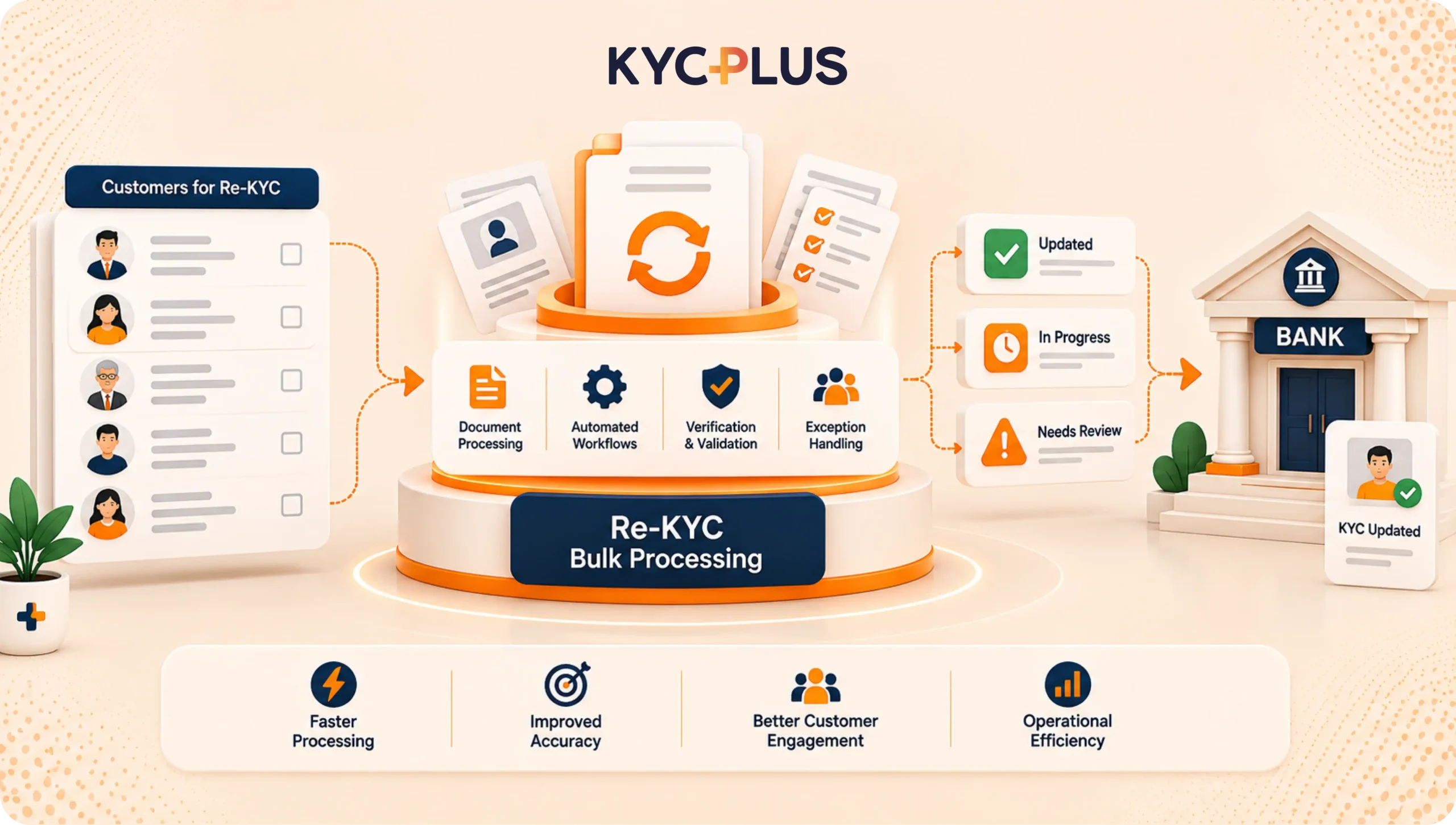
Re-KYC has become an important part of customer lifecycle management for banks and financial institutions. Customer information, identity documents, contact details, and other KYC-related records may need to be updated periodically based on applicable regulatory requirements and the bank’s internal policies. For a bank with a large customer base, managing these updates manually can become a time-consuming and operationally challenging process. The challenge becomes even greater when thousands of customers need to complete their KYC updates within a defined period. Branch employees may need to contact customers, collect documents, verify information, update records, maintain documentation, and track pending cases. When these activities are handled through spreadsheets, physical documents, emails, and disconnected systems, the process can become difficult to monitor and scale. A Re-KYC Bulk Processing Solution provides a technology-driven approach to managing large volumes of Re-KYC cases through centralized workflows, automation, document processing, customer communication, verification, and status tracking.
Instead of treating every Re-KYC case as a completely separate manual activity, banks can use a structured Re-KYC solution with a bulk-processing workflow to identify customers, initiate requests, collect updated information, process documents, review exceptions, and update relevant systems.
This approach can be particularly useful for cooperative banks, Urban Cooperative Banks (UCBs), District Central Cooperative Banks (DCCBs), and other institutions with large customer databases and limited operational resources.
An effective solution needs to address the complete Re-KYC lifecycle, including customer identification, communication, data capture, document processing, verification, exception handling, audit trails, reporting, and integration with the bank’s existing CBS and other systems.
This article explains how automated bulk Re-KYC works, why banks need it, what features to look for, how it can improve operational efficiency, and how a solution such as KYCPLUS can complement an existing banking technology environment.
Re-KYC refers to the process of updating and maintaining customer KYC information when an update is required according to applicable requirements and the bank’s customer lifecycle processes.
KYC is not necessarily a one-time activity. Customer information can change over time. A customer may change an address, mobile number, occupation, business details, identification documents, or other relevant information.
Banks therefore need processes to identify customers requiring updates and obtain the necessary information.
The exact requirements and frequency of KYC updates depend on applicable regulatory requirements, customer risk categorization, and the bank’s policies.
A traditional Re-KYC process may involve branch visits, physical forms, document submission, manual verification, and employee follow-up.
Digital technology can simplify many of these activities by providing structured workflows for customer communication, document submission, information capture, verification, and record management.
Managing a small number of Re-KYC cases manually may be possible for a branch. The challenge increases significantly when the bank has thousands or even a much larger number of customers requiring updates.
For example, consider a bank with a large customer database distributed across multiple branches.
If thousands of customers need to update their KYC information, employees may need to:
Performing these activities manually can consume significant employee time.
A Re-KYC Bulk Processing Solution can help convert this fragmented process into a centralized workflow.
Instead of managing cases individually through disconnected channels, the bank can organize Re-KYC activities into batches, assign workflows, track progress, and identify exceptions.
A Re-KYC Bulk Processing Solution is a technology platform designed to help banks process large numbers of Re-KYC cases through automated or semi-automated workflows.
The exact capabilities differ between platforms, but a comprehensive solution may include:
The objective is to reduce repetitive manual work while maintaining appropriate controls.
Rather than requiring employees to manage every customer interaction manually, the platform can automate repetitive steps and allow employees to focus on cases requiring review or intervention.
An automated Re-KYC process generally starts with identifying customers whose KYC information needs to be updated.
The bank can provide the relevant customer data through its existing system or another approved data source.
The Re-KYC Bulk Processing Solution can then create cases and initiate the appropriate workflow.
Customer identification → Bulk case creation → Customer communication → Information and document collection → OCR/data extraction → Verification → Review → Approval → Record update → Reporting
The exact workflow can be configured according to the bank’s requirements.
The major advantage is that the process can be managed centrally rather than through multiple disconnected manual activities.
The first major requirement in large-scale Re-KYC is knowing which customers need to complete the process.
A bank may have customer information spread across branches, databases, and systems.
A Re-KYC Bulk Processing Solution can help organize eligible customer records into structured processing groups.
For example, customers can potentially be segmented according to:
The exact segmentation should be based on the bank’s policies and applicable requirements.
Centralized customer identification makes it easier for management to understand the overall Re-KYC workload.
One of the most time-consuming activities in bulk Re-KYC can be customer follow-up.
Employees may need to contact customers repeatedly to inform them about pending requirements.
A digital Re-KYC workflow can support automated communication through configured channels, subject to the bank’s communication policies and available integrations.
The communication can provide information about:
Automated reminders can also help reduce the number of pending cases.
The goal is not simply to send more messages. The communication should guide customers through a clear and convenient process.
Physical document collection can create significant operational overhead.
Customers may need to visit branches, submit photocopies, and wait for employees to manually process the information.
A digital Re-KYC Bulk Processing Solution can provide workflows for collecting required documents electronically, where permitted and configured according to the bank’s requirements.
Customers can submit documents through supported channels, while the bank can track whether the required information has been received.
This can reduce unnecessary branch visits and simplify document handling.
However, digital document collection should always include appropriate security, access controls, validation, and data-protection mechanisms.
OCR, or Optical Character Recognition, can play an important role in document-heavy Re-KYC workflows.
When customers submit supported identity or address documents, OCR can extract relevant information from the document.
Instead of employees manually typing every field, extracted information can be presented for review.
This can reduce repetitive data-entry work and improve processing speed.
A Re-KYC Bulk Processing Solution with OCR capabilities can therefore help banks process large numbers of documents more efficiently.
However, OCR should not be treated as a replacement for human review in every situation.
Document quality, image clarity, document type, and other factors can affect extraction results. A good workflow should therefore include validation and exception handling.
Data captured through digital forms or OCR may need to be checked before being accepted.
A Re-KYC platform can support validation rules based on the bank’s configured requirements.
For example, the system may identify:
This helps employees focus their attention on exceptions rather than manually checking every case.
When evaluating a Re-KYC Bulk Processing Solution, banks should understand how validation rules can be configured and how exceptions are presented to users.
Not every Re-KYC case will be completed successfully on the first attempt.
Customers may submit incomplete documents, unclear images, inconsistent information, or information that requires additional review.
An effective system should therefore have a clear exception-management workflow.
Instead of simply marking a case as “failed,” the system can identify the reason and route it to the appropriate employee or branch.
Examples may include:
This is an important capability because bulk processing is not about forcing every case through automation.
The objective is to automate standard cases while efficiently routing exceptions for human review.
One of the biggest challenges in manual Re-KYC is knowing the status of every customer.
Employees may have to maintain spreadsheets or check multiple systems.
A centralized Re-KYC Bulk Processing Solution can provide status visibility through dashboards and reports.
A bank may be able to view cases such as:
This gives branch managers and administrators a clearer view of campaign progress.
Management can also identify branches or customer segments with higher pending volumes.
Large banks and cooperative banking institutions may have customers spread across numerous branches.
Managing Re-KYC branch by branch can make reporting and coordination difficult.
A centralized Re-KYC Bulk Processing Solution can help create a common framework across branches while still allowing branch-level access and responsibility.
For example, head-office users may monitor overall progress while branch employees can access cases assigned to their branch.
This can create a balance between centralized visibility and decentralized execution.
Cooperative banks can face unique operational challenges because they may have multiple branches and a large number of customers who traditionally interact through branch-based processes.
For these institutions, a Re-KYC Bulk Processing Solution can help reduce the operational workload associated with high-volume customer updates.
UCBs can use centralized workflows to coordinate Re-KYC across branches.
DCCBs can evaluate bulk-processing capabilities based on their customer base, branch structure, internal resources, and existing banking technology.
The solution should be flexible enough to support the bank’s operational structure rather than forcing every institution into the same workflow.
A Re-KYC platform should not be treated as a replacement for the bank’s core banking system.
The CBS remains responsible for core banking functions such as accounts, deposits, loans, transactions, and related banking operations.
A Re-KYC Bulk Processing Solution should instead work alongside the existing CBS.
Integration allows relevant customer information and KYC status to move between systems according to the bank’s approved architecture.
For example, the KYC solution platform can manage the Re-KYC workflow while the CBS continues to act as the core banking system.
This approach can help banks improve Re-KYC processes without replacing their existing CBS infrastructure.
APIs can play an important role in connecting a Re-KYC platform with the bank’s existing technology environment.
Through appropriate APIs, systems can exchange relevant information securely and efficiently.
Depending on the architecture, integrations may involve:
The exact data exchanged should be defined by the bank’s technical and operational requirements.
When selecting a Re-KYC Bulk Processing Solution, banks should therefore evaluate the availability, security, documentation, and flexibility of integration mechanisms.
Re-KYC can generate a large volume of documents.
If these documents are stored across physical files, employee computers, emails, and separate folders, retrieval can become difficult.
A centralized document-management capability can help organize customer documents within the appropriate workflow.
An effective Re-KYC Bulk Processing Solution can help associate documents with customer records and workflow cases while providing appropriate access controls.
This can make it easier for authorized employees to locate information when required.
Document management should also consider retention, auditability, access permissions, and security according to the bank’s policies and applicable requirements.
KYC-related activities require appropriate record keeping.
Banks should be able to understand what happened during a customer case, including relevant actions, approvals, changes, and workflow status.
A Re-KYC Bulk Processing Solution can provide audit trails that help the bank track activity within the platform.
Audit information can help answer questions such as:
The exact audit requirements should be determined according to the bank’s policies and applicable regulatory obligations.

Large-scale Re-KYC requires management visibility.
A bank should be able to understand overall progress and identify areas requiring attention.
A centralized Re-KYC Bulk Processing Solution can provide dashboards and reports showing campaign-level and branch-level performance.
Useful reporting categories may include:
Such reporting can help management allocate resources more effectively.
Instead of waiting for manual reports from individual branches, authorized users can access centralized information.
One important misconception about automated Re-KYC is that every activity can or should happen without human involvement.
In reality, automation should be used to handle repetitive and predictable activities while employees manage cases requiring judgment or additional verification.
A good Re-KYC Bulk Processing Solution can therefore follow a “straight-through processing plus exception handling” approach.
Standard cases can move through predefined workflows, while exceptions can be routed to authorized employees.
This approach can help improve efficiency without removing necessary human oversight.
The adoption of a Re-KYC Bulk Processing Solution can provide several potential benefits.
Automated workflows can reduce repetitive activities such as data entry, status tracking, document sorting, and routine follow-up.
Digital workflows can reduce delays caused by physical paperwork and disconnected processes.
Centralized dashboards allow management and authorized employees to understand the status of Re-KYC campaigns.
Digital workflows can reduce unnecessary branch visits and provide customers with more convenient ways to submit information.
Centralized document management can make customer records easier to organize and retrieve.
A technology platform can help banks manage larger volumes without increasing manual effort at the same rate.
Standardized workflows can help branches follow a consistent process.
Selecting a Re-KYC Bulk Processing Solution requires more than checking whether the product supports automated reminders.
Banks should evaluate the complete workflow.
The solution should support efficient creation or ingestion of large numbers of Re-KYC cases.
The platform should support appropriate channels for collecting information and documents.
Banks should evaluate supported document types, extraction capabilities, validation, and exception handling.
The system should allow workflows to be configured according to the bank’s processes.
The platform should be capable of integrating with the existing CBS and other required systems.
Management should have access to useful campaign, branch, and case-level reports.
The solution should provide appropriate authentication, access control, encryption, logging, and monitoring.
The system should be capable of processing increasing volumes of customers and documents.
The provider should offer implementation assistance, technical support, troubleshooting, training, and ongoing maintenance as agreed.
Cloud technology can provide additional flexibility for banks implementing a Re-KYC Bulk Processing Solution, depending on the deployment model and the institution’s technology requirements.
A cloud-based platform can potentially provide centralized access, scalable infrastructure, and simplified deployment.
However, banks should evaluate cloud architecture carefully.
Important considerations include:
Cloud deployment should be evaluated according to the bank’s security and technology policies rather than treated as a benefit by itself.
A large Re-KYC exercise can be managed like a structured campaign.
Instead of treating all customers identically, the bank can organize cases into different campaigns or processing groups.
For example, a bank may create campaigns based on branches, customer categories, pending cases, or other internally defined criteria.
A Re-KYC Bulk Processing Solution can help administrators create, monitor, and report on these campaigns.
Campaign-level visibility can make it easier to understand how much work remains and where operational resources are required.
Branch employees often have multiple responsibilities beyond KYC.
They may manage customer service, deposits, loans, account operations, documentation, and other banking activities.
When Re-KYC is handled manually at scale, it can add considerable workload.
Automation can reduce repetitive tasks and allow branch employees to focus on cases that genuinely require their attention.
For example, instead of manually checking every submitted document, employees can review cases that the system has identified as incomplete or requiring additional verification.
This can make the Re-KYC process more manageable during high-volume campaigns.
Customer experience is another important part of Re-KYC modernization.
A customer may become frustrated if they have to repeatedly visit a branch, submit the same information, or wait without knowing the status of their request.
A digital Re-KYC Bulk Processing Solution can provide a more structured process.
Customers can receive clear instructions, submit information through supported digital channels, and receive appropriate communication about the status of their request.
The exact customer journey will depend on the bank’s policies, technology environment, and available channels.
KYCPLUS can complement a bank’s existing CBS by providing specialized KYC and customer lifecycle capabilities.
The platform can support workflows around:
For a bank implementing a Re-KYC Bulk Processing Solution, KYCPLUS can be positioned as an additional technology layer rather than a replacement for the CBS.
The bank’s CBS can continue handling core banking operations while KYCPLUS manages specialized KYC and Re-KYC workflows.
This approach can be particularly useful for institutions that already have an established CBS but want to improve the efficiency of customer lifecycle processes.
A bank does not necessarily need to replace its CBS to modernize Re-KYC.
Instead, KYCPLUS can integrate with the existing banking environment.
Existing CBS → Integration Layer → KYCPLUS → Re-KYC Workflow → Customer/Documents/Verification → Relevant Information Back to Banking Systems
The actual architecture will depend on the bank’s CBS, integration capabilities, security requirements, and operational workflow.
The key principle is that the CBS remains the core banking platform.
KYCPLUS provides specialized capabilities around KYC and customer lifecycle management.
This approach can help banks modernize Re-KYC without introducing unnecessary disruption to their core banking operations.
The value of a Re-KYC Bulk Processing Solution becomes especially clear when the bank has a large customer base.
If thousands of cases need to be processed, manual workflows can create bottlenecks.
Bulk processing allows the bank to initiate and manage many cases through a centralized framework.
However, scale should not come at the expense of control.
The platform should provide appropriate access management, workflow approvals, auditability, exception handling, and reporting.
The goal is to process high volumes while maintaining consistent operational controls.
Banks should implement automated Re-KYC in phases rather than immediately moving every customer into a new workflow.
A practical approach can include:
Identify the bank’s current Re-KYC process, customer volumes, systems, challenges, and desired outcomes.
Review customer records, identify required cases, and prepare appropriate data for processing.
Define how the solution will connect with the CBS and other relevant systems.
Run the workflow with a limited group of branches or customers to identify issues.
Expand the process gradually after successful testing.
Track completion rates, exceptions, customer responses, processing times, and operational performance.
This phased approach can help reduce implementation risk.
Banks should avoid several common mistakes when implementing bulk Re-KYC automation.
Technology cannot solve every problem if the underlying workflow is unclear.
Banks should first understand and simplify the process where possible.
Poor customer data can create duplicate records, mismatches, and exceptions.
Data preparation should therefore be part of the implementation.
Sending reminders is only one part of Re-KYC.
The platform should manage the complete lifecycle from customer response through verification and record updates.
Some cases will require manual review.
The system should provide a structured exception workflow.
A standalone KYC platform can create another information silo if it cannot communicate effectively with the bank’s existing systems.
Employees need to understand the new workflows and how to manage exceptions.
Training should be included in implementation planning.
Banks should define measurable objectives before implementing a Re-KYC Bulk Processing Solution.
Possible metrics include:
These metrics can help management understand whether automation is delivering the expected operational benefits.
The exact KPIs should be selected according to the bank’s goals and Re-KYC process.
Re-KYC is likely to become increasingly technology driven as banks continue to digitize customer lifecycle management.
Automation, OCR, digital document processing, workflow engines, APIs, analytics, and centralized dashboards can help institutions manage customer updates more efficiently.
The future is unlikely to be about completely removing employees from the process.
Instead, technology can handle repetitive tasks while employees focus on exceptions, approvals, customer assistance, and activities requiring judgment.
This makes the concept of a Re-KYC Bulk Processing Solution increasingly relevant for banks that want to manage large customer populations without creating proportionally larger operational workloads.
Managing Re-KYC for a large customer base can be challenging when the process depends heavily on manual data entry, physical documents, branch-level follow-ups, spreadsheets, and disconnected systems.
A Re-KYC Bulk Processing Solution can provide a more structured approach by bringing customer identification, communication, information capture, document processing, OCR, verification, exception management, reporting, and workflow tracking into a centralized environment.
The objective is not simply to automate every step. The objective is to automate repetitive activities while ensuring that cases requiring human review are routed to the appropriate employees.
For cooperative banks, UCBs, DCCBs, and other financial institutions, bulk processing can help manage high-volume Re-KYC campaigns more efficiently while improving visibility across branches and customer segments.
Integration is another critical consideration. Banks should not treat a Re-KYC platform as a replacement for their existing CBS. The CBS can continue to perform core banking functions, while a specialized KYC platform can handle additional KYC and customer lifecycle workflows.
KYCPLUS follows this complementary approach. It can integrate with an existing CBS and provide capabilities around Re-KYC, KYC, digital onboarding, OCR, document management, CKYC-related workflows, customer information capture, and compliance processes.
Ultimately, the right Re-KYC Bulk Processing Solution should provide a balance of automation, security, scalability, integration, operational control, customer convenience, and human oversight.
For banks planning to modernize their Re-KYC operations, the focus should not only be on processing more cases. It should be on creating a reliable, trackable, scalable, and integrated process that can support the bank’s customer lifecycle requirements over the long term.
Ans: A Re-KYC Bulk Processing Solution is a technology platform designed to help banks manage large volumes of Re-KYC cases through centralized workflows, digital communication, document collection, OCR, verification, exception handling, reporting, and system integration.
Ans: Banks with large customer databases may have thousands of customers requiring KYC updates. Processing these cases manually can increase employee workload and make tracking difficult. Bulk processing can help organize and manage large numbers of cases through a structured workflow.
Ans: Yes, several parts of the Re-KYC process can be automated depending on the bank’s workflow and technology architecture. These may include case creation, customer communication, document collection, OCR, status tracking, reminders, reporting, and routing of exceptions.
Ans: Yes. A suitable solution can integrate with an existing CBS through APIs or other supported integration mechanisms. The CBS can continue performing core banking functions while the KYC platform manages specialized Re-KYC and customer lifecycle workflows.
Ans: No. KYCPLUS is not a replacement for the bank’s CBS. It can work alongside the existing CBS and provide additional capabilities for Re-KYC, KYC, digital onboarding, OCR, document management, CKYC-related workflows, and compliance processes.
Ans: OCR can extract information from supported customer documents, reducing repetitive manual data entry. The extracted information can then be reviewed and validated according to the bank’s workflow. Cases with unclear or inconsistent information can be routed for manual review.
Ans: Yes. Cooperative banks, UCBs, and DCCBs can consider bulk Re-KYC technology based on their customer volumes, branch structure, existing CBS, internal resources, and digital transformation requirements.
Ans: Banks should consider bulk case processing, customer communication, digital document collection, OCR, workflow management, validation, exception handling, document management, reporting, audit trails, security, scalability, and integration capabilities.
Ans: A digital workflow can reduce repetitive manual activities such as data entry, document handling, status tracking, and routine follow-up. This can allow branch employees to focus more on exceptions, customer assistance, and cases requiring manual review.
Ans: Banks should evaluate the solution based on functionality, security, scalability, integration with the existing CBS, document processing, OCR, workflow flexibility, reporting, vendor support, implementation requirements, and total cost of ownership. A pilot or controlled implementation can also help the bank evaluate the platform before a full rollout.
