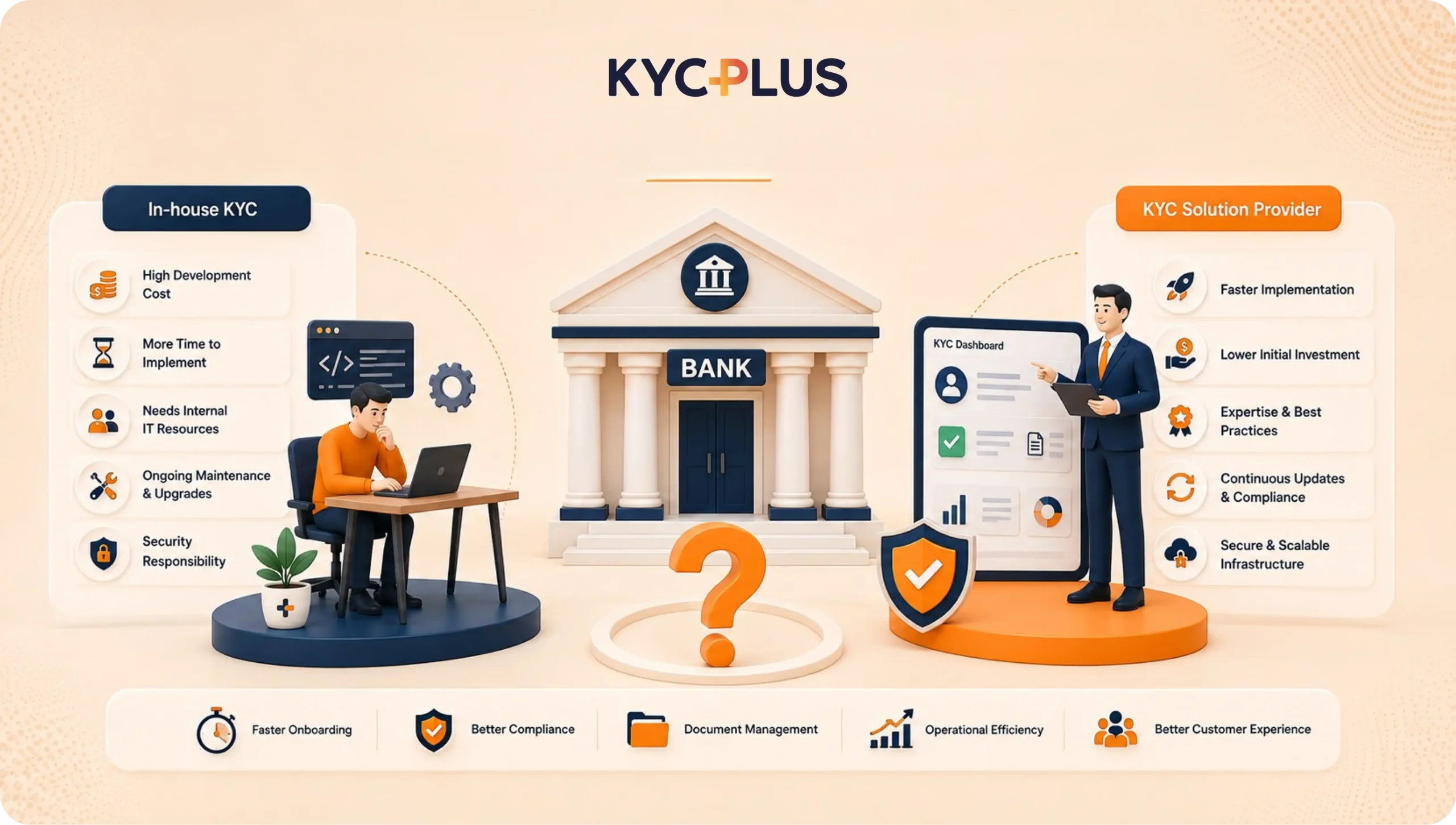
Know Your Customer (KYC) is one of the most important processes in modern banking. Before providing banking services, financial institutions need to collect and verify customer information, maintain appropriate records, manage documents, and complete applicable regulatory and compliance processes. As customer onboarding becomes increasingly digital, banks are also looking for faster and more efficient ways to manage KYC operations. This has led many banks to consider an important technology decision: should they build and manage their KYC infrastructure internally, or should they work with a specialized technology provider? The discussion around In-house KYC vs KYC Solution Provider is particularly relevant for banks that want to improve onboarding speed, reduce manual work, strengthen document management, and integrate KYC processes with their existing banking technology.
An in-house approach can give a bank direct control over technology, processes, and customization. However, it can also require significant investment in software development, infrastructure, cybersecurity, technical manpower, maintenance, upgrades, and regulatory changes.
A specialized KYC solution provider, on the other hand, can provide an existing technology platform designed specifically for KYC and onboarding requirements. This can help banks implement digital workflows without developing every component internally.
There is no single answer that works for every institution. The right choice depends on the bank’s size, technology capabilities, budget, internal resources, operational requirements, customer volume, integration needs, and long-term strategy.
Understanding In-house KYC vs KYC Solution Provider therefore requires looking beyond the initial software cost. Banks need to compare the complete operational and technology implications of both approaches.
In-house KYC means that a bank develops, manages, or substantially controls its own KYC technology and operational infrastructure.
Under this model, the bank may use its internal IT team to build applications or configure existing enterprise systems to support customer onboarding, document collection, verification, record management, and related processes.
The exact architecture can differ from one bank to another.
An institution may build its own:
The bank may also use multiple third-party components while managing the overall solution internally.
The biggest attraction of an in-house model is control. The bank can define its workflows and make changes according to its own requirements.
However, control also comes with responsibility.
The bank becomes responsible for maintaining the technology, managing updates, fixing issues, monitoring security, supporting users, integrating with other systems, and adapting the platform as requirements change.
This is one of the most important points to consider when evaluating In-house KYC vs KYC Solution Provider.
A KYC solution provider is a specialized technology company that provides software and infrastructure designed to support KYC, customer onboarding, document processing, verification, and related compliance workflows.
Instead of developing every capability internally, a bank can integrate the provider’s platform with its existing banking technology.
Depending on the solution, capabilities may include:
For banks evaluating In-house KYC vs KYC Solution Provider, the major difference is where the technology responsibility sits.
With an in-house model, the bank manages a much larger portion of the technology lifecycle.
With a specialized provider, the provider manages and maintains the solution while the bank focuses on configuring workflows, integrating systems, managing users, and governing the process.
KYC is not a one-time activity. Customer information needs to be captured, verified, maintained, updated, and managed throughout the customer relationship.
A bank may need to handle thousands or millions of customer records depending on its size.
Manual KYC processes can create challenges such as:
Technology can help address these challenges, but the bank needs to decide how that technology should be developed and managed.
This is where In-house KYC vs KYC Solution Provider becomes a strategic decision.
The bank must consider not only what the system can do but also who will build it, maintain it, secure it, update it, integrate it, and support it over the next several years.
One of the first differences between the two approaches is technology development.
With an in-house model, the bank needs to design the architecture and develop or configure the required capabilities.
This may involve developers, database administrators, cybersecurity specialists, UI/UX teams, testers, project managers, business analysts, and banking-domain experts.
The development process can take significant time, particularly if the bank wants to build a complete digital KYC ecosystem.
A specialized provider already has a technology platform that can be configured according to the bank’s requirements.
When comparing In-house KYC vs KYC Solution Provider, banks should therefore ask how much development effort is actually required internally and whether the bank has the necessary technology resources.
Cost is often one of the first factors considered in In-house KYC vs KYC Solution Provider discussions.
At first glance, building an internal solution may appear attractive because the bank may believe that it can avoid recurring vendor fees.
However, the actual cost of an in-house solution can include much more than software development.
Banks may need to invest in:
These costs can continue throughout the lifecycle of the platform.
A solution provider typically follows a different commercial model, such as licensing, subscription, implementation fees, transaction-based pricing, or a combination.
The bank therefore needs to compare the total cost of ownership rather than only comparing development cost with subscription cost.
Time is another important consideration.
Developing an in-house KYC platform can require multiple stages:
1. Requirement gathering
2. Architecture design
3. Development
4. Integration
5. Testing
6. Security assessment
7. User acceptance testing
8. Deployment
9. Training
10. Ongoing improvement
A specialized KYC solution provider may already have the underlying platform and can therefore focus on configuration and integration.
This can potentially reduce implementation time.
For banks launching new digital onboarding services or trying to reduce customer onboarding delays, implementation speed can have a direct business impact.
Therefore, In-house KYC vs KYC Solution Provider should also be evaluated from a time-to-value perspective.
The question is not simply “Which option costs less?” It is also “Which option can deliver the required capabilities within the bank’s desired timeframe?”
One of the strongest arguments for in-house development is customization.
A bank can design workflows specifically around its internal processes.
For example, it can decide how customer information is captured, how approvals are handled, how documents are stored, and how information moves between departments.
However, specialized KYC platforms can also offer configuration and customization capabilities.
The important distinction is that configuration usually works within the architecture of an existing platform, while in-house development gives the bank greater control over the underlying technology.
In-house KYC vs KYC Solution Provider, banks should determine whether they genuinely require extensive customization.
If the bank’s requirements can be handled through configuration and integrations, developing an entire platform internally may not be necessary.
Security is one of the most critical areas in KYC operations.
KYC systems handle sensitive customer information and documents. Therefore, banks need strong controls around authentication, access, encryption, monitoring, logging, data storage, and incident management.
With an in-house platform, the bank is responsible for designing and maintaining these controls.
This can provide direct control but also creates significant responsibility for the bank’s IT and cybersecurity teams.
A specialized provider should be evaluated on the basis of its security architecture, access controls, encryption, monitoring, infrastructure, incident response, and data governance practices.
During an In-house KYC vs KYC Solution Provider evaluation, banks should not assume that either model is automatically more secure.
Security depends on how the solution is designed, deployed, managed, and monitored.
The bank should conduct appropriate due diligence regardless of the chosen approach.
KYC processes operate in a regulatory environment that can change over time.
Banks may need to modify workflows, forms, documentation, verification processes, reporting, or record management as applicable requirements evolve.
With an in-house system, the bank’s technology team must identify required changes and implement, test, and deploy them.
This can require coordination between compliance, operations, IT, cybersecurity, and management.
With a specialized provider, some technology changes can be managed by the provider, depending on the scope of the service and contractual responsibilities.
This does not transfer the bank’s regulatory responsibility to the provider. The bank remains responsible for ensuring that its processes comply with applicable requirements.
This distinction is important when considering In-house KYC vs KYC Solution Provider.
A provider can supply technology capabilities, but the bank must maintain appropriate governance and compliance oversight.
Software does not remain static.
Operating systems change, security threats evolve, integrations need updates, customer expectations change, and business processes are modified.
An in-house KYC platform therefore requires continuous maintenance.
The bank may need to allocate developers and technical staff to:
A specialized provider takes responsibility for maintaining its platform according to the service agreement.
This can reduce the internal technology burden.
For banks comparing In-house KYC vs KYC Solution Provide, ongoing maintenance should therefore be included in the financial and operational evaluation.
The KYC needs of a bank can increase significantly as its customer base grows.
An institution may start with a limited number of onboarding cases but eventually handle thousands of applications every month.
An in-house platform needs to be designed to scale accordingly.
This means the bank must consider application performance, database capacity, infrastructure, storage, network capacity, and technical support.
A specialized provider may already operate its platform for multiple customers and may have infrastructure designed to support varying workloads.
When evaluating In-house KYC vs KYC Solution Providers, the bank should ask how the solution will handle increased customer volumes, document storage, OCR workloads, integrations, and Re-KYC requirements.
KYC technology rarely operates independently.
Banks generally already have a CBS that manages core banking functions. A KYC platform needs to exchange relevant information with the CBS and other banking applications.
This is an important part of In-house KYC vs KYC Solution Provider.
An in-house platform can be designed around the bank’s existing CBS and technology architecture.
However, this requires the bank’s internal team to build and maintain those integrations.
A specialized KYC provider can offer APIs or other integration mechanisms that allow the KYC platform to communicate with the existing CBS.
Instead, the KYC platform should complement the existing core banking environment.
KYCPLUS can be positioned as a specialized KYC and onboarding technology layer that works alongside a bank’s existing CBS.
The CBS continues to perform its core banking responsibilities, while KYCPLUS can support specialized processes around customer onboarding, KYC, OCR, document management, CKYC, Re-KYC solution, and related compliance workflows.
This approach is particularly relevant when evaluating In-house KYC vs KYC Solution Provide because a bank does not necessarily need to replace its existing core banking infrastructure to improve KYC operations.
For example, a bank can continue using its existing CBS while integrating KYCPLUS for digital onboarding and KYC workflows.
A typical workflow could involve:
Customer information capture → Document collection → OCR/data extraction → KYC workflow → Review/verification → Document management → Relevant CBS integration
The exact workflow can be configured according to the bank’s operational requirements.
This allows the bank to use its existing CBS while adding specialized capabilities through a dedicated platform.
Document processing is a major component of modern KYC.
Customers may submit identity documents and other supporting documents during onboarding. Manually entering information from these documents can consume significant employee time.
OCR technology can help extract information from supported documents and reduce repetitive manual data entry.
In an in-house system, the bank needs to develop or integrate OCR capabilities and maintain them over time.
A specialized KYC solution can provide OCR as part of the broader platform.
This is another important factor in In-house KYC vs KYC Solution Provider
Banks should evaluate not only whether OCR exists but also how accurately it works, what document types it supports, how extracted data is validated, and how exceptions are handled.
KYC is not only about verifying customer information. Banks also need to maintain appropriate customer documentation and records.
An effective document management process can help banks organize, retrieve, and manage customer documents according to their operational and regulatory requirements.
An in-house approach requires the bank to build the document repository, search functionality, access controls, retention mechanisms, audit trails, and related infrastructure.
A specialized KYC platform can provide these capabilities as part of the solution.
When comparing In-house KYC vs KYC Solution Provider banks should therefore consider the entire document lifecycle rather than looking only at customer verification.
KYC does not end when an account is opened.
Banks may need to conduct Re-KYC and update customer information according to applicable requirements and internal policies.
Managing these processes manually can become difficult as the customer base grows.
A dedicated KYC platform can help create workflows for identifying cases, collecting updated information, processing documents, tracking pending cases, and maintaining records.
An in-house system can also provide these capabilities, but the bank must design and maintain the functionality.
Therefore, In-house KYC vs KYC Solution Provider should be considered from a long-term customer lifecycle perspective, not only from the initial account-opening process.
The objective of KYC technology is not simply to digitize existing paperwork.
The system should help reduce repetitive work and improve process visibility.
An efficient digital workflow can allow employees to see pending cases, incomplete documents, verification status, exceptions, and approvals.
This can reduce the amount of time employees spend searching for information or manually coordinating cases.
A specialized platform can provide pre-built workflows that can be configured according to the bank’s processes.
An in-house platform can be designed around exactly the same requirements, but development and continuous improvement remain the bank’s responsibility.
This is an important operational factor in In-house KYC vs KYC Solution Provider
The availability of internal technology talent can significantly influence the decision.
Large banks may already have substantial software development, infrastructure, cybersecurity, database, and integration teams.
Smaller institutions may have more limited technology resources.
For a bank with a strong internal development team, an in-house KYC platform may be technically feasible.
For an institution that wants to focus its internal resources on core banking, infrastructure, cybersecurity, and other strategic initiatives, working with a specialized provider may be more practical.
Thus, In-house KYC vs KYC Solution Provider should be evaluated according to the bank’s actual internal capabilities rather than a generic industry assumption.
A common concern about using a solution provider is vendor dependency.
Banks may worry that they will lose control over their technology or become dependent on a third party.
This concern is legitimate and should be addressed through proper contracts, architecture, data governance, APIs, service-level agreements, and exit procedures.
A bank should understand:
On the other hand, an in-house platform also creates a different type of dependency: dependency on internal employees, internal technology infrastructure, and institutional knowledge.
Therefore, In-house KYC vs KYC Solution Provider is not simply a question of dependency versus independence. It is a question of where technology responsibility should reside.
There is no universal answer.
A large institution with extensive technology resources, a mature software development team, and highly specific requirements may have the capability to build and maintain significant portions of its KYC technology internally.
However, a bank that wants faster implementation, specialized KYC capabilities, predictable technology support, and reduced internal development requirements may benefit from working with a solution provider.
For cooperative banks, UCBs, and DCCBs, the decision should consider technology budgets, internal IT capabilities, customer volume, existing CBS architecture, branch network, KYC workload, and future digital plans.
The most practical approach to In-house KYC vs KYC Solution Provider may sometimes be a hybrid model.
Under a hybrid model, the bank retains control over governance, policies, data, and business processes while using specialized technology from a provider for specific KYC functions.
A hybrid approach combines internal control with specialized external technology.
The bank can define its KYC policies and business rules while using a solution provider for capabilities such as:
This can provide a balance between control and specialization.
For many institutions, this approach can make the discussion around In-house KYC vs KYC Solution Provider more practical because the choice does not always have to be completely one-sided.
The bank can retain ownership of its core processes while using technology that would otherwise require substantial internal development.
Before making a decision, banks should answer several practical questions.
If the bank does not have enough developers, cybersecurity specialists, infrastructure teams, and support staff, building a complete KYC platform may create a long-term burden.
If implementation needs to happen quickly, a ready technology platform may provide an advantage.
Highly specialized processes may require extensive customization.
The bank should include development, infrastructure, employees, maintenance, upgrades, security, and support when calculating the cost of an internal system.
The bank should assess how the KYC platform will connect with its CBS, digital channels, document systems, and other applications.
Technology requires continuous maintenance. The bank should clearly identify the team responsible for this work.
These questions make the In-house KYC vs KYC Solution Provider decision more objective.
An in-house model generally provides greater direct control over technology design and customization. The bank can build workflows specifically around its processes and maintain direct ownership of development decisions.
However, it also requires greater responsibility for development, infrastructure, security, upgrades, maintenance, integrations, and technical staffing.
A specialized KYC provider can offer an existing platform, domain-focused capabilities, implementation support, and ongoing technology maintenance.
The bank may have less control over the underlying product architecture, but it can potentially reduce the internal development burden.
When assessing In-house KYC vs KYC Solution Provider, banks should therefore compare both benefits and responsibilities.
The right decision depends on what the institution wants to control internally and what it prefers to obtain as a specialized technology service.
Banks should avoid making the decision based only on the initial cost.
Another mistake is assuming that building internally means there are no recurring costs. Software requires continuous maintenance and security updates.
Similarly, banks should not assume that every external provider automatically solves all KYC challenges.
The provider should be evaluated carefully for security, functionality, integrations, scalability, support, data governance, and relevant banking experience.
A bank should also avoid selecting a platform without considering the existing CBS.
KYC technology should fit into the bank’s existing technology environment rather than creating another isolated system.
This is why In-house KYC vs KYC Solution Provider should always be evaluated as part of the bank’s overall digital transformation strategy.
KYCPLUS can help banks strengthen KYC and onboarding capabilities without requiring them to replace their existing CBS.
Its role can be focused on specialized customer and compliance workflows.
Depending on the bank’s requirements, the platform can support:
For banks considering In-house KYC vs KYC Solution Provider, a platform such as KYCPLUS can provide an alternative to building every KYC capability internally.
The bank can continue using its existing CBS as the core banking system while integrating KYCPLUS for specialized processes.
This can help avoid unnecessary replacement of the CBS while allowing the institution to modernize customer onboarding and KYC operations.
If a bank decides to work with a KYC solution provider, it should conduct proper due diligence.
The evaluation should cover the following areas.
Does the solution support the bank’s required KYC, onboarding, OCR, document management, Re-KYC, and compliance workflows?
Can the solution integrate with the bank’s CBS and other existing applications?
Are appropriate controls available for authentication, access management, encryption, monitoring, and audit trails?
Can the platform handle the bank’s current and future customer volumes?
Does the provider offer implementation, training, troubleshooting, upgrades, and ongoing technical support?
Does the bank retain appropriate control over its customer information and documents?
Is pricing transparent, and does the bank understand implementation, subscription, integration, support, and other potential costs?
A structured evaluation can help banks select a provider based on long-term suitability rather than marketing claims.
The debate around In-house KYC vs KYC Solution Provider does not have one universal winner. Both approaches can work when they are aligned with the bank’s requirements, resources, technology strategy, and operational model.
An in-house approach can provide greater control and customization, but it requires significant responsibility for development, infrastructure, cybersecurity, maintenance, integrations, upgrades, and technical resources.
A specialized KYC solution provider can reduce the need to build every capability internally and can provide ready technology for digital onboarding, KYC workflows, OCR, document management, Re-KYC, CKYC-related processes, and other customer lifecycle requirements.
For many banks, particularly institutions that want to modernize quickly without creating a large internal KYC technology burden, a specialized provider can be a practical option.
The decision should ultimately be based on total cost of ownership, implementation time, internal technical expertise, security, scalability, integration, maintenance, compliance requirements, and long-term flexibility.
Most importantly, KYC technology should complement the bank’s existing core banking environment. A KYC platform does not need to replace the CBS. Instead, it can integrate with the existing CBS and provide specialized capabilities around customer onboarding, KYC, OCR, document management, CKYC, Re-KYC, and compliance.
KYCPLUS follows this complementary approach. It can work alongside the bank’s existing CBS to strengthen KYC and onboarding processes while allowing the core banking system to continue performing its primary banking functions.
For a bank evaluating In-house KYC vs KYC Solution Provider, the best approach is therefore the one that delivers the right balance of control, technology capability, security, scalability, cost, and operational efficiency.
Ans: In-house KYC means the bank develops, manages, or substantially controls its own KYC technology. A KYC solution provider offers specialized technology that the bank can use through implementation and integration with its existing systems. The main difference is where technology development and maintenance responsibilities sit.
Ans: Not necessarily. In-house KYC may avoid certain vendor charges but requires spending on development, infrastructure, employees, cybersecurity, maintenance, upgrades, integrations, and support. Banks should compare the complete total cost of ownership.
Ans: Banks may use specialized providers to access ready technology, reduce development time, support digital onboarding, automate document processing, improve KYC workflows, and reduce the internal technology burden associated with building and maintaining these capabilities.
Ans: Yes. A suitable KYC platform can integrate with an existing CBS through APIs or other supported integration mechanisms. The CBS can continue managing core banking operations while the KYC platform handles specialized onboarding and KYC workflows.
Ans: No. KYCPLUS is not a replacement for the CBS. It can integrate with an existing CBS and provide additional capabilities such as digital onboarding, KYC, OCR, document management, CKYC, Re-KYC, and compliance-related workflows.
Ans: Security depends on the solution architecture, infrastructure, access controls, encryption, monitoring, data governance, and operational practices. Banks should conduct appropriate vendor due diligence before selecting a provider.
Ans: A specialized KYC platform can support Re-KYC workflows depending on its capabilities and configuration. Banks should evaluate how the system identifies cases, collects updated information, manages documents, tracks progress, and integrates relevant information with existing systems.
Ans: Banks should evaluate functionality, security, integration, scalability, implementation time, vendor experience, data governance, support, customization, pricing, and long-term maintenance.
Ans: Yes. Cooperative banks, UCBs, and DCCBs can evaluate specialized KYC platforms based on their customer volume, branch network, existing CBS, internal IT resources, onboarding requirements, and digital transformation plans.
Ans: Neither approach is universally better. An in-house solution may suit institutions with strong internal technology resources and highly specific requirements, while a specialized provider may be more suitable for banks seeking faster implementation and dedicated KYC technology capabilities. The decision should be based on the bank’s long-term operational and technology requirements.
