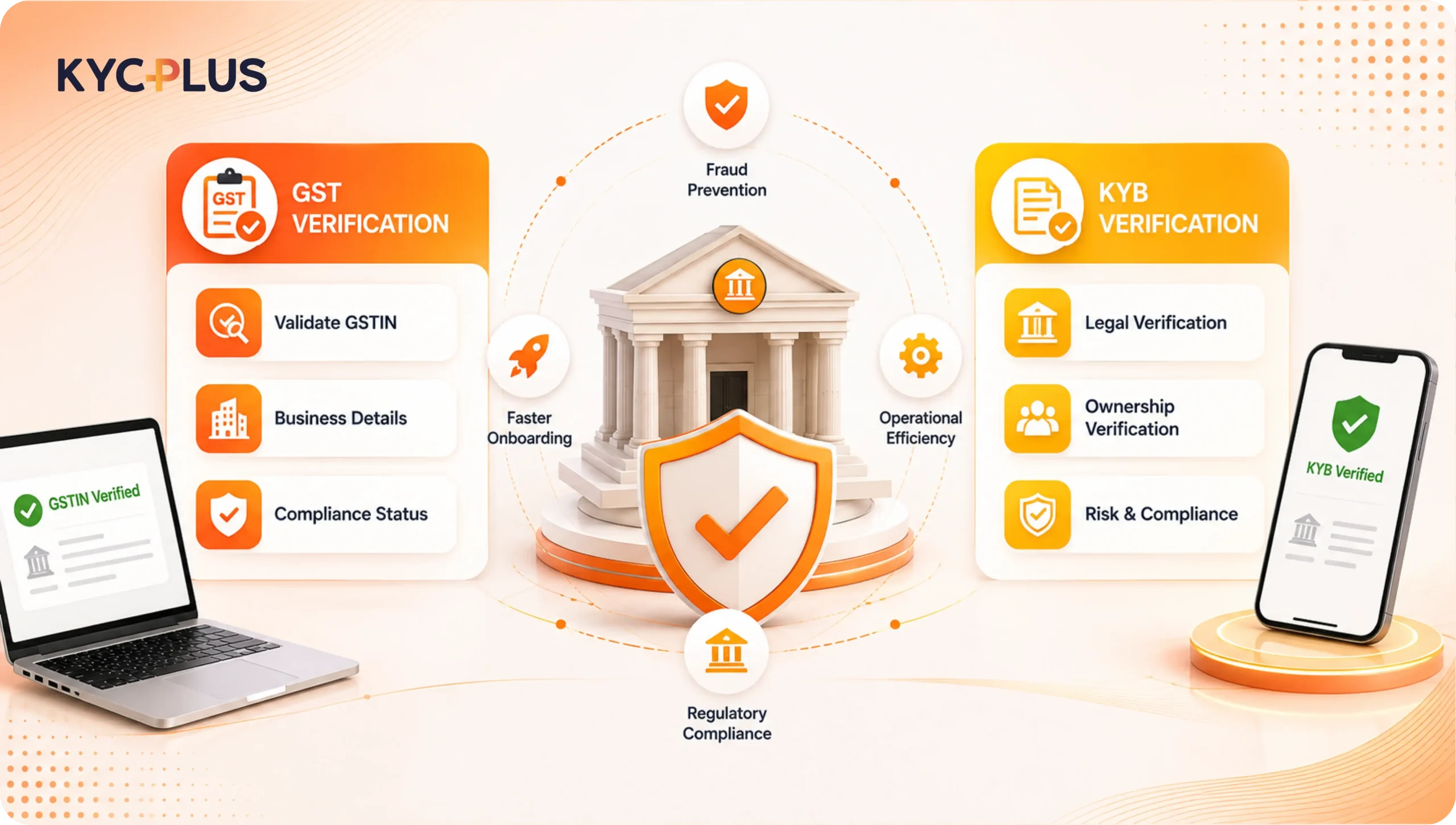
As businesses increasingly move toward digital onboarding, verifying the identity of customers is no longer enough. Organizations must also verify the legitimacy of the businesses they deal with. Whether onboarding vendors, merchants, distributors, corporate clients, or business partners, organizations need confidence that the entity is genuine, legally registered, tax compliant, and authorized to operate. This is where GST Verification and KYB become essential.
GST Verification and KYB help organizations establish trust before starting a business relationship. They reduce the risk of fraud, improve regulatory compliance, and ensure businesses interact only with legitimate entities. From banks and NBFCs to insurance companies, fintech platforms, payment aggregators, e-commerce marketplaces, and B2B service providers, almost every industry today relies on business verification before providing financial products or commercial services.
Unlike traditional customer verification, which focuses on individuals, business verification involves validating multiple aspects of an organization. This includes confirming GST registration, company registration details, business ownership, tax identification numbers, authorized signatories, and supporting documents. As digital transactions continue to grow, manual verification methods are becoming slower, more expensive, and increasingly prone to errors.
Modern organizations therefore prefer API-driven verification solutions that can verify businesses within seconds while maintaining regulatory compliance. These solutions improve operational efficiency, reduce paperwork, and create a smoother onboarding experience for corporate customers.
In this comprehensive guide, we will explore GST Verification and KYB, understand how they work, examine their benefits, discuss common challenges, and learn why combining both creates a stronger business verification process.
GST Verification is the process of validating a business’s Goods and Services Tax (GST) registration details using its GST Identification Number (GSTIN). Every business registered under India’s GST system receives a unique GSTIN that identifies it for taxation purposes.
During GST Verification, organizations verify whether the GSTIN is genuine, active, and associated with the correct business. The verification process also confirms important business details such as the legal business name, trade name, registration status, business constitution, principal place of business, registration date, taxpayer type, and jurisdiction.
GST Verification helps organizations ensure that the company they are dealing with is officially registered under GST regulations. This is particularly important for businesses involved in financial services, lending, supplier onboarding, procurement, logistics, B2B commerce, and vendor management.
Manual verification through government portals may work for occasional checks, but organizations handling hundreds or thousands of business onboardings require automated verification through APIs. API-based GST Verification provides instant responses, reduces manual effort, and integrates directly into existing onboarding workflows.
Besides verifying business authenticity, GST Verification also supports tax compliance by ensuring businesses maintain valid GST registrations before commercial transactions begin.
Know Your Business (KYB) is the business equivalent of Know Your Customer (KYC). While KYC focuses on verifying individual customers, KYB verifies companies, organizations, partnerships, LLPs, trusts, proprietorships, and other business entities before establishing a commercial relationship.
The objective of KYB is to confirm that a business is legitimate, legally registered, operational, and compliant with applicable regulations. It also identifies the individuals responsible for managing or owning the organization, helping businesses understand exactly who they are dealing with.
A complete KYB process generally includes verifying company registration details, GST registration, PAN, CIN, incorporation certificates, ownership information, directors, authorized signatories, Ultimate Beneficial Owners (UBOs), business addresses, financial documents, and supporting licenses wherever applicable.
KYB has become increasingly important because financial crimes are no longer limited to fake individual identities. Fraudulent companies, shell businesses, fake vendors, and money laundering networks often operate through seemingly legitimate organizations. Proper KYB helps organizations identify these risks before onboarding a business.
Today, banks, NBFCs, payment aggregators, insurance companies, fintech firms, marketplaces, procurement platforms, and government agencies all perform KYB as part of their compliance and risk management processes.
Business relationships involve financial risk. Every time an organization approves a corporate customer, vendor, merchant, distributor, or supplier without proper verification, it exposes itself to potential fraud, compliance failures, tax issues, and reputational damage.
GST Verification confirms that a business is registered under the GST framework and that its registration details match official records. However, GST alone cannot verify ownership structures, directors, beneficial owners, or other important business information.
KYB fills this gap by providing a broader verification framework that examines the complete business identity. It validates company registration, legal existence, ownership information, regulatory compliance, and supporting documentation.
Together, GST Verification and KYB help organizations:
Organizations that combine both verification methods create a stronger foundation for secure and compliant business relationships.
The GST Verification process starts when a business provides its GSTIN during onboarding.
The verification platform validates the GST number against official records and retrieves publicly available registration details. These details are compared with the information submitted during onboarding to identify inconsistencies.
A typical GST Verification process includes:
The applicant submits a valid GSTIN as part of the onboarding process.
The GST number is checked for correct format and authenticity.
Business details associated with the GSTIN are retrieved through secure verification systems.
The retrieved information is compared with the onboarding application to identify mismatches.
If inconsistencies are detected, the application may require additional review before approval.
Modern API integrations complete this entire process within seconds, allowing businesses to onboard corporate customers much faster than traditional manual verification methods.

KYB is more comprehensive because it verifies multiple aspects of a business rather than only its tax registration.
The process generally begins with collecting basic company information, including the legal business name, registration number, GSTIN, PAN, CIN (where applicable), business address, incorporation documents, and authorized representative details.
The verification platform then validates these records against trusted databases and regulatory sources. It also verifies ownership information, directors, shareholders, and beneficial owners wherever applicable.
Many organizations additionally perform document verification, risk screening, sanctions screening, politically exposed person (PEP) checks, and adverse media screening for high-risk businesses.
Modern KYB solution automate these activities using APIs, OCR, workflow automation, and centralized dashboards, significantly reducing manual verification efforts while improving compliance.
Implementing GST Verification and KYB provides significant operational and compliance advantages.
The most important benefit is fraud prevention. Organizations can detect fake businesses before financial relationships begin, reducing losses associated with fraudulent merchants, vendors, or borrowers.
Digital verification also accelerates onboarding. Instead of manually reviewing documents over several days, businesses can verify companies within minutes, improving customer satisfaction while reducing operational costs.
Compliance becomes easier because standardized verification procedures help organizations meet regulatory expectations. Automated audit trails further simplify internal reviews and external inspections.
Business data quality also improves significantly. Automated verification minimizes manual entry errors, reduces duplicate records, and ensures customer databases remain accurate.
Scalable verification systems further support business growth by allowing organizations to onboard thousands of businesses without proportionally increasing operational resources.
Despite their benefits, implementing GST Verification and KYB also presents several challenges.
Many organizations continue relying on manual verification processes that consume considerable time and increase the possibility of human errors. Reviewing incorporation certificates, GST registrations, PAN details, ownership documents, and authorization letters manually can delay onboarding significantly.
Data consistency is another challenge. Business names may appear differently across GST registrations, PAN records, incorporation certificates, and banking documents. Small spelling differences, abbreviations, or address variations often require additional validation before approval.
Ownership structures can also become complex, particularly for large corporations, subsidiaries, partnerships, LLPs, trusts, and multinational organizations. Identifying Ultimate Beneficial Owners (UBOs) may require examining multiple layers of ownership and supporting documentation.
Regulatory requirements also continue evolving. Financial institutions, fintech companies, and regulated entities must regularly update their onboarding procedures to remain compliant with changing RBI, FIU-IND, SEBI, IRDAI, GST, and anti-money laundering guidelines.
Integration challenges may arise when verification systems need to connect with Core Banking Systems (CBS), CRMs, ERP platforms, loan management systems, merchant onboarding portals, procurement applications, and document management systems. Organizations therefore benefit from choosing flexible API-based verification platforms that integrate easily with existing technology infrastructure.
Finally, maintaining customer experience while strengthening compliance remains a delicate balance. Businesses want faster onboarding without compromising verification quality. The most successful organizations achieve this balance through intelligent automation, API integrations, document digitization, workflow automation, and centralized verification platforms.
Although GST Verification and KYB are closely related, they serve different purposes within the business onboarding process. Many organizations mistakenly assume that verifying a GST number is sufficient to establish the legitimacy of a business. In reality, GST Verification confirms only the GST registration details, whereas KYB provides a comprehensive assessment of the business’s identity, ownership, legal existence, and compliance status.
GST Verification answers questions such as:
On the other hand, KYB answers broader questions:
This distinction makes both verification methods equally important rather than interchangeable.
One of the biggest differences lies in the scope of verification. GST Verification focuses exclusively on validating GST registration details. It ensures that a GST Identification Number belongs to a legitimate registered taxpayer and confirms publicly available registration information.
KYB, however, goes much deeper. It verifies the complete identity of a business by examining registration documents, ownership structures, business licenses, directors, PAN details, incorporation records, GST registration, and other supporting information. This broader verification process helps organizations understand who they are doing business with before establishing a commercial relationship.
Another important difference is regulatory application. GST Verification primarily supports tax-related compliance and vendor validation, whereas KYB supports anti-money laundering (AML), fraud prevention, customer due diligence, merchant onboarding, supplier verification, and regulatory compliance across multiple industries.
Automation also differs between the two. GST Verification can often be completed almost instantly through API integrations, while KYB involves multiple verification stages that may include document verification, OCR, ownership validation, and workflow approvals. However, modern digital platforms have significantly reduced the time required for comprehensive KYB.
Every industry has unique onboarding requirements, but almost all organizations dealing with corporate customers benefit from combining GST Verification and KYB.
Banks use both verification methods before opening current accounts, sanctioning business loans, issuing overdrafts, or onboarding commercial customers. GST Verification confirms tax registration, while KYB validates company ownership, authorized representatives, and business legitimacy.
NBFCs perform GST Verification and KYB before approving business loans, equipment finance, invoice financing, working capital facilities, and SME lending. This reduces fraud risks while strengthening regulatory compliance.
Insurance companies rely on business verification when issuing commercial insurance policies. Verifying GST details and company identity ensures policies are issued to legitimate organizations while simplifying underwriting processes.
FinTech companies perform digital KYB before onboarding merchants, payment service providers, lenders, and business customers. Instant API-based verification enables seamless digital onboarding while maintaining compliance with financial regulations.
Payment aggregators and payment gateways use GST Verification and KYB before activating merchant accounts. This protects payment ecosystems from fraudulent businesses and improves merchant quality.
E-commerce marketplaces verify sellers before allowing them to list products online. GST Verification confirms tax registration, while KYB ensures the seller operates as a legitimate business entity.
Procurement platforms and large enterprises perform business verification before approving suppliers, distributors, logistics partners, and service providers. This reduces procurement fraud while improving vendor governance.
Many organizations ask whether GST Verification alone is sufficient. The answer depends on the level of business risk.
For low-risk verification scenarios, validating GST registration may provide basic assurance that a business exists. However, financial institutions, regulated entities, and businesses dealing with significant commercial transactions require much deeper verification.
GST Verification confirms that the business is registered under GST and that its tax-related information matches official records.
KYB then validates the legal identity of the organization, confirms ownership structures, verifies directors and authorized representatives, reviews incorporation documents, and performs additional compliance checks wherever necessary.
Using both methods together offers several advantages:
Rather than replacing each other, GST Verification and KYB work together to create a secure digital onboarding ecosystem.
Despite increasing adoption of digital verification, many organizations still make avoidable mistakes during business onboarding.
One common mistake is relying only on document collection without actually verifying the authenticity of those documents. Simply collecting GST certificates or incorporation certificates does not guarantee that the business information is valid or current.
Another mistake is performing only GST Verification while ignoring ownership verification. Fraudulent businesses may possess valid GST registrations while concealing beneficial ownership or providing misleading business information.
Manual verification remains another major challenge. Human verification processes are slower, inconsistent, and more vulnerable to errors. Automated API-based verification significantly improves both speed and accuracy.
Many organizations also fail to maintain proper audit records. Regulatory inspections often require evidence of verification activities, making centralized audit trails an essential part of modern compliance programs.
Businesses should also avoid treating verification as a one-time activity. Periodic reviews help ensure that customer information remains accurate as businesses grow, relocate, change ownership, or update registrations.
Business fraud has become increasingly sophisticated. Fraudsters may create shell companies, use fake documents, manipulate ownership structures, or register fraudulent businesses to obtain financial products or access commercial services.
GST Verification serves as an important first layer of defense by confirming that a business possesses a valid GST registration. However, fraud prevention becomes much stronger when combined with KYB.
KYB helps identify suspicious ownership structures, fake businesses, unauthorized representatives, forged documentation, and inconsistencies across multiple business records. Organizations can perform enhanced due diligence before establishing high-value business relationships.
Automated verification systems further improve fraud detection by cross-checking multiple data sources simultaneously, identifying mismatches instantly, and routing suspicious applications for manual review.
As digital commerce expands, fraud prevention will increasingly depend on automated business verification rather than traditional paper-based processes.
Managing GST Verification and KYB manually becomes increasingly difficult as organizations grow. Financial institutions, NBFCs, cooperative banks, insurance companies, fintech firms, and enterprise businesses require scalable solutions capable of verifying thousands of businesses quickly while maintaining compliance.
KYCPLUS simplifies this process by providing a unified digital business verification platform. Instead of using multiple disconnected systems, organizations can perform GST Verification, business verification, document collection, compliance checks, and workflow automation from a centralized solution.
The platform supports GST Verification APIs for instant GSTIN validation and can be integrated with additional verification services such as PAN Verification, CIN Verification, and other business validation APIs to strengthen KYB processes. This enables organizations to verify multiple business attributes without switching between different applications.
KYCPLUS also includes intelligent OCR technology that automatically extracts information from GST certificates, PAN cards, incorporation certificates, and other business documents. This reduces manual data entry, improves accuracy, and accelerates onboarding.
Built-in Document Management helps securely store business documents, while Workflow Automation routes applications through verification and approval stages automatically. Interactive dashboards provide real-time visibility into verification status, pending cases, and operational performance, while Audit Trails maintain complete records of every verification activity for compliance and regulatory reporting.
Seamless API integration allows organizations to connect KYCPLUS with Core Banking Systems (CBS), CRMs, ERP platforms, loan management systems, merchant onboarding portals, and other enterprise applications, enabling a faster, more secure, and scalable business onboarding experience.
Business verification is not just a best practice—it is a regulatory requirement for many industries. Organizations dealing with financial transactions, merchant onboarding, lending, insurance, investments, and B2B services are expected to verify the legitimacy of businesses before establishing a commercial relationship. Proper GST Verification and KYB help organizations comply with multiple regulatory frameworks while reducing financial and operational risks.
The Reserve Bank of India (RBI) requires regulated entities such as banks, NBFCs, payment system operators, and financial institutions to perform adequate due diligence before onboarding business customers. Customer Due Diligence (CDD) and Enhanced Due Diligence (EDD) play an important role in preventing fraud, money laundering, and financial crimes.
The Prevention of Money Laundering Act (PMLA) also requires regulated entities to identify and verify customers, including businesses. Organizations must understand the ownership structure of companies, identify Ultimate Beneficial Owners (UBOs), and maintain proper records of verification activities.
Financial Intelligence Unit – India (FIU-IND) expects reporting entities to monitor suspicious transactions and maintain complete customer identification records. Strong KYB procedures help organizations meet these obligations while improving risk management.
GST Verification API supports compliance by ensuring that businesses possess valid GST registrations and that their registration details match official government records. This reduces tax-related risks and improves vendor authenticity during procurement and financial transactions.
Organizations operating in securities and insurance sectors must also follow guidelines issued by SEBI and IRDAI, respectively. Both regulators emphasize customer due diligence, fraud prevention, and proper documentation before onboarding business entities.
Apart from regulatory compliance, businesses should maintain secure data storage, encrypted communication, role-based access controls, audit logs, and document retention policies to protect sensitive business information and satisfy compliance audits.
Choosing the right verification solution is a strategic decision that directly impacts onboarding speed, compliance, customer experience, and operational efficiency. Businesses should look beyond basic verification and invest in solutions that support long-term digital transformation.
The first consideration should be automation. Manual verification processes increase turnaround time, create operational bottlenecks, and introduce human errors. API-based verification allows businesses to validate GST details and business information within seconds while improving consistency.
A good verification platform should support multiple verification services from a single interface. Instead of relying on different vendors for GST Verification, PAN Verification, CIN Verification, document verification, and KYB workflows, organizations should choose an integrated solution capable of handling all business verification requirements.
Scalability is equally important. As organizations grow, the number of business customers, merchants, suppliers, and corporate clients also increases. The verification platform should comfortably support higher transaction volumes without compromising performance.
Document automation is another key factor. Solutions with OCR technology automatically extract information from GST certificates, incorporation documents, PAN cards, partnership deeds, and other business documents. This minimizes manual data entry while improving processing speed and accuracy.
Security should never be compromised. Businesses should select platforms offering encrypted communication, secure APIs, document encryption, user authentication, role-based access controls, and comprehensive audit trails.
Workflow flexibility also matters. Every organization follows a different approval process. A configurable workflow engine enables businesses to customize verification stages, assign approval authorities, generate alerts, and automate decision-making.
Finally, seamless integration with existing enterprise applications—including Core Banking Systems (CBS), CRM software, ERP platforms, merchant onboarding systems, procurement software, and loan management systems—ensures smooth implementation without disrupting existing operations.
Modern organizations require much more than individual verification APIs. They need an end-to-end business verification ecosystem that combines automation, compliance, document management, workflow control, and seamless integration. KYCPLUS addresses these requirements by providing a centralized platform for digital business onboarding.
KYCPLUS enables organizations to perform GST Verification through secure API integrations, allowing businesses to instantly validate GSTIN details and retrieve relevant registration information during onboarding. This significantly reduces manual verification efforts while improving customer experience.
The platform can also integrate with additional business verification services such as PAN Verification and CIN Verification, helping organizations strengthen their KYB process through multiple layers of business validation.
Intelligent OCR technology automatically extracts information from GST certificates, PAN cards, Certificate of Incorporation, partnership deeds, MSME certificates, and other supporting documents.
Document Management capabilities enable organizations to securely store business documents in a centralized digital repository. Documents remain easily accessible for future audits, renewals, compliance reviews, and customer servicing.
Workflow Automation ensures that every business application follows a predefined approval journey. Applications can automatically move between verification teams, compliance officers, risk departments, and final approval authorities without manual coordination.
Interactive dashboards provide real-time visibility into verification status, pending approvals, rejected applications, processing times, compliance metrics, and operational performance. Decision-makers gain valuable insights that help improve business onboarding efficiency.
Comprehensive Audit Trails record every verification activity, document upload, approval decision, and user action. These logs simplify regulatory inspections while strengthening organizational governance.
API Integration enables KYCPLUS to connect seamlessly with Core Banking Systems (CBS), CRM applications, ERP platforms, loan management systems, procurement software, merchant onboarding portals, and other enterprise systems. This eliminates duplicate data entry while ensuring consistent business information across multiple platforms.
By combining GST Verification, business verification, document digitization, workflow automation, dashboards, audit trails, and enterprise integrations within one platform, KYCPLUS helps organizations create faster, more secure, and fully digital business onboarding processes.
Business verification is rapidly evolving as organizations embrace digital transformation. Future verification systems will become more intelligent, automated, and interconnected through secure APIs and artificial intelligence.
Artificial Intelligence will play a larger role in detecting fraudulent businesses, identifying document manipulation, analyzing ownership structures, and predicting onboarding risks before business relationships begin.
OCR technology will continue improving its ability to extract information from complex business documents with minimal manual intervention. Automated document classification and verification will further reduce operational costs.
Real-time API ecosystems will enable businesses to validate multiple business attributes instantly, creating a seamless onboarding experience for merchants, suppliers, corporate customers, and financial institutions.
Risk-based verification models will become increasingly common, allowing organizations to apply enhanced verification only where necessary while maintaining faster onboarding for lower-risk businesses.
Continuous KYB will also gain importance. Rather than verifying businesses only once, organizations will periodically monitor business status, GST registration changes, ownership updates, compliance records, and regulatory actions throughout the customer relationship.
As India’s Digital Public Infrastructure (DPI) expands, business verification will become increasingly integrated, paperless, secure, and efficient, supporting the country’s growing digital economy.
GST Verification and KYB have become essential components of modern business onboarding. While GST Verification validates a business’s GST registration and tax identity, KYB provides a comprehensive assessment of the organization’s legal existence, ownership, regulatory compliance, and overall authenticity. Together, they help businesses reduce fraud, strengthen compliance, improve operational efficiency, and build trusted commercial relationships.
Organizations across banking, NBFCs, fintech, insurance, payment services, e-commerce, procurement, and enterprise sectors increasingly combine both verification methods to create secure and scalable onboarding processes. Automated verification not only reduces manual effort but also enhances customer experience by enabling faster approvals and digital documentation.
Platforms like KYCPLUS further simplify this journey by integrating GST Verification, PAN Verification, CIN Verification, OCR, document management, workflow automation, dashboards, audit trails, and enterprise API integrations into a single digital ecosystem. As technology and regulations continue to evolve, businesses investing in intelligent verification platforms today will be better prepared for the future of digital business onboarding.
Ans: GST Verification is the process of validating a business’s GST Identification Number (GSTIN) to confirm that the business is registered under GST and that its registration details match official government records.
Ans: Know Your Business (KYB) is the process of verifying the legal identity, ownership, registration, and compliance status of a business before establishing a commercial relationship.
Ans: No. GST Verification confirms GST registration, but KYB verifies additional information such as company registration, ownership, directors, business documents, and compliance, making onboarding more secure.
Ans: Banks, NBFCs, insurance companies, fintech firms, payment aggregators, e-commerce marketplaces, procurement platforms, logistics companies, and enterprise businesses commonly use both verification methods.
Ans: KYB helps organizations prevent fraud, verify business legitimacy, identify beneficial owners, comply with regulations, and reduce onboarding risks.
Ans: API integrations provide instant verification results, reduce manual work, improve accuracy, and enable businesses to onboard customers much faster.
Ans: GST certificates, PAN cards, Certificate of Incorporation, CIN details, partnership deeds, business licenses, MSME certificates, address proof, and authorization documents are commonly verified.
Ans: Yes. Modern API-driven platforms automate business verification, document extraction, workflow management, compliance checks, and reporting, significantly improving operational efficiency.
Ans: KYCPLUS offers GST Verification, PAN Verification, CIN Verification, OCR, document management, workflow automation, dashboards, audit trails, and seamless API integration to simplify digital business onboarding.
Ans: The future includes AI-powered verification, continuous business monitoring, real-time APIs, intelligent OCR, automated risk assessment, Digital Public Infrastructure integration, and fully paperless business onboarding.
