 Blog
Aadhaar Verification vs CKYC Verification: What’s the Difference? A Complete Guide for Businesses
Blog
Aadhaar Verification vs CKYC Verification: What’s the Difference? A Complete Guide for Businesses
Blog
Aadhaar Verification vs CKYC Verification: What’s the Difference? A Complete Guide for Businesses
Blog
Aadhaar Verification vs CKYC Verification: What’s the Difference? A Complete Guide for Businesses
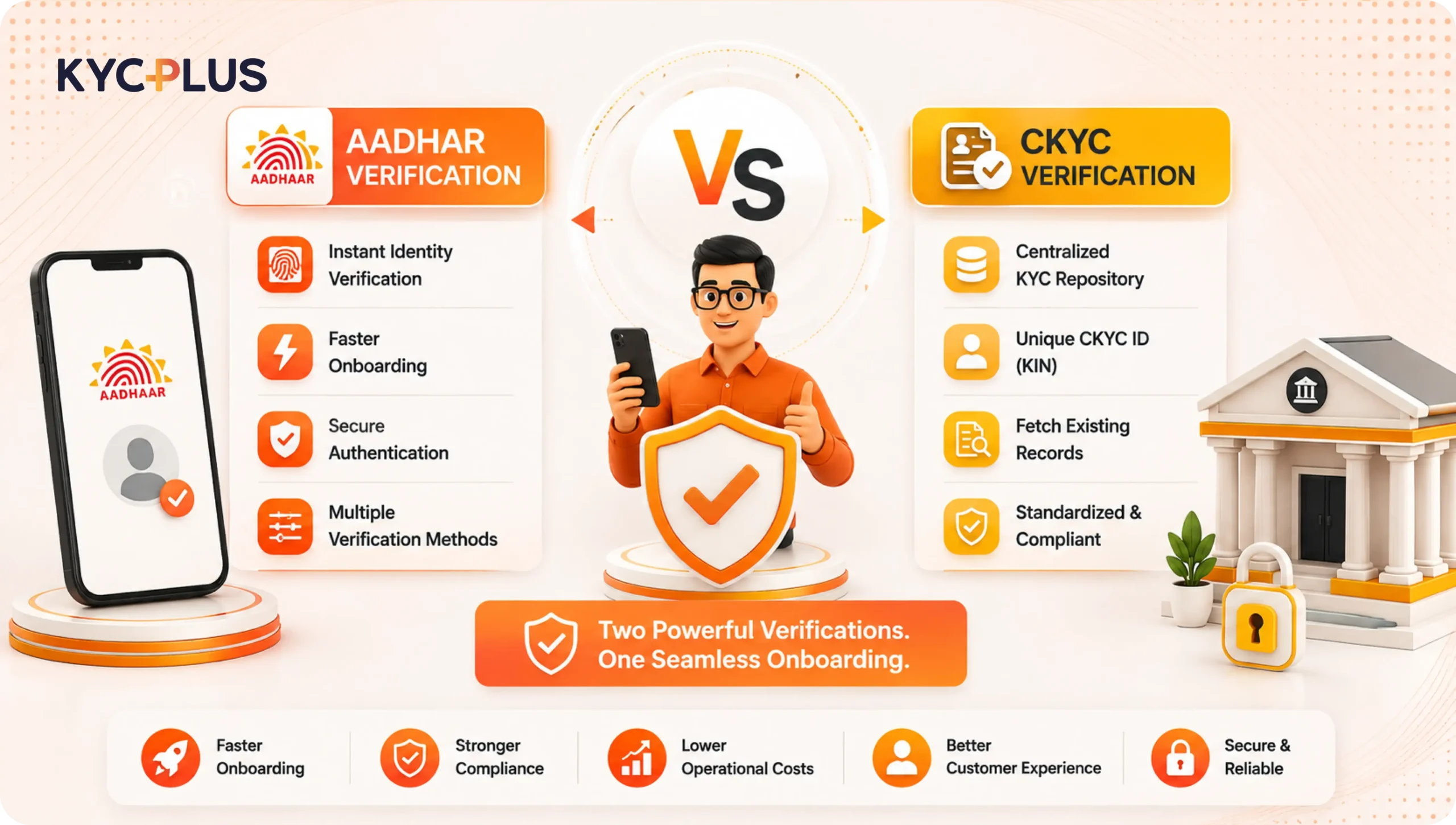
In today’s digital economy, verifying a customer’s identity has become one of the most critical steps in delivering secure and compliant financial services. Understanding Aadhaar Verification vs CKYC Verification is essential for banks, NBFCs, fintech companies, and other financial institutions when selecting the right identity verification method for different onboarding and compliance requirements. Whether a customer is opening a bank account, applying for a loan, purchasing an insurance policy, investing in mutual funds, or signing up for a fintech application, identity verification is the foundation of a safe and trustworthy onboarding process. With the rapid growth of digital banking and online financial services in India, businesses need verification methods that are fast, accurate, secure, and compliant with regulatory requirements.
Traditionally, customer verification relied heavily on physical document collection, manual verification, and repeated submission of identity proofs whenever a customer approached a new financial institution. This process was time-consuming, costly, and inconvenient for both customers and organizations. Customers often had to visit branches multiple times, submit photocopies of the same documents repeatedly, and wait several days for verification to be completed. Financial institutions, on the other hand, had to allocate significant resources to document verification, record management, and compliance checks.
To overcome these challenges, India introduced several digital identity verification initiatives that transformed the customer onboarding experience. Among these, Aadhaar Verification and CKYC Verification have emerged as two of the most widely used verification mechanisms. Both play an essential role in Know Your Customer (KYC) compliance, but they are designed for different purposes and operate in different ways.
Depending on the applicable method and regulatory framework, it may involve Aadhaar authentication, Aadhaar e-KYC, Offline Aadhaar Verification, QR code verification, Virtual ID (VID), or OTP-based verification. It provides a quick and reliable way to confirm customer identity and supports faster digital onboarding.
CKYC Verification, on the other hand, is based on the Central KYC Registry (CKYCR), maintained by the Central Registry of Securitization Asset Reconstruction and Security Interest of India (CERSAI). Instead of verifying identity directly through Aadhaar, CKYC creates a centralized repository of KYC records submitted by regulated entities. Once a customer’s KYC details are successfully registered, they receive a unique CKYC Identifier (KIN), allowing authorized financial institutions to retrieve the customer’s verified KYC records instead of collecting the same documents repeatedly.
Although both Aadhaar Verification and CKYC Verification contribute to customer onboarding, they are not interchangeable. Aadhaar Verification focuses on identity authentication, while CKYC Verification focuses on maintaining and reusing verified KYC records across regulated institutions. Understanding this distinction is important for banks, NBFCs, insurance companies, mutual fund houses, stockbrokers, cooperative banks, fintech companies, and other regulated organizations looking to build efficient and compliant onboarding processes.
As customer expectations continue to evolve, organizations are increasingly adopting digital onboarding platforms that integrate multiple verification methods into a single workflow. Solutions such as KYCPLUS help businesses simplify Aadhaar Verification, CKYC Verification, document management, OCR-based data extraction, workflow automation, and audit trail management, enabling faster customer onboarding while maintaining compliance and operational efficiency.
In this comprehensive guide, we’ll explain Aadhaar Verification and CKYC Verification in detail, compare their features, discuss their benefits and limitations, identify the key differences, and help businesses determine when each verification method should be used.
Aadhaar Verification is the process of verifying the identity of an individual using the Aadhaar number issued by the Unique Identification Authority of India (UIDAI). It allows organizations to confirm that the customer is genuine and that the identity information provided during onboarding matches the records associated with the Aadhaar database or approved offline verification methods.
Since Aadhaar is one of the most widely accepted identity documents in India, Aadhaar Verification has become an important component of digital customer onboarding. It enables businesses to verify customer identity quickly, accurately, and securely without relying entirely on manual document verification.
Over the last decade, Aadhaar Verification has significantly transformed the way financial institutions onboard customers. Instead of requiring customers to submit multiple identity documents and wait several days for verification, organizations can now complete identity verification digitally within a much shorter timeframe, depending on the verification method used.
Today, Aadhaar Verification is used by banks, NBFCs, insurance companies, fintech organizations, cooperative banks, payment service providers, stockbrokers, mutual fund companies, telecom operators, and various government agencies. Its widespread adoption has helped simplify customer onboarding while reducing paperwork, operational costs, and verification errors.
It is important to understand that Aadhaar Verification does not always mean online authentication using Aadhaar data. Depending on regulatory permissions and business requirements, organizations may perform verification through several approved methods, including Aadhaar e-KYC (where applicable), Offline Aadhaar XML, Secure QR Code Verification, Virtual ID (VID), OTP authentication, or biometric authentication.
By adopting Aadhaar Verification as part of their onboarding process, businesses can improve operational efficiency, enhance customer experience, strengthen fraud prevention, and support compliance with applicable regulatory guidelines.
As India continues to embrace digital transformation, customers increasingly expect instant access to banking, lending, insurance, and investment services. Waiting several days for identity verification is no longer acceptable in a competitive digital marketplace. Aadhaar Verification addresses this challenge by enabling organizations to verify customer identities faster while maintaining a high level of accuracy and security.
One of the biggest advantages of Aadhaar Verification is its ability to reduce the dependency on manual verification processes. Instead of collecting multiple documents, manually entering customer information, and physically verifying records, organizations can automate significant portions of the verification process. This not only reduces operational costs but also minimizes human errors and improves overall efficiency.
Aadhaar Verification also strengthens fraud prevention. Identity theft, fake documents, impersonation, and forged identity proofs remain major concerns for financial institutions. By using approved Aadhaar-based verification methods, organizations can improve confidence in customer identity before offering financial products or services.
Another important benefit is improved customer experience. Digital onboarding allows customers to complete verification remotely without visiting a branch multiple times or submitting the same documents repeatedly. Faster onboarding leads to higher customer satisfaction and increased conversion rates, especially for fintech companies and digital-first businesses.
For regulated entities, Aadhaar Verification supports compliance by providing a reliable method for identity verification when used in accordance with applicable laws and regulatory guidelines. It also forms an important part of broader digital KYC Strategy, enabling organizations to build secure and efficient onboarding workflows.
Aadhaar Verification can be performed using different methods depending on regulatory permissions, business requirements, and customer preferences.
In this method, a One-Time Password (OTP) is sent to the mobile number linked with the customer’s Aadhaar. After entering the OTP, the customer’s identity is authenticated through the approved verification process. This method is commonly used because it is simple, quick, and convenient for customers.
Biometric verification authenticates the customer using fingerprints or iris scans linked to the Aadhaar database. This method provides a high level of assurance and is commonly used where biometric infrastructure is available.
Customers can download an Offline Aadhaar XML file or share a digitally signed offline verification document. Organizations can verify the information without accessing the Aadhaar database directly, making this method privacy-friendly while still enabling secure identity verification.
The Aadhaar card contains a secure QR code that can be scanned using authorized software. The QR code contains digitally signed information that helps organizations verify the authenticity of the Aadhaar document quickly and accurately.
Instead of sharing the actual Aadhaar number, customers can generate a temporary Virtual ID through UIDAI services. Businesses can use this VID for Aadhaar-based verification, enhance customer privacy while reducing exposure of the Aadhaar number.
Each verification method serves different operational requirements, allowing organizations to choose the most appropriate approach based on customer convenience, regulatory compliance, and business workflows.
Aadhaar Verification has transformed the way organizations onboard customers by replacing lengthy manual verification procedures with faster and more efficient digital processes. As businesses continue to adopt digital-first operations, Aadhaar Verification has become an essential part of customer onboarding, helping organizations improve operational efficiency while enhancing customer trust and regulatory compliance.
One of the biggest advantages of Aadhaar Verification is speed. Traditional KYC processes often require customers to visit a branch, submit multiple documents, and wait several days for manual verification. Aadhaar Verification significantly reduces this turnaround time by enabling digital identity verification.
Whether a customer is opening a savings account, applying for a personal loan, purchasing insurance, or registering on a fintech platform, Aadhaar Verification helps organization’s complete identity checks much faster. This improves customer satisfaction while allowing businesses to onboard more customers in less time.
Modern customers expect simple and convenient digital experiences. Aadhaar Verification enables organizations to provide a seamless onboarding journey without requiring excessive paperwork or repeated branch visits.
Customers can complete identity verification from their home or office using approved digital verification methods. A faster onboarding experience improves customer confidence and increases the likelihood of successful application completion.
Manual verification processes often involve entering customer information into multiple systems, increasing the possibility of human error.
Common issues include:
Automated Aadhaar Verification minimizes these errors by reducing manual data entry and ensuring greater consistency throughout the onboarding process.
Identity fraud continues to be one of the biggest challenges for financial institutions. Fraudsters frequently use forged identity documents, fake credentials, or stolen personal information to gain unauthorized access to financial services.
Aadhaar Verification helps organizations strengthen fraud prevention by verifying customer identity through approved verification methods. This improves confidence that the person completing the onboarding process is genuine.
Manual customer verification requires dedicated staff, document storage, repeated follow-ups, and extensive administrative work.
Digital Aadhaar Verification helps organizations reduce operational costs by:
Over time, these efficiencies contribute to significant cost savings.
Modern businesses require verification solutions that integrate smoothly with their existing technology infrastructure.
Aadhaar Verification APIs can be integrated into:
This enables organizations to create fully digital onboarding workflows without disrupting existing operations.
Organizations across industries are investing heavily in digital transformation initiatives.
Aadhaar Verification supports these efforts by replacing paper-based verification with secure digital processes, helping organizations deliver faster services while improving operational efficiency.

Although Aadhaar Verification offers numerous benefits, organizations must also address certain operational and regulatory challenges when implementing Aadhaar-based verification.
Identity verification regulations continue to evolve. Organizations must ensure that their Aadhaar Verification processes remain aligned with applicable laws and regulatory requirements.
Regular policy updates, employee training, and technology upgrades are essential for maintaining compliance.
Many customers are unfamiliar with different Aadhaar Verification methods.
Some customers believe sharing an Aadhaar card alone completes verification, while others may not understand Offline Aadhaar Verification, Virtual ID (VID), or QR code verification.
Organizations should educate customers about available verification options to improve the onboarding experience.
Certain verification methods depend on internet connectivity and digital infrastructure.
Poor network availability may temporarily delay the verification process, particularly in remote locations.
Businesses should implement alternative verification workflows whenever possible.
Customers are increasingly aware of data privacy and security.
Organizations must ensure Aadhaar information is handled responsibly, protected against unauthorized access, and processed according to applicable privacy and regulatory requirements.
Implementing strong encryption, role-based access controls, and secure APIs helps maintain customer trust.
Large organizations often operate multiple legacy systems.
Integrating Aadhaar Verification into existing Core Banking Systems, CRM platforms, loan management software, and enterprise applications may require careful planning and technical expertise.
Choosing a scalable verification platform simplifies this process.
Central Know Your Customer (CKYC) Verification is a standardized KYC framework designed to eliminate the need for customers to repeatedly submit KYC documents whenever they establish relationships with different regulated financial institutions.
The Central KYC Registry (CKYCR), maintained by the Central Registry of Securitization Asset Reconstruction and Security Interest of India (CERSAI), acts as a centralized repository of customer KYC records. Once a customer’s KYC details are successfully uploaded by a regulated entity, a unique 14-digit CKYC Identifier (KIN) is generated.
This identifier enables other authorized financial institutions to retrieve the customer’s KYC information from the centralized registry instead of collecting the same documents repeatedly.
Before the introduction of CKYC, customers often had to submit identical KYC documents multiple times while opening bank accounts, purchasing insurance, investing in mutual funds, applying for loans, or opening Demat accounts.
CKYC significantly reduces this duplication by promoting a standardized and reusable KYC framework across regulated institutions.
Today, CKYC Verification is widely adopted by:
By simplifying customer onboarding and reducing duplicate documentation, CKYC Verification improves operational efficiency while providing a better customer experience.
The CKYC Verification process follows a structured workflow designed to create a reusable KYC record.
1.The customer submits identity and address documents to a regulated financial institution.
2. The institution verifies the submitted documents according to applicable KYC requirements.
3. After successful verification, the institution uploads the customer’s KYC information to the Central KYC Registry.
4. The registry generates a unique CKYC Identifier (KIN) for the customer.
5. When the customer approaches another regulated institution in the future, the organization can retrieve the customer’s CKYC record using the CKYC Identifier instead of requesting all documents again, subject to applicable procedures.
This centralized workflow saves time for both customers and financial institutions.
The primary objective of CKYC Verification is to create a unified KYC ecosystem across India’s financial sector.
Some of the major objectives include:
By establishing a common KYC repository, CKYC enables regulated entities to deliver faster and more consistent onboarding experiences.
CKYC Verification includes several features that make it an effective solution for customer identity management.
Customer KYC information is maintained within a centralized registry, reducing duplication across financial institutions.
Every registered customer receives a unique KIN, making future verification significantly easier.
Authorized institutions can retrieve existing customer records instead of requesting fresh documents every time.
Customers no longer need to repeatedly submit the same identity and address documents to multiple organizations.
CKYC promotes uniform customer identification procedures across regulated financial institutions.
Electronic record management improves operational efficiency while reducing dependency on paper-based documentation.
CKYC Verification provides substantial advantages for both businesses and customers.
For businesses, it reduces document collection efforts, improves compliance, lowers operational costs, accelerates onboarding, and standardizes verification procedures.
For customers, it eliminates repetitive document submissions, shortens onboarding time, reduces paperwork, and provides a more convenient experience across multiple financial institutions.
When integrated with digital onboarding platforms like KYCPLUS, organizations can combine CKYC Verification with OCR-based document extraction, workflow automation, centralized document management, and audit trails. This enables compliance teams to manage customer onboarding from a single platform while improving efficiency and maintaining consistency across verification workflows.
As digital customer onboarding becomes the standard across India’s financial ecosystem, both Aadhaar Verification and CKYC Verification have become essential identity verification methods. Different industries rely on one or both solutions depending on their regulatory obligations, customer onboarding requirements, and operational workflows. Understanding where each verification method fits helps organizations build faster, compliant, and customer-friendly onboarding journeys.
The banking sector remains the largest adopter of both Aadhaar Verification and CKYC Verification. Banks use Aadhaar Verification for instant digital identity authentication, especially during savings account opening, fixed deposit creation, digital lending, and mobile banking registration. CKYC Verification is equally important because it enables banks to retrieve an existing customer’s KYC information from the Central KYC Registry instead of collecting documents repeatedly. This significantly reduces paperwork, improves customer experience, and ensures compliance with RBI and CERSAI regulations.
Digital lending platforms, vehicle finance companies, personal loan providers, and microfinance institutions depend on Aadhaar-based eKYC to verify customer identity within minutes. CKYC Verification further enhances the process by allowing NBFCs to fetch verified customer records whenever available, reducing fraud risks and eliminating duplicate documentation.
Insurance companies increasingly rely on both verification methods to simplify policy issuance and claims processing. Aadhaar Verification enables insurers to validate policyholders quickly during digital onboarding, while CKYC Verification provides standardized customer records that can be reused across multiple insurance products. This improves operational efficiency and supports compliance with IRDAI guidelines.
Stockbrokers, mutual fund companies, and wealth management firms regulated by SEBI also benefit significantly from these verification mechanisms. Investment accounts require robust customer identification before trading or investing. Aadhaar Verification enables quick identity authentication, whereas CKYC Verification helps financial institutions access previously verified KYC records, making investment onboarding much faster.
Whether offering payments, digital wallets, lending, insurance, investment, or financial advisory services, FinTech businesses prioritize frictionless onboarding. Aadhaar Verification provides instant digital identity confirmation, while CKYC Verification reduces document collection for returning customers and strengthens regulatory compliance.
Urban Cooperative Banks, District Central Cooperative Banks (DCCBs), and Multi-State Cooperative Credit Societies are also rapidly adopting digital verification technologies. Traditionally dependent on manual KYC procedures, these institutions are now digitizing customer onboarding to reduce paperwork, improve branch efficiency, and comply with evolving RBI regulations. Aadhaar Verification simplifies identity authentication, while CKYC Verification supports centralized KYC management across branches.
Payment aggregators, payment gateways, prepaid wallet providers, and regulated financial intermediaries also depend on Aadhaar Verification to verify merchants and customers during onboarding. CKYC Verification further supports customer due diligence where applicable, helping organizations comply with anti-money laundering regulations.
Government departments, public sector organizations, pension authorities, and welfare distribution systems also utilize Aadhaar Verification for identity authentication during benefit delivery, subsidy management, and citizen service enrollment. While CKYC is primarily focused on financial institutions, organizations interacting with regulated financial products often leverage CKYC records wherever permitted.
As digital transformation continues across industries, organizations increasingly combine Aadhaar Verification and CKYC Verification rather than choosing one over the other. This combination creates a faster, more secure, and highly compliant customer onboarding process.
Every organization implementing Aadhaar Verification or CKYC Verification must comply with India’s regulatory framework. Digital identity verification is not only about improving customer convenience but also about meeting legal obligations designed to prevent fraud, identity theft, money laundering, and financial crimes.
The Reserve Bank of India (RBI) requires regulated financial institutions to follow comprehensive Know Your Customer (KYC) guidelines before establishing customer relationships. Banks, NBFCs, cooperative banks, and payment institutions must perform proper customer identification and maintain updated records throughout the customer lifecycle.
The Central Registry of Securitization Asset Reconstruction and Security Interest of India (CERSAI) operates the Central KYC Registry. Financial institutions are encouraged to upload customer KYC records after successful verification and retrieve existing records whenever available. This centralized approach minimizes repetitive documentation and improves standardization across the financial sector.
The Unique Identification Authority of India (UIDAI) governs the use of Aadhaar authentication and Aadhaar eKYC services. Organizations authorized to use Aadhaar-based services must comply with UIDAI’s security, privacy, authentication, and consent requirements. Customer consent remains an essential component of Aadhaar-based verification.
The Prevention of Money Laundering Act (PMLA) establishes customer due diligence requirements for regulated entities. Proper identity verification helps organizations detect suspicious activities, prevent financial fraud, and maintain accurate audit records.
Sector-specific regulators such as SEBI for securities markets and IRDAI for insurance companies also prescribe KYC requirements aligned with national AML regulations. Organizations operating across multiple financial services often implement both Aadhaar Verification and CKYC Verification to satisfy various compliance obligations simultaneously.
Strong cybersecurity measures, encrypted data transmission, access control mechanisms, audit logging, and secure document management are equally important. Compliance today extends beyond identity verification and includes protecting customer information throughout its lifecycle.
Choosing between Aadhaar Verification and CKYC Verification should never be treated as selecting one solution over another. Instead, organizations should evaluate how both methods complement each other based on business requirements, regulatory obligations, customer experience, and operational efficiency.
Businesses that require instant digital onboarding generally prioritize Aadhaar Verification because it provides immediate identity authentication. However, organizations dealing with repeat customers or multiple financial products benefit significantly from CKYC Verification, which retrieves previously verified customer records without requesting documents again.
Scalability is another important consideration. A suitable verification solution should support high transaction volumes while maintaining fast response times and strong reliability. Financial institutions experiencing rapid growth should invest in API-driven platforms capable of integrating with existing Core Banking Systems (CBS), Loan Management Systems (LMS), CRMs, and digital onboarding platforms.
Automation capabilities also play a critical role. Modern verification platforms should include OCR-based document extraction, automated data validation, workflow management, document storage, audit trails, dashboard reporting, and exception handling. These capabilities reduce manual intervention while improving operational accuracy.
Security should remain a top priority. Organizations should choose solutions that offer encrypted communication, role-based access controls, secure document repositories, detailed activity logs, and compliance with applicable regulatory requirements.
Finally, businesses should consider long-term flexibility. As regulatory requirements evolve, organizations need verification platforms capable of supporting new APIs, additional verification services, future compliance updates, and digital transformation initiatives without requiring major system changes.
Modern financial institutions require more than simple identity verification. They need a complete onboarding ecosystem that combines compliance, automation, document management, workflow optimization, and seamless integration. This is where KYCPLUS provides significant value.
KYCPLUS integrates Aadhaar Verification and CKYC Verification into a unified digital onboarding platform designed for banks, NBFCs, cooperative banks, insurance companies, and financial institutions. Instead of managing multiple disconnected systems, organizations can perform identity verification, document collection, compliance checks, and customer onboarding from a single platform.
The platform supports Aadhaar Verification APIs for faster customer authentication while also providing CKYC Search, CKYC Download, and CKYC Upload capabilities. This enables organizations to retrieve existing customer records, minimize duplicate documentation, and maintain standardized KYC processes.
KYCPLUS also includes intelligent OCR technology that automatically extracts information from identity documents, reducing manual data entry and minimizing human errors. Face Match and Liveness Detection strengthen identity verification by ensuring that the person completing onboarding is physically present and matches the submitted identity document.
Additional capabilities such as Digi Locker integration simplify secure document retrieval, while Document Management Systems help organizations organize customer records digitally with complete audit history. Workflow Automation reduces operational delays by routing applications automatically through different approval stages.
Interactive dashboards provide real-time monitoring of onboarding performance, pending verification cases, compliance metrics, and operational efficiency. CBS Integration enables seamless data synchronization between customer onboarding and core banking operations, while detailed Audit Trails maintain complete visibility into every verification activity for regulatory inspections.
Together, these capabilities help financial institutions deliver faster onboarding, stronger compliance, improved operational efficiency, and a better customer experience.
The future of digital identity verification in India will be driven by automation, artificial intelligence, API-first architecture, and paperless financial services. Financial institutions are moving toward completely digital onboarding journeys where customers can open accounts, apply for loans, purchase insurance, and invest without visiting physical branches.
Artificial Intelligence will increasingly assist in fraud detection, document verification, anomaly detection, and risk assessment. OCR technologies will continue improving document recognition accuracy, while biometric authentication will become more secure and user-friendly.
Video KYC, continuous KYC monitoring, Account Aggregator integration, Digital Public Infrastructure (DPI), and API-based compliance services will further strengthen India’s digital financial ecosystem. Organizations adopting flexible verification platforms today will be better prepared for future regulatory changes and technological advancements.
Aadhaar Verification and CKYC Verification are not competing solutions but complementary components of India’s modern digital identity ecosystem. Aadhaar Verification enables instant identity authentication and accelerates customer onboarding, while CKYC Verification simplifies regulatory compliance by allowing institutions to retrieve previously verified KYC records from the Central KYC Registry.
Organizations that combine both verification methods benefit from faster onboarding, reduced paperwork. Improved customer experience, stronger fraud prevention, and better regulatory compliance. As financial services continue their digital transformation journey. Integrating both verification methods into a unified onboarding workflow will become increasingly important.
Solutions like KYCPLUS help financial institutions bring these capabilities together through automation, API integration. OCR, workflow management, document management, audit trails, and seamless CBS integration, enabling organizations to build secure, scalable, and future-ready customer onboarding processes.
Ans: Aadhaar Verification authenticates a customer’s identity using Aadhaar-related services, whereas CKYC Verification retrieves standardized KYC records stored in the Central KYC Registry. One focuses on id
Ans: Yes. Many banks, NBFCs, and financial institutions combine both methods to improve onboarding speed, reduce documentation, and strengthen compliance.
Ans: Regulated entities are required to comply with applicable KYC regulations, and uploading or retrieving CKYC records supports standardized compliance as prescribed by regulatory authorities.
Ans: The Central KYC Registry is operated by CERSAI under the regulatory framework established for financial institutions in India.
Ans: Banks, NBFCs, insurance companies, FinTech firms, cooperative banks, payment institutions, and investment platforms are among the primary users.
Ans: If a customer’s valid CKYC record already exists, financial institutions may retrieve the information instead of requesting the same documents again, subject to regulatory requirements.
Ans: OCR automatically extracts customer information from documents, reducing manual entry, improving accuracy, and accelerating verification.
Ans: Encryption, secure APIs, audit trails, role-based access controls, document security, and compliance monitoring are essential features.
Ans: KYCPLUS combines Aadhaar Verification, CKYC services, OCR, Face Match, Liveness Detection, DigiLocker integration, workflow automation, dashboards, document management, audit trails, and CBS integration into a unified platform.
Ans: The future includes AI-powered verification, continuous KYC, Video KYC, Digital Public Infrastructure, API-based compliance services, biometric advancements, and increasingly paperless customer onboarding experiences.