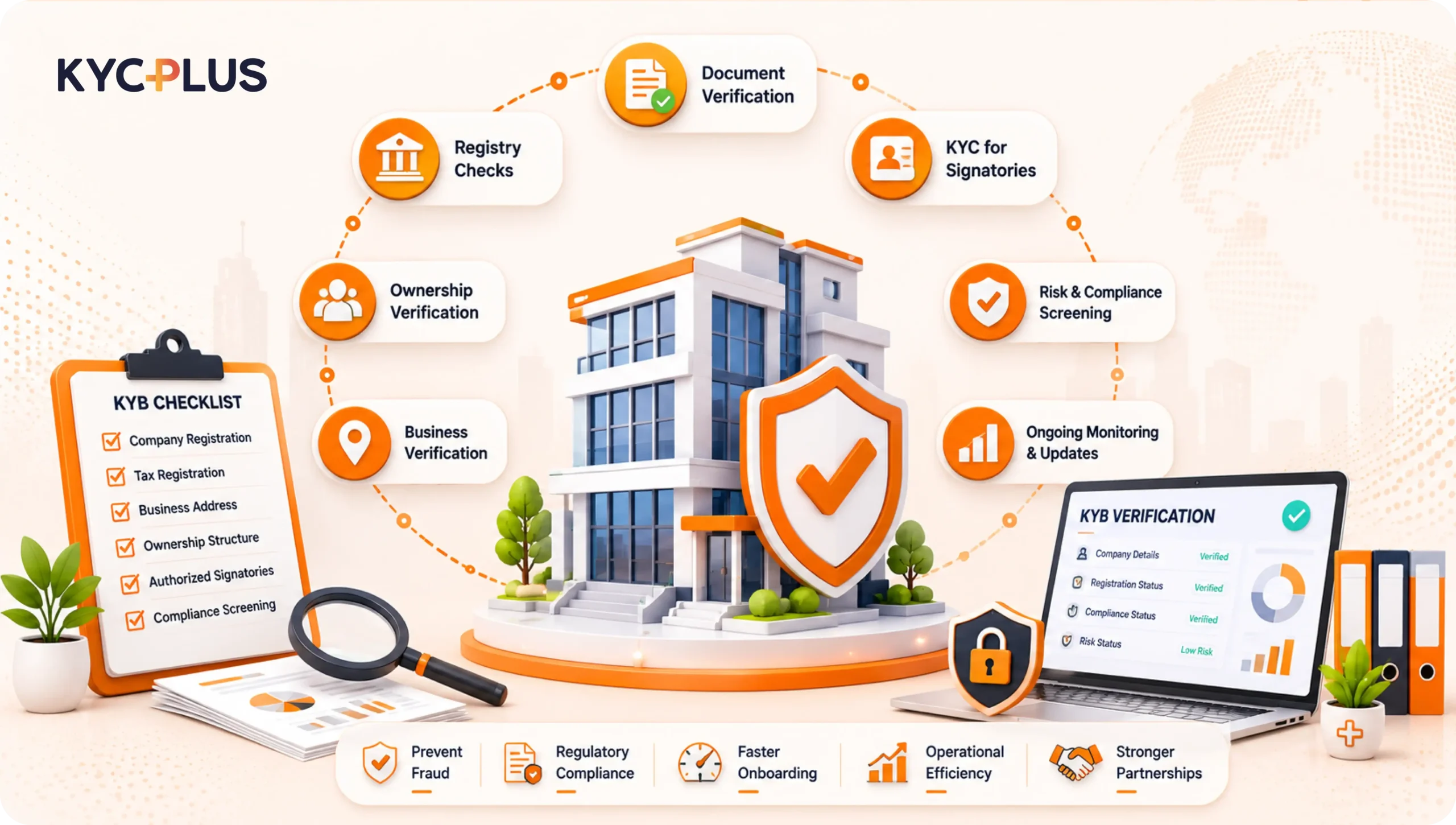
As digital business transactions continue to grow, organizations are no longer verifying only individual customers – they must also verify the businesses they work with. Whether it’s onboarding a corporate client, merchant, vendor, supplier, or business partner, verifying the legitimacy of an organization has become a critical step in reducing fraud and meeting regulatory expectations. This process is known as Business Verification and forms the foundation of Know Your Business (KYB) compliance. It helps organizations confirm that a company is legally registered, operational, and authorized to conduct business before establishing a commercial relationship. A strong Business Verification process also helps identify fake companies, shell entities, fraudulent ownership structures, and other risks that could expose businesses to financial losses or compliance issues.
As industries such as banking, fintech, insurance, payment services, and B2B platforms continue to digitize their operations, the number of business customers being onboarded has increased significantly. Traditional verification methods that rely on manual document collection, physical verification, and time-consuming compliance reviews are often unable to keep pace with modern business demands. These outdated processes can lead to delayed onboarding, higher operational costs, inconsistent verification, and poor customer experiences.
To overcome these challenges, many organizations are adopting automated Business Verification solutions that use APIs, OCR, digital document validation, company registry checks, and workflow automation.
To overcome these challenges, many organizations are adopting automated Business Verification solutions that use APIs, OCR, digital document validation, company registry checks, and workflow automation.
In this comprehensive guide, we’ll explore what Business Verification is, why KYB compliance matters, the biggest challenges organizations face during verification, and how modern digital solutions can help businesses build faster, safer, and more compliant onboarding processes.
Businesses today operate in a highly connected digital ecosystem where partnerships, vendors, suppliers, merchants, distributors, and corporate customers can be onboarded without ever meeting in person. While digital transformation has made business operations faster and more efficient, it has also increased the risk of fraud, fake companies, identity theft, money laundering, and financial crimes.
Without a proper Business Verification process, organizations may unknowingly establish relationships with shell companies, inactive businesses, or entities operating with forged documents. Such relationships can result in financial losses, regulatory penalties, legal disputes, and significant reputational damage.
Implementing a structured Business Verification process provides several important advantages:
For organizations handling hundreds or thousands of business applications each month, Business Verification is no longer just a compliance requirement—it’s an essential risk management practice.
Many people confuse Know Your Customer (KYC) with Know Your Business (KYB). Although both processes aim to prevent fraud and support regulatory compliance, they focus on different types of customers.
KYC is designed to verify the identity of individual customers before providing financial products or services. It involves validating personal identity documents, confirming addresses, and conducting customer due diligence.
KYB, on the other hand, is specifically designed for legal entities such as companies, partnerships, trusts, and other organizations. Instead of verifying an individual, KYB verifies the legitimacy, ownership structure, and operational status of a business.
In many situations, organizations perform both KYC and KYB together. For example, when a company opens a corporate bank account, the institution verifies the business through KYB while conducting KYC Verification for directors, beneficial owners, or authorized signatories. This combined approach helps financial institutions confirm both the legitimacy of the business entity and the identities of the individuals associated with it, strengthening compliance and reducing fraud risks.
An effective Business Verification process consists of several verification stages that help organizations evaluate whether a business can be trusted.
The first step is confirming that the business is officially registered with the relevant government authority.
Verification typically includes:
This helps confirm that the organization legally exists.
Businesses are also verified using their tax registration details.
Depending on the country and regulatory requirements, this may include:
Validating tax information reduces the chances of onboarding fraudulent businesses.
Organizations verify the registered office and operational address of a company to confirm its physical presence.
Documents commonly used include:
Address verification becomes particularly important for businesses involved in financial transactions.
Certain industries require businesses to obtain licenses before offering products or services.
Examples include:
Verifying these licenses ensures the business is legally authorized to operate.
A company may appoint one or more individuals to represent the organization during onboarding.
Businesses therefore verify:
This ensures that the individual completing the onboarding process has the legal authority to act on behalf of the organization.
One of the most important components of KYB is identifying the Ultimate Beneficial Owner (UBO).
A UBO is the individual who ultimately owns or controls the business, even if ownership exists through multiple corporate layers.
Verifying UBOs helps organizations:
Because ownership structures can be complex, UBO verification is often one of the most challenging aspects of Business Verification.
Organizations also assess whether the company’s declared activities match its actual operations.
This may include verifying:
Understanding the nature of a business helps organizations perform more accurate risk assessments.
Know Your Business (KYB) Compliance is the process of verifying the identity, ownership, and legitimacy of business entities before establishing commercial relationships. While a KYC solution verifies individual identities, KYB extends those principles to organizations, helping businesses understand exactly who they are dealing with and reduce compliance and fraud risks.
A comprehensive KYB program generally includes:
Rather than being a one-time verification exercise, a KYB solution should support continuous monitoring throughout the business relationship. Companies may change ownership, update registration details, merge with other organizations, or modify their operational structure. Regular reviews help organizations maintain accurate records, identify changes promptly, and respond to evolving risk levels more effectively.
Digital platforms such as KYCPLUS make this process significantly easier by centralizing business documents, automating verification workflows, maintaining audit trails, and simplifying periodic reviews. Instead of relying on spreadsheets, emails, and manual follow-ups, compliance teams can manage Business Verification from a single platform.
Strong KYB compliance protects organizations from both regulatory and commercial risks.
Some of its major benefits include:
KYB helps identify shell companies, fake registrations, forged incorporation documents, and suspicious ownership structures before onboarding.
Businesses operating in regulated sectors are expected to perform adequate due diligence before establishing commercial relationships.
Business Verification supports these compliance requirements by ensuring organizations verify legal entities appropriately.
Not all businesses present the same level of risk.
Through Business Verification, organizations can classify business customers according to ownership, industry, geography, transaction patterns, and operational history.
This enables compliance teams to apply enhanced due diligence where required.
Trust is the foundation of every successful business partnership.
Verifying organizations before onboarding reduces uncertainty, strengthens confidence, and supports long-term commercial relationships built on transparency and compliance.
Business Verification has become increasingly complex as organizations expand their operations, onboard business customers digitally, and comply with evolving regulatory requirements. While verifying an individual customer is relatively straightforward, verifying a business often involves reviewing multiple documents, ownership structures, licenses, tax registrations, and regulatory records.
For compliance teams, this means dealing with large volumes of information while ensuring every verification is accurate, consistent, and completed within a reasonable timeframe. Manual processes can quickly become inefficient, especially as the number of business customers grows.
Below are some of the biggest challenges organizations face during Business Verification.
One of the first hurdles in Business Verification is obtaining all the required documents from a business.
Depending on the type of organization, businesses may need to submit:
Many applications are delayed because documents are missing, outdated, or submitted in poor quality.
Compliance teams often spend valuable time requesting revised documents, resulting in slower onboarding and increased operational costs.
Digital solutions such as KYCPLUS simplify document collection by allowing businesses to upload documents through a centralized portal, reducing paperwork and improving document tracking.
Submitting a registration certificate does not automatically confirm that a company is active or legally operating.
Organizations must verify details such as:
Manual verification through multiple government portals can be time-consuming and increases the possibility of overlooking inconsistencies.
Automated Business Verification solutions help validate company information more efficiently by integrating with trusted data sources wherever applicable.
One of the most challenging aspects of Business Verification is identifying the Ultimate Beneficial Owner (UBO).
Many companies have complex ownership structures involving:
Determining who ultimately owns or controls the organization often requires extensive documentation and careful analysis.
Incomplete ownership information can increase compliance risks and make due diligence significantly more difficult.
Modern KYB platforms assist compliance teams by organizing ownership information and maintaining structured records that simplify ongoing reviews.
Fraudsters continue to develop sophisticated methods to create fake businesses and fraudulent corporate identities.
Common risks include:
Without a strong Business Verification process, organizations may unknowingly establish relationships with fraudulent entities.
Technologies such as OCR, document authentication, digital verification workflows, and risk-based screening help detect suspicious applications before onboarding is completed.
Regulatory requirements related to KYB, AML, and customer due diligence continue to evolve.
Businesses must regularly update their verification procedures to align with applicable regulations and industry standards.
Challenges include:
Organizations using manual processes often find it difficult to implement regulatory updates consistently across all branches or departments.
Traditional Business Verification involves multiple manual activities such as:
As business applications increase, these activities create operational bottlenecks.
Long verification cycles not only delay onboarding but can also frustrate potential business customers.
Automation reduces repetitive work, allowing compliance professionals to focus on complex or high-risk cases instead of routine verification tasks.
Manual processes naturally introduce the possibility of errors.
Some common examples include:
Even minor errors can result in compliance issues, delayed approvals, or poor customer experiences.
Automated Business Verification reduces these risks by standardizing workflows and minimizing manual intervention.
Organizations experiencing rapid growth often struggle to scale their verification processes.
For example:
Manual verification simply cannot scale efficiently without significantly increasing staffing costs.
Digital Business Verification platforms enable organizations to process large numbers of applications while maintaining consistency and compliance.
Many organizations still rely on:
Managing thousands of business documents this way creates operational inefficiencies and increases the likelihood of lost or outdated records.
Centralized document management solutions help maintain organized, searchable, and secure records while simplifying audits and future reviews.
Platforms like KYCPLUS provide centralized document storage, audit trails, and workflow management, making document handling significantly more efficient.
When verification activities are spread across emails, spreadsheets, and multiple systems, compliance managers often struggle to answer simple questions such as:
Without centralized visibility, managing Business Verification becomes increasingly difficult.
Dashboard-based solutions provide real-time insights into application status, pending reviews, completed verifications, and compliance activities.
Digital transformation has fundamentally changed how organizations approach Business Verification. Instead of relying entirely on manual reviews, businesses now automate repetitive verification tasks using APIs, OCR, workflow automation, and centralized compliance platforms.
Automation not only accelerates onboarding but also improves accuracy, consistency, and regulatory readiness.
Some of the biggest advantages include:
Solutions like KYCPLUS combine these capabilities into a unified platform, helping organizations simplify Business Verification while supporting KYB compliance and reducing operational complexity.
Organizations adopting digital Business Verification experience significant operational improvements compared to traditional manual processes.
Businesses can complete verification much more quickly, reducing delays and improving customer satisfaction.
Automated validation minimizes manual errors and creates more consistent verification outcomes.
Digital verification tools help detect suspicious businesses before they are onboarded.
Automation reduces administrative work, allowing compliance teams to focus on higher-value activities.
Standardized workflows and digital audit trails make regulatory reporting easier and improve overall governance.
Whether onboarding hundreds or thousands of business customers, digital verification platforms support business growth without requiring proportional increases in manpower.
In the next part, we’ll explore the industries that benefit most from Business Verification, discuss how to choose the right Business Verification solution, explain how KYCPLUS simplifies KYB compliance, examine future trends, answer the most frequently asked questions, and conclude with key takeaways.
Business Verification is no longer limited to traditional banks. As businesses continue to digitize their operations and collaborate with organizations across different industries, verifying the legitimacy of business entities has become an essential part of risk management and regulatory compliance.
Whether an organization is onboarding corporate customers, merchants, suppliers, distributors, or vendors, Business Verification helps establish trust before a commercial relationship begins.
Below are some of the industries where Business Verification plays a critical role.
Banks regularly onboard companies for:
Before providing these services, banks must verify company registration details, beneficial ownership, authorized signatories, and other compliance-related information.
Automating Business Verification helps banks reduce onboarding time while maintaining strong compliance standards.
NBFCs provide financial services to thousands of businesses every year.
Business Verification helps NBFCs:
Digital verification also enables faster loan approvals and improves the overall customer experience.
FinTech companies often operate entirely online, making digital verification essential.
Business Verification enables FinTech organizations to:
Automation is particularly valuable for rapidly growing FinTech businesses handling large onboarding volumes.
Payment gateways and merchant acquiring platforms must verify businesses before allowing them to process digital payments.
Business Verification helps confirm:
This reduces financial crime risks while protecting payment ecosystems.
Insurance providers use Business Verification when issuing corporate insurance policies or onboarding business customers.
Verification helps ensure that:
Software companies providing enterprise solutions often onboard corporate customers remotely.
Business Verification enables them to:
Large organizations frequently work with hundreds or thousands of vendors.
Business Verification helps procurement teams verify:
This minimizes procurement risks and improves supplier management.
Urban Cooperative Banks, District Central Cooperative Banks, and Multi-State Cooperative Credit Societies increasingly rely on Business Verification when onboarding corporate customers and commercial account holders.
Digital verification helps these institutions modernize their processes while reducing paperwork and improving operational efficiency.
Selecting the right Business Verification solution requires more than simply comparing software features. Organizations should evaluate whether the platform can support current operational needs while remaining flexible enough to accommodate future growth.
Here are some important factors to consider.
Choose a solution that supports multiple verification activities, including:
A single platform capable of handling multiple verification requirements simplifies day-to-day operations.
The solution should integrate easily with:
Smooth integration reduces implementation time and improves operational efficiency.
Business information is highly confidential.
Choose a platform that provides:
Strong security practices help protect sensitive business information.
Your Business Verification platform should continue performing efficiently even as onboarding volumes increase.
Whether processing 100 applications or 10,000, the solution should maintain speed and accuracy.
Real-time dashboards help organizations monitor:
Better visibility leads to better decision-making.
Reliable implementation assistance, technical support, and product updates are equally important when selecting a Business Verification partner.
Managing Business Verification through disconnected systems, spreadsheets, emails, and manual document reviews can quickly become inefficient as customer volumes grow. Organizations need a centralized solution that combines automation, compliance, and operational visibility without disrupting existing workflows.
KYCPLUS is designed to simplify Business Verification by bringing together multiple verification capabilities within a single platform. It enables organizations to manage document collection, OCR-based data extraction, workflow automation, centralized document management, audit trails, dashboard reporting, and digital verification processes through one integrated solution.
For financial institutions, cooperative banks, NBFCs, fintech companies, and enterprise organizations, KYCPLUS can also support broader compliance initiatives by integrating Business Verification with customer onboarding workflows, helping teams reduce repetitive manual tasks while maintaining consistency across every verification.
Another advantage of KYCPLUS is its ability to integrate with existing Core Banking Systems (CBS) and enterprise applications. This allows organizations to modernize their verification processes without replacing their current infrastructure, making digital transformation more practical and cost-effective.
As verification volumes continue to increase, organizations need solutions that are not only compliant but also scalable. By streamlining Business Verification and reducing operational complexity, KYCPLUS helps compliance teams focus on higher-risk cases while routine verification activities are handled through standardized digital workflows.
Implementing KYB successfully requires more than collecting documents. Organizations should establish a structured verification framework that supports both compliance and operational efficiency.
Some recommended best practices include:
Following these practices helps organizations reduce risk while improving verification consistency.
Technology is transforming how organizations verify businesses. Over the coming years, Business Verification will become increasingly automated, intelligent, and integrated into digital business ecosystems.
Some of the major trends include:
AI will continue improving fraud detection, document analysis, and risk scoring by identifying suspicious patterns more accurately.
Advanced OCR engines will extract and validate business information from a wider range of documents with greater accuracy.
Businesses increasingly expect instant verification rather than waiting several days for manual reviews.
API-driven Business Verification will continue reducing onboarding times.
Instead of verifying businesses only during onboarding, organizations are moving toward continuous monitoring of company status, ownership changes, and compliance risks throughout the business relationship.
Businesses increasingly prefer modular APIs that integrate seamlessly with existing enterprise applications, allowing Business Verification to become part of automated digital workflows.
As organizations continue expanding their digital operations, Business Verification has become a critical component of secure corporate onboarding and effective KYB compliance. Traditional manual verification processes often struggle to keep pace with increasing business volumes, evolving regulatory expectations, and sophisticated fraud techniques.
By adopting modern digital verification solutions, organizations can automate repetitive tasks, improve verification accuracy, strengthen fraud prevention, and accelerate business onboarding while maintaining compliance. A well-designed Business Verification process not only reduces operational risk but also builds trust with corporate customers, vendors, suppliers, and business partners.
Platforms such as KYCPLUS demonstrate how automation can simplify Business Verification by combining document management, workflow automation, audit trails, and centralized compliance into one integrated solution. As technology continues to evolve, businesses that invest in scalable and intelligent verification processes will be better positioned to deliver faster onboarding, stronger compliance, and sustainable long-term growth.
Ans: Business Verification is the process of confirming that a company is legally registered, operational, and authorized to conduct business before establishing a commercial relationship.
Ans: KYC verifies individual customers, while KYB verifies businesses, their ownership structures, and legal status.
Ans: It helps organizations reduce fraud, improve regulatory compliance, verify legitimate businesses, and build trusted commercial relationships.
Ans: Banks, NBFCs, fintech companies, insurance providers, payment service providers, B2B platforms, cooperative banks, and vendor management organizations commonly use Business Verification.
Ans: Common documents include the Certificate of Incorporation, GST Registration, PAN, business licenses, address proof, and authorization documents. Requirements vary depending on the industry and applicable regulations.
Ans: A UBO is the individual who ultimately owns or controls a business, even if ownership exists through multiple legal entities.
Ans: Automation speeds up document collection, reduces manual errors, improves fraud detection, standardizes workflows, and simplifies compliance reporting.
Ans: Yes. Modern verification solutions can integrate with Core Banking Systems, CRM platforms, ERP software, loan management systems, and other enterprise applications.
Ans: KYCPLUS provides a centralized platform for Business Verification through workflow automation, OCR-based document extraction, document management, audit trails, dashboard reporting, and integration with existing business systems, helping organizations streamline KYB compliance.
Ans: Organizations should evaluate verification capabilities, security, scalability, ease of integration, reporting features, compliance support, and the provider’s implementation and customer support services.
