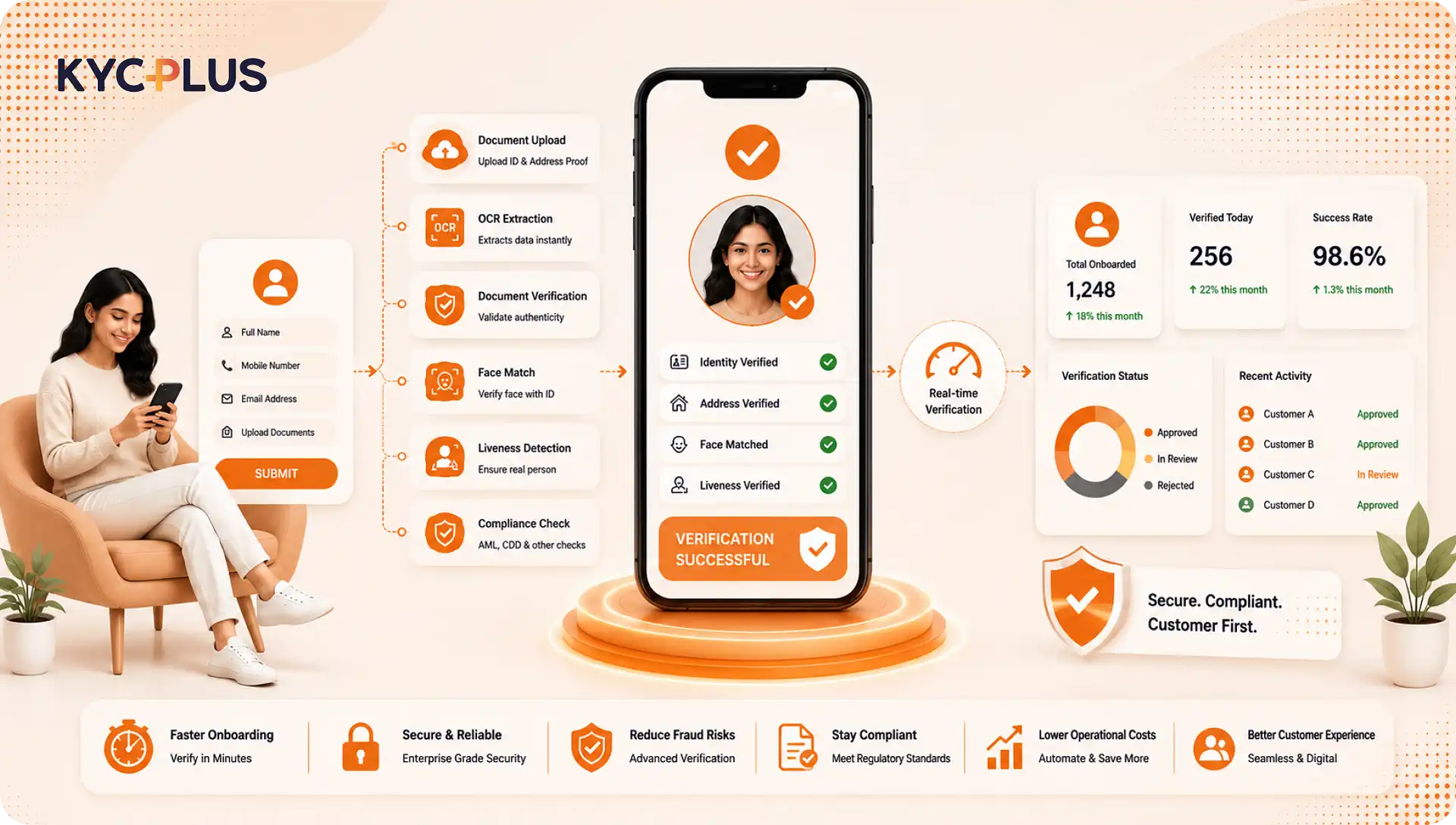
In today’s digital economy, customers expect instant access to products and services. Whether opening a bank account, applying for a loan, purchasing insurance, or registering for a financial application, people no longer want lengthy paperwork or multiple branch visits. They expect a fast, secure, and fully digital experience that allows them to complete the process from anywhere. To Automate Customer Onboarding, businesses increasingly adopt digital identity verification, document processing, and workflow automation technologies that accelerate customer registration while improving accuracy. For businesses, meeting these expectations while staying compliant with regulatory requirements can be challenging. Traditional onboarding processes often involve collecting physical documents, manually verifying customer information, reviewing identity proofs, and maintaining paper records.
This is where Automate Customer Onboarding automation powered by KYC APIs is transforming the way organizations operate. Instead of relying on manual verification, businesses can integrate KYC APIs into their applications to automate identity verification, validate customer documents, perform face matching, conduct liveness detection, and complete compliance checks within minutes.
Automated onboarding not only improves operational efficiency but also enhances the customer experience. Faster verification means quicker account activation, reduced application abandonment, and improved customer satisfaction. At the same time, businesses benefit from stronger fraud prevention, standardized verification processes, and better compliance management.
As digital banking, fintech services, insurance platforms, and online financial products continue to grow, automated Automate Customer Onboarding has become a strategic investment rather than a technological upgrade. Organizations that embrace automation can scale their operations more effectively while maintaining security and regulatory compliance.
In this guide, we’ll explore what it means to Automate Customer Onboarding, why it is important, the limitations of traditional onboarding, and how a KYC solution helps businesses automate the entire customer onboarding journey while improving compliance, accuracy, and operational efficiency.
Automate Customer Onboarding is the process of welcoming a new customer into a business by collecting the required information, verifying their identity, completing compliance checks, and granting access to products or services.
For regulated industries such as banking, financial services, insurance, and fintech, onboarding is more than just account creation. It includes identity verification, Know Your Customer (KYC) procedures, customer due diligence, document validation, and risk assessment before establishing a business relationship.
A well-designed onboarding process should achieve two important objectives:
Modern Automate Customer Onboarding focuses on delivering these objectives through digital technologies that minimize manual intervention and reduce processing time.
Automate Customer Onboarding creates the first impression of your organization. A slow or complicated process may discourage potential customers, while a seamless onboarding experience builds confidence and encourages long-term engagement.
An effective onboarding process helps businesses:
Organizations that invest in efficient onboarding often experience lower customer drop-off rates and stronger customer retention.
Although onboarding requirements vary across industries, most businesses aim to achieve the following objectives:
Confirm that the customer is who they claim to be by validating government-issued identity documents and personal information.
Meet KYC, Anti-Money Laundering (AML), Customer Due Diligence (CDD), and other applicable regulatory obligations.
Detect forged documents, fake identities, duplicate accounts, and suspicious applications before services are provided.
Evaluate customer risk based on identity information, expected activities, and business policies.
Reduce onboarding time while making the registration process simple, secure, and convenient.
Before digital transformation, most organizations relied on manual onboarding procedures.
A traditional onboarding workflow generally includes:
Although this approach has been widely used for many years, it presents several operational challenges, particularly for organizations handling a large number of customer applications.
Manual document verification and approval workflows can take hours or even several days, delaying account activation.
Physical forms and photocopied documents increase administrative effort while making document management more difficult.
Manual data entry can result in incorrect customer information, duplicate records, or incomplete verification.
Businesses require dedicated staff for document collection, verification, compliance checks, and record management.
Customers increasingly expect digital services. Long waiting periods and repeated document submissions often lead to application abandonment.
As customer volumes grow, manual onboarding becomes difficult to manage without significantly increasing staffing costs.
A KYC API (Know Your Customer Application Programming Interface) is a software interface that enables businesses to automate customer identity verification by integrating verification services directly into their websites, mobile applications, or internal systems.
Rather than manually reviewing every customer application, the API performs multiple verification tasks automatically and returns the results in real time.
Depending on the solution, a KYC API can support:
Because APIs integrate directly with existing business applications, customers can complete verification without leaving the onboarding journey.
Businesses today need onboarding processes that are fast, secure, scalable, and compliant. Manual verification often cannot meet these expectations, especially as customer volumes increase.
KYC APIs address these challenges by automating repetitive verification tasks, reducing human intervention, improving consistency, and enabling businesses to onboard customers more efficiently.
Instead of spending valuable time reviewing every application manually, compliance teams can focus on exceptional or high-risk cases while routine customer verification is completed automatically.
Businesses today need a faster, more secure, and scalable way to verify customers without creating unnecessary friction during registration. This is where KYC APIs play a vital role. By integrating identity verification directly into websites, mobile applications, or business platforms, organizations can automate Automate Customer Onboarding from start to finish.
Instead of asking customers to visit a branch, submit physical documents, and wait for manual approval, businesses can complete most verification steps digitally within minutes. This not only improves operational efficiency but also delivers the seamless experience that modern customers expect.
Let’s look at how an automated Automate Customer Onboarding process typically works.
The journey begins when a customer registers through a website, mobile application, or online portal.
Basic information is collected, such as:
This information is securely captured and passed to the KYC API for further verification.
The customer uploads the required identity and address proof documents.
Depending on business requirements, these may include:
Most modern platforms allow customers to upload documents using their smartphone camera or desktop browser.
Some advanced solutions also detect blurry images, cropped documents, glare, or poor lighting and prompt users to upload better-quality images before verification begins.
Once the document is uploaded, Optical Character Recognition (OCR) automatically extracts information from the document.
The extracted details generally include:
Since the information is extracted automatically, businesses avoid manual data entry and significantly reduce typing errors.
OCR also speeds up Automate Customer Onboarding because customers don’t need to enter the same information multiple times.
After extracting the information, the system verifies the authenticity of the submitted document.
Typical verification checks include:
If the document appears suspicious or incomplete, the application can be flagged for manual review.
Many businesses require customers to capture a live selfie during registration.
The KYC API compares the live image with the photograph available on the uploaded identity document.
This process helps confirm that the applicant is the rightful owner of the submitted identity document.
Face matching significantly strengthens Automate Customer Onboarding security while reducing identity fraud.
Identity fraud has become increasingly sophisticated. Fraudsters may attempt to bypass verification using printed photographs, screenshots, recorded videos, or manipulated images.
Liveness Detection helps prevent these attacks by verifying that a real person is present during the verification process.
This additional security layer improves trust without making the onboarding experience complicated.
Before approving a customer, businesses often perform additional regulatory checks.
Depending on industry requirements, these may include:
Automating these checks allows organizations to remain compliant while reducing manual effort.
After successful verification, the system generates a verification result.
Typical outcomes include:
Approved customers can immediately proceed with account activation or access the requested service.
For flagged applications, compliance teams receive detailed verification reports to support informed decision-making.

Selecting the right KYC API requires understanding the features that contribute to a secure and efficient onboarding process.
The API verifies customer identities without requiring extensive manual intervention, helping organizations onboard customers faster.
OCR extracts information from uploaded documents accurately, reducing manual data entry and minimizing errors.
Facial recognition compares the customer’s selfie with the photograph on the submitted identity document.
Liveness Detection confirms that the verification is being completed by a real person instead of a spoofing attempt.
Most KYC APIs provide verification results within seconds, enabling faster Customer Onboarding.
Verified documents are stored securely in digital format, making future retrieval and compliance audits easier.
Modern KYC APIs integrate with:
Easy integration reduces implementation time while improving operational efficiency.
Businesses can monitor verification status, customer records, operational performance, and audit logs through centralized dashboards.
Organizations across industries are adopting digital verification because automation delivers measurable operational and business benefits.
Automation reduces onboarding time from several hours or days to just a few minutes, allowing customers to access products and services much sooner.
Customers prefer a simple digital registration process that requires minimal paperwork and no branch visits.
A smooth Automate Customer Onboarding journey improves satisfaction and reduces application abandonment.
Automation reduces the need for manual document review, repetitive data entry, and physical record management, resulting in lower operating costs.
Since customer information is extracted and validated automatically, businesses experience fewer data entry mistakes and more consistent verification outcomes.
Combining OCR, document authentication, face matching, and liveness detection helps businesses identify fraudulent applications before onboarding is completed.
Automated workflows standardize verification procedures, maintain audit trails, and simplify compliance reporting for regulated organizations.
Whether processing hundreds or thousands of applications each day, API-driven verification enables businesses to scale Automate Customer Onboarding without proportionally increasing staff.
The growing demand for digital services has fundamentally changed customer expectations. People want to complete registrations quickly, securely, and from any location. At the same time, businesses must balance speed with strong identity verification and regulatory compliance.
Automating Automate Customer Onboarding with KYC APIs helps organizations achieve both goals. By reducing manual effort, improving verification accuracy, and accelerating customer approvals, businesses can deliver a better onboarding experience while maintaining security and compliance standards.
Rather than replacing compliance professionals, automation allows them to focus on complex or high-risk cases while routine verification is completed efficiently through standardized digital workflows.
In the next part, we’ll compare automated Automate Customer Onboarding with traditional manual onboarding, explore industry use cases, discuss compliance considerations, explain how to choose the right KYC API, and conclude with FAQs and future trends.
Every business wants an onboarding process that is fast, secure, and compliant. However, many organizations still rely on manual verification while others have adopted automated Automate Customer Onboarding using KYC APIs.
Both approaches have their place, but the right choice depends on factors such as customer volume, business size, regulatory requirements, and long-term growth plans.
Understanding the differences between these two methods helps organizations make informed decisions and build a more efficient onboarding process.
Manual Automate Customer Onboarding involves human intervention at almost every stage of the verification process.
A typical manual workflow includes:
Although this approach has been used for many years, it becomes increasingly difficult to manage as customer volumes grow.
Automated Automate Customer Onboarding uses KYC APIs to complete most verification tasks digitally.
The system can automatically:
Only applications that require additional investigation are forwarded to compliance teams for manual review.
Digital onboarding is now essential across many industries that require secure identity verification before offering products or services.
Banks use Automate Customer Onboarding automation to:
Automation allows banks to process large numbers of applications while maintaining consistent verification standards.
Non-Banking Financial Companies use automated onboarding for:
Faster verification helps reduce loan processing time and improves customer satisfaction.
FinTech businesses operate in highly competitive markets where customers expect instant service.
Automated Automate Customer Onboarding enables them to:
Insurance providers use KYC APIs to verify policyholders before issuing policies or processing claims.
Automation reduces paperwork while improving compliance.
Urban Cooperative Banks, District Central Cooperative Banks, and Multi-State Cooperative Credit Societies are increasingly digitizing Automate Customer Onboarding to improve operational efficiency and reduce manual work.
Automated onboarding helps these institutions:
Investment platforms use digital onboarding to verify investors before enabling trading, mutual fund investments, or securities transactions.
Fast verification encourages quicker account activation.
Customer identity verification is governed by various regulatory and compliance requirements. Organizations should ensure that their onboarding process aligns with applicable laws and industry standards.
Important compliance areas include:
In India, businesses should also consider applicable requirements issued by regulators such as the Reserve Bank of India (RBI), along with relevant CKYC and Prevention of Money Laundering (PMLA) provisions where applicable. Since regulations evolve over time, organizations should always refer to the latest official guidelines.
Selecting the right API provider is an important business decision.
Before choosing a solution, consider the following factors.
The API should integrate smoothly with:
Choose a platform that supports:
A reliable provider should offer:
Protecting customer data should always be a priority.
Your Automate Customer Onboarding solution should support future growth without affecting verification speed or performance.
Comprehensive dashboards and reporting tools help monitor verification performance, compliance activities, and operational efficiency.
Modern organizations require a solution that combines automation, compliance, and operational efficiency within a single platform.
KYCPLUS helps simplify Automate Customer Onboarding by bringing together multiple verification capabilities into one streamlined workflow. The platform supports OCR-based document extraction, digital document verification, Face Match, Liveness Detection, CKYC processes, and a comprehensive ReKYC solution that streamlines periodic customer updates while ensuring regulatory compliance. It also provides centralized document management, dashboard-based monitoring, and audit trails for complete visibility across the onboarding lifecycle.
KYCPLUS is designed to integrate with existing Core Banking Systems (CBS) and business applications, allowing organizations to modernize their onboarding process without replacing their existing infrastructure.
By reducing manual verification efforts and improving process consistency, businesses can onboard customers faster while maintaining strong compliance and security standards.
Automate Customer Onboarding continues to evolve as technology and customer expectations change.
Several emerging trends are shaping the future of digital onboarding.
AI is improving fraud detection, document verification, and risk assessment through intelligent automation.
Facial recognition and behavioral biometrics are making identity verification more secure.
Businesses are moving beyond one-time verification by continuously monitoring customer information throughout the customer relationship.
Digital documentation continues to replace physical paperwork, making onboarding faster and more environmentally friendly.
Organizations increasingly prefer modular APIs that integrate easily with their existing technology ecosystem.
As digital services continue to expand, businesses need onboarding processes that are secure, efficient, and customer friendly. Traditional methods, while familiar, often struggle to keep pace with growing customer expectations and increasing verification demands.
Automated Automate Customer Onboarding powered by KYC APIs enables organizations to streamline identity verification, reduce operational costs, strengthen fraud prevention, and improve compliance without compromising the customer experience.
Whether you are a bank, NBFC, fintech company, insurance provider, or cooperative bank, investing in an automated onboarding solution can help you deliver faster services, build customer trust, and scale your operations with confidence. By selecting the right KYC API and implementing a well-designed onboarding workflow, businesses can create a future-ready customer experience while meeting evolving regulatory requirements.
Ans: Automate Customer Onboarding is the process of registering, verifying, and activating a new customer before providing products or services.
Ans: It helps businesses verify customer identities, reduce fraud, improve compliance, and create a positive first customer experience.
Ans: KYC APIs automate document verification, OCR, Face Match, Liveness Detection, compliance checks, and digital record management.
Ans: Banks, NBFCs, fintech companies, insurance providers, cooperative banks, payment companies, and investment platforms commonly use automated onboarding.
Ans: Yes. Automated verification uses technologies such as OCR, document authentication, Face Match, and Liveness Detection to identify fraudulent applications.
Ans: Businesses typically verify documents such as Aadhaar Card, PAN Card, Passport, Driving Licence, and Voter ID, depending on applicable regulations.
Ans: Yes. Most modern APIs integrate with websites, mobile applications, CRM systems, loan management platforms, and Core Banking Systems.
Ans: Yes. Businesses of all sizes can benefit from automation by reducing manual work, improving accuracy, and enhancing customer experience.
Ans: OCR automatically extracts customer information from documents, reducing manual data entry and improving accuracy.
Ans: Businesses should evaluate verification features, security, integration capabilities, scalability, reporting tools, compliance support, and vendor reliability.
