Blog What is KYB Verification and Why Businesses Need It?
Blog
What is KYB Verification and Why Businesses Need It?
In today’s interconnected business world, trust and transparency are no longer optional — they are essential. Just as banks and financial institutions must verify the identity of individual customers through KYC (Know Your Customer), they must also validate the legitimacy of the businesses they deal with. This process is known as KYB Verification (Know Your Business), and it has become a cornerstone of modern compliance frameworks.
KYB Verification ensures that companies are not unknowingly engaging with shell corporations, fraudulent vendors, or entities involved in money laundering or terrorist financing. It goes beyond surface-level checks, digging into ownership structures, beneficial owners, and regulatory compliance status. For banks, NBFCs, fintechs, and enterprises, KYB is not just a regulatory requirement — it is a strategic safeguard that protects financial integrity and builds long-term trust in B2B relationships.
Global compliance pressure: Regulators worldwide, including RBI in India and FATF internationally, demand stronger due diligence on businesses.
Fraud prevention: With rising cases of corporate fraud, KYB helps institutions detect and avoid risky partnerships.
Investor confidence: Verified businesses attract more investment, as KYB demonstrates governance and accountability.
Cross-border expansion: Companies entering international markets must meet KYB standards to comply with foreign regulations.
KYB vs KYC: Setting the Context
KYC (Know Your Customer): Focuses on individuals — verifying identity, address, and financial behavior.
KYB (Know Your Business): Focuses on organizations — validating incorporation documents, ownership structures, and compliance records.
Together, KYC and KYB form a complete due diligence framework that ensures both individuals and businesses are legitimate participants in the financial ecosystem.
The Role of KYB in Modern Business
KYB Verification is not just about ticking compliance boxes. It is about:
The concept of KYB Verification (Know Your Business) has evolved significantly over the past two decades, shaped by global regulatory frameworks, technological advancements, and the growing need for transparency in corporate dealings. What began as a basic requirement for banks to validate business accounts has now become a comprehensive compliance mandate across industries worldwide.
1. Global Origins of KYB Verification
Post-9/11 regulations: After 2001, governments worldwide tightened anti-money laundering (AML) and counter-terrorist financing (CFT) laws. KYB Verification emerged as a way to ensure businesses were not being used as fronts for illicit activities.
FATF guidelines: The Financial Action Task Force (FATF) introduced global standards requiring financial institutions to identify and verify beneficial owners of companies.
EU directives: The European Union’s AML directives mandated KYB checks for banks, fintechs, and corporate service providers.
2. KYB in the Indian Context
RBI guidelines: The Reserve Bank of India requires banks and NBFCs to conduct KYB Verification for corporate clients, vendors, and business partners.
SEBI regulations: Securities and Exchange Board of India enforces KYB for brokerage firms and investment houses to prevent market manipulation.
At its core, KYB Verification (Know Your Business) is the process of validating the identity, ownership, and legitimacy of a business entity. Just as KYC ensures that individuals are genuine customers, KYB ensures that companies are authentic, law-abiding, and compliant with regulatory standards.
1. Defining KYB Verification
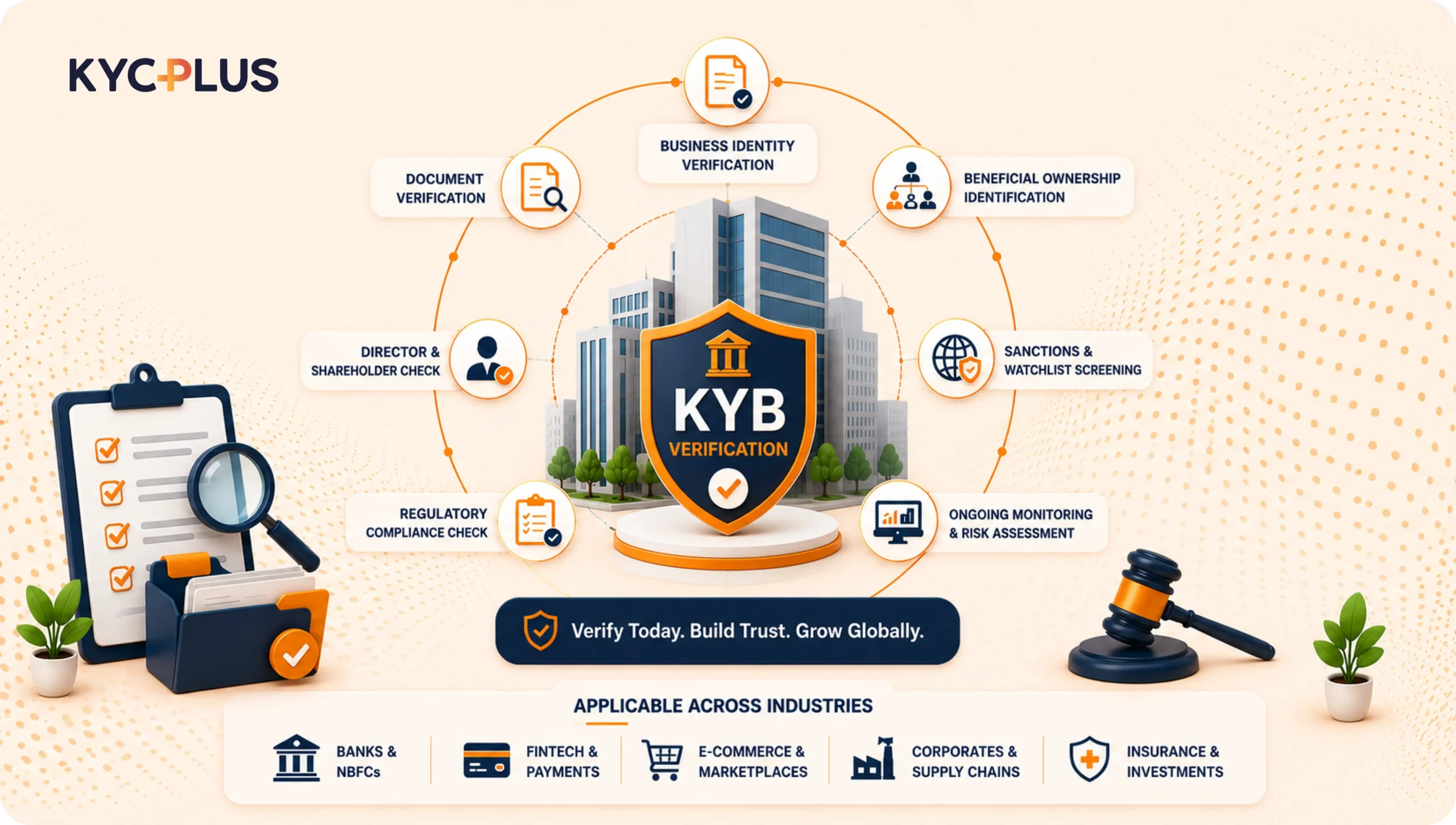
KYB Verification involves a structured set of checks to confirm:
Business identity: Validating incorporation certificates, GST registration, PAN, and other legal documents.
Beneficial ownership: Identifying individuals who ultimately control the company, even if hidden behind complex structures.
Directors and shareholders: Conducting background checks to prevent fraud or links to illicit activities.
Regulatory compliance: Ensuring the business holds necessary licenses and is not listed on sanctions or watchlists.
2. KYB vs KYC
KYC (Know Your Customer): Focuses on individuals — verifying identity, address, and financial behavior.
KYB (Know Your Business): Focuses on organizations — validating incorporation, ownership, and compliance records.
Together, they form a holistic due diligence framework for financial institutions and enterprises.
3. Components of KYB Verification
Business Identity Verification: Checking incorporation certificates, GST, PAN, and tax filings.
Sanctions & Watchlist Screening: Ensuring businesses are not linked to terrorism, money laundering, or fraud.
Ongoing Monitoring: Continuous checks to detect changes in ownership or compliance status.
4. Why KYB Verification is Critical
Prevents fraud: Detects shell companies and fake vendors.
Ensures compliance: Aligns with RBI, SEBI, FATF, and global AML/CFT regulations.
Builds trust: Strengthens B2B relationships by ensuring transparency.
Supports growth: Verified businesses attract investors and enable smoother global expansion.
5. Practical Example
Imagine a bank onboarding a new corporate client. Without KYB Verification, the bank risks dealing with a shell company hiding illicit funds. With KYB, the bank validates incorporation documents, checks beneficial owners against sanctions lists, and ensures compliance — protecting both itself and the financial system.
The importance of KYB Verification (Know Your Business) has grown rapidly as companies, banks, and fintechs face increasing regulatory scrutiny and rising risks of fraud. For organizations engaged in B2B transactions, vendor onboarding, or corporate partnerships, KYB is no longer optional — it is a critical safeguard.
1. Regulatory Compliance
AML/CFT obligations: Regulators worldwide, including RBI in India and FATF globally, require businesses to verify corporate clients and partners.
Legal mandates: KYB Verification ensures compliance with laws like the Companies Act, SEBI guidelines, and international AML directives.
Avoiding penalties: Non-compliance can lead to heavy fines, restrictions, and reputational damage.
2. Fraud Prevention
Detecting shell companies: KYB helps identify businesses created solely to launder money or evade taxes.
Vendor risk management: Prevents onboarding of fraudulent suppliers or fake contractors.
Financial protection: Reduces exposure to scams, identity theft, and corporate fraud.
3. Transparency in B2B Transactions
Trust building: Verified businesses inspire confidence among partners and clients.
Supply chain integrity: KYB ensures vendors and distributors are legitimate, reducing risks of disruption.
Due diligence: Investors prefer companies that conduct thorough KYB Verification of their partners.
Risk reduction: Verified business relationships reduce chances of financial irregularities.
Market credibility: Strong compliance frameworks attract global investors.
5. Global Expansion Readiness
Cross-border compliance: KYB Verification aligns with international standards, enabling smoother entry into foreign markets.
Partnership assurance: Ensures overseas vendors and clients meet local regulatory requirements.
Competitive advantage: Businesses with robust KYB frameworks are seen as reliable global partners.
6. Case Example
A fintech company expanding into Europe must comply with EU AML directives. By implementing KYB Verification, it validates corporate clients, checks beneficial owners against sanctions lists, and ensures compliance — avoiding penalties and building trust with regulators and partners.
KYB Verification Process
Understanding the KYB Verification (Know Your Business) process is essential for banks, NBFCs, fintechs, and enterprises that engage with corporate clients, vendors, or partners. Unlike KYC, which focuses on individuals, KYB involves multiple layers of checks to ensure that businesses are legitimate, compliant, and trustworthy.
1. Step‑by‑Step Workflow
a. Document Collection
Incorporation certificate, GST registration, PAN, and tax filings.
Licenses and permits relevant to the industry.
Proof of business address and operational existence.
b. Beneficial Ownership Identification
Mapping shareholders and directors.
Identifying Ultimate Beneficial Owners (UBOs) who control the company.
Screening owners against sanctions and watchlists.
c. Sanctions & Compliance Screening
Checking against RBI, SEBI, FATF, and global AML/CFT lists.
Ensuring the business is not blacklisted or under investigation.
d. Background Checks
Verifying directors’ and shareholders’ history.
Detecting links to fraud, corruption, or financial crimes.
e. Ongoing Monitoring
Continuous tracking of changes in ownership, compliance status, or regulatory filings.
Automated alerts for suspicious activity.
2. Role of Technology in KYB Verification
AI & Machine Learning: Detect hidden ownership structures and unusual transaction patterns.
Blockchain: Provides transparent, tamper‑proof records of business identity.
Cloud Platforms: Scale KYB processes across thousands of accounts simultaneously.
Video KYB: Enables remote verification of directors and authorized signatories.
3. KYB in Practice: Industry Examples
Banking: Before opening a corporate account, banks conduct KYB Verification to ensure the business is legitimate.
Fintechs: Payment gateways verify merchants to prevent fraud.
NBFCs: Lenders validate borrowers’ businesses to reduce credit risk.
Supply Chains: Corporates verify vendors to ensure compliance and reliability.
4. Benefits of a Strong KYB Process
Compliance assurance: Meets RBI, SEBI, and global AML/CFT mandates.
Fraud prevention: Detects shell companies and risky vendors.
While KYB Verification (Know Your Business) is designed to protect institutions and businesses, failing to comply with these requirements can lead to severe consequences. Regulators worldwide — including RBI, SEBI, FATF, and EU authorities — impose strict penalties on organizations that neglect KYB obligations. Effective risk management strategies are therefore essential to avoid financial, operational, and reputational damage.
1. Consequences of Non‑Compliance
Regulatory fines: Banks and NBFCs can face heavy monetary penalties for lapses in KYB Verification.
Operational restrictions: Regulators may suspend or limit business operations until compliance is restored.
Reputational damage: Non‑compliance erodes trust among customers, investors, and partners.
Legal liability: Directors and compliance officers may be held personally accountable for failures.
2. Global Case Studies
Europe: Several banks were fined millions of euros for failing to verify beneficial owners of shell companies.
United States: Under the Corporate Transparency Act, businesses that fail to disclose ownership details face criminal charges and fines.
India: RBI inspections have penalized NBFCs and cooperative banks for weak KYB frameworks and incomplete records.
3. Risk Mitigation Strategies
Robust frameworks: Establish clear KYB Verification policies aligned with RBI and FATF guidelines.
Automation: Use AI and RegTech platforms to reduce manual errors and speed up verification.
Continuous monitoring: Implement systems that track changes in ownership or compliance status.
Staff training: Educate compliance teams on evolving KYB requirements.
Vendor communication: Clearly explain KYB processes to partners to reduce resistance.
4. Role of Technology in Risk Management
AI risk scoring: Assigns risk levels to businesses based on ownership and transaction history.
Blockchain records: Provides tamper‑proof evidence of compliance.
Cloud alerts: Automated notifications for suspicious activity or regulatory changes.
5. Practical Example
A payment gateway onboarding merchants uses automated KYB Verification. The system flags a vendor whose beneficial owner appears on a sanctions list. By detecting this early, the company avoids regulatory penalties and reputational harm.
Implementing KYB Verification (Know Your Business) effectively requires more than just meeting regulatory requirements. To truly safeguard against fraud, ensure compliance, and build trust in B2B relationships, organizations must adopt best practices that make KYB both efficient and reliable.
1. Build a Robust Compliance Framework
Establish clear KYB policies aligned with RBI, SEBI, FATF, and global AML/CFT standards.
Define risk categories for businesses (low, medium, high) and tailor verification depth accordingly.
Document processes for audits and inspections to demonstrate compliance readiness.
2. Leverage Automation and RegTech Solutions
Use AI-powered platforms to automate document checks and beneficial ownership mapping.
Integrate KYB Verification with government databases (MCA, GST, PAN) for instant validation.
Deploy RegTech solutions like KYCPLUS to streamline workflows and reduce manual errors.
3. Strengthen Customer and Vendor Communication
Clearly explain why KYB Verification is required to reduce resistance.
Provide user-friendly digital channels for document submission.
Offer multilingual support to ensure inclusivity across regions.
4. Conduct Internal Audits and Monitoring
Regularly review KYB processes to identify gaps.
Implement continuous monitoring of ownership changes and compliance status.
Use automated alerts to flag suspicious activity in real time.
5. Invest in Staff Training
Train compliance teams on evolving KYB regulations and technologies.
Conduct workshops on identifying red flags in corporate structures.
Encourage a culture of compliance across departments.
6. Adopt a Risk-Based Approach
Apply enhanced due diligence for high-risk businesses.
Simplify KYB for low-risk entities to avoid unnecessary delays.
Balance efficiency with thoroughness to optimize onboarding.
7. Ensure Global Alignment
Stay updated on international KYB requirements for cross-border transactions.
Use global sanctions lists to screen beneficial owners.
Align with FATF recommendations to maintain credibility in global markets.
8. Case Example
A multinational NBFC uses a RegTech platform for KYB Verification. By automating document checks, integrating with MCA and GST databases, and continuously monitoring ownership changes, the NBFC reduces onboarding time by 70% while ensuring compliance with RBI and FATF standards.
The landscape of KYB Verification (Know Your Business) is rapidly evolving, driven by regulatory changes, digital identity initiatives, and the growing demand for transparency in global business transactions. What began as a compliance requirement is now becoming a strategic differentiator for organizations that want to build trust, attract investors, and expand internationally.
1. Anticipated Regulatory Changes
Stricter beneficial ownership rules: Regulators worldwide are tightening disclosure requirements to prevent hidden ownership.
Continuous monitoring mandates: Future KYB frameworks will require not just one-time checks but ongoing verification.
Integration with AML/CFT laws: KYB Verification will be more closely tied to anti-money laundering and counter-terrorist financing obligations.
2. Integration with Digital Identity Initiatives
India’s digital stack: KYB Verification will increasingly leverage Aadhaar, GST, and MCA databases for instant validation.
Global digital IDs: Countries are developing corporate digital identity systems, making KYB faster and more reliable.
Blockchain-based registries: Transparent, tamper-proof records will become standard for verifying business legitimacy.
3. KYB as a Competitive Differentiator
Investor attraction: Companies with strong KYB frameworks will be seen as safer investments.
Global partnerships: Verified businesses will find it easier to collaborate across borders.
Customer trust: Transparent KYB processes will enhance brand reputation and loyalty.
4. Role of Technology in the Future
AI-driven KYB: Predictive analytics will identify risks before they materialize.
Automated compliance: Platforms like KYCPLUS will provide real-time KYB Verification aligned with evolving regulations.
Cross-border integration: Cloud-based KYB solution will connect with international databases, enabling seamless global compliance.
5. Case Example
A multinational fintech expanding into Asia uses blockchain-based KYB Verification. By instantly validating corporate clients against global registries, it reduces onboarding time, ensures compliance with FATF standards, and builds trust with regulators and investors.
The adoption of KYB Verification (Know Your Business) is reshaping industries across the globe. What was once seen as a compliance burden is now recognized as a driver of trust, innovation, and competitive advantage. By ensuring that businesses engage only with legitimate partners, KYB strengthens financial integrity and builds resilience in the corporate ecosystem.
1. Strengthening Financial Integrity
Banks and NBFCs: KYB Verification helps financial institutions prevent fraud, money laundering, and regulatory breaches.
Fintechs: Payment gateways and digital lenders rely on KYB to validate merchants and borrowers, ensuring safe transactions.
Capital markets: Brokerage firms and investment houses use KYB to maintain transparency and protect investors.
2. Driving Digital Innovation
Automation: AI-powered KYB platforms reduce manual workload and accelerate onboarding.
Blockchain: Transparent registries enhance trust in cross-border business dealings.
Cloud solutions: Enable institutions to scale KYB solution across thousands of accounts simultaneously.
3. Enhancing B2B Trust
Vendor onboarding: Corporates use KYB to ensure suppliers are legitimate and compliant.
Partnerships: Verified businesses inspire confidence, making collaborations smoother.
Customer loyalty: Transparent KYB processes strengthen brand reputation and trust.
4. Competitive Advantage for Compliant Businesses
Investor attraction: Companies with strong KYB frameworks are seen as safer investments.
Global expansion: Verified businesses find it easier to enter new markets and meet international compliance standards.
Reputation building: KYB Verification demonstrates governance and accountability, setting businesses apart from competitors.
5. Case Example
A cooperative bank implementing KYB Verification for all corporate accounts not only meets RBI compliance but also gains a reputation for transparency. This attracts new clients, strengthens investor confidence, and positions the bank as a trusted institution in the financial ecosystem.
The journey through KYB Verification (Know Your Business) shows that it is far more than a regulatory checkbox — it is a strategic necessity for modern businesses. By validating corporate identities, uncovering beneficial ownership, and ensuring compliance with AML/CFT laws, KYB strengthens the very foundation of financial integrity.
1. Compliance as a Cornerstone
Regulators like RBI, SEBI, and FATF have made KYB Verification mandatory to protect financial systems from fraud and misuse. Businesses that embrace KYB not only avoid penalties but also demonstrate accountability and governance.
2. Trust and Transparency
KYB Verification builds confidence in B2B relationships. Whether onboarding vendors, entering partnerships, or expanding globally, verified businesses inspire trust among clients, investors, and regulators.
3. Technology as an Enabler
Digital transformation — through AI, blockchain, and RegTech platforms like KYCPLUS — has made KYB Verification faster, more reliable, and scalable. Automation reduces manual errors, while continuous monitoring ensures ongoing compliance.
4. Strategic Advantage
Companies that prioritize KYB Verification gain a competitive edge. They attract investors, expand into new markets with ease, and strengthen their reputation as transparent, trustworthy organizations.
5. Call to Action
For banks, NBFCs, fintechs, and corporates, the time to act is now. Implementing robust KYB Verification frameworks is not just about meeting regulatory requirements — it is about safeguarding your business, building long-term trust, and positioning yourself for sustainable growth in a globalized economy.
Ans: KYB Verification is the process of confirming the identity, ownership, and legitimacy of a business entity. It ensures organizations deal only with authentic, law‑abiding companies.
Q2. How does KYB differ from KYC?
Ans: KYC (Know Your Customer) focuses on individuals. KYB (Know Your Business) focuses on organizations, validating incorporation documents, beneficial ownership, and compliance records.
Q3. Who requires KYB Verification?
Ans: Banks, NBFCs, fintechs, corporates, and even startups must conduct KYB Verification when onboarding vendors, partners, or corporate clients.
Q4. What documents are needed for KYB Verification?
Ans: Incorporation certificate
GST registration and PAN
Business licenses and permits
Shareholding and director details
Proof of business address
Q5. Can KYB Verification be done digitally?
Ans: Yes. Modern RegTech platforms use AI, blockchain, and cloud integration to automate KYB Verification, making it faster and more reliable.
Q6. Why is KYB Verification important for fraud prevention?
Ans: It helps detect shell companies, fake vendors, and hidden beneficial owners, protecting businesses from financial losses and reputational damage.
Q7. Is KYB Verification mandatory for startups?
Ans: Yes. Even startups must undergo KYB Verification when opening corporate accounts, raising funds, or partnering with financial institutions.
Q8. How does KYB Verification benefit investors?
Ans: Investors gain confidence knowing that businesses have verified partners and transparent ownership structures, reducing risk in funding decisions.
Q9. Who enforces KYB compliance in India?
Ans: The Reserve Bank of India (RBI), SEBI, and other regulators enforce KYB Verification requirements for financial institutions and corporates.
Q10. How does KYCPLUS support KYB Verification?
Ans: KYCPLUS automates document checks, beneficial ownership validation, and sanctions screening. It ensures compliance with RBI, SEBI, and FATF guidelines while making KYB Verification seamless for businesses.
KYCPLUS cuts KYC processing and onboarding time by 80%, ensuring
seamless compliance and a frictionless experience.