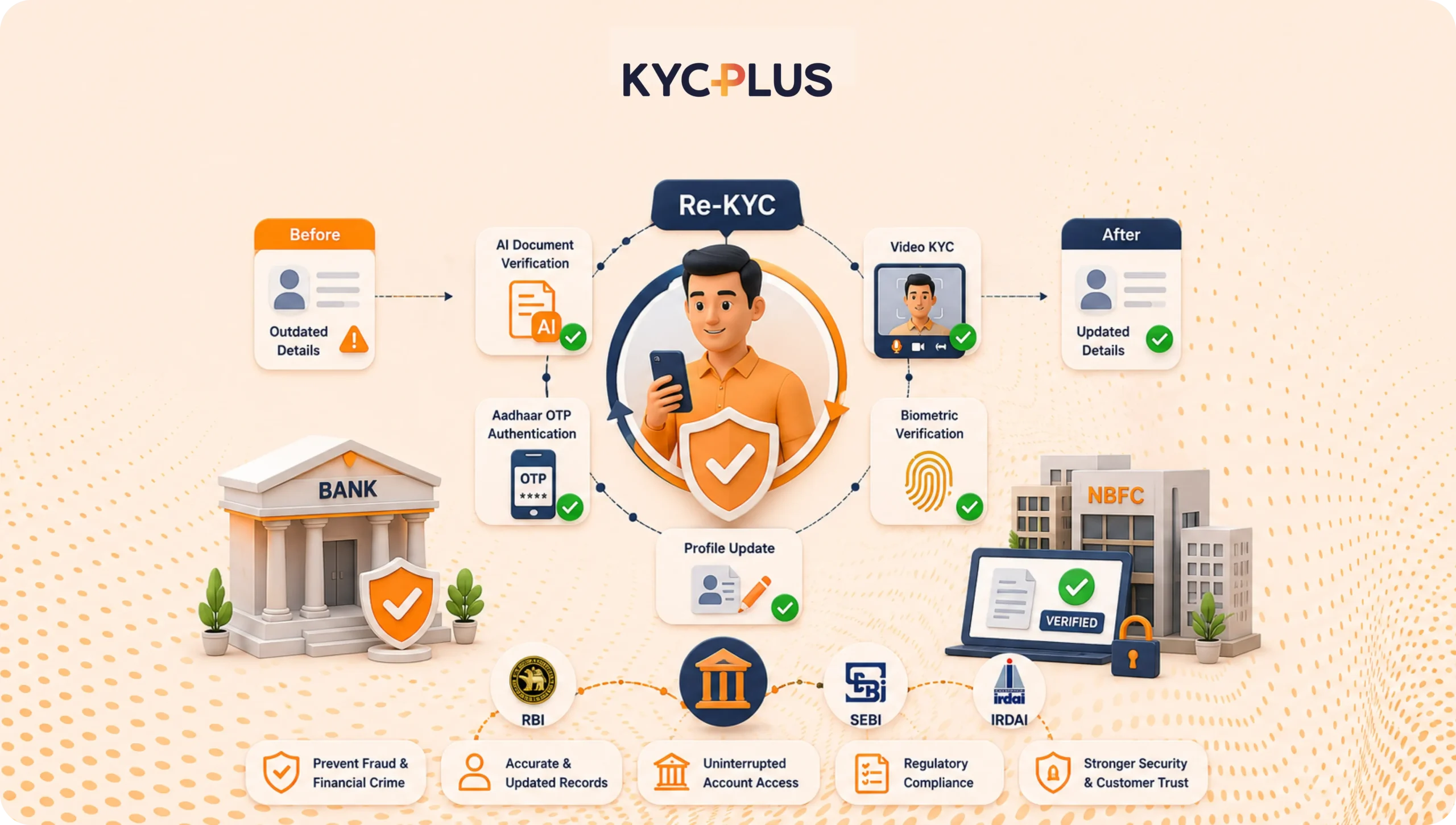
In India’s rapidly evolving financial ecosystem, compliance and customer security have become non-negotiable priorities. One of the most significant regulatory practices ensuring both is the Re-KYC (Re-Know Your Customer) process. While most people are familiar with the initial KYC procedure required to open a bank account or avail financial services, fewer understand the importance of updating these details periodically. That’s where Re-KYC comes in. This Complete Guide to Re-KYC Verification in India aims to provide a comprehensive understanding of why Re-KYC matters, how it works, and what customers and institutions must do to stay compliant. By the end of this guide, you’ll have clarity on the regulatory framework, the step-by-step process, and the future of digital Re-KYC in India.
The Reserve Bank of India (RBI) mandates that banks and financial institutions periodically update customer details to ensure accuracy and prevent misuse. This requirement is not just a bureaucratic formality—it plays a crucial role in safeguarding against fraud, identity theft, and money laundering. With millions of transactions happening daily, outdated or incorrect customer information can expose institutions to regulatory risks and customers to financial vulnerabilities.
Traditionally, Re-KYC involved visiting a branch, filling forms, and submitting physical documents. However, with India’s push toward digital transformation, the process has become faster, more secure, and often paperless. Today, customers can complete Re-KYC through mobile apps, internet banking, or even video KYC sessions. This evolution reflects India’s broader fintech revolution, where convenience and compliance go hand in hand.
To understand Re-KYC, it’s important to revisit the concept of KYC itself. Know Your Customer (KYC) is the process by which banks, NBFCs, and other financial institutions verify the identity and address of a customer before offering services. It is a regulatory requirement designed to prevent fraud, money laundering, and misuse of financial systems.
Re-KYC (Re-Know Your Customer), on the other hand, is the periodic updating of this information. The Reserve Bank of India (RBI) mandates that institutions must ensure customer records remain accurate and up to date. This means that even if you completed KYC years ago, you may be asked to submit updated documents or confirm your details again.
For example, if your address has changed, or if your documents have expired, Re-KYC ensures that your bank has the latest information.
The RBI requires banks to conduct Re-KYC at intervals depending on the risk category of the customer:
This classification is based on factors such as transaction patterns, account activity, and customer profile.
Failure to complete Re-KYC within the stipulated time can lead to account restrictions, including blocked transactions or frozen accounts.
By clarifying these basics, this Complete Guide to Re-KYC Verification in India sets the foundation for understanding why the process is essential and how it impacts both customers and institutions.
The Re-KYC process is not just a best practice adopted by banks; it is a regulatory requirement enforced by the Reserve Bank of India (RBI) and supported by other financial regulators such as SEBI (Securities and Exchange Board of India) and IRDAI (Insurance Regulatory and Development Authority of India). Understanding this framework is essential for both institutions and customers, as it defines the timelines, procedures, and consequences of non-compliance.
The RBI has issued multiple circulars mandating periodic updates of customer information. According to these guidelines:
Risk categorization is based on transaction behavior, account activity, and customer profile. For example, customers with frequent international transactions or high-value transfers may be classified as high-risk.
This cross-sectoral approach ensures that the entire financial ecosystem remains secure and compliant.
Failure to comply with Re-KYC regulations can have serious consequences:
The regulatory framework ensures uniformity across institutions and protects the integrity of India’s financial system. By mandating periodic updates, regulators aim to:
This Complete Guide to Re-KYC Verification in India highlights that compliance is not optional—it is a legal obligation. Both customers and institutions must treat Re-KYC as a critical part of financial hygiene, ensuring smooth operations and long-term security.
Re-KYC is more than a regulatory requirement; it is a safeguard for both customers and financial institutions. In India’s dynamic financial landscape, where millions of transactions occur daily, maintaining updated customer records is critical to ensuring trust, compliance, and security. This Complete Guide to Re-KYC Verification in India emphasizes the importance of the process by highlighting its role in fraud prevention, smooth banking operations, and customer confidence.
One of the primary reasons Re-KYC is important is its ability to prevent fraud. Outdated information can create loopholes that fraudsters exploit. For example, if a customer’s address or contact details are no longer valid, unauthorized transactions may go unnoticed. By updating records periodically, banks can:
Re-KYC also ensures uninterrupted access to financial services. Customers who fail to complete Re-KYC may face restrictions such as blocked transactions, frozen accounts, or delays in loan approvals. By keeping records current, institutions can:
Trust is the foundation of any financial relationship. When customers know their information is secure and regularly updated, they feel more confident in using banking services. Re-KYC demonstrates that institutions prioritize customer safety and regulatory compliance, which strengthens long-term relationships.
For institutions, Re-KYC is not optional—it is a legal obligation. Non-compliance can lead to penalties, reputational damage, and increased scrutiny from regulators. By adhering to Re-KYC guidelines, banks and NBFCs not only protect themselves but also contribute to the stability of India’s financial system.
With the rise of digital banking, Re-KYC has become even more important. Online transactions, mobile banking, and fintech integrations demand accurate customer data to ensure secure operations. Digital Re-KYC methods such as video verification and Aadhaar-based authentication make the process faster and more reliable, aligning with India’s push toward a cashless economy.
In summary, this Complete Guide to Re-KYC Verification in India underscores that Re-KYC is essential for fraud prevention, smooth operations, regulatory compliance, and customer trust. It is not just a formality but a cornerstone of modern financial security. Why Re-KYC is Important
Re-KYC is more than a regulatory requirement; it is a safeguard for both customers and financial institutions. In India’s dynamic financial landscape, where millions of transactions occur daily, maintaining updated customer records is critical to ensuring trust, compliance, and security. This Complete Guide to Re-KYC Verification in India emphasizes the importance of the process by highlighting its role in fraud prevention, smooth banking operations, and customer confidence.
One of the primary reasons identity verification is important in Re-KYC is its ability to prevent fraud. Outdated information can create loopholes that fraudsters exploit. For example, if a customer’s address or contact details are no longer valid, unauthorized transactions may go unnoticed. By updating records periodically, banks can:
Re-KYC also ensures uninterrupted access to financial services. Customers who fail to complete Re-KYC may face restrictions such as blocked transactions, frozen accounts, or delays in loan approvals. By keeping records current, institutions can:
Trust is the foundation of any financial relationship. When customers know their information is secure and regularly updated, they feel more confident in using banking services. Re-KYC demonstrates that institutions prioritize customer safety and regulatory compliance, which strengthens long-term relationships.
For institutions, Re-KYC is not optional—it is a legal obligation. Non-compliance can lead to penalties, reputational damage, and increased scrutiny from regulators. By adhering to Re-KYC guidelines, banks and NBFCs not only protect themselves but also contribute to the stability of India’s financial system.
With the rise of digital banking, Re-KYC has become even more important. Online transactions, mobile banking, and fintech integrations demand accurate customer data to ensure secure operations. Digital Re-KYC methods such as video verification and Aadhaar-based authentication make the process faster and more reliable, aligning with India’s push toward a cashless economy.
In summary, this Complete Guide to Re-KYC Verification in India underscores that Re-KYC is essential for fraud prevention, smooth operations, regulatory compliance, and customer trust. It is not just a formality but a cornerstone of modern financial security.
The Re-KYC process is designed to ensure that customer records remain accurate, updated, and compliant with regulatory standards. While the initial KYC is completed at the time of onboarding, Re-KYC is a periodic refresh of those details. This Complete Guide to Re-KYC Verification in India explains the step-by-step process, both offline and online, so customers can complete it smoothly without facing account restrictions.

For customers who prefer traditional methods or live in areas with limited digital access, offline Re-KYC remains a reliable option.
Digital Re-KYC has gained popularity due to convenience and speed. Many banks now allow customers to complete the process without visiting a branch.
This Complete Guide to Re-KYC Verification in India shows that the process is straightforward when customers are prepared with the right documents and follow the steps carefully. Whether offline or online, Re-KYC ensures compliance, security, and uninterrupted access to financial services.
As India’s financial sector embraces digital transformation, customers today have two primary options to complete their Re-KYC: the traditional offline method and the modern online approach. Each has its advantages and limitations and understanding them helps customers choose the most convenient path. This Complete Guide to Re-KYC Verification in India compares both methods to highlight how they work in practice.
The offline method remains the default choice for many customers, especially in rural areas or where digital infrastructure is limited.
Digital Re-KYC has revolutionized the process by making it faster, paperless, and more secure.
The choice between online and offline Re-KYC depends on customer preference, accessibility, and comfort with digital tools. Urban customers often prefer online Re-KYC for its speed, while rural customers may rely on offline methods due to limited connectivity.
This Complete Guide to Re-KYC solution in India shows that both methods serve the same purpose—keeping customer records updated and compliant. The digital option is the future, but offline Re-KYC remains essential to ensure inclusivity across India’s diverse population.
While the Re-KYC process is designed to strengthen compliance and customer security, many individuals and institutions face practical challenges during its implementation. These hurdles can delay verification, frustrate customers, and increase operational costs for banks. This Complete Guide to Re-KYC Verification in India highlights the most common challenges and explains why addressing them is critical for smoother adoption.
One of the biggest challenges is that many customers are unaware of the need for Re-KYC. They often assume that once KYC is completed during account opening, no further updates are required. As a result, notices from banks are ignored until accounts are restricted. Awareness campaigns and proactive communication are essential to bridge this gap.
Although online Re-KYC offers convenience, technical glitches can create obstacles:
These issues discourage customers from adopting digital methods, forcing them back to offline processes.
With sensitive documents being uploaded online, customers often worry about data misuse. Concerns about hacking, unauthorized access, or identity theft make some hesitant to complete Re-KYC digitally. Institutions must reassure customers by highlighting secure encryption, OTP authentication, and compliance with data protection laws.
For banks and NBFCs, managing large-scale Re-KYC campaigns can be resource intensive. Staff must handle thousands of updates, verify documents, and resolve customer queries. This increases workload and operational costs, especially during peak compliance cycles.
India’s diverse population means that not all customers have equal access to digital tools. Elderly customers, those in remote areas, and individuals unfamiliar with technology often struggle with online Re-KYC. Ensuring inclusivity requires maintaining offline options alongside digital solutions.
This Complete Guide to Re-KYC Verification in India shows that while Re-KYC is essential, challenges such as awareness gaps, technical issues, privacy concerns, and inclusivity must be addressed. By improving communication, strengthening digital infrastructure, and offering hybrid solutions, institutions can make Re-KYC smoother and more customer friendly.
The financial sector in India is undergoing rapid digital transformation, and Re-KYC is evolving alongside it. What was once a manual, paper-heavy process is now becoming streamlined, secure, and technology-driven. This Complete Guide to Re-KYC Verification in India explores the future trends that will redefine how customers and institutions approach Re-KYC in the coming years.
Artificial Intelligence (AI) is set to play a major role in automating Re-KYC. Machine learning models can analyze customer behavior, detect anomalies, and flag suspicious activities in real time. AI-powered document recognition will further reduce errors, ensuring faster and more accurate verification.
Blockchain technology offers a decentralized and tamper-proof way to store identity records. By leveraging blockchain, financial institutions can ensure that customer data remains secure, transparent, and easily verifiable. This will minimize fraud risks and enhance trust in digital Re-KYC processes.
Government-backed platforms like Aadhaar and Digi Locker will play a central role in Re-KYC. Aadhaar-based OTP authentication already simplifies digital verification, while Digi Locker allows customers to share verified documents instantly. Together, these tools will make Re-KYC faster, paperless, and universally accessible.
As internet penetration increases across rural India, more customers will be able to complete Re-KYC online. Banks are investing in mobile-friendly platforms and multilingual support to ensure inclusivity. This expansion will reduce reliance on branch visits and bring convenience to millions of customers.
With growing concerns about data misuse, the future of Re-KYC will emphasize stronger encryption, compliance with data protection laws, and customer consent mechanisms. Institutions will need to balance convenience with privacy, reassuring customers that their sensitive information is safe.
Regulators like RBI, SEBI, and IRDAI are expected to update their guidelines to reflect technological advancements. Future regulations may include standardized digital Re-KYC protocols, cross-sector interoperability, and stricter penalties for non-compliance.
This Complete Guide to Re-KYC Verification in India shows that the future of Re-KYC lies in technology-driven solutions that combine speed, security, and inclusivity. AI, blockchain, Aadhaar integration, and enhanced privacy measures will transform Re-KYC into a seamless experience, ensuring that India’s financial ecosystem remains robust and customer friendly.
Re-KYC is not just a compliance requirement; it is a cornerstone of financial security and customer trust in India’s banking and financial ecosystem. Financial institutions can prevent fraud, maintain regulatory compliance, and deliver uninterrupted services by periodically updating customer records. For customers, completing Re-KYC on time means peace of mind, smoother transactions, and continued access to essential financial products.
This Complete Guide to Re-KYC Verification in India has walked through the fundamentals of the process—its definition, regulatory framework, importance, step-by-step procedures, challenges, and future trends. Whether completed offline at a branch or digitally through mobile apps and video verification, Re-KYC ensures that both institutions and customers remain protected in an increasingly digital financial environment.
The future of Re-KYC in India is clearly digital, with AI, blockchain, Aadhaar integration, and enhanced privacy measures shaping the next phase of compliance. Yet inclusivity remains vital, as offline methods continue to serve customers in rural and underserved regions. By balancing innovation with accessibility, India’s financial institutions can make Re-KYC a seamless experience for all. Ultimately, Re-KYC is not a burden but an opportunity to strengthen trust between customers and institutions. It reflects India’s commitment to building a secure, transparent, and future-ready financial system. By proactively completing Re-KYC, customers contribute to this vision while safeguarding their own financial journey.
Ans: Re-KYC (Re-Know Your Customer) is the periodic updating of customer identity and address details. It is required by RBI to ensure records remain accurate, prevent fraud, and maintain compliance.
Ans: The frequency depends on your risk category:
Ans: Your account may face restrictions such as blocked transactions, frozen balances, or limited access to services. Once Re-KYC is completed, full functionality is restored.
Ans: Yes. Most banks now offer online Re-KYC through mobile apps or internet banking. Customers can upload documents digitally, complete video verification, and authenticate via Aadhaar OTP.
Ans:You typically need:
Ans: Yes. e-KYC is electronic verification done during onboarding, while Re-KYC is the periodic update of customer records. Both ensure compliance but occur at different stages.
Ans: Yes. NRIs can complete Re-KYC online using video KYC and Aadhaar OTP authentication. Many banks also allow scanned document uploads through secure portals.
Ans: Banks usually send reminders via SMS, email, or letters 30–60 days before the deadline. Customers should act promptly to avoid account restrictions.
Ans: Yes. Re-KYC applies to savings accounts, current accounts, fixed deposits, insurance policies, and investment accounts. Institutions must ensure all customer records are updated.
Ans: Re-KYC protects you from fraud, ensures uninterrupted access to services, and strengthens trust with your bank. It also keeps your records aligned with regulatory requirements, making future transactions smoother.
