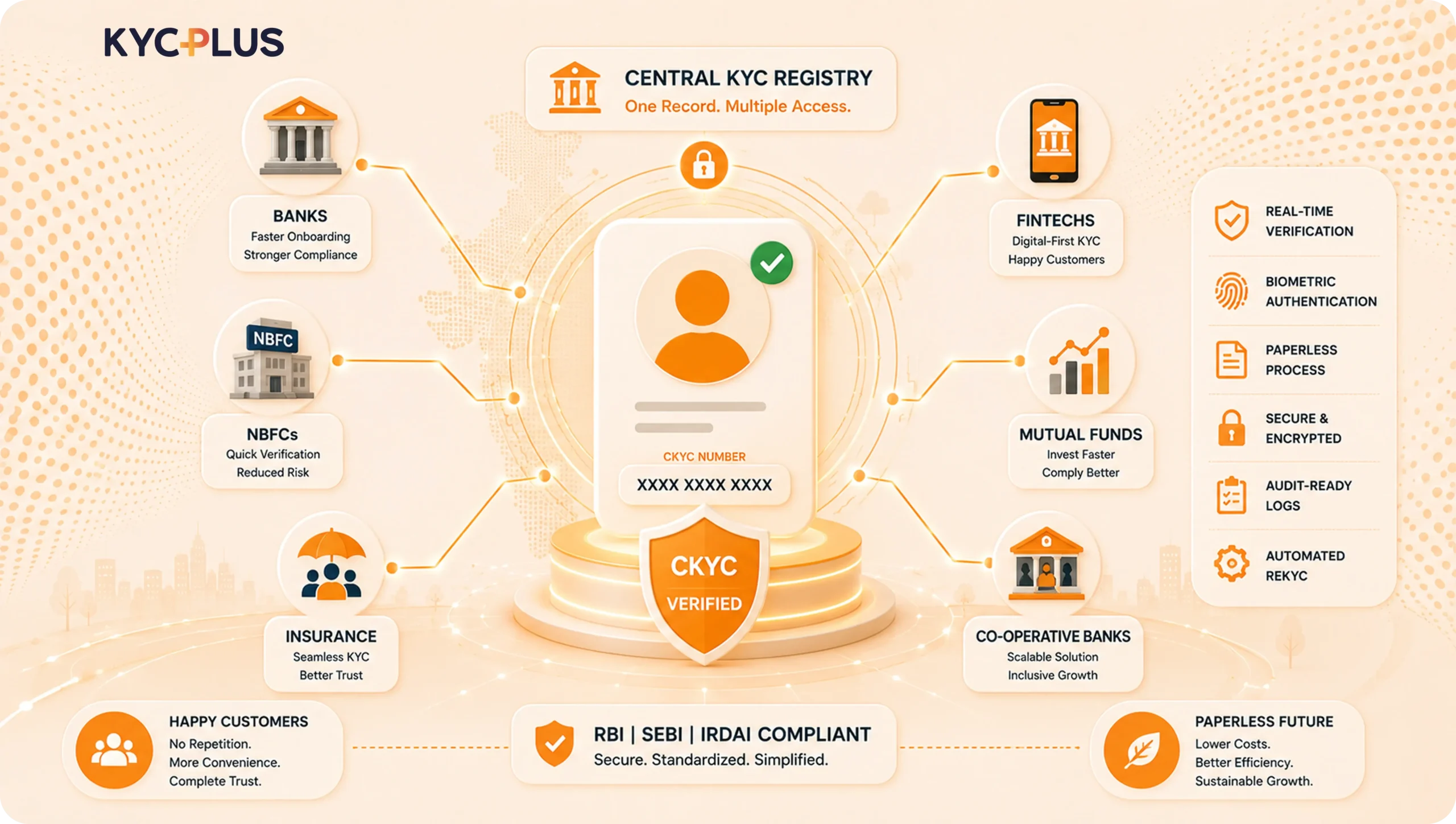
In the modern financial landscape, compliance is not just a regulatory checkbox — it is the foundation of trust between institutions and customers. The Digital CKYC Verification Solution in India has become a game‑changer by enabling banks, NBFCs, and fintechs to verify customer identity through a centralized, paperless, and audit‑ready process. This solution eliminates duplication of records, reduces fraud, and ensures that every customer’s KYC data is securely stored and instantly accessible.
For institutions, the Digital CKYC Verification Solution in India means faster onboarding, reduced operational costs, and seamless compliance with RBI, SEBI, and IRDAI mandates. For customers, it translates into convenience — no repeated branch visits, no redundant document submissions, and quicker access to financial services. By automating ReKYC updates and integrating with CRM systems, financial institutions can maintain complete, compliant records without disrupting customer experience.
This transformation is particularly relevant for platforms like KYCPLUS, which provide advanced digital verification tools tailored for Indian financial institutions. By embedding the Digital CKYC Verification Solution in India into their workflows, banks and NBFCs can achieve audit‑season readiness, strengthen customer trust, and position themselves as leaders in digital compliance.
As India accelerates toward a paperless economy, the Digital CKYC Verification Solution in India represents the future of compliance. It integrates technology with regulation, ensuring that every customer record is standardized, secure, and accessible across the financial sector. In this blog, we will explore the evolution of KYC, the role of CKYC, and how digital verification — supported by solutions like KYCPLUS — is reshaping compliance and customer experience in India.
The journey of KYC in India has been a story of transformation — from manual paperwork to digital compliance. Initially, banks and NBFCs relied on physical documents like PAN cards, Aadhaar, voter IDs, and utility bills to verify customer identity. This process was slow, error‑prone, and often led to duplication of records across institutions. Customers had to repeatedly submit the same documents whenever they opened a new account or applied for a loan.
With the rise of digital banking, eKYC emerged as the first step toward modernization. Aadhaar‑based authentication allowed institutions to verify identity electronically, reducing paperwork and speeding up onboarding. However, eKYC still had limitations — records were fragmented, duplication persisted, and compliance audits remained complex.
This centralized repository stores verified customer records, ensuring that once a customer completes KYC with one institution, the same record can be accessed by others. This eliminated duplication and created a single source of truth for regulators and financial institutions.
Today, the Digital CKYC Verification Solution in India represents the next stage of this evolution. By integrating CKYC Registry APIs with core banking systems and CRMs, institutions can instantly fetch and verify customer data. This solution not only streamlines onboarding but also automates periodic Re-KYC solution updates, making compliance seamless and customer‑friendly.
Platforms like KYCPLUS have further enhanced this journey by offering ready‑to‑deploy digital verification tools. With Digital CKYC Verification Solution in India, powered by solutions such as KYCPLUS, banks and NBFCs can achieve audit‑season readiness, reduce operational costs, and deliver branch‑free convenience to customers.
In short, the evolution of KYC in India has moved from manual paperwork → eKYC → CKYC → Digital CKYC Verification Solution in India, with each stage bringing greater efficiency, compliance accuracy, and customer trust.
The Central KYC Registry (CKYCR) is India’s unified system for storing and managing customer identity records. It was introduced to solve one of the biggest challenges in financial compliance — duplication of KYC across multiple institutions. Before CKYC, every bank, NBFC, or insurance company maintained its own KYC database, which meant that customers had to repeatedly submit the same documents whenever they opened a new account, applied for a loan, or invested in a financial product. This fragmented approach created inefficiencies, compliance risks, and customer frustration.
CKYC changed this by creating a single repository of verified customer records. Once a customer completes KYC with one institution, their details are uploaded to the CKYC Registry and assigned a unique CKYC number. This number acts as a permanent reference for their identity, allowing other institutions to access the same verified record without requiring fresh documentation.
Instead of relying on manual checks or repeated submissions, banks and NBFCs can instantly validate customer identity, automate ReKYC updates, and maintain audit‑ready logs. This digital layer transforms CKYC from a static repository into a dynamic compliance tool that supports paperless onboarding and regulatory transparency.
For regulators like RBI, SEBI, and IRDAI, CKYC ensures standardized reporting and reduced duplication. For institutions, it means lower operational costs, faster onboarding, and stronger fraud prevention. Customers, it delivers branch‑free convenience and trust — no repeated visits, no redundant paperwork, and quicker access to financial services.
The Digital best cKYC verification API is therefore not just about compliance; it is about creating a smoother financial journey. By integrating CKYC Registry APIs with core banking systems and CRMs, institutions can achieve seamless verification, while customers experience a truly paperless process.
Platforms like KYCPLUS (mentioned here subtly) align with this vision by offering advanced modules that help institutions adopt CKYC faster and more efficiently. However, the focus remains on the broader compliance ecosystem — CKYC itself is the backbone, and digital verification is the engine that powers its practical implementation.
In essence, CKYC is the central pillar of India’s KYC framework, and the Digital CKYC Verification Solution in India is the future of how institutions will implement it — secure, standardized, and customer‑friendly.
The Digital CKYC Verification Solution in India is designed to make compliance faster, smarter, and paperless. At its core, it connects financial institutions directly with the Central KYC Registry (CKYCR) through secure APIs, allowing banks, NBFCs, and fintechs to instantly verify customer identity. This eliminates manual checks, reduces duplication, and ensures that every customer record is audit‑ready.
Institutions integrate their core banking systems or CRMs with CKYC Registry APIs. This enables real‑time access to customer records.
Using identifiers like PAN, Aadhaar, or CKYC number, the system fetches verified records directly from the registry.
The Digital CKYC Verification Solution in India validates customer identity instantly, ensuring compliance without delays.
Periodic updates are automated. Customers receive reminders via SMS, email, or WhatsApp, making branch‑free ReKYC possible.
Every verification is logged in a secure, standardized format, ensuring institutions are always audit‑season ready.
The Digital CKYC Verification Solution in India is not just a compliance tool; it is a strategic enabler for financial institutions. By embedding this solution into their workflows, banks and NBFCs can deliver seamless onboarding experiences while meeting regulatory mandates.
Solutions like KYCPLUS (mentioned here lightly) complement this ecosystem by offering ready‑to‑deploy modules that simplify integration and enhance efficiency. However, the larger picture remains clear — CKYC is the backbone, and digital verification is the engine that powers India’s move toward paperless compliance.
The Digital CKYC Verification Solution in India is more than just a compliance requirement — it is a comprehensive framework designed to simplify identity verification, reduce duplication, and deliver paperless convenience. By combining technology with regulation, this solution ensures that banks, NBFCs, and fintechs can meet RBI, SEBI, and IRDAI mandates while offering customers a seamless onboarding experience.
Institutions can instantly fetch customer records from the CKYC Registry using secure APIs. The Digital CKYC Verification Solution in India validates identity in seconds, reducing delays and manual errors.
Periodic KYC updates are automated, with reminders sent via SMS, email, or WhatsApp. This ensures customers remain compliant without repeated branch visits.
All customer records accessed through the Online CKYC Verification Platform for Banks are encrypted end‑to‑end, protecting sensitive information from unauthorized access.
Institutions can engage customers across multiple channels — email, SMS, WhatsApp — making compliance communication more effective and customer‑friendly.
Every verification is logged in a standardized format. This feature ensures institutions are always prepared for audits, reducing compliance stress during regulatory checks.
The solution integrates with fraud detection systems, helping institutions identify suspicious activity and prevent misuse of identity records.
Whether it’s a large bank or a mid‑tier NBFC, the Online CKYC Verification Platform for Banks can be scaled to fit different operational needs.
Solutions like KYCPLUS (mentioned here subtly) align with these features by offering ready‑to‑deploy modules that simplify integration. But the real strength lies in the Online CKYC Verification Platform for Banks itself — a system that transforms compliance from a burden into a strategic advantage.
The Online CKYC Verification Platform for Banks is not just a compliance mechanism — it is a strategic advantage for banks, NBFCs, and fintechs. By adopting this solution, institutions can streamline operations, reduce costs, and strengthen customer trust, all while meeting regulatory mandates.
Traditional KYC processes often required multiple branch visits and repeated document submissions. With the Digital CKYC Verification Solution in India, institutions can instantly verify customer identity through CKYC Registry APIs. This reduces onboarding time from days to minutes, enabling faster account openings and loan approvals.
Manual verification and duplication of records increase compliance costs. By centralizing identity verification, the Online CKYC Verification Platform for Banks minimizes paperwork, reduces manpower requirements, and lowers the overall cost of compliance.
Fraudulent identities and duplicate records are major risks in financial services. The Digital CKYC Verification Solution in India ensures that every customer record is verified against a centralized registry, making it harder for fraudsters to exploit loopholes.
Every verification performed through the Online CKYC Verification Platform for Banks is logged in a standardized format. This ensures institutions are always prepared for audits, reducing stress during regulatory checks and improving compliance scores.
Customers value transparency and convenience. By offering branch‑free ReKYC and paperless onboarding, institutions using the Digital CKYC Verification Solution in India build stronger relationships with their clients. Trust leads to loyalty, and loyalty drives long‑term growth.
Whether it’s a large national bank or a mid‑tier NBFC, the Online CKYC Verification Platform for Banks can be scaled to fit different operational needs. Institutions can integrate it into existing CRMs and core banking systems without disrupting workflows.
While platforms like KYCPLUS can support institutions with ready‑to‑deploy modules, the real value lies in the solution itself. The Digital CKYC Verification Solution in India empowers financial institutions to move beyond compliance as a burden and embrace it as a competitive

Adopting the Online CKYC Verification Platform for Banks requires a structured approach to ensure smooth integration and compliance readiness. Institutions cannot simply plug in the system overnight; they must follow a step‑by‑step process that aligns with regulatory mandates and operational workflows.
Before going live, institutions should test the integration in a sandbox environment.
This helps identify errors, validate workflows, and ensure that the Digital CKYC Verification Solution in India functions correctly.
Following this checklist ensures that institutions adopt the Digital CKYC Verification Solution in India in a structured, error‑free manner. It reduces risks, improves efficiency, and guarantees that compliance standards are met without disrupting customer experience.
Solutions like KYCPLUS can support institutions at specific stages — for example, during API integration or audit log configuration — but the checklist itself is universal for all financial institutions adopting digital CKYC.
While the Online CKYC Verification Platform for Banks offers immense benefits, its implementation is not without challenges. Financial institutions often face hurdles related to cost, integration, training, and data security. However, organizations can overcome these challenges with the right strategies, ensuring smooth adoption and long-term compliance success.
Setting up the Online CKYC Verification Platform for Banks requires investment in technology, API integration, and system upgrades. Smaller NBFCs and cooperative banks may find this cost burdensome.
Solution: Institutions can adopt phased integration — starting with core onboarding processes and gradually expanding to ReKYC automation and audit logs. This reduces upfront expenses while still delivering compliance benefits.
Employees accustomed to manual KYC processes may struggle with digital workflows. Without proper training, errors can occur, reducing the effectiveness of the Digital CKYC Verification Solution in India.
Solution: Conduct structured training programs, including hands‑on workshops and compliance simulations. This ensures staff understand both the technical and regulatory aspects of digital CKYC.
Customer identity records are highly sensitive. Institutions worry about breaches or unauthorized access when adopting the Online CKYC Verification Platform for Banks.
Solution: Implement strong encryption, multi‑factor authentication, and regular security audits. By following RBI and SEBI guidelines, institutions can safeguard customer data while maintaining compliance.
The CKYC Registry periodically updates its system, which can disrupt workflows if institutions are not prepared.
Solution: Establish monitoring systems that track registry changes and update APIs accordingly. The Online CKYC Verification Platform for Banks should be flexible enough to adapt to new formats or regulatory requirements.
Many customers are unaware of CKYC or its benefits. This can lead to confusion during onboarding or ReKYC processes.
Solution: Institutions should run awareness campaigns explaining how the Digital CKYC Verification Solution in India simplifies compliance. Clear communication builds trust and reduces resistance.
By addressing these challenges proactively, institutions can unlock the full potential of the Online CKYC Verification Platform for Banks. While platforms like KYCPLUS can provide support in specific areas such as API integration or audit readiness, the broader responsibility lies with institutions to adopt best practices and ensure smooth compliance.
The Digital CKYC Verification Solution in India is not just a present‑day compliance tool; it is the foundation for the future of paperless financial services. As technology evolves, this solution will continue to expand its role, integrating with advanced systems and reshaping how institutions and customers interact.
Artificial Intelligence will play a major role in strengthening the Online CKYC Verification Platform for Banks. By analyzing customer behavior patterns and transaction histories, AI can detect anomalies and flag potential fraud in real time. This proactive approach will reduce risks and enhance trust across the financial ecosystem.
Blockchain technology offers immutable records and decentralized verification. In the future, the Digital CKYC Verification Solution in India could leverage blockchain to store identity records securely, ensuring transparency and tamper‑proof compliance. This would further reduce duplication and strengthen audit readiness.
Integration with DigiLocker and other government digital platforms will make the Online CKYC Verification Platform for Banks even more seamless. Customers will be able to share verified identity documents directly from government repositories, reducing manual uploads and ensuring authenticity.
While large banks and NBFCs have already embraced digital CKYC, the next wave will involve cooperative banks and smaller financial institutions. The Digital CKYC Verification Solution in India will help these institutions modernize their compliance processes, making them competitive in a digital economy.
The scope of the Online CKYC Verification Platform for Banks will extend beyond traditional banking. Insurance companies, mutual funds, and fintech startups will increasingly rely on CKYC for customer onboarding, creating a unified compliance ecosystem across financial services.
Future versions of the Digital CKYC Verification Solution in India will include predictive dashboards that highlight upcoming compliance risks, audit deadlines, and customer ReKYC requirements. This will allow institutions to act proactively rather than reactively.
In short, the future of compliance in India is digital, secure, and customer‑centric. The Online CKYC Verification Platform for Banks will evolve into a multi‑layered system powered by AI, blockchain, and government integrations, ensuring that financial institutions remain compliant while customers enjoy a truly paperless experience.
Real‑world examples highlight how the Digital CKYC Verification Solution in India is transforming compliance and customer onboarding. By looking at practical implementations, we can see how institutions have reduced costs, improved efficiency, and strengthened customer trust.
A mid‑tier private bank faced challenges with repetitive KYC submissions and slow onboarding. Customers often had to visit branches multiple times, leading to dissatisfaction. After adopting the Digital CKYC Verification Solution in India, the bank integrated CKYC Registry APIs directly into its CRM.
Impact: Onboarding time reduced from 3–4 days to less than 30 minutes.
Result: Customer satisfaction scores improved, and compliance audits became smoother with standardized logs.
An NBFC dealing with microfinance loans struggled with duplication of customer records. Manual verification increased costs and slowed loan disbursement. By implementing the Digital CKYC Verification Solution in India, the NBFC automated ReKYC updates and centralized customer identity checks.
Impact: Operational costs dropped by 25%.
Result: Loan approvals accelerated, and fraud cases reduced significantly.
An insurance provider needed faster onboarding for policyholders while ensuring compliance with IRDAI mandates. By adopting the Digital CKYC Verification Solution in India, the company enabled paperless onboarding and automated compliance reporting.
Impact: Policy issuance time reduced from days to hours.
Result: Improved customer trust and stronger regulatory alignment.
The evolution of KYC in India has moved from manual paperwork to eKYC, then CKYC, and now to the Digital CKYC Verification Solution in India. This transformation is not just about compliance — it is about building trust, reducing duplication, and delivering a paperless, customer‑friendly experience.
For financial institutions, the Online CKYC Verification Platform for Banks means faster onboarding, reduced operational costs, stronger fraud prevention, and audit‑ready compliance. Customers, it ensures convenience, transparency, and seamless access to financial services. For regulators, it provides standardized reporting and a unified compliance framework.
CKYC will continue to serve as the backbone while AI, blockchain, and government integrations power the future of compliance. Institutions that adopt the Digital CKYC Verification Solution in India today are not only meeting regulatory requirements — they are positioning themselves for long‑term growth in a digital economy.
In short, CKYC is the foundation, and digital verification is the engine driving India toward a secure, paperless, and customer‑centric financial ecosystem.
Ans:CKYC stands for Central KYC Registry, a centralized database of customer identity records. The Digital CKYC Verification Solution in India allows institutions to access these records instantly, reducing duplication and paperwork.
Ans: It eliminates repeated document submissions, enables branch‑free onboarding, and ensures faster access to financial services. Customers enjoy a truly paperless experience.
Ans: CKYC ensures standardized compliance across banks, NBFCs, and insurance companies. With the Digital CKYC Verification Solution in India, institutions can reduce costs, prevent fraud, and stay audit‑ready.
Ans: A CKYC number is a unique identifier assigned to each customer record in the registry. Using the Digital CKYC Verification Solution in India, institutions can fetch and verify customer identity through this number.
Ans: Yes. The Digital CKYC Verification Solution in India supports automated ReKYC updates, sending reminders via SMS, email, or WhatsApp to ensure customers remain compliant.
Ans: By verifying records against a centralized registry, the Digital CKYC Verification Solution in India makes it harder for fraudsters to create duplicate or fake identities.
Ans: Absolutely. The Digital CKYC Verification Solution in India is scalable and can be integrated into both large and small institutions, making compliance accessible to all.
Ans: Regulators like RBI, SEBI, and IRDAI mandate CKYC compliance. The Digital CKYC Verification Solution in India ensures institutions meet these requirements while simplifying reporting.
Ans: Every verification is logged in a standardized format. The Digital CKYC Verification Solution in India ensures institutions are always prepared for audits, reducing compliance stress.
Ans: Institutions can explore platforms like KYCPLUS, which provide modules to simplify integration. However, the core strength lies in the Digital CKYC Verification Solution in India, which is the backbone of paperless compliance.
