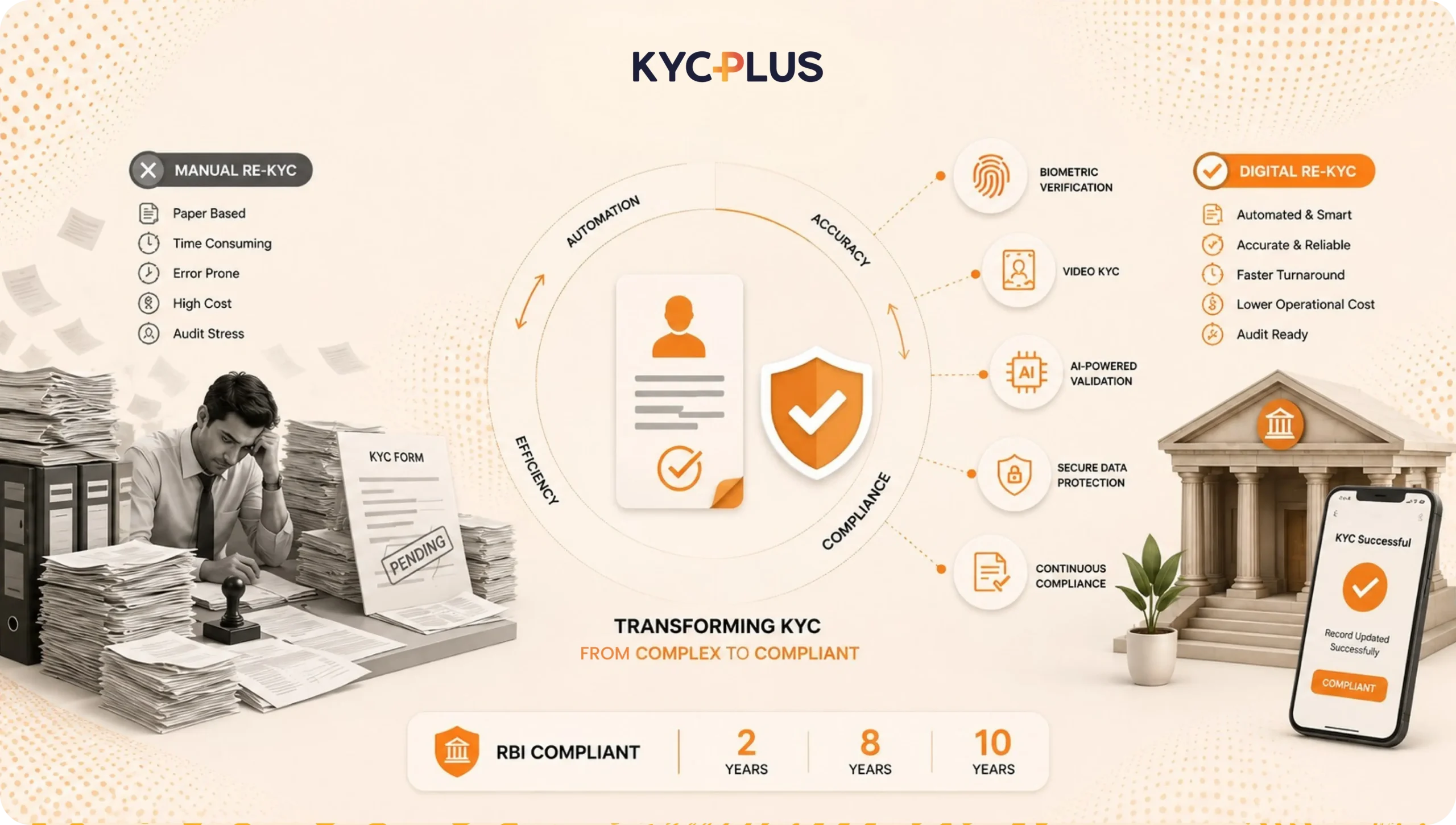
In today’s compliance-driven financial ecosystem, adopting a digital solution for periodic KYC update is no longer optional — it is a necessity. With regulators tightening norms and customers demanding seamless experiences, banks, NBFCs, and cooperative institutions must move beyond manual, paper-heavy processes. Periodic KYC updates are mandated by the Reserve Bank of India (RBI) to ensure customer records remain accurate, fraud-free, and audit-ready. Yet, traditional methods often lead to delays, errors, and high operational costs.
A digital solution for periodic KYC update addresses these challenges by automating timelines, reducing human dependency, and empowering customers with self-service options like Self-KYC and Video KYC. It transforms compliance from being a burden into a driver of efficiency, transparency, and trust.
The Reserve Bank of India (RBI) has consistently emphasized that every financial institution must adopt a digital solution for periodic KYC update to ensure compliance with anti‑money laundering (AML) and counter‑terrorist financing (CTF) regulations. Periodic KYC updates are not just a tick‑box exercise; they are a safeguard designed to protect the integrity of the financial system. By ensuring that customer records remain accurate, verified, and up to date, banks and NBFCs can prevent fraud, reduce reputational risks, and maintain trust with regulators and customers alike.
RBI guidelines classify customers into three categories based on risk profiles:
These timelines are critical because they balance regulatory oversight with customer convenience. However, in practice, institutions relying on manual processes often struggle to meet these deadlines. Paper‑based systems, fragmented record‑keeping, and human dependency create bottlenecks that lead to compliance gaps. This is where an online periodic KYC Verification solution becomes indispensable — it automates reminders, centralises data, and ensures that no customer record is overlooked.
Regulators are pushing institutions to embrace digital transformation for several reasons:
Institutions that fail to adopt an online periodic KYC Verification solution risk facing penalties, reputational damage, and strained relationships with regulators. Audit teams often highlight incomplete documentation, delayed updates, and inconsistent reporting as major compliance failures. In contrast, banks that digitise their KYC processes demonstrate resilience, efficiency, and readiness to adapt to evolving regulatory landscapes.
Without a digital solution for periodic KYC update, banks and financial institutions continue to rely on outdated manual processes that create inefficiencies and compliance risks. The traditional approach — paper forms, branch visits, and human verification — may have worked in the past, but in today’s fast‑paced financial ecosystem, it is no longer sustainable.
Manual KYC updates often involve customers visiting branches, filling out forms, and waiting for staff to process documents. This leads to significant delays, especially during audit season when thousands of records must be updated simultaneously. An online periodic KYC Verification solution eliminates these bottlenecks by automating reminders, enabling online submissions, and reducing turnaround time from weeks to hours.
Human error is one of the biggest risks in compliance. Misplaced documents, incorrect data entry, or incomplete verification can result in audit failures and penalties. By contrast, a digital solution for periodic KYC update ensures accuracy through automated validation, centralized storage, and AI‑driven checks that flag inconsistencies before they become compliance issues.
Auditors frequently highlight gaps in manual KYC processes — missing signatures, outdated addresses, or incomplete forms. These gaps not only create stress for compliance teams but also expose institutions to regulatory fines. A online periodic KYC Verification solution provides audit‑ready logs, timestamped records, and centralised dashboards that make inspections smoother and more transparent.
Maintaining large compliance teams, handling paperwork, and managing branch‑level updates significantly increase operational costs. For cooperative banks and NBFCs with limited resources, this becomes a major burden. By adopting a digital solution for periodic KYC update, institutions can cut costs by reducing manpower requirements, minimizing paperwork, and streamlining workflows.
Customers today expect convenience. Long queues, repeated document submissions, and delays frustrate them, leading to dissatisfaction and attrition. A digital Identity Verification for Periodic KYC empowers customers with self‑service options like online portals, mobile apps, and Video KYC, ensuring compliance without compromising customer experience.
The growing complexity of compliance requirements in Indian banking has made it clear that institutions can no longer rely solely on manual processes. Without a digital solution for periodic KYC update, banks and NBFCs face mounting challenges: delays in customer record updates, audit failures, rising operational costs, and customer dissatisfaction. Regulators like the Reserve Bank of India (RBI) have emphasized that periodic KYC updates are not optional — they are mandatory safeguards against fraud, money laundering, and reputational risks. In this environment, digital transformation is not just desirable; it is essential.
Traditional KYC processes were designed for a time when customer bases were smaller, transactions were slower, and regulatory oversight was less intense. Today, financial institutions handle millions of accounts, each requiring periodic updates based on risk categories. Manual systems simply cannot keep pace with this scale. Paper based documentation, branch visits, and human verification create bottlenecks that lead to compliance gaps. A digital Identity Verification for Periodic KYC addresses these issues by automating timelines, centralizing data, and ensuring that every customer record is updated accurately and on time.
RBI guidelines explicitly encourage institutions to adopt technology for compliance. Regulators understand that manual systems are prone to errors and delays, which undermine the integrity of the financial system. By mandating periodic updates every 2, 8, or 10 years depending on risk category, RBI has created a framework that demands efficiency. A digital solution for periodic KYC update ensures that these timelines are met seamlessly, reducing the risk of penalties and strengthening institutional credibility.
Customers today expect convenience, speed, and transparency. They are accustomed to digital banking, mobile apps, and instant transactions. Asking them to visit branches, fill out forms, and wait weeks for updates feels outdated and frustrating. A digital Identity Verification for Periodic KYC empowers customers with self service options like online portals, mobile apps, and Video KYC. This not only improves compliance but also enhances customer satisfaction, reducing attrition and building loyalty.
Compliance is often seen as a cost center, but with the right technology, it can become a driver of efficiency. A digital solution for periodic KYC update reduces manpower requirements, minimizes paperwork, and streamlines workflows. Institutions can cut compliance costs by up to 40–50% while improving accuracy and speed. For cooperative banks and NBFCs operating in Tier 2 and Tier 3 markets, this efficiency is critical to maintaining competitiveness.
Audits are a major source of stress for compliance teams. Manual systems often result in incomplete documentation, missing signatures, and outdated records. A digital Identity Verification for Periodic KYC provides audit-ready logs, timestamped records, and centralised dashboards that make inspections smoother and more transparent. Institutions that digitise their KYC processes demonstrate resilience and readiness, strengthening their relationships with regulators.
Financial fraud is a growing concern, with criminals exploiting gaps in manual systems to launder money or create fake identities. A digital solution for periodic KYC update incorporates AI-driven fraud detection, biometric verification, and centralized data checks to flag suspicious activity. By reducing human dependency and increasing automation, institutions can significantly lower their risk exposure.

The adoption of a digital Identity Verification for Periodic KYC is not just about meeting regulatory requirements. It also provides strategic benefits:
Cooperative banks often struggle with limited resources and manpower. Manual KYC updates create significant operational stress, especially during audit season. By adopting an end-to-end periodic KYC Solution, these institutions can automate compliance, reduce costs, and improve customer satisfaction. This not only strengthens their regulatory standing but also enhances their ability to compete with larger banks.
India is undergoing a massive digital transformation, with initiatives like Aadhaar, UPI, and Digital India reshaping the financial landscape. In this context, a digital solution for periodic KYC update aligns perfectly with national priorities. It supports financial inclusion, enhances transparency, and empowers institutions to serve customers more effectively.
The evolution of compliance from manual to digital is part of a broader trend in banking. Institutions are increasingly adopting technology to streamline operations, reduce costs, and improve customer experiences. A End-to-End Periodic KYC Solution is a natural extension of this trend. By integrating with Aadhaar, CKYC, and other national databases, digital platforms provide seamless compliance that is both efficient and secure.
The future of compliance will be defined by technology. AI, blockchain, biometrics, and cloud scalability will play a central role in shaping how institutions manage customer records. A digital solution for periodic KYC update provides the foundation for this future, enabling institutions to adapt quickly to evolving regulatory landscapes. By investing in digital solutions today, banks and NBFCs can position themselves for long term success.
The strength of any compliance platform lies in the features it offers. A End-to-End Periodic KYC Solution must go beyond basic record‑keeping; it should integrate automation, security, and customer convenience into one seamless system. Institutions that adopt such solutions not only meet RBI mandates but also transform compliance into a driver of efficiency and trust.
One of the most powerful features of a digital solution for periodic KYC update is Aadhaar‑based eKYC. By leveraging India’s national identity infrastructure, banks can instantly verify customer details with minimal friction.
Central KYC (CKYC) is a government initiative to create a unified customer record across institutions. A End-to-End Periodic KYC Solution must integrate seamlessly with CKYC to ensure compliance.
Empowering customers is critical in today’s digital era. A digital solution for periodic KYC update should include self‑KYC modules that allow customers to update details independently.
Video KYC has emerged as a secure, RBI‑approved method for remote verification. A End-to-End Periodic KYC Solution that includes Video KYC ensures compliance without compromising convenience.
Fraud prevention is a cornerstone of compliance. A digital solution for periodic KYC update must incorporate AI‑driven fraud detection to flag suspicious activity.
Periodic updates are time‑bound, and missing deadlines can lead to penalties. A digital solution for periodic KYC update automates reminders for both customers and compliance teams.
Fragmented records are a major challenge in manual systems. A digital solution for periodic KYC update provides centralized storage accessible across branches.
Compliance is not just about updating records; it is also about demonstrating readiness. A End-to-End Periodic KYC Solution should include analytics and reporting tools.
Each feature of a digital solution for periodic KYC update addresses a specific pain point in manual systems. Together, they create a holistic platform that transforms compliance:
Institutions that adopt such solutions position themselves as leaders in compliance and customer service.
Adopting a digital solution for periodic KYC update is not just about meeting RBI mandates; it is about unlocking strategic advantages that reshape how banks, NBFCs, and cooperative institutions operate. Compliance, when digitized, becomes a driver of efficiency, trust, and market expansion. Institutions that embrace technology gain measurable benefits across cost reduction, operational excellence, customer satisfaction, and long‑term scalability.
Manual KYC updates require large compliance teams, branch‑level manpower, and extensive paperwork. This inflates costs and slows down processes. A digital solution for periodic KYC update streamlines workflows by automating reminders, centralizing data, and reducing human dependency.
For cooperative banks and NBFCs with limited budgets, these savings are critical. By reallocating resources from compliance overheads to customer engagement, institutions strengthen both efficiency and profitability.
Audits are a major source of stress for compliance teams. Manual systems often result in incomplete documentation, missing signatures, and outdated records. A digital solution for periodic KYC update provides audit‑ready logs, timestamped records, and centralized dashboards.
Customers today expect convenience, speed, and transparency. Long queues, repeated document submissions, and delays frustrate them, leading to dissatisfaction and attrition. A digital solution for periodic KYC update empowers customers with self‑service options like online portals, mobile apps, and Video KYC.
Institutions aiming to expand into Tier‑2 and Tier‑3 markets face unique challenges: limited manpower, high operational costs, and dispersed customer bases. A digital solution for periodic KYC update enables scalability without proportional increases in staff.
Financial fraud is a growing concern, with criminals exploiting gaps in manual systems to launder money or create fake identities. A digital solution for periodic KYC update incorporates AI‑driven fraud detection, biometric verification, and centralized data checks.
The future of compliance will be defined by technology. AI, blockchain, biometrics, and cloud scalability will play a central role in shaping how institutions manage customer records. A digital solution for periodic KYC update provides the foundation for this future.
Institutions that digitize compliance gain a competitive edge. Customers prefer banks that offer convenience, regulators trust institutions with transparent processes, and markets reward efficiency. A digital solution for periodic KYC update positions institutions as leaders in compliance and customer service.
Financial inclusion has become one of the most important goals in India’s banking ecosystem. Millions of people in Tier‑2, Tier‑3, and rural areas still face barriers to accessing formal financial services. Manual compliance processes, branch dependency, and paperwork often discourage underserved populations from maintaining updated records. This is where a digital solution for periodic KYC update plays a transformative role. By digitizing compliance, institutions can reach more customers, reduce friction, and align with national priorities like Digital India and Jan Dhan Yojana.
Traditional KYC updates require customers to physically visit branches, submit documents, and wait for verification. For rural populations, this often means traveling long distances, losing work hours, and incurring costs. A digital solution for periodic KYC update eliminates these barriers by enabling remote verification through mobile apps, online portals, and Video KYC.
Financial inclusion is not just about opening accounts; it is about maintaining them. Many low‑income customers lose access to banking services because their KYC records are outdated. A digital solution for periodic KYC update ensures that these customers remain compliant without facing unnecessary hurdles.
India’s push for financial inclusion through schemes like Pradhan Mantri Jan-Dhan Yojana and Digital India requires scalable compliance solutions. A digital solution for periodic KYC updates aligns perfectly with these initiatives.
Trust is a critical factor in financial inclusion. Customers in rural areas often hesitate to engage with banks due to past experiences with delays, errors, or lack of transparency. A digital solution for periodic KYC update builds trust by offering clear, efficient, and transparent processes.
Cooperative banks play a vital role in rural financial inclusion but often struggle with limited resources. Manual KYC updates create operational stress and discourage customers. By adopting a digital solution for periodic KYC update, cooperative banks can automate compliance, reduce costs, and improve customer satisfaction. This not only strengthens their regulatory standing but also enhances their ability to serve rural populations effectively.
The adoption of a digital solution for periodic KYC update has long‑term benefits for financial inclusion:
Financial inclusion is not just a social goal; it is a strategic priority for institutions. By adopting a digital solution for periodic KYC update, banks and NBFCs can expand their customer base, strengthen regulatory compliance, and contribute to national development. The synergy between compliance and inclusion creates a win‑win scenario: regulators achieve transparency, institutions gain efficiency, and customers enjoy access to reliable financial services.
The future of compliance in Indian banking will be defined by technology. Institutions that fail to adopt a digital solution for periodic KYC update risk falling behind in efficiency, transparency, and customer trust. As regulators tighten norms and customers demand seamless experiences, the next decade will see digital KYC in India evolve into a fully automated, AI‑driven ecosystem that integrates with national identity frameworks, blockchain, and biometric verification.
AI is already transforming how institutions manage risk and fraud detection. In the context of a digital solution for periodic KYC update, AI will play a central role in:
Blockchain technology offers immutable records that cannot be altered or tampered with. A digital solution for periodic KYC update integrated with blockchain will provide:
Biometrics will become a cornerstone of future compliance. A digital solution for periodic KYC update that integrates biometric verification ensures:
As customer bases grow, scalability becomes critical. A digital solution for periodic KYC update built on cloud infrastructure offers:
India’s digital ecosystem — Aadhaar, UPI, DigiLocker, and CKYC — will shape the future of compliance. A digital solution for periodic KYC update that integrates with these initiatives ensures:
Regulators will continue to push institutions towards digitization. Future guidelines may mandate AI‑driven fraud detection, biometric verification, and blockchain integration. Institutions that already use a digital solution for periodic KYC update will be better prepared to adapt quickly.
By 2030, compliance will be fully digital. Institutions using manual systems will struggle with penalties, reputational risks, and customer attrition. Those that adopt a digital solution for periodic KYC update today will enjoy:
The true impact of a digital solution for periodic KYC update can be best understood through real‑world case studies and practical scenarios. Institutions across India — from large commercial banks to small cooperative societies — are discovering that digitizing compliance is not just about meeting RBI mandates, but about transforming operations, reducing costs, and building customer trust.
A leading private sector bank with millions of customers struggled with manual KYC updates. Audit teams frequently flagged incomplete records, and customers complained about long queues. By adopting a digital solution for periodic KYC update, the bank:
The result was a significant improvement in customer satisfaction and regulator confidence.
Urban cooperative banks often operate with limited resources. One such bank in Gujarat faced challenges during audit season, with thousands of records pending updates. By implementing a digital solution for periodic KYC update, the bank:
An NBFC expanding into Tier‑2 and Tier‑3 cities needed a scalable compliance solution. Manual processes were not feasible given the dispersed customer base. By adopting a digital solution for periodic KYC update, the NBFC:
This allowed the NBFC to grow rapidly while maintaining compliance integrity.
Every year, institutions face intense pressure during audit season. Manual systems often result in incomplete documentation and compliance gaps. A digital solution for periodic KYC update ensures that records are audit‑ready, reducing stress for compliance teams and improving regulator relationships.
Customers often leave institutions that fail to provide convenient services. Long queues and repeated document submissions frustrate them. A digital solution for periodic KYC update empowers customers with self‑service options, improving satisfaction and reducing attrition.
Fraudsters exploit gaps in manual systems to create fake identities or launder money. A digital solution for periodic KYC update incorporates AI and biometric verification to flag suspicious activity, reducing risk exposure.
Rural populations often struggle with branch dependency and paperwork. A digital solution for periodic KYC update enables remote compliance, supporting financial inclusion and aligning with national priorities like Digital India.
These case studies and scenarios highlight several key lessons:
In the evolving landscape of Indian banking, adopting a digital solution for periodic KYC update is no longer a choice — it is a necessity. Manual processes have proven inadequate in meeting RBI mandates, preventing fraud, and ensuring customer satisfaction. Institutions that digitize compliance gain measurable benefits: reduced costs, improved audit readiness, enhanced customer trust, and the ability to expand into Tier‑2 and Tier‑3 markets.
The future of compliance will be defined by technology — AI, blockchain, biometrics, and cloud scalability. By investing in a digital solution for periodic KYC update today, banks, NBFCs, and cooperative institutions position themselves as leaders in efficiency, transparency, and financial inclusion.
Solutions like KYCPLUS demonstrate how compliance can be transformed into a driver of growth. With features like Aadhaar‑based eKYC, CKYC integration, Video KYC, and AI‑driven fraud detection, institutions can meet RBI mandates seamlessly while building long‑term trust with customers.
Ans: It is a technology‑driven platform that automates RBI‑mandated KYC updates, ensuring compliance, efficiency, and customer convenience.
Ans: Because manual processes are slow, error‑prone, and costly. Digital solutions streamline workflows and improve audit readiness.
Ans: RBI mandates updates every 2 years for high‑risk customers, 8 years for medium‑risk, and 10 years for low‑risk.
Ans: Yes. A digital solution for periodic KYC update enables Self‑KYC and Video KYC, allowing customers to update records from home.
Ans: By automating reminders, centralizing data, and reducing manpower requirements, institutions save up to 40–50% in costs.
Ans: Yes. Platforms use AI, biometrics, and encryption to ensure data integrity and prevent fraud.
Ans: A digital solution for periodic KYC update eliminates branch dependency, making compliance accessible to rural and underserved populations.
Ans: CKYC integration ensures unified customer records across institutions, reducing duplication and improving regulatory alignment.
Ans: It provides audit‑ready logs, timestamped records, and centralized dashboards, making inspections smoother and more transparent.
Ans: Because KYCPLUS is India’s leading platform offering Aadhaar‑based eKYC, CKYC integration, Video KYC, and AI‑driven fraud detection — making it the best digital solution for periodic KYC update.
