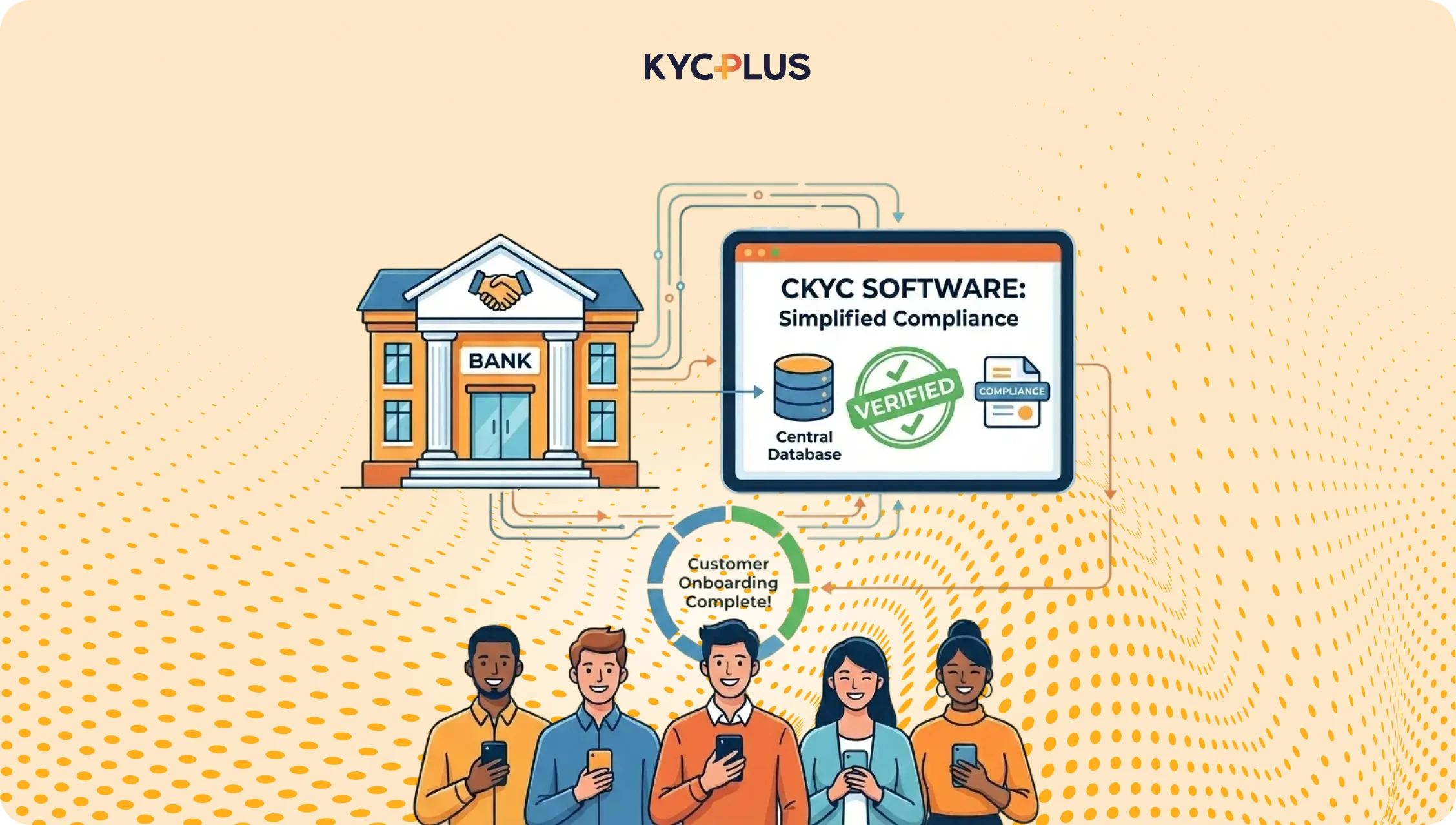
The Indian financial ecosystem is evolving rapidly, and Co-operative banks are at the heart of this transformation. These banks, often serving semi-urban and rural communities, play a crucial role in financial inclusion. However, with increasing regulatory requirements from the Reserve Bank of India (RBI), compliance has become a top priority. One of the most significant regulatory frameworks introduced in recent years is the Central Know Your Customer (CKYC) system. CKYC is a centralized repository of KYC records that allows financial institutions to access verified customer data. For Co-operative banks, adopting CKYC software for Co-operative banks is no longer optional; it is essential.
Traditionally, Co-operative banks relied on manual processes for KYC verification. This was time-consuming, error-prone, and often led to compliance gaps. With the introduction of CKYC software for Co-operative Bank, technology now plays a pivotal role in:
When it comes to CKYC solutions, KYCPLUS stands out as a reliable, affordable, and compliance-ready software. Designed specifically for Co-operative banks and credit societies, KYCPLUS offers:
By integrating KYCPLUS, Co-operative banks can not only meet compliance requirements but also enhance customer satisfaction and trust.
CKYC Software for Co-operative Banks: Simplifying Compliance & Customer Onboarding
Co-operative banks play a vital role in serving communities across India, especially in semi-urban and rural areas. However, without adopting CKYC software for Co-operative banks’ operations, these institutions face several challenges that directly impact compliance, efficiency, and customer trust.
Traditionally, Co-operative banks rely on manual KYC verification. Staff members must collect documents, validate them, and store records physically or in basic systems. This process is slow, error-prone, and resource-intensive. Mistakes in manual verification can lead to compliance failures, which may result in penalties from regulators.
RBI has made CKYC mandatory for financial institutions. Without proper software, Co-operative banks struggle to meet these requirements. Inconsistent data entry, missing records, and outdated formats increase the risk of non-compliance. Regulatory audits become stressful, and banks may face fines or restrictions if they fail to demonstrate proper CKYC implementation.
Customers expect quick and seamless onboarding. Manual KYC often takes days, frustrating new clients and slowing down account opening. In competitive markets, delays can cause customers to shift to other banks that offer faster digital onboarding. Without CKYC software for Co-operative Bank, institutions lose their edge in attracting and retaining customers.
When records are maintained manually, duplication is common. A single customer might open multiple accounts with different details, making fraud detection difficult. Fraudsters exploit these gaps to create fake identities or misuse accounts. CKYC prevents duplication by assigning a unique CKYC number to each customer, but without proper software, banks cannot leverage this safeguard effectively.
Manual processes consume significant staff time and resources. Employees spend hours verifying documents, entering data, and preparing compliance reports. This reduces productivity and increases costs. Without automation, banks cannot scale their operations efficiently.
The challenges mentioned above highlight why CKYC software for Co-operative bank is essential. KYCPLUS provides a ready-made solution tailored for Co-operative banks and credit societies. With features like batch upload, instant verification, and RBI-compliant reporting, KYCPLUS eliminates manual errors, speeds up onboarding, and ensures compliance.
Without CKYC software, Co-operative banks face:
By adopting CKYC software for the Co-operative bank through KYCPLUS, institutions can reduce compliance risks, speed up onboarding, and prevent fraud.
CKYC software directly addresses the challenges:
KYCPLUS delivers automation, compliance, fraud prevention, and multilingual support, making it the ideal CKYC solution for Co-operative banks.

For Co-operative banks, adopting CKYC software for Co-operative banks is not just about compliance; it is about efficiency, security, and customer satisfaction. The right software must be designed to handle the unique needs of these institutions, which often manage large volumes of customer data across diverse communities. Below are the core features that make CKYC software indispensable for Co-operative banks.
Co-operative banks deal with thousands of customers daily. Manual entry is slow and error-prone. CKYC software allows batch uploads, enabling banks to process multiple customer records at once. Verification is automated, reducing human error and saving time. With KYCPLUS, batch-based formatting and instant verification are built in, making compliance seamless.
Searching for customer records manually can be frustrating. CKYC software provides instant search functionality, allowing staff to quickly retrieve customer details using CKYC numbers. This speeds up service delivery and ensures accuracy. KYCPLUS integrates this feature, helping banks serve customers faster.
Data security is critical in banking. CKYC software ensures that customer records are encrypted and stored securely. This prevents unauthorized access and protects sensitive information. KYCPLUS uses advanced encryption standards, ensuring that Co-operative banks remain compliant with RBI’s data protection guidelines.
Co-operative banks often serve customers in regional languages. CKYC software must provide multi-language support to ensure accessibility. KYCPLUS offers English, Hindi, and Marathi interfaces, making it easier for staff and customers to interact with the system.
Regulatory audits are a regular part of banking operations. CKYC software generates audit trails and compliance reports automatically. This reduces the burden on staff and ensures transparency. With KYCPLUS, banks get RBI-compliant reports ready for submission, simplifying the audit process.
When Co-operative banks look for a CKYC solution, they need more than just software. They need a partner who understands their unique challenges, regulatory requirements, and customer expectations. This is where KYCPLUS stands out as a trusted CKYC partner for Co-operative banks by offering features that are bank-specific.
Unlike generic solutions, KYCPLUS is designed specifically for Co-operative banks and credit societies. It addresses the operational realities of these institutions: large customer bases, multilingual communities, and strict RBI compliance. By focusing on these needs, KYCPLUS ensures that banks get a solution that truly fits their environment.
Compliance is the backbone of CKYC. KYCPLUS generates RBI-compliant reports and outputs instantly, reducing the stress of audits and inspections. Banks can present these reports directly to regulators without additional formatting, saving time and ensuring accuracy.
Co-operative banks often operate with limited budgets. KYCPLUS offers an affordable pricing model without compromising on features. It is also scalable, meaning banks can start small and expand usage as their customer base grows. This flexibility makes KYCPLUS a sustainable choice for institutions of all sizes.
Several Co-operative banks have already adopted KYCPLUS with impressive results:
Urban Co-operative Bank in Maharashtra: Reduced onboarding time from three days to twenty minutes.
Rural Co-operative Bank: Enhanced customer trust by offering faster, secure and customer-friendly onboarding.
These examples show how CKYC software for Co-operative banks, powered by KYCPLUS, delivers measurable improvements.
KYCPLUS is not just about compliance; it is about customer experience. With features like multi-language support (English, Hindi, Marathi), instant verification, and secure data handling, KYCPLUS helps banks build stronger relationships with their customers.
The adoption of CKYC software for Co-operative banks brings significant advantages that go beyond compliance. For institutions serving diverse communities, CKYC software ensures smoother processes, stronger customer relationships, and long-term sustainability.
Regulatory compliance is one of the biggest challenges for Co-operative banks. CKYC software ensures that customer records are stored in RBI-approved formats and verified against the centralized CKYC database. This reduces the risk of errors and penalties. With KYCPLUS, banks can generate compliance-ready reports instantly, making audits stress-free.
Customers want to feel secure when dealing with financial institutions. CKYC software builds trust by ensuring that its data is verified, encrypted, and centrally stored. When customers know their information is safe and compliant, they are more likely to continue banking with the institution. KYCPLUS strengthens this trust by offering secure encryption and multilingual support, making the process transparent and accessible.
Manual KYC processes consume valuable staff time. CKYC software automates verification, reporting, and record management, freeing employees to focus on customer service. This efficiency reduces costs and improves productivity. For Co-operative banks, which often operate with limited resources, this efficiency is critical. KYCPLUS enhances operational workflows with batch uploads and instant verification, ensuring smooth day-to-day functioning.
Non-compliance can lead to heavy penalties from regulators. CKYC software minimizes this risk by ensuring that all records are accurate, complete, and up to date. By adopting CKYC software for Co-operative banks, institutions safeguard themselves against regulatory fines. KYCPLUS provides RBI-compliant outputs that can be presented directly during inspections, reducing the risk of penalties.
In today’s market, speed and reliability matter. Banks that implement CKYC software can onboard customers faster, detect fraud more effectively, and provide better service. This gives them a competitive edge over institutions still relying on manual processes. With KYCPLUS, Co-operative banks can position themselves as modern, customer-friendly, and compliance-ready institutions.
Implementing CKYC software for Co-operative banks requires careful planning and execution. Co-operative banks must ensure that the transition from manual KYC to CKYC is smooth, compliant, and efficient. Below is a practical step-by-step guide to help institutions adopt CKYC software successfully.
The first step is to assess the bank’s current KYC process. Identify gaps, compliance risks, and inefficiencies. Determine the volume of customer records that need to be migrated to CKYC. This analysis helps banks understand the scope of implementation and choose the right solution.
Once requirements are clear, the next step is installing the CKYC software. Banks must ensure that the system is compatible with their existing infrastructure. With KYCPLUS, installation is straightforward and designed to integrate seamlessly with Co-operative banks’ operations.
Employees must be trained to use the new system effectively. Training should cover batch uploads, customer search, compliance reporting, and fraud detection. KYCPLUS offers user-friendly interfaces and multilingual support, making training easier for staff across different regions.
Migrating existing customer records to CKYC is a critical step. Banks must ensure that data is accurate, complete, and formatted correctly. CKYC software simplifies this process by validating records during migration. KYCPLUS provides batch-based formatting tools that make data migration efficient and error-free.
Before full-scale implementation, banks should run pilot tests to ensure the system works as expected. Testing helps identify issues and fine-tune processes. Once successful, the bank can go live with CKYC software, making compliance and onboarding faster and more reliable.
By following these steps with KYCPLUS, Co-operative banks can:
KYCPLUS is designed to make implementation easy, affordable, and scalable, ensuring that banks can adopt CKYC without disruption.
The true impact of CKYC software for Co-operative banks can be seen in real-life examples. Several Co-operative banks across India have successfully implemented CKYC solutions, transforming their compliance processes and customer onboarding experiences. These case studies highlight how adopting KYCPLUS has delivered measurable results.
This bank faced challenges with manual KYC verification, leading to onboarding delays and compliance risks. After implementing KYCPLUS, the bank reduced account opening time from three days to just three hours. Batch uploads and instant verification streamlined operations, while RBI-compliant reporting simplified audits. Customers appreciated the faster service, resulting in higher satisfaction and retention.
In rural areas, language barriers often slow down customer onboarding. A Co-operative bank serving villages implemented KYCPLUS, which offers multi-language support in English, Hindi, and Marathi. This feature allowed staff to interact with customers more effectively, building trust and improving accessibility. The bank saw a 40% increase in new account openings within six months, proving that CKYC software can drive growth even in rural markets.
The financial sector is constantly evolving, and Co-operative banks must adapt to stay relevant. As compliance requirements grow stricter and customer expectations rise, CKYC software for Co-operative banks will continue to transform. Looking ahead, several future trends are set to redefine CKYC and its role in Co-operative banking.
Artificial Intelligence (AI) is becoming a powerful tool in fraud prevention. Future CKYC software will integrate AI algorithms to detect suspicious patterns, flag duplicate accounts, and identify potential risks in real time. For Co-operative banks, this means stronger protection against fraud and improved customer trust. KYCPLUS is already preparing for these advancements, ensuring banks remain ahead of the curve.
Blockchain technology offers transparency, immutability, and security. By integrating blockchain into CKYC systems, banks can ensure that customer records are tamper-proof and easily auditable. This will enhance compliance and reduce disputes. Co-operative banks adopting CKYC software for Co-operative banks with blockchain features will gain a significant edge in data security.
As digital banking expands, CKYC software will integrate seamlessly with mobile apps, online portals, and digital payment systems. Customers will be able to complete KYC verification remotely, reducing the need for physical visits. KYCPLUS is designed to support digital banking synergy, making onboarding faster and more convenient.
Future CKYC solutions will focus not only on compliance but also on customer experience. Features like multilingual support, instant verification, and mobile-friendly interfaces will become standard. For Co-operative banks serving diverse communities, these enhancements will improve accessibility and satisfaction.
RBI and other regulators are expected to introduce new compliance standards. CKYC software must adapt quickly to these changes. Solutions like KYCPLUS are built to update instantly, ensuring that Co-operative banks remain compliant without disruption.
Choosing the right CKYC software for Co-operative banks is critical. Banks need a solution that not only meets RBI compliance but also enhances customer experience, reduces operational risks, and fits within budget constraints. Among the available options, KYCPLUS stands out as the most practical and trusted choice for Co-operative banks and credit societies.
Regulatory compliance is often seen as complex and time-consuming. With KYCPLUS, compliance becomes simple. The software generates RBI-approved reports instantly, ensuring that banks are always audit-ready. This reduces stress during inspections and eliminates the risk of penalties.
Co-operative banks often operate with limited resources. KYCPLUS offers an affordable pricing model without compromising on features. It is scalable, meaning banks can start small and expand usage as their customer base grows. This flexibility makes KYCPLUS a sustainable solution for institutions of all sizes.
KYCPLUS is designed with customers in mind. Features like multi-language support (English, Hindi, Marathi), instant verification, and secure encryption make onboarding faster and more accessible. By improving customer experience, banks can build stronger relationships and increase retention.
Manual KYC processes consume valuable staff time. KYCPLUS automates verification, reporting, and fraud detection, freeing employees to focus on customer service. This efficiency reduces costs and improves productivity, making day-to-day operations smoother.
Several Co-operative banks have already implemented KYCPLUS with measurable success:
For Co-operative banks, compliance is no longer optional; it is mandatory. The Reserve Bank of India (RBI) has made it clear that Know Your Customer (KYC) processes must be standardized, secure, and centralized. This is why CKYC software for Co-operative banks has become a necessity rather than a luxury.
Without CKYC software, Co-operative banks risk penalties, inefficiency, and customer dissatisfaction.
CKYC software is not just about compliance; it is about future-proofing banking operations. By adopting CKYC, Co-operative banks position themselves as modern, reliable, and customer-friendly institutions. This strategic shift ensures long-term sustainability and competitiveness in the financial sector.
Among available solutions, KYCPLUS stands out as the most practical choice. It offers:
By choosing KYCPLUS, Co-operative banks gain a solution that not only meets compliance requirements but also enhances customer experience and operational efficiency.
The journey from manual KYC to CKYC is a transformation every Co-operative bank must embrace. Compliance, efficiency, and customer trust are the pillars of modern banking, and CKYC software delivers all three. With KYCPLUS, Co-operative banks can move confidently into the future, knowing they are compliant, secure, and customer-focused.
“Ultimately, technology in banking is only as meaningful as the trust it builds. With the Central KYC Registry (CKYC), cooperative banks and societies can simplify compliance, reduce duplication, and ensure safer onboarding for their members. By combining regulatory discipline with genuine care, institutions not only meet RBI standards but also strengthen long-term relationships. CKYC is more than a compliance tool; it is a bridge of trust, efficiency, and confidence for the future of cooperative banking.
Ans: CKYC software ensures compliance with RBI regulations, prevents duplication of customer records, and speeds up onboarding. Without it, banks risk penalties, inefficiency, and fraud.
Ans: By automating verification and linking customers to a unique CKYC number, onboarding time is reduced from days to hours. This improves customer satisfaction and gives banks a competitive edge.
Ans: Yes. KYCPLUS is designed specifically for Co-operative banks and credit societies. It is scalable, affordable, and adaptable to institutions of all sizes, whether urban, semi-urban, or rural.
Ans: CKYC software uses AES 256 encryption and secure storage to protect customer information. KYCPLUS follows RBI guidelines for data protection, ensuring that sensitive records remain safe from unauthorized access.
Ans: Yes. CKYC assigns a unique CKYC number to each customer, eliminating duplication. With KYCPLUS, fraud detection is enhanced through instant verification and centralized record checks.
Ans: Implementation depends on the size of the bank and the volume of customer records. With KYCPLUS, installation and data migration are streamlined, allowing banks to go live quickly with minimal disruption.
Ans: Yes. KYCPLUS offers multi-language support, including English, Hindi, and Marathi, making it easier for staff and customers to interact with the system.
Ans:
